全国统一大市场

Search documents
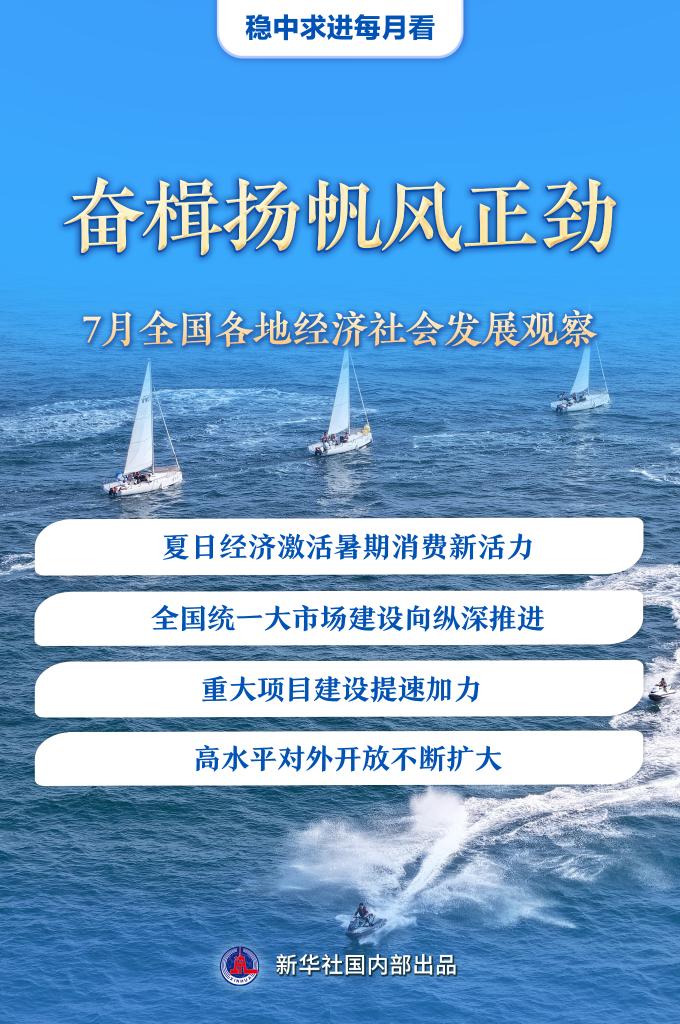
稳中求进每月看|奋楫扬帆风正劲——7月全国各地经济社会发展观察
Shang Hai Zheng Quan Bao· 2025-07-30 14:33
Group 1: Summer Economic Activities - The summer economy is revitalizing consumption with unique cultural and tourism activities, such as the martial arts-themed attractions in Kaifeng, which saw a 230% increase in visitor numbers compared to last year [2][3] - Various regions are promoting differentiated cultural tourism activities, leading to a surge in summer travel, with new projects enhancing visitor experiences [3] Group 2: National Unified Market Development - The construction of a national unified market is advancing, with initiatives like the seamless migration of businesses across provinces, exemplified by a company moving from Chongqing to Yibin [4] - The Central Economic Committee has outlined plans to deepen the national unified market, with multiple regions implementing measures to facilitate this integration [4][5] Group 3: Acceleration of Major Projects - Major infrastructure projects are being expedited, including the completion of a 750 kV power transmission project around the Tarim Basin and the production commencement of the world's largest single green ammonia facility in Jilin [6][7] - The government has allocated 800 billion yuan for construction projects, supporting 1,459 initiatives to stimulate economic growth [6] Group 4: Expansion of High-Level Opening Up - High-level international exhibitions are being successfully held, showcasing innovations and attracting significant foreign participation, such as the third Chain Expo with 172 overseas delegations [8][9] - China's commitment to expanding high-level opening up is evident through various foreign investment projects, including the opening of the largest LEGO park in Shanghai and the launch of a major ExxonMobil project [9][10]
稳中求进每月看丨奋楫扬帆风正劲——7月全国各地经济社会发展观察
Xin Hua She· 2025-07-30 14:31
Group 1: Summer Economic Activation - The summer economy is revitalizing consumer spending, with unique cultural and tourism activities driving increased visitor numbers, such as a 230% year-on-year increase in visitor traffic at a themed attraction in Henan [5][10] - Various regions are launching differentiated cultural tourism activities to boost summer travel, including adventure sports and cultural festivals, contributing to a rise in tourism consumption [5][10] Group 2: National Unified Market Development - The construction of a national unified market is progressing, with initiatives to facilitate business migration and streamline administrative processes, exemplified by a company relocating with reduced bureaucratic hurdles [11][14] - Collaborative agreements among regions, such as the Yangtze River Delta, are enhancing market integration and regulatory cooperation, supporting the establishment of a unified market [11][14] Group 3: Acceleration of Major Project Construction - Major infrastructure projects are being expedited, with significant milestones achieved, such as the completion of a 4,197 km power transmission project and the production commencement of a large-scale green ammonia facility [17][20] - The government has allocated 800 billion yuan for construction projects, supporting 1,459 initiatives, which is crucial for stabilizing the economy and boosting domestic demand [17][20] Group 4: Expansion of High-Level Opening Up - High-level international exhibitions are being successfully held, attracting increased participation and showcasing innovations, which reinforces China's commitment to opening its markets [23][26] - Foreign investment cases, such as the opening of the largest LEGO park in Shanghai and significant projects by multinational corporations, highlight the ongoing expansion of China's openness to global business [23][26]

债券视角解读7月政治局会议
CMS· 2025-07-30 14:21
Report Summary 1. Report Industry Investment Rating No information provided. 2. Core Viewpoints - The macro - policy in the second half of the year is set to "continue to exert force and increase force in a timely manner" to promote the recovery of domestic demand and achieve the annual GDP growth target of 5% [2][3]. - The "anti - involution" policy will be steadily advanced, and it is expected that CPI and PPI will rise moderately in the second half of the year [4]. - Fiscal policy emphasizes accelerating the issuance and use of government bonds, and attention should be paid to whether there will be additional fiscal measures in the fourth quarter [4][5]. - Monetary policy maintains a loose tone, with structural monetary policy tools as the focus, and the coordination between monetary and fiscal policies will be strengthened [7]. - The bond market will experience increased volatility, and the investment strategy should be defensive [8]. 3. Summary by Directory I. Macro - policy orientation - The macro - policy in the second half of the year needs to continue and increase force to consolidate the economic recovery and achieve the 5% GDP growth target. It aims to release domestic demand potential by promoting consumption and expanding effective investment [2][3]. II. "Anti - involution" and price trends - The "anti - involution" policy will be advanced to promote the balance of supply and demand and the return of prices to a reasonable level. It is expected that CPI and PPI will rise steadily in the second half of the year, and attention should be paid to the implementation of capacity governance measures in key industries [4]. III. Fiscal policy - The fiscal policy is set to be more proactive. As of July 30, the cumulative issuance of local new general bonds was 538.3 billion with a progress of 67.3%, and that of local new special bonds was 277.6 billion with a progress of 63.13%. Attention should be paid to whether there will be additional fiscal measures in the fourth quarter [4][5]. IV. Monetary policy - Monetary policy will maintain a loose tone, with structural monetary policy tools as the focus. The coordination between monetary and fiscal policies will be strengthened to keep liquidity abundant and lower the comprehensive social financing cost [7]. V. Bond market strategy - The influence of the stock market on the bond market has increased, bringing re - pricing pressure on long - term bonds. The short - term risk of a bearish bond market is low. The investment strategy suggests that the 10 - year treasury bond rate of 1.75% - 1.8% has allocation value, and attention can be paid to the allocation value of short - duration and 7 - 10 - year credit bonds after adjustment [8][9].
稳中求进每月看 | 奋楫扬帆风正劲——7月全国各地经济社会发展观察
Xin Hua She· 2025-07-30 14:07
Group 1: Summer Economic Activity - The summer economy is revitalizing consumption, with various regions launching unique cultural and tourism activities to boost summer travel [2][3] - The Wansui Mountain Scenic Area in Kaifeng, Henan, reported a 230% increase in visitor numbers compared to last year, with around 70,000 daily visitors during the summer [2] - Regions like Guizhou and Xinjiang are creating new consumption scenarios by integrating culture, tourism, sports, and food [2] Group 2: National Unified Market Development - The construction of a national unified market is advancing, with 355 administrative service items achieving "Chuan Yu Tong Ban" (Sichuan-Chongqing mutual recognition) [3][4] - The Central Economic Committee has outlined plans to deepen the construction of a unified national market, with various regions actively participating [3][4] - The Beijing-Tianjin-Hebei region is focusing on industrial transfer and restructuring, while Jiangsu is enhancing regulatory frameworks to support market integration [3][4] Group 3: Major Project Acceleration - Major infrastructure projects are being expedited, including the completion of the 750 kV transmission project around the Tarim Basin, which spans 4,197 kilometers [5][6] - The National Development and Reform Commission has allocated 800 billion yuan for "two heavy" construction projects, supporting 1,459 projects [6] - The successful progress of these projects is crucial for stabilizing the economy and expanding domestic demand [6] Group 4: High-Level Opening Up - High-level international exhibitions are being successfully held, with the third Chain Expo seeing a 2.2 times increase in foreign delegations compared to the previous year [7][8] - The opening of the world's largest LEGO park in Shanghai and the launch of ExxonMobil's ethylene project in Guangdong highlight China's commitment to foreign investment [8][9] - China's proactive approach to expanding high-level opening up is seen as a source of confidence and opportunity for global development [8][9]
730政治局会议点评:牛市定心丸,稳策即利好
Huachuang Securities· 2025-07-30 13:42
证 券 研 究 报 告 牛市定心丸,稳策即利好 ——730政治局会议点评 2025年7月30日 证券分析师:姚 佩 执业编号:S0360522120004 邮箱:yaopei@hcyjs.com 联系人:朱冬墨 邮箱:zhudongmo@hcyjs.com 本报告由华创证券有限责任公司编制 卖的出价或询价。本报告所载信息均为个人观点,并不构成对所涉及证券的个人投资建议。 请仔细阅读PPT后部分的分析师声明及免责声明。 @2021 华创 版权所有 宏观政策持续发力、适时加力 证 券 研 究 报 告 | 政治局会议 | 2025年7月政治局会议 | 2025年4月政治局会议 | 2024年12月经济工作会议 | 2024年12月政治局会议 | 2024年9月政治局会议 | 2024年7月政治局会议 | | --- | --- | --- | --- | --- | --- | --- | | | 经济运行稳中有进,高质量发展取得新成效。主要经济 | | 一年来的发展历程很不平凡,成绩令人鼓舞,特别是9 | | | | | | 指标表现良好,新质生产力积极发展,改革开放不断深 | 经济呈现向好态势,社会信心持续提振 ...
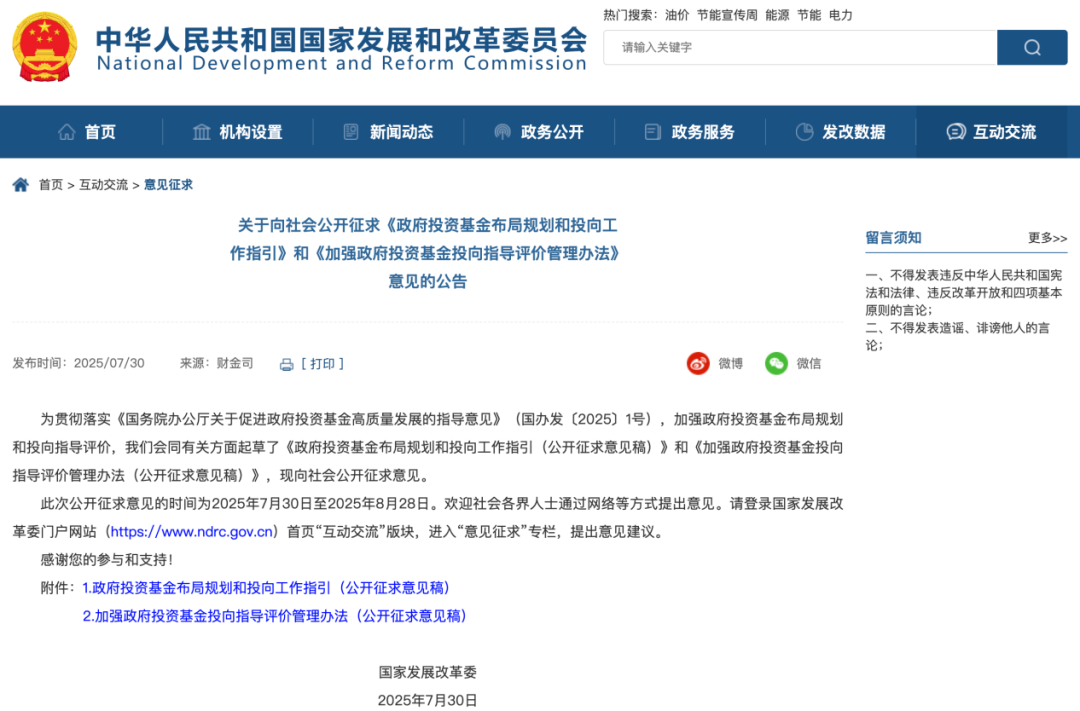
政府投资基金将迎两大新政 涉四个支持重点领域
Zheng Quan Ri Bao Wang· 2025-07-30 13:05
7月30日,国家发展改革委会同有关方面起草的《政府投资基金布局规划和投向工作指引(公开征求意 见稿)》(以下简称《指引》)和《加强政府投资基金投向指导评价管理办法(公开征求意见稿)》向 社会公开征求意见。公开征求意见的时间为2025年7月30日至2025年8月28日。 三是地方基金要找准定位,在省级政府统筹管理下综合考虑本地区财力、产业资源基础、债务风险等情 况,因地制宜选择投资领域。新设地方基金直投项目或其子基金投资项目要注重于地区特色优势产业、 区域创新能力提升,以及小微民营企业和科创企业支持孵化,带动社会资本有效参与。 四是政府投资基金要着力增加高端产能供给,聚焦产业技术创新和关键核心技术攻关,推动加快实现高 水平科技自立自强。其中,产业投资类基金要在产业发展方面发挥引领带动作用,围绕完善现代化产业 体系,支持改造提升传统产业、培育壮大新兴产业、布局建设未来产业;创业投资类基金要围绕发展新 质生产力,通过市场化方式投资种子期、初创期企业,兼顾早中期中小微企业,支持科技创新,解决重 点关键领域"卡脖子"难题。 《指引》要求,政府投资基金不得通过明股实债等方式变相增加地方政府隐性债务,除并购重组、定向 增发 ...
7月政治局会议解读:立足当下,着眼长远
Yin He Zheng Quan· 2025-07-30 13:04
Economic Performance - The Politburo meeting affirmed the good performance of the economy in the first half of the year, with GDP growth reaching 5.3% year-on-year, exceeding market expectations[2] - The meeting emphasized the need to consolidate the economic recovery and address prominent issues in economic operations, such as insufficient effective demand and low price levels[2] Policy Direction - The meeting highlighted the importance of "bottom-line thinking" to safeguard domestic economic and social stability, prioritizing employment as a key policy goal[2] - It was stated that macro policies should continue to exert force and be implemented in a timely manner, with a focus on more proactive fiscal policies in the second half of the year[3] Monetary Policy - The monetary policy remains moderately loose, with expectations for 1-2 interest rate cuts in the second half of the year, totaling a reduction of 20-30 basis points[3] - The meeting indicated that structural monetary policy tools would be utilized to support technology innovation, boost consumption, and stabilize foreign trade, with a new focus on small and micro enterprises[3] Market Competition and Consumption - The meeting called for the promotion of a unified national market and the optimization of market competition order to eliminate disorderly competition[3] - Service consumption is emphasized as a new growth point, with per capita service consumption expenditure increasing by 4.9% year-on-year, accounting for 45% of total per capita consumption expenditure[3] Long-term Planning - The decision to hold the Fourth Plenary Session in October to formulate the "14th Five-Year Plan" proposal reflects a long-term strategic vision[2] - The "14th Five-Year Plan" is seen as crucial for achieving the long-term goal of socialist modernization, with a focus on new quality productivity and emerging pillar industries[4]
7月政治局会议点评:730政治局会议六大关注要点
ZHESHANG SECURITIES· 2025-07-30 11:21
Report Industry Investment Rating No relevant content provided. Core Viewpoints of the Report - The rhythm of macro - policies may change in the second half of the year. The downward trend of treasury bond yields remains the general direction. The equity market is expected to have a long - bull market. The core of bond market trading lies in controlling the rhythm of band trading, and it is maintained that the third quarter is the window for going long in the bond market in the second half of the year [1][7]. Summary According to the Table of Contents 730 Politburo Meeting Six Key Points of Concern 1. **Affirming the achievements of economic development in the first half of the year and a potentially stable and improving external environment** - In the first two quarters of 2025, China's GDP grew by 5.4% and 5.2% year - on - year respectively, with a cumulative growth of 5.3% in the first half of the year. To achieve the 5% growth target, the GDP growth rate in the second half only needs to reach 4.7%, so the economic work pressure is relatively small [14]. - Compared with the April meeting, the external environment uncertainty has significantly decreased. The overall trend of the equal - tariff policy is clear, and Sino - US relations have continued to ease [15]. 2. **Macro - policies should be both continuous, stable and flexible** - Continuity and stability mean maintaining an actively expanding macro - policy to support the overall trend of the marginal improvement of the macro - economy [16]. - Flexibility and predictability aim to guide market expectations, and the possibility of policy discretion in the second half of the year may increase [16]. 3. **From "intensifying implementation" to "timely boosting", the policy rhythm may change** - In terms of rhythm, "timely boosting" reflects the difference in the macro - environment between April and July, and the flexibility of macro - policies will increase. The policy strength depends on the economic operation [18]. - In terms of quality, from "making full use" to "implementing in detail", the policy will shift from "expanding quantity" to "improving quality". Fiscal policy focuses on improving capital use efficiency, and monetary policy aims to promote the decline of social comprehensive financing costs [18][19]. 4. **Defining three major anti - involution tasks** - The tasks are to "govern the disorderly competition of enterprises in accordance with laws and regulations, promote the capacity governance of key industries, and standardize local investment promotion behaviors". The policy determination of anti - involution should not be underestimated [4][20]. 5. **More positive statements about the capital market** - The meeting proposed to "enhance the attractiveness and inclusiveness of the domestic capital market and consolidate the momentum of the capital market's recovery and improvement". The equity market is expected to have a long - bull market [5][21]. 6. **Focusing on urban renewal in the real estate field** - The meeting only mentioned "implementing the spirit of the Central Urban Work Conference and carrying out high - quality urban renewal". The real estate market may still need further policy support [6][22]. Mapping to the Bond Market - In the process of promoting the decline of social comprehensive financing costs, the downward trend of treasury bond yields remains the general direction. With the increase in macro - policy flexibility, bond market fluctuations may expand. The core of bond market trading in the second half of the year lies in controlling the rhythm of band trading, and it is maintained that the third quarter is the window for going long in the bond market in the second half of the year [7][25].
粤开宏观:政治局会议释放的九大信号
Yuekai Securities· 2025-07-30 11:11
Economic Outlook - The "14th Five-Year Plan" period is characterized by both strategic opportunities and risks, with increasing uncertainties in the economic environment[5] - China's economy achieved a growth rate of 5.3% in the first half of 2025, supported by policies such as the trade-in program for consumer goods and proactive fiscal measures[7][8] Policy Direction - The government aims to maintain stable and flexible fiscal and monetary policies, with an emphasis on timely adjustments based on economic conditions[9][10] - A total of 11.86 trillion yuan in new fiscal deficits and special bonds is planned for 2025, with 5,550 billion yuan of long-term special bonds already issued by June 2025[11] Consumption and Services - The government is focusing on boosting service consumption, which is currently a weak point in the economy, by expanding the scope of trade-in policies to include service sectors[12][13] - The trade-in program for consumer goods is expected to generate over 1.6 trillion yuan in sales, accounting for more than 6.5% of total retail sales in the first half of 2025[12] Real Estate Market - The real estate market is in a slow recovery phase, with urban renewal initiatives being a key strategy to stabilize housing demand[25] - Despite a brief recovery in early 2025, real estate sales and investment have shown negative growth since May, necessitating further government intervention[25] Debt Management - The government is committed to managing local government debt risks, prohibiting the creation of new hidden debts, and promoting the clearance of financing platforms[26][27] - The focus is on transforming local financing platforms to operate independently from government control by mid-2027[27][28] Capital Market Stability - The capital market has shown resilience, with the Shanghai Composite Index rising by 7.9% since the beginning of the year, stabilizing around 3,600 points[29] - Efforts will be made to enhance the attractiveness and inclusiveness of the domestic capital market to maintain its upward momentum[29][30]
事关政府投资基金,国家发展改革委重磅发布
2 1 Shi Ji Jing Ji Bao Dao· 2025-07-30 10:32
7月30日,据国家发改委网站消息,国家发改委向社会公开征求《政府投资基金布局规划和投向工作指引》(以下简称《工作指引》)和《加强政府投资基 金投向指导评价管理办法》(以下简称《管理办法》)意见。其中提出,政府投资基金要着力增加高端产能供给,聚焦产业技术创新和关键核心技术攻关, 推动加快实现高水平科技自立自强。 《工作指引》规定,政府投资基金要着力增加高端产能供给,聚焦产业技术创新和关键核心技术攻关,推动加快实现高水平科技自立自强。其中,产业投 资类基金要在产业发展方面发挥引领带动作用,围绕完善现代化产业体系,支持改造提升传统产业、培育壮大新兴产业、布局建设未来产业;创业投资类 基金要围绕发展新质生产力,通过市场化方式投资种子期、初创期企业,兼顾早中期中小微企业,支持科技创新,解决重点关键领域"卡脖子"难题。 《工作指引》明确,国家级基金要立足全局、抓大放小,重点支持国家层面现代化产业提质升级、关键核心技术攻关和跨区域重大项目建设,补齐产业发 展短板,突破产业基础瓶颈,聚焦少数关键领域发挥示范引领作用。鼓励国家级基金加强与地方基金联动,在前沿科技领域和产业链关键环节,结合地方 资源禀赋,通过联合设立子基金或对地 ...