
通胀

Search documents
国际金价突破4500美元关口,2026年黄金还会领涨全球资产吗?
Sou Hu Cai Jing· 2025-12-23 23:36
Core Viewpoint - The international gold price has surpassed the $4,500 mark, with a cumulative increase of over 70% since 2025, outperforming most global assets. The sustainability of this bullish trend in gold as 2026 approaches is questioned [2]. Group 1: Gold Price Trends - The current gold bull market is not limited to 2025, having started its upward cycle in 2016. Prior to 2025, gold prices rose for two consecutive years, with increases of 13.45% in 2023 and 27.39% in 2024 [2]. - In 2025, gold prices accelerated, breaking through significant thresholds of $3,000, $3,500, $4,000, and $4,500 within a year, marking the highest annual increase in years [2]. Group 2: Factors Influencing Gold Prices - Geopolitical tensions have heightened safe-haven demand for gold, significantly contributing to rising prices. The expectation of increasing global inflation, alongside the Federal Reserve entering a rate-cutting cycle, has positioned gold as a primary beneficiary [3]. - Central banks globally have been increasing their gold reserves, with China's central bank adding gold for 13 consecutive months. As of late November, China's gold reserves stood at approximately 74.12 million ounces, reflecting both asset allocation needs and strategic significance [4]. Group 3: Changes in Global Asset Allocation - The ongoing increase in gold holdings by major central banks indicates a profound shift in global asset allocation structures. As of the second quarter of 2025, the dollar's share in global foreign exchange reserves was about 56.32%, continuing a downward trend, while gold's share was approximately 24% and on the rise [5]. - The decline in the dollar's dominance in foreign exchange reserves suggests a potential shift in the global monetary landscape, with the credibility of the dollar's credit system facing significant challenges [5][6]. Group 4: Strategic Importance of Gold - Gold's strategic influence is notably increasing, underpinning the current bull market. The weakening of the dollar's credit system is a key factor driving gold's enhanced international status [7]. - Historical patterns indicate that gold bull markets typically last around ten years. The current bull market, which began in 2016, will reach a critical juncture in 2026, raising questions about whether it will mark a turning point [7].


特朗普批评市场“利好不涨”反常现象 并警告异见者休想掌舵美联储
Di Yi Cai Jing· 2025-12-23 23:14
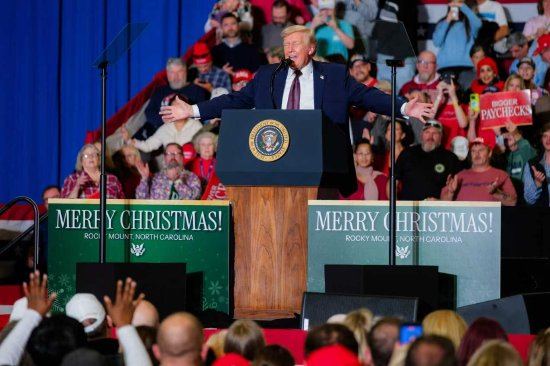
Core Viewpoint - The article highlights President Trump's praise for the third-quarter GDP growth rate of 4.2%, which significantly exceeds the expected 2.5% growth, while also noting the unusual market reaction where good news leads to market stagnation or decline due to concerns over potential interest rate hikes to combat inflation [1] Group 1 - The GDP growth rate for the third quarter reached 4.2%, surpassing the forecast of 2.5% [1] - Market reactions have changed, with positive news now often resulting in flat or declining stock markets due to fears of immediate interest rate increases to prevent potential inflation [1] - Trump emphasizes that strong market performance should not trigger inflation, attributing inflation concerns to poor policy decisions [1] Group 2 - Trump expresses a desire for the new Federal Reserve Chairman to lower interest rates during favorable market conditions rather than suppressing the market unnecessarily [1] - He envisions a market that behaves naturally, rising and falling as it should, which he believes has not been seen in decades [1] - Trump asserts that inflation issues will resolve themselves naturally and that interest rate hikes should only occur when necessary, not to suppress market growth [1]
美国消费者信心指数继续下滑,降至4月加征关税以来最低水平
Feng Huang Wang· 2025-12-23 22:49
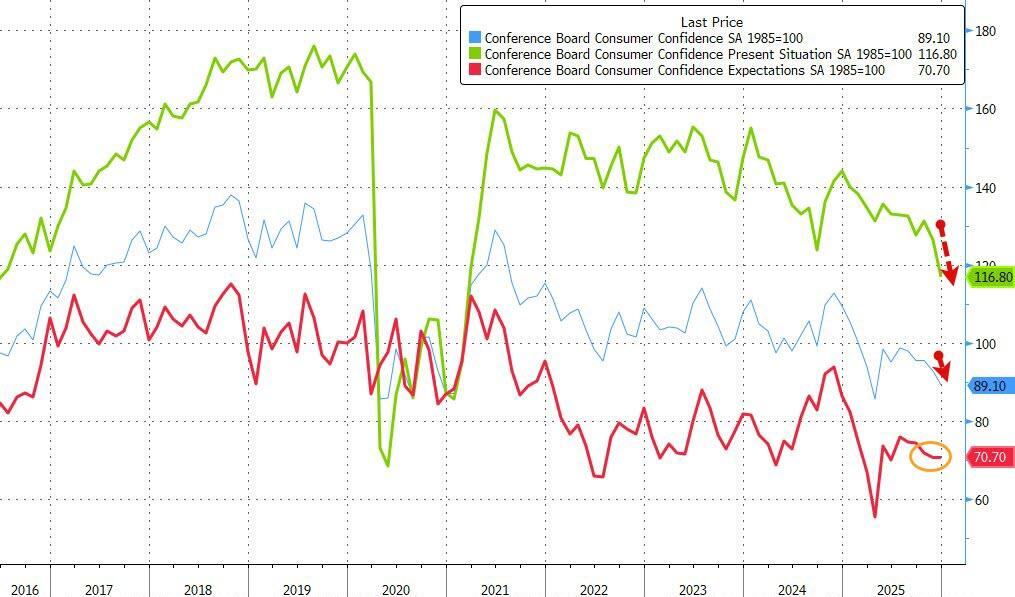
Group 1 - The consumer confidence index in the U.S. dropped to 89.1 in December, marking the fifth consecutive month of decline and the lowest level since April, down from a revised 92.9 in November [1] - The assessment of current economic conditions fell by 9.5 points to 116.8, with inflation and rising prices being the primary concerns for consumers, followed by tariff issues [3] - The percentage of consumers who view job opportunities as "plentiful" decreased from 28.2% in November to 26.7%, while those who find jobs "hard to get" increased from 20.1% to 20.8% [3] Group 2 - The average monthly job additions since March have been only 35,000, compared to 71,000 in the same period last year, indicating a stagnation in the labor market due to uncertainty surrounding tariffs and high interest rates [4] - Despite the overall pessimism, the proportion of respondents who believe the economy will not enter a recession in the next year has increased [5] - The evaluation of current household financial situations fell into negative territory for the first time in nearly four years, while expectations for future financial conditions reached the most optimistic level since January [6]
特朗普批评市场“利好不涨”反常现象,并警告异见者休想掌舵美联储
Sou Hu Cai Jing· 2025-12-23 21:25
Core Viewpoint - The article highlights President Trump's praise for the Q3 GDP growth rate of 4.2%, which significantly exceeds the expected 2.5% [1]. However, the market's reaction is unusual, as good news now often leads to market stagnation or declines due to concerns over potential interest rate hikes to combat inflation [1]. Group 1 - The GDP growth rate for Q3 reached 4.2%, surpassing the forecast of 2.5% [1] - The market is reacting negatively to positive economic news, with fears that it may trigger interest rate increases to prevent inflation [1] - Trump argues that strong market performance should not lead to inflation, attributing potential inflation to poor policy decisions [1] Group 2 - Trump expresses a desire for the new Federal Reserve Chairman to lower interest rates during positive market conditions rather than suppressing the market unnecessarily [1] - He envisions a market that behaves naturally, rising and falling as it should, which has not been seen in decades [1] - Trump asserts that inflation issues will resolve themselves and that interest rate hikes should only occur when necessary, not to curb market growth [1]
美国消费者信心连续第五个月下滑 就业看法更趋悲观
Xin Lang Cai Jing· 2025-12-23 20:27
Group 1 - The consumer confidence index in the U.S. has declined for the fifth consecutive month, dropping from 92.9 to 89.1, marking the longest decline since 2008 [2][6] - The current conditions index fell to 116.8, the lowest level since February 2021, while the expectations index for the next six months remained unchanged in December [2][6] - Concerns over inflation, tariffs, and the political situation continue to suppress consumer confidence, with high prices and labor market worries persisting throughout the year [4][8] Group 2 - Economists had initially expected a rebound in consumer confidence following the end of a record government shutdown, but the report indicates ongoing declines [4][8] - Job growth remains weak, the unemployment rate is rising, and inflation is still above the Federal Reserve's target, which may continue to drag down consumer confidence [4][8] - The proportion of consumers who believe "jobs are hard to find" has increased, while those who think "jobs are plentiful" has decreased, narrowing the gap to the lowest level since early 2021 [4][8] Group 3 - Respondents' assessment of their current financial situation has declined, with this indicator falling into negative territory for the first time in nearly four years [4][8] - There has been a decrease in purchasing plans for major appliances, housing, and automobiles, as well as a decline in the proportion of consumers planning to travel [4][8]

特朗普称美联储主席应在市场表现良好时降低利率
Xin Lang Cai Jing· 2025-12-23 19:37
Core Viewpoint - President Trump is advocating for the new Federal Reserve Chair to lower interest rates when the economy is performing well, signaling a desire for a candidate committed to rate cuts as he prepares to announce his nominee [1][4]. Economic Performance - The U.S. economy grew at an annualized rate of 4.3% in the third quarter, exceeding the expectations of all but one economist surveyed by Bloomberg [3][6]. - The S&P 500 index has risen for four consecutive days and is on track to reach a record high [3][6]. Political Pressure and Candidate Selection - Trump is under increasing political pressure to address voter concerns about affordability, linking lower interest rates to a boost in the housing market [3][6]. - He has narrowed down his list of candidates for the Federal Reserve Chair to "three to four" individuals and plans to announce his decision in the coming weeks [3][6]. - Notable candidates include National Economic Council Director Kevin Hassett and former Fed Governor Kevin Walsh, along with praise for Fed Governor Christopher Waller [3][6].
美国消费者信心连续第五个月下滑 追平08金融危机以来最长纪录
智通财经网· 2025-12-23 15:33
Group 1 - The core viewpoint of the articles indicates that U.S. consumer confidence has declined for the fifth consecutive month, reflecting growing pessimism regarding the labor market and business environment [1][2] - The Conference Board Consumer Confidence Index fell to 89.1 in December, down from 92.9 in the previous month, marking the longest streak of declines since the 2008 financial crisis [1] - Four out of five components of the overall index decreased, with one component showing significant weakness, highlighting concerns about prices, inflation, tariffs, trade, and political factors [1] Group 2 - High price levels and concerns about a weakening job market have continuously suppressed consumer sentiment, keeping the index at low levels since the pandemic [2] - Current trends show a slowdown in U.S. job growth and an increase in unemployment rates, while inflation remains above the Federal Reserve's target, exacerbating household anxiety about the economic outlook [2] - Economists predict that hiring activity will remain sluggish next year, with limited improvement in the unemployment rate, which may continue to pressure consumer confidence [2]
美国消费者信心连续第五个月下滑 对就业的看法更趋悲观
Xin Lang Cai Jing· 2025-12-23 15:20
Core Insights - The consumer confidence index in the U.S. has declined for the fifth consecutive month, dropping from 92.9 to 89.1, marking the longest decline since 2008 [1][2] - The current conditions index fell to 116.8, the lowest level since February 2021, while the expectations index for the next six months remained unchanged in December [1][2] - High inflation and concerns about the labor market have suppressed consumer confidence throughout the year, with the index hovering near pandemic lows [1][2] Economic Outlook - Employment growth remains weak, with rising unemployment rates and inflation still above the Federal Reserve's target [1][2] - Economists predict that hiring activity will remain moderate next year, with limited improvement in the unemployment rate, which may continue to drag down consumer confidence [1][2] - Wage growth is expected to slow further by 2026, potentially exacerbating consumption disparities among different income groups [1][2]
每日机构分析:12月23日
Xin Hua Cai Jing· 2025-12-23 14:44
Group 1 - The British pound's recent upward trend may soon lose momentum due to ongoing economic headwinds, with predictions indicating that the Bank of England may further ease policies in 2026, limiting the pound's gains in the new year [1] - Japanese government bonds saw a significant drop in prices, but a slight recovery occurred due to potential buying interest, with the 10-year Japanese government bond yield reaching 2.080%, the highest since February 1999 [1] - The South Korean central bank's financial stability report highlighted increasing financial vulnerabilities due to soaring housing prices and a weak currency, despite the overall resilience of the financial system [3] Group 2 - The Japanese finance minister's comments on the yen's volatility led to a stronger yen, but concerns remain about the yen being a favored short position if the Bank of Japan does not accelerate interest rate hikes [2] - The Australian dollar's monetary policy path is closely tied to quarterly CPI data, with potential pressure for rate hikes in February 2024 if inflation remains high, although current inflation levels do not challenge the central bank's expectations [3] - The Singapore dollar has emerged as one of the strongest Asian currencies this year, benefiting from avoiding the worst impacts of U.S. tariff policies and a weakening dollar [2]
银比油贵!时隔45年的震撼一幕或成危机前兆?
Jin Shi Shu Ju· 2025-12-23 14:41
Group 1 - The core viewpoint of the articles highlights the significant rise in silver and gold prices, with silver reaching a historic high of $70 per ounce, surpassing the price of crude oil [1] - Key triggers for the surge in silver prices include signals from Federal Reserve Chairman Jerome Powell regarding a shift to loose monetary policy and comments from New York Fed President John Williams that laid the groundwork for a potential rate cut in December [1] - The market is signaling that traders are betting on central banks in Western countries resorting to money printing to dilute debt, leading investors to seek assets not controlled by any central bank or government [2] Group 2 - The current economic stability relies heavily on public trust in the value of currency, which is now showing signs of erosion, prompting central banks to be cautious [3] - The last time silver prices were significantly higher than oil was in the early 1980s, which preceded a period of severe inflation, rising interest rates, market crashes, and economic recession [3] - The potential for a fiscal crisis is becoming increasingly realistic, as the dynamics of currency devaluation relative to gold could impact industrial metals and the broader economic supply chain [2][3]