
人民币汇率

Search documents
2025年5月23日银行间外汇市场人民币汇率中间价
news flash· 2025-05-23 01:19
2025年5月23日银行间外汇市场人民币汇率中间价 美元/人民币报7.1919,上调(人民币贬值)16点; 欧元/人民币报8.1269,下调193点; 港元/人民币报0.9186,上调0.2点; 英镑/人民币报9.6661,上调187点; 澳元/人民币报4.6192,下调81点; 加元/人民币报5.1983,上调99点; 100日元/人民币报5.0067,上调58点; 人民币/俄罗斯卢布报11.0636,下调217点; 新西兰元/人民币报4.2521,下调167点; 人民币/林吉特报0.59333,上调5.5点; 瑞士法郎/人民币报8.6935,下调161点; 新加坡元/人民币报5.5729,下调55点。 ...
人民币汇率升破7.2,多空“厮杀”下,谁在主导这波行情?
Sou Hu Cai Jing· 2025-05-22 23:26
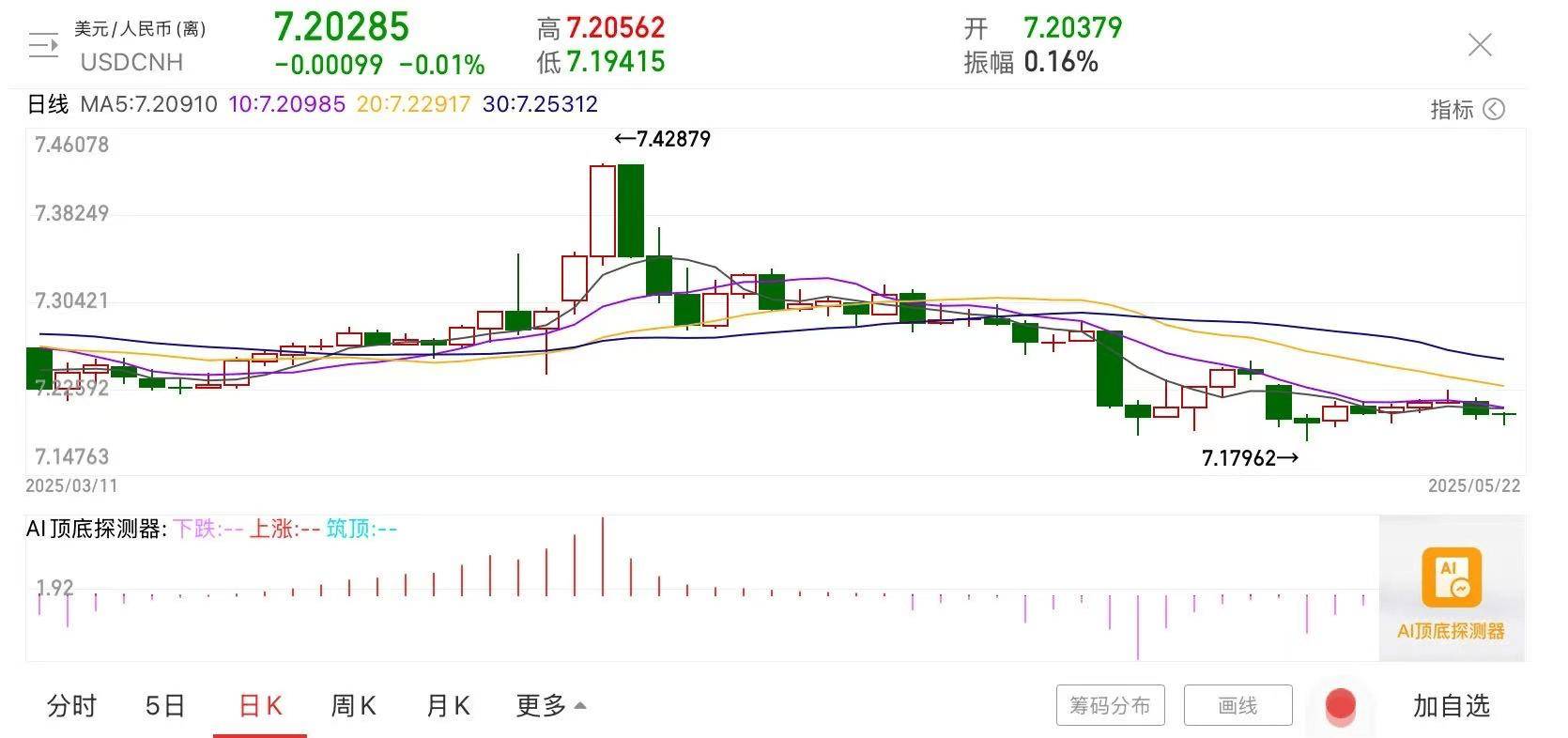
今年5月以来,汇率市场多空博弈态势加剧。以美元兑离岸人民币汇率为例,从4月中上旬的1美元兑7.42元人民币一路震荡下跌。5月21日,美元兑离岸人民 币再度跌破7.2元关口。 在这背后,中美贸易紧张局势缓和、国内释放经济稳增长信号、美联储政策转向预期升温。市场对于中国经济和资产的信心显著提升,支撑人民币汇率的因 素正在积聚。 中美谈判意外破冰,市场迎来"减压时刻" 在全球贸易保护主义阴云笼罩的背景下,5月12日,《中美日内瓦经贸会谈联合声明》一经发布,市场为之振奋。这份声明不仅标志着此次会谈取得了突破 性进展,更被市场视为全球贸易摩擦降温的关键信号。 贸易协议的走向主导着市场情绪并影响着人民币汇率的走势。渣打中国宏观策略主管刘洁就表示,短期美元对人民币有望下行,人民币中间价不排除进一步 调强至7.17-7.18,但未来人民币汇率仍将取决于中国经济状况和贸易谈判进展。 LPR、存款利率同步下调,国内政策支持增强 5月20日,新一期贷款市场报价利率(LPR)出炉,1年期LPR降至3%,5年期以上LPR降至3.5%,均较上一期下降10个基点,这是今年以来LPR首次下降。 同日,六大国有银行、招商银行等多家银行宣布下调 ...

中国宏观经济专题报告(第104期):关税政策下的人民币汇率走向及应对-CMF
Sou Hu Cai Jing· 2025-05-22 06:50
贸易与金融汇率背离:CFETS指数等贸易汇率贬值5.2%左右,而人民币对美元金融汇率基本稳定,形成"稳定资本流动、促进出口"的合意轨迹。 二、影响人民币汇率的关键因素 关税与贸易顺差:一季度中国货物贸易顺差1.96万亿元,4月单月顺差7000亿元,出口韧性显著,但美国关税的全面影响尚未完全显现,需警惕后续次级关 税影响。 中美利率倒挂:中美10年期国债收益率倒挂幅度超230个基点,4月8-9日达260个基点,加剧汇率波动压力,但中国经济基本面弱化倒挂影响。 跨境资本流动:一季度非银行部门跨境资金净流入517亿美元,货物贸易资金流入2063亿美元,外资增持人民币债券,资本流动平稳支撑汇率。 一、关税背景下人民币汇率走势特征 2025年特x普政府对中国商品实施罕见的阶梯式加税,从2月1日的10%快速升至4月10日的125%,中国同步对等反制。这一政策对人民币汇率产生显著影 响: 突发性贬值冲击:4月8日美方加税至84%,离岸人民币汇率盘中触及7.4295,在岸市场次日触及7.3506,但美元指数波动有限,显示关税对人民币的直接冲 击。 美元超调与人民币稳定:今年以来美元指数贬值7.4%,最大跌幅达9.3%,但人民 ...

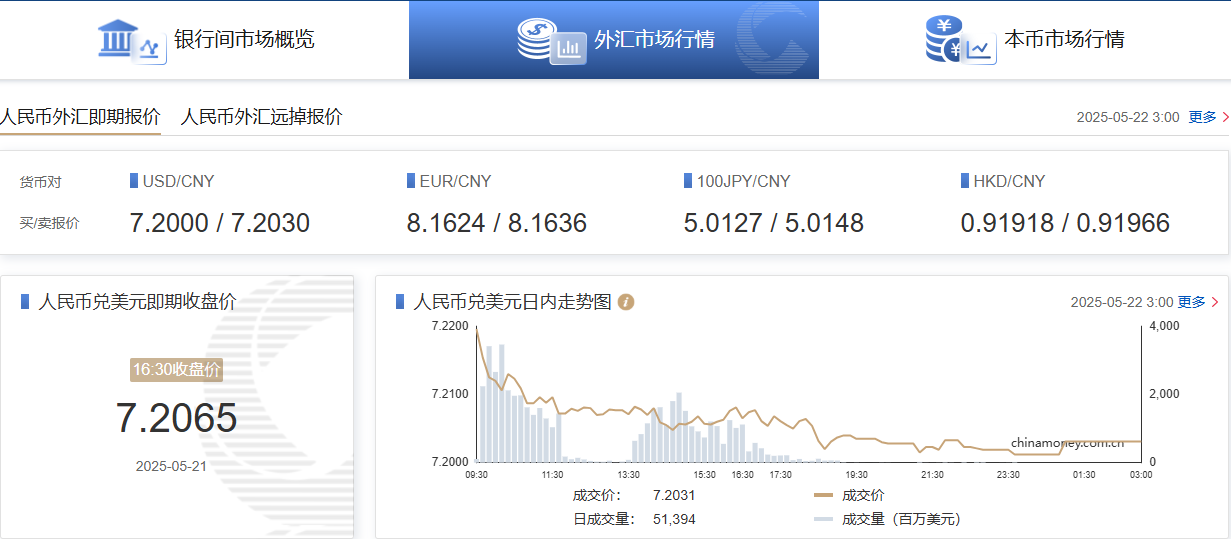
在岸人民币兑美元(CNY)北京时间03:00收报7.2031元,较周二夜盘收盘涨134点。成交量513.94亿美元。
news flash· 2025-05-21 19:11
Group 1 - The onshore Chinese yuan (CNY) closed at 7.2031 against the US dollar, appreciating by 134 points compared to the previous night session [1] - The trading volume for the yuan was reported at 51.394 billion USD [1]
香港离岸人民币市场观察(2025年4月刊):支持人民币汇率走强的积极因素增多
工银亚洲· 2025-05-21 15:12
Group 1: Offshore RMB Market Overview - As of March 2025, Hong Kong's offshore RMB deposits totaled 9,598.48 billion RMB, a decrease of 7.3% month-on-month but an increase of 1.6% year-on-year[6] - The total RMB remittances related to cross-border trade settlements reached 11,839.76 billion RMB, increasing by 11.3% month-on-month but decreasing by 5.2% year-on-year[6] - The RMB RTGS clearing amount in March was 67.0 trillion RMB, up 12.6% month-on-month, marking the highest level in seven months[6] Group 2: Currency and Interest Rate Trends - The average USD index in April was 100.66, down 3.33% from March, with a month-end value of 99.64, reflecting a 4.37% decline[5] - The USD/CNY and USD/CNH exchange rates showed slight decreases of 0.16% and 0.05% respectively by the end of April, with average rates of 7.3025 and 7.3048[5] - The CNH HIBOR rates for overnight, 1-month, and 3-month periods averaged 1.40%, 1.88%, and 1.99% respectively, showing declines of 26.2 basis points, 14.9 basis points, and 17.2 basis points month-on-month[17] Group 3: Market Sentiment and Future Outlook - The offshore RMB bond issuance in April totaled 306.5 billion RMB, a decrease of 30.8% month-on-month and 13.1% year-on-year[30] - The offshore RMB market is expected to see increased activity in bond financing due to improved growth confidence from easing trade tensions and supportive monetary policies[33] - The market sentiment towards the RMB is optimistic, with expectations of a stronger RMB exchange rate amid favorable trade negotiations and economic data[12]
外汇专题报告:结售汇双边放量,汇率区间波动
Hua Tai Qi Huo· 2025-05-21 09:42
Report Summary Core Views - In April, both sides of foreign exchange settlement and sales volume increased, with the scale of settlement and sales rising simultaneously, and the overall deficit slightly expanding. The significant growth of forward net settlement reflects the improvement of enterprises' settlement expectations and more proactive hedging behavior [3]. - The US dollar index fluctuated weakly, and the Federal Reserve maintained a wait - and - see stance. After the withdrawal of the counter - cyclical factor, the fluctuation range of the RMB exchange rate increased [3]. Data Core Highlights Foreign Exchange Market Supply - Demand Structure - In April 2025, the bank foreign exchange settlement and sales deficit was $4.257 billion, slightly expanding from the previous value of - $1.967 billion. The scale of both settlement and sales increased, indicating higher activity in enterprises' foreign exchange transactions. The surplus of bank customer - related foreign exchange settlement and sales expanded from $96 million to $589.3 million, while the deficit of banks' own foreign exchange settlement and sales expanded from - $2.063 billion to - $10.15 billion [4]. - The spot exchange rate of the US dollar against the RMB rose 0.34% month - on - month, and the market trading activity declined slightly, with the average spot inquiry trading volume falling to $42.234 billion [4]. Forward Transaction Structure - In April, the forward market continued to recover. The forward settlement signing amount increased by $4.358 billion month - on - month, and the forward sales signing amount decreased by $2.193 billion, driving the cumulative outstanding forward net settlement amount to expand from $903 million to $5.231 billion. The forward purchase performance amount increased by $7.519 billion, much higher than the increase in settlement performance [5]. - The forward settlement hedging ratio rose to 8.59%, the highest point this year, while the forward purchase hedging ratio dropped to 4.3% [5]. Securities Investment - In April, the foreign - related receipts and payments under securities investment changed from a surplus of $7.37 billion to a deficit of $12.493 billion. The trading volumes of both the Shanghai - Hong Kong Stock Connect and the Shenzhen - Hong Kong Stock Connect decreased, and the two - way difference narrowed. However, the bond custody volume of overseas investors in RMB bonds rose to 29,781.5 billion yuan [6]. Goods Trade - In April, the goods trade surplus narrowed, dragging down the foreign exchange settlement and sales surplus. The global manufacturing PMI fell from 52 in March to 50.8 in April, and China's manufacturing PMI dropped to 49, returning to the contraction range. The US manufacturing PMI remained at 51.2, while Japan and the Eurozone were still in the contraction range [6]. Exchange Rate Views - The US inflation shows an initial slowdown trend, but the Fed maintains a cautious policy stance. The US core CPI in April fell to 2.8% year - on - year, and the PPI also declined month - on - month. However, the Fed did not adjust its policy, and the US dollar index fell to around 100 [8]. - The easing of tariffs boosted expectations, and the exchange rate fluctuated more after the withdrawal of the counter - cyclical factor. In May, the RMB exchange rate fluctuated around 7.20. After the withdrawal of the counter - cyclical factor, the exchange rate was more driven by market supply and demand, and the short - term fluctuation range increased. The 1 - year USDCNY swap point dropped to - 2160, and the RMB exchange rate may show a two - way shock pattern in the short term [8].
管涛 | 4月外汇市场分析报告:极限关税施压无碍银行结售汇顺差扩大
Sou Hu Cai Jing· 2025-05-21 08:22
Core Viewpoint - In April, despite extreme tariff pressures, the RMB exchange rate quickly stabilized and rebounded after a brief adjustment, while the multilateral exchange rate continued to weaken. The passive appreciation of the RMB under a weak dollar index should not be overly concerning [3][5][6]. Group 1: RMB Exchange Rate Dynamics - In April, the RMB exchange rate initially fell due to the impact of Trump's tariffs but rebounded quickly, with the onshore RMB rate at 7.2632 and offshore RMB rate at 7.2689 by the end of the month, reflecting a depreciation of 0.2% and 0.1% respectively compared to the previous month [5][6]. - The RMB nominal effective exchange rate index fell by 2.2% in April, which was greater than the 1.4% decline in the dollar index, indicating a broader weakening of the RMB against other currencies [6][7]. - The RMB's actual effective exchange rate weakened due to inflation differentials, which helps maintain the price competitiveness of Chinese exports [7]. Group 2: Cross-Border Capital Flows - Cross-border capital continued to show net inflows, with a historical high of $630 billion in goods trade surplus in April, despite pressures in securities investment [10][11]. - In April, foreign investment in domestic bonds increased by $109 billion, indicating a strong interest in RMB-denominated assets, supported by effective government measures [11][12]. - The net outflow in securities investment was $125 billion, but this was less than the average monthly outflow of $284 billion from October 2024 to January 2025, suggesting limited pressure on cross-border capital outflows [11][12]. Group 3: Market Responses and Government Actions - The Chinese government implemented a series of financial support policies and counter-tariff measures, which helped stabilize market expectations and maintain foreign investment interest in RMB assets [12][10]. - The Central Huijin Investment Company announced plans to increase holdings in ETFs and quality stocks, reinforcing market confidence [12]. - The willingness of market participants to settle foreign exchange transactions increased, with a surplus in bank foreign exchange settlements rising from $63 billion to $166 billion in April [16][17].

2025年5月21日银行间外汇市场人民币汇率中间价
news flash· 2025-05-21 01:19
2025年5月21日银行间外汇市场人民币汇率中间价 美元/人民币报7.1937,上调(人民币贬值)6点; 欧元/人民币报8.1265,上调455点; 港元/人民币报0.91889,下调5.2点; 英镑/人民币报9.6436,上调323点; 澳元/人民币报4.6278,下调178点; 加元/人民币报5.1780,上调210点; 100日元/人民币报4.9908,上调217点; 人民币/俄罗斯卢布报11.2073,上调286点; 新西兰元/人民币报4.2733,上调34点; 人民币/林吉特报0.59487,下调15点; 瑞士法郎/人民币报8.7012,上调868点; 新加坡元/人民币报5.5638,上调55点。 ...
内外套日报-20250520
Yong An Qi Huo· 2025-05-20 03:28
Group 1: Investment Ratings - No investment ratings for the industry are provided in the report. Group 2: Core Views - The report analyzes import profits, internal - external price differences, and trading strategies across multiple industries including agriculture, energy, metals, and precious metals. It also considers the impacts of tariffs, supply - demand, and exchange rates on these factors [1][3]. Group 3: Industry - Specific Summaries Agriculture - **Cotton**: Due to trade wars, sanctions, and tariff policies, the relationship between domestic and foreign cotton markets has changed. After tariff cuts, the strength of Zhengzhou cotton and US cotton has reversed. Continued attention to tariff policy changes is recommended [1]. - **Oils and Oilseeds**: These commodities have a high import dependency. Their international supply - demand balance is transmitted to the domestic market through imports, and the focus should be on the difference in domestic and foreign supply - demand rhythms [1]. Iron Ore - In the short - term, the shipping and arrival of iron ore are increasing, iron - water production is oscillating at a high level. With strong overseas macro - disturbances and relatively stable domestic macro - conditions, the ore price center has declined, and there are fewer short - term internal - external price difference opportunities. In the long - run, the global supply - demand balance is more surplus compared to the Chinese market [1]. Energy - **SC**: The internal - external price relationship is weakening. - **FU**: In summer, the internal - external relationship remains weak, and the internal - external price difference of FU09 is compressing. - **LU**: The external crack spread basis has rebounded, and with the cancellation of warehouse receipts, the internal - external relationship is strengthening. - **PG**: After tariff relaxation, the external price has risen. The internal - external price difference has decreased significantly [1]. - **PX**: Domestic PX operating rates have declined, and there are still some overseas maintenance. As TA restarts, the PX de - stocking rate is expected to increase. The current internal - external price difference has converged significantly, and the valuation is becoming neutral, so it is recommended to wait and see [1]. Metals - **Aluminum**: Close the internal - external reverse arbitrage position to take profit. - **Tin**: As overseas and Myanmar mines resume production smoothly, pay attention to internal - external positive arbitrage opportunities. The LME inventory has been low recently. - **Zinc**: Close the internal - external reverse arbitrage position [1]. Precious Metals - **Gold**: The RMB exchange rate has an impact on the domestic price, and the internal - external price ratio has dropped rapidly. The end of the domestic consumption peak season and the Diwali - supported gold consumption in India have also contributed to this decline. - **Silver**: The spot discount has widened, and the import window is closed [3].
2025年5月20日银行间外汇市场人民币汇率中间价
news flash· 2025-05-20 01:18
Core Viewpoint - The interbank foreign exchange market shows fluctuations in the Renminbi (RMB) exchange rates against various currencies, indicating a mixed trend in currency valuation as of May 20, 2025 [1] Exchange Rate Summary - The USD/RMB rate is reported at 7.1931, an increase of 15 points, indicating a depreciation of the RMB against the USD [1] - The EUR/RMB rate stands at 8.0810, up by 260 points, reflecting a stronger Euro against the RMB [1] - The HKD/RMB rate is at 0.91941, down by 4.4 points, suggesting a slight strengthening of the RMB against the HKD [1] - The GBP/RMB rate is reported at 9.6113, an increase of 337 points, indicating a depreciation of the RMB against the GBP [1] - The AUD/RMB rate is at 4.6456, up by 293 points, showing a weaker RMB against the AUD [1] - The CAD/RMB rate is at 5.1570, down by 39 points, indicating a stronger RMB against the CAD [1] - The JPY/RMB rate is reported at 4.9691, up by 98 points, reflecting a weaker RMB against the JPY [1] - The RMB/RUB rate is at 11.1787, down by 625 points, indicating a significant depreciation of the RMB against the RUB [1] - The NZD/RMB rate is at 4.2699, up by 277 points, suggesting a weaker RMB against the NZD [1] - The RMB/MYR rate is at 0.59637, down by 1.8 points, indicating a stronger RMB against the MYR [1] - The CHF/RMB rate is reported at 8.6144, down by 101 points, reflecting a stronger RMB against the CHF [1] - The SGD/RMB rate is at 5.5583, up by 110 points, indicating a weaker RMB against the SGD [1]