去美元化

Search documents
长江宏观:金价疯涨,全球央行疯狂购金,金价最终走向何方?
Sou Hu Cai Jing· 2026-01-10 17:10
Core Viewpoint - The traditional gold pricing model has become ineffective since 2022, primarily due to large-scale gold purchases by global central banks, which have become the main driver of gold price increases. This shift is attributed to structural cracks in the dollar credit system, rising geopolitical uncertainties, and a long-term trend towards diversification of global reserve assets [1]. Group 1: Traditional Gold Pricing Framework - Traditionally, gold pricing is based on three references: commodity attributes (positively correlated with inflation), currency attributes (negatively correlated with the dollar index), and financial attributes (negatively correlated with real interest rates) [3]. Group 2: Breakdown of Traditional Pricing Framework - Since 2022, the negative correlation between gold prices and real interest rates has been disrupted, with instances of simultaneous fluctuations. This breakdown is due to two main reasons: distorted real interest rates in high inflation environments and the emergence of central bank gold purchases as a dominant force [5][6]. Group 3: Shift in Gold Pricing Model - The gold pricing model is shifting from financial attributes to commodity supply and demand attributes, as the marginal changes in demand, particularly from central banks, are now the key determinants of price [5]. Group 4: Reasons for Central Bank Gold Purchases - Central banks are collectively purchasing gold due to concerns over the potential collapse of the current international monetary system, driven by structural cracks in the dollar credit system, highlighted by the freezing of Russian foreign reserves [6][7]. - The U.S. faces fundamental issues, including a rising debt crisis and political polarization, which undermine confidence in the dollar and drive a shift towards gold [7][8]. Group 5: Geopolitical Risks and Demand for Gold - Increasing geopolitical risks and trade frictions enhance the demand for gold as a safe-haven asset, further elevating its value [10]. Group 6: Future Gold Price Trends - The factors driving gold price increases remain strong and may even strengthen, including the long-term strategic shift of central banks towards gold accumulation, challenges to dollar credit, ongoing geopolitical uncertainties, and the relative weakness of other assets [12][13][15][17]. - Central banks' intentions to increase gold reserves are supported by policy measures, and the current low percentage of gold in global official reserves indicates significant potential for growth [12]. Conclusion - The current gold bull market reflects profound trends of "de-dollarization" and "global re-risking," with central banks as the most critical marginal buyers. The ongoing concerns regarding the dollar's credibility and geopolitical risks suggest that the trend of central bank gold purchases and the upward trajectory of gold prices are likely to continue [18].


不让买俄油!特朗普放出3招,连续点名中国,是时候该算总账了
Sou Hu Cai Jing· 2026-01-10 16:16
Group 1 - The Trump administration is implementing a strategy to control global energy markets by sanctioning buyers of Russian oil, targeting oil-producing countries, and seizing oil tankers [1][3] - The newly approved sanctions under the "2025 Sanctions on Russia Act" require China, India, and Brazil to halt imports of Russian oil or face tariffs up to 500% [3][7] - Russia's oil export revenue heavily relies on energy trade, with China accounting for nearly half of its total exports, while India and Brazil are also significant partners [3][10] Group 2 - The U.S. has previously intervened in Venezuela's economy, controlling its oil revenue and mandating that profits be deposited in U.S.-designated accounts [5][10] - Recent U.S. military actions included seizing oil tankers flagged by Russia, indicating a shift in strategy to apply pressure on Russia's energy buyers through secondary sanctions [7][9] - The geopolitical landscape is shifting, with the U.S. aiming to replace multilateral trade orders with unilateral rules, particularly in energy trade [10][12] Group 3 - China is the largest oil importer globally, with imports from Russia reaching 108 million tons in 2024, constituting 19.6% of its total oil imports [10][12] - The trend of de-dollarization is evident, with 99.1% of trade between China and Russia being settled in local currencies, reducing the effectiveness of U.S. sanctions [12][14] - India has resisted fully stopping Russian oil imports, emphasizing the need to protect domestic consumer interests, while Brazil also supports continued energy cooperation with Russia [14][16] Group 4 - The EU has aligned with the U.S. in sanctioning Russia, but questions the legality of unilateral sanctions and is concerned about market stability [16] - The share of Russian oil exports to the EU has drastically decreased from 40-45% pre-conflict to 4-5% in 2026, with Asian markets, particularly China and India, absorbing 80% of Russian oil exports [16]
中国央行的黄金储备直接创下历史新高!
Sou Hu Cai Jing· 2026-01-10 14:51
最新数据一曝光,全网都看明白了:中国央行的黄金储备直接创下历史新高!截至去年12月,我们手里 的黄金已经达到7415万盎司,折算下来差不多2306吨,更关键的是,这已经是连续14个月疯狂增持了! 不少人纳闷,央行为啥要这么执着买黄金?这背后藏着的大棋局,说出来恐怕让美国都坐不住! 要说 这增持的时机,那可是精准踩在节点上,正好是美国大选尘埃落定,特朗普重返白宫之际。当时大家就 预判,2025年美国的全球战略肯定要大改,果不其然,特朗普上台后又是逼着美联储降息,又是在全球 掀贸易战,国际金融市场瞬间变得波诡云谲。 这些年美国老把金融当武器,到处搞长臂管辖,不少国家都怕了,纷纷想办法摆脱对美元的依赖。而中 国要推动人民币国际化,让更多国家愿意用、敢用人民币,就必须有足够的黄金做信用背书。黄金的价 值不分国界,不管国际局势怎么变,它的硬通货属性都不会变。手里有这么多黄金,就是向世界证明: 咱们有能力稳住人民币币值,人民币国际化自然能走得更顺。 现在来看,这些风险不仅没消失,反而 越来越大。 美联储主席鲍威尔马上就要卸任了,特朗普要换自己人上台,下半年美国的金融政策大概率会更激进, 国际金融市场又要面临新的冲击。台海 ...
黄金碾压美债!30年首夺储备之王,普通人该抄底还是跑路?
Sou Hu Cai Jing· 2026-01-10 14:51
Core Viewpoint - Gold has officially surpassed U.S. Treasury bonds to become the world's largest reserve asset for the first time in 30 years, indicating a significant shift in global financial dynamics [1][3]. Group 1: Gold vs. U.S. Treasury Bonds - As of the end of 2025, global central bank gold reserves are valued at $3.93 trillion, while U.S. Treasury bonds hold a value of $3.88 trillion [3]. - The last time gold held this position was in 1996, marking a long-term trend rather than a short-term fluctuation [3]. - Central banks are increasingly favoring gold over U.S. Treasury bonds, with significant purchases recorded in recent years [4][5]. Group 2: Central Bank Behavior - In the first three quarters of 2025, global central banks purchased a total of 634 tons of gold, with projections suggesting annual purchases will exceed 1,000 tons for the fourth consecutive year [4]. - The People's Bank of China has also been actively increasing its gold reserves, reaching approximately 2,304 tons by the end of October 2025 [5]. - In contrast, foreign official institutions have significantly reduced their net purchases of U.S. securities, with a 94.4% decrease noted in the second quarter of 2025 [5]. Group 3: Trust and Risk Factors - The decline in trust towards U.S. Treasury bonds is attributed to concerns over U.S. financial practices, including the use of financial sanctions [7][8]. - The U.S. national debt has surpassed $38 trillion, raising fears of potential defaults or devaluation through monetary policy [8][9]. - The shift from U.S. Treasury bonds to gold reflects a broader trend of diminishing confidence in fiat currencies [9]. Group 4: Market Predictions - Analysts have differing views on gold's future, with some predicting prices could reach $5,000 per ounce by 2026, while others caution against potential corrections due to speculative buying [10][11]. - Factors supporting gold's price increase include accelerated de-dollarization, ongoing central bank purchases, and persistent geopolitical risks [11]. - Risks to gold's valuation include high current prices, supply constraints, and potential competition from digital currencies [11]. Group 5: Investment Recommendations - Investors are advised against over-investing in gold, with recommendations suggesting a portfolio allocation of 10%-20% [13]. - Caution is advised against using loans to purchase gold, as this could lead to significant financial losses [13]. - Legitimate investment channels for gold include bank-issued paper gold, gold ETFs, and standard gold bars, while avoiding high-yield platforms that may be fraudulent [13][14].

【南篱/黄金】2026第一次非农
Sou Hu Cai Jing· 2026-01-10 13:19
Group A: ETF Holdings - Since December 1, there have been 19 changes in ETF holdings, with 10 increases and 9 decreases, indicating a relatively stable position [3] - In late December, the increase in holdings surged significantly, with five consecutive increases, suggesting a dominant bullish sentiment in the market [5] Group B: Speculative Sentiment Report - The current long-short ratio indicates insufficient downward pressure, making any declines appear as mere adjustments rather than significant sell-offs [6] - From December 16 to December 29, the market has returned to a normal consolidation phase, moving away from extreme positions [8] Group C: Fundamental Analysis 1. U.S. Trade and Political Actions - The U.S. has implemented tariffs to encourage manufacturing return and balance trade deficits, with recent actions including the arrest of Venezuelan President Maduro, raising questions about international law and human rights [9] - The U.S. dollar's reserve status is under threat due to these aggressive actions, increasing interest in gold as a liquid asset [11] 2. Interest Rate Decisions - The year marks a transition for the Federal Reserve, with expectations of a dovish successor to Powell, potentially leading to two rate cuts in 2026 [12][13] 3. Gold Demand and Market Dynamics - Central banks continue to increase gold holdings, with demand expected to remain strong, supporting long-term price increases [14] - The Bloomberg Commodity Index is set for annual rebalancing, which may lead to liquidity pressures due to technical selling by passive funds [14] Group D: Employment Data - The ADP employment report shows a positive trend with an increase of 41,000 jobs, indicating a stabilizing job market [15] - The upcoming non-farm payroll data is anticipated to show a slight decrease in unemployment, with expectations set at 6,000 jobs added [17]

拉美学者:“唐罗主义”引起拉美主权危机
Xin Lang Cai Jing· 2026-01-10 13:16
中新社圣保罗1月9日电 (记者 林春茵 韩禹)多位拉美学者近日接受中新社记者采访时指出,美国对委内 瑞拉发动军事袭击,强行控制委总统马杜罗夫妇,标志着美国意在通过"唐罗主义"掠夺资源以维系霸 权,严重践踏国际法,更引起拉美国家的主权危机。 美国总统特朗普9日称,已取消此前预计的对委内瑞拉第二波军事打击,并表示两国正"携手合作",重 建油气基础设施。 多位学者受访时指出,美国丢弃道义遮羞布,正试图将"例外状态"变为"常态",只要出于维持霸权的需 要,任何国际法条文皆可被悬置。 墨西哥国立自治大学经济研究所高级研究员阿娜·埃斯·塞塞尼亚(Ana Esther Ceceña)认为,美国对委内瑞 拉的军事行动,是美国与拉丁美洲关系乃至更广泛国际关系的一个转折点。 圣保罗州立大学国际经济学教授路易斯·安东尼奥·保利诺(Luís Antonio Paulino)表示,这是一个危险的先 例,因为它违反了国际法不干涉他国内政的重要原则。 塞塞尼亚进一步分析,当前,美国经济正面临严重困难;来自其他国家的竞争,加之全球交易逐步"去 美元化",正削弱其世界地位。对美洲大陆领土及自然财富的控制,已成为美国维系其全球权力地位不 可或缺 ...
伊朗骚乱,“全国范围”断网,哈梅内伊喊话特朗普;内存涨价潮引爆市场,闪迪大涨37%;韩国回应“无人机入侵朝鲜领空”| 一周国际财经
Mei Ri Jing Ji Xin Wen· 2026-01-10 12:43
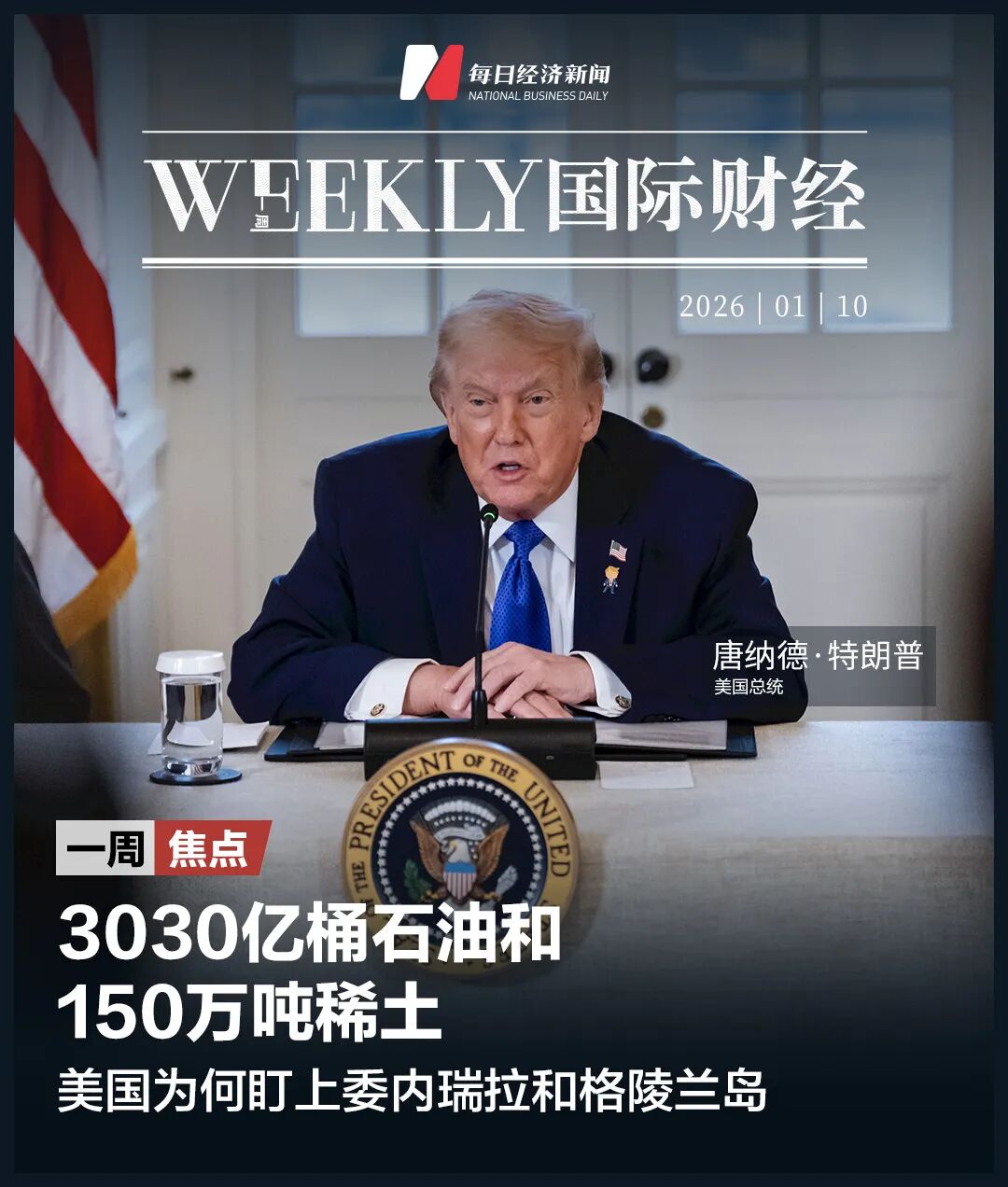
Group 1 - The Trump administration is aggressively targeting Venezuela and Greenland for their vast natural resources, with plans to invest $100 billion to control Venezuela's oil and to acquire Greenland for its rare earth minerals [4][5][10]. - Approximately 20% of global oil trade is now conducted without using the US dollar, and the dollar's share in global foreign exchange reserves has dropped to a record low of 56.92%, indicating a weakening of the dollar's dominance [5][21][24]. - Venezuela holds the world's largest proven oil reserves at 303 billion barrels, which is about 17% of the global total, and the US aims to control its oil sales and production [7][8][9]. Group 2 - Greenland is rich in strategic resources, including 1.5 million tons of rare earth elements, and is considered vital for US national security due to its location and resource wealth [11][12][17]. - The US Secretary of State has prioritized the competition for energy and resource dominance as a key diplomatic objective [6]. - The US government plans to control the sale of Venezuelan oil, with immediate plans to refine and sell up to 50 million barrels, with proceeds being personally overseen by Trump [8][9]. Group 3 - The US is facing a significant debt burden exceeding $38 trillion, which is driving the need to secure stable financing through resource control [25][31]. - The traditional "petrodollar" system, where oil sales are conducted in dollars, is under threat as more countries move towards non-dollar transactions, complicating the US's financial strategy [18][24]. - The US's efforts to regain control over oil and resources are seen as a way to restore confidence in US debt instruments and combat the trend of "de-dollarization" [24][31].


特朗普通告全球,不许3国购买俄石油,我国第一个表示不服
Sou Hu Cai Jing· 2026-01-10 11:57
Core Viewpoint - The U.S. Senate is moving forward with a bill that would impose severe tariffs, up to 500%, on countries purchasing Russian oil, gas, and uranium, specifically targeting China, India, and Brazil, as a means to pressure these nations to stop funding Russia amid the Ukraine conflict [2][6]. Group 1: U.S. Legislative Actions - Senator Lindsey Graham has indicated that President Trump has approved a strengthened sanctions bill against Russia, which could be voted on in the Senate next week [2]. - The bill aims to leverage tariffs as a tool to exert influence over major economies that continue to engage in energy trade with Russia [2][6]. Group 2: China's Response - China's Ministry of Foreign Affairs has firmly opposed the unilateral sanctions imposed by the U.S., asserting that their energy cooperation with Russia is legitimate and should not be interfered with [2][5]. - The Chinese government emphasizes that energy security is crucial for its economic stability, making it impractical for China to comply with U.S. sanctions that threaten its energy supply [3][5]. Group 3: Economic Implications - China’s energy imports from Russia are significant, with Russian oil constituting a large portion of its energy needs, making the U.S. sanctions a substantial risk for China’s energy security [3][5]. - The trade between China and Russia has increasingly moved towards "de-dollarization," with over 95% of transactions now conducted in local currencies, reducing the impact of U.S. sanctions that rely on the dollar [5][6]. Group 4: Broader Geopolitical Context - The U.S. strategy appears to aim at cutting off Russia's war funding while simultaneously attempting to assert dominance over emerging powers like China and India [6]. - The potential implementation of these tariffs could lead to significant trade confrontations, increased global energy prices, and disruptions in supply chains, ultimately affecting the global economy [6][7].
囤积商品的时代来临了
Hua Er Jie Jian Wen· 2026-01-10 11:48
Core Insights - The commodity market is undergoing a significant paradigm shift due to escalating geopolitical tensions and global supply chain restructuring, moving from a "just-in-time" model to a "just-in-case" stockpiling approach [1][2] - Countries are increasingly building strategic reserves to mitigate risks associated with potential wars, shipping disruptions, or geopolitical blockades, leading to a reconfiguration of supply and demand across various commodities [1][4] Group 1: Commodity Trends - Energy and strategic metals are becoming focal points for stockpiling, with countries potentially amassing around 1.4 billion barrels of oil, sufficient to sustain supply for hundreds of days, far exceeding the 90-day international norm [1][3] - The prices of critical military metals such as tungsten and cobalt have experienced significant volatility, with projected price increases of 229% and 120% respectively by 2025 [1][5] Group 2: Investment Implications - The shift in commodity dynamics suggests new trading themes for investors, particularly around "de-dollarization" and the demand for metals driven by national security needs [2][6] - Central banks are accelerating their gold purchases as a hedge against credit risk, with the share of the dollar in global foreign exchange reserves dropping to 56.92%, prompting a shift in gold's pricing logic [6] Group 3: Market Opportunities - Investors are advised to focus on capital market opportunities related to this macro narrative, such as European defense stocks and commodity ETFs, as funds are increasingly flowing into "hard assets" [7] - Gold mining stocks are also positioned to benefit, with all tracked gold miners achieving record profits at current gold prices, indicating a strong market for gold as a value storage asset [7]
3.93万亿美元!30年第一次:反超美债,黄金成全球最大储备资产!释放了什么危险信号?
Sou Hu Cai Jing· 2026-01-10 11:09
Core Viewpoint - A historic shift has occurred as gold has officially surpassed U.S. Treasury bonds to become the largest reserve asset held by global central banks, marking a significant change in the financial landscape [1][2]. Group 1: Historical Context and Current Trends - The total value of gold held by central banks has approached $4 trillion, reaching $3.93 trillion, while U.S. Treasury bonds stand at $3.88 trillion, a situation not seen since 1996 [2][4]. - In 2025, gold prices surged, with an annual increase of nearly 70%, peaking above $4,500 per ounce, prompting central banks to aggressively accumulate gold despite its high price [4][6]. - A survey indicated that 95% of central banks expect to continue increasing their gold reserves in the next 12 months, with 43% planning to add to their holdings, a record high [5]. Group 2: Motivations Behind Central Banks' Actions - A decline in trust towards U.S. dollar assets is a primary reason for this shift, as concerns over the U.S. national debt exceeding $38 trillion and ongoing political instability have raised doubts about the long-term stability of U.S. Treasury bonds [9]. - Geopolitical tensions have created a "fear premium," leading central banks to view gold as a protective asset against global uncertainties, akin to a financial "bulletproof vest" [10]. - The diversification of reserves is becoming essential, with central banks moving towards a mix of assets, including gold, euros, and renminbi, to reduce reliance on dollar-denominated assets [12]. Group 3: Future Outlook - Analysts predict that the structural demand for gold will not cease easily, as many emerging market countries still have gold reserve ratios below 10%, indicating room for growth [14]. - Even if the quantity of gold purchased may decrease from peak levels, the value proportion will likely continue to rise, providing support for gold prices [14]. - The shift towards gold signifies a broader trend of increasing volatility and uncertainty in the global financial landscape, prompting a reevaluation of what constitutes reliable wealth [14][15].