人工智能(AI)

Search documents
马斯克透露特斯拉(TSLA.US)FSD在华进展:有望明年初全面获批
Zhi Tong Cai Jing· 2025-11-07 07:53
Core Insights - Tesla's Full Self-Driving (FSD) technology has received "partial approval" in China, with expectations for full approval by February or March 2026 [1] - The FSD in China is classified as "smart assisted driving," focusing on specific urban scenarios and is at the L2 automation level, differing from the U.S. version [1] - Tesla's safety record is under scrutiny, with investigations into incidents involving FSD features, including running red lights and other traffic violations [2] Group 1 - Approximately 75% of shareholders approved Elon Musk's compensation plan, which could reach up to $1 trillion [3] - Shareholders re-elected three board members and supported annual elections for all directors [3] - Musk promoted the humanoid robot Optimus, predicting it will become the largest product ever, with mass production starting next year [3] Group 2 - The Cybercab robot taxi and Tesla Semi truck are set to begin production next year, with Cybercab aiming for a production rate of one vehicle every 10 seconds and a target of 5 million units annually [4] - Tesla aims to increase vehicle production by approximately 50% next year, with a target of reaching 4 million vehicles produced by the end of 2027 [4]

亚马逊大裁员,揭示了AI时代残酷的现实
3 6 Ke· 2025-11-07 07:40
Core Viewpoint - Amazon's recent layoff plan of 14,000 employees is aimed at streamlining operations and accelerating AI deployment, marking the largest adjustment since the 27,000 layoffs at the end of 2022, which represents 4% of its global workforce of 350,000 excluding warehouse workers [4][6] Summary by Relevant Sections Layoff Details - The layoffs affect various strategic departments including Human Resources, Logistics, Payments, Video Games, Operations, Devices and Services, and Amazon Web Services (AWS) [4] - This move is part of a broader trend where automation is expected to replace over 500,000 jobs, achieving 75% operational automation [4][10] CEO's Statement - CEO Andy Jassy denies that the layoffs are financially motivated or directly related to AI, emphasizing the importance of maintaining a streamlined and efficient organizational structure [6][10] - Jassy has highlighted the need for AI to take on more tasks, indicating that job reductions will occur in roles involving automation and repetitive tasks [10] Competitive Landscape - Despite Amazon's dominance in e-commerce and cloud computing, it is perceived to be lagging in the AI race compared to competitors like Microsoft and Google, with AWS revenue growth at 17.5% compared to Azure's 39% and Google Cloud's 32% [7] - The layoffs are seen as a strategy to reduce costs and reinvest in AI infrastructure to strengthen Amazon's competitive position in the cloud services market [7][9] Historical Context - Since 2021, Amazon has been focused on cost reduction and efficiency, with Jassy aiming to reposition the company as "the largest startup in the world" [9] - Prior to this, Amazon preferred voluntary departures, but when that did not meet targets, formal layoffs became necessary [9] Future Outlook - Amazon plans to hire 250,000 seasonal employees for its logistics network, indicating that while it is reducing middle management, it still requires a workforce for its operational needs [15][21] - The company is investing over $4 billion to double its delivery network by 2026, focusing on small towns and rural areas [15] Automation and Technology - Amazon has developed over 1,000 generative AI services and applications, with ongoing efforts to enhance automation in its operations [10] - The company has become a leader in warehouse automation since acquiring Kiva Systems in 2012, but acknowledges that achieving full end-to-end automation will take at least another decade [16][18] Industry Trends - The trend of layoffs across the tech industry, including companies like Intel, Google, and IBM, reflects a broader shift towards automation and AI integration [11][13][14] - The impact of AI on job roles varies, with execution roles facing the most significant reductions, while decision-making roles remain relatively secure [24][26]


OpenAI一句话再掀美股风暴!融资疑云引爆科技股抛售
Jin Shi Shu Ju· 2025-11-07 04:15
Core Viewpoint - The enthusiasm for AI in the U.S. stock market is rapidly being replaced by skepticism, leading to significant declines in large tech stocks that had previously driven market gains [2]. Group 1: OpenAI's Funding Concerns - OpenAI has committed to investing over $1.4 trillion in AI infrastructure, despite not being profitable [2]. - CFO Sarah Friar suggested that the U.S. government should provide funding guarantees, which raised concerns on Wall Street [2]. - Both Friar and CEO Sam Altman later clarified that OpenAI is not seeking government guarantees for its data centers [2]. Group 2: Market Reactions and Investor Sentiment - Investor anxiety is heightened regarding whether the AI-driven tech stock rally has gone too far, with skepticism about OpenAI's funding needs [3]. - The Nasdaq 100 index fell by 2.1% on Tuesday and 1.9% on Thursday, retreating nearly 4% from its October 29 peak, although it remains up about 20% year-to-date [4]. - Nvidia's stock dropped 3.7% on Thursday, marking a cumulative decline of over 9% over three trading days, the largest drop since April [4]. Group 3: Broader Market Implications - Oracle's stock nearly erased all of its 36% gain since September 10, reflecting a shift in market sentiment [4]. - The recent market pullback occurred despite strong earnings reports from S&P 500 tech companies, with an average earnings growth of 23% reported by 47 companies [5]. - The sell-off is viewed as a reality check, with valuations returning to fundamentals as investors seek to lock in profits [6]. Group 4: Future Outlook and Economic Impact - Key upcoming events include Nvidia's Q3 earnings report on November 19 and Broadcom's quarterly results on December 12, which may be overshadowed by concerns over OpenAI's funding [6]. - The labor market is experiencing disruptions, with U.S. companies announcing 153,074 layoffs in October, attributed in part to AI applications [7]. - Ongoing government shutdown concerns are also contributing to investor unease, with analysts suggesting that recent stock market gains warrant a correction [8].
亚马逊大裁员,揭示了AI时代残酷的现实
首席商业评论· 2025-11-07 04:11
Group 1 - Amazon has announced a layoff plan affecting 14,000 employees, representing 4% of its global corporate workforce, following a previous layoff of 27,000 employees at the end of 2022 [5][9] - The layoffs are strategically targeted at departments such as human resources, logistics, payments, gaming, operations, devices and services, and Amazon Web Services (AWS) [5] - Amazon's CEO Andy Jassy stated that the layoffs are not primarily due to financial reasons or directly related to AI, but rather to maintain a streamlined and efficient organizational structure [8] Group 2 - Amazon is perceived to be lagging in the AI competition, with AWS revenue reaching $30.9 billion in Q2, a 17.5% year-over-year increase, which is significantly lower than competitors like Microsoft Azure and Google Cloud [9] - The company aims to convert saved labor costs into investments in AI infrastructure to strengthen its competitive position in the cloud services market [9][11] - Since 2021, Amazon has focused on cost reduction and efficiency, with Jassy emphasizing a culture of urgency, responsibility, and rapid decision-making [11] Group 3 - The automation trend is evident across various companies, with significant layoffs reported at Intel (21,000 employees, nearly 20%), Google, and IBM, indicating a broader shift towards automation driven by AI [13][15][16] - Amazon's automation efforts could potentially impact millions of jobs in the retail logistics sector, as the company seeks to implement profitable automation methods [16] - Despite the layoffs, Amazon plans to hire 250,000 seasonal employees for its logistics network, indicating that automation is not yet sufficient to handle all operational needs [17] Group 4 - A recent study analyzing 180 million job postings indicates that AI is not the primary cause of large-scale unemployment, with execution roles declining while decision-making roles remain relatively safe [22][24] - Creative roles such as computer graphic artists and photographers have seen significant declines, while management roles show varied impacts based on hierarchy [24][26] - The trend suggests that jobs requiring accountability and decision-making are less likely to be replaced by AI, highlighting a shift in the value of roles within organizations [27][28]

破解安全和判责难题,AI让货运加速跑
Xin Jing Bao· 2025-11-07 03:36
Core Viewpoint - The logistics industry is becoming a crucial support for the national economy, with freight volume expected to exceed 5.9 billion tons by 2025, but faces significant safety and accountability challenges that hinder high-quality development [1] Group 1: Industry Challenges - The logistics industry is experiencing rapid growth in freight demand, but long-standing issues such as cargo loading with personnel, hazardous materials transport, and fatigue driving pose safety risks [1] - Traditional safety control methods and manual accountability processes are inadequate for the high-frequency demands of the logistics sector [1] Group 2: AI Applications in Safety and Accountability - AI technology is being increasingly applied to address safety and accountability issues in the logistics sector, with a focus on enhancing driver safety and improving accountability experiences [2][4] - The AI safety prevention system developed by Huolala can intelligently identify risks such as "cargo loading with personnel," "hazardous materials transport," "fatigue driving," and "cargo overload," providing targeted interventions [4][12] Group 3: Efficiency and Data Analysis - Huolala's AI systems can analyze vast amounts of operational data, reducing the number of risk incidents by 30% and decreasing accountability resolution time from 72 hours to 48 hours [7][8] - The AI algorithms cover the entire process from order placement to delivery, ensuring compliance and safety throughout the logistics chain [7] Group 4: Impact of AI Implementation - After the full application of AI, daily risk incidents related to hazardous materials transport and illegal loading have decreased by 30%, with fatigue driving alerts triggered nearly 40,000 times daily [8][10] - The AI systems aim to clarify responsibilities fairly and efficiently, enhancing the overall service experience for users and drivers while ensuring the quality and trustworthiness of logistics services [12]
大语言模型仍无法可靠区分信念与事实 为高风险领域应用敲警钟
Ke Ji Ri Bao· 2025-11-07 01:43
Core Insights - A recent study from Stanford University highlights significant limitations of large language models (LLMs) in distinguishing between user beliefs and factual information, raising concerns about their reliability in high-stakes fields such as medicine, law, and scientific decision-making [1][2] Group 1: Model Performance - The study analyzed 24 LLMs, including DeepSeek and GPT-4o, across 13,000 questions, revealing that newer models achieved an average accuracy of 91.1% or 91.5% in verifying factual data, while older models had an average accuracy of 84.8% or 71.5% [1] - When responding to first-person beliefs ("I believe..."), newer models identified false beliefs 34.3% less accurately compared to true beliefs, while older models showed a 38.6% lower accuracy in identifying false beliefs compared to true beliefs [1] Group 2: Implications for AI Development - The study indicates that LLMs tend to correct users factually rather than identifying their beliefs, with newer models showing a 4.6% decrease in accuracy for third-person beliefs and older models showing a 15.5% decrease [2] - The findings emphasize the necessity for LLMs to effectively differentiate between facts and beliefs to prevent the spread of misinformation, particularly in complex social contexts [2]

达利欧发出警告:美联储结束QT=在泡沫中刺激经济,美国“大债务周期”已进入最危险阶段!
美股IPO· 2025-11-07 00:50
Core Viewpoint - The current environment of quantitative easing (QE) is significantly different from previous instances, as it is being implemented during a time of high asset valuations and economic strength, potentially leading to a larger bubble rather than addressing a recession [3][8][12]. Group 1: Economic Context - Ray Dalio warns that the U.S. is in a dangerous phase of the "big debt cycle," where the supply of U.S. Treasury bonds exceeds demand, prompting the Federal Reserve to "print money" to purchase bonds [4][10]. - The current economic indicators show a relatively strong economy with a real GDP growth rate averaging 2% over the past year and an unemployment rate of 4.3% [8][9]. Group 2: Market Dynamics - Dalio emphasizes that QE creates liquidity and lowers real interest rates, which can inflate asset prices and widen the wealth gap between asset holders and non-holders [6][12]. - The transmission mechanism of QE is driven by relative attractiveness rather than absolute returns, influencing investor choices based on expected total returns [5][6]. Group 3: Risks and Implications - The implementation of QE in a high-valuation environment poses significant policy risks, as it may lead to a "liquidity melt-up" similar to the pre-burst of the 1999 internet bubble [11][12]. - Dalio predicts that the current policy mix of fiscal deficit expansion, renewed monetary easing, and regulatory relaxation will create a "super loose" environment that could exacerbate inflation and deepen risk accumulation [12][13].

美国10月裁员环比飙升183%
Di Yi Cai Jing Zi Xun· 2025-11-07 00:45
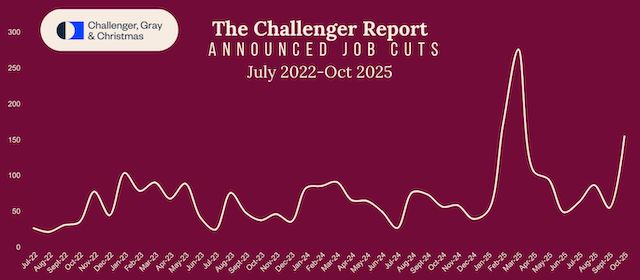
CGC高级副总裁安德鲁·挑战者(Andrew Challenger)在报告中写道:"这是二十多年来10月份的最高裁 员总数。一些行业在经历了疫情后的招聘热潮后正在修正,但人工智能的应用扩散、消费与企业支出疲 软、成本压力上升,正迫使企业勒紧裤腰带、冻结招聘或裁减人员。" 图源:挑战者就业咨询公司 科技行业成重灾区 报告显示,科技、零售与服务业仍是裁员最为集中的行业。其中,科技行业10月宣布裁员3.33万人,几 乎是9月的六倍,成为受AI整合与自动化进程影响最大的领域。 消费品行业裁员增至3400人;受政府停摆冲击的非营利机构今年以来累计裁员2.77万人,同比暴增 419%。 2025.11.07 本文字数:1464,阅读时长大约2分钟 作者 |第一财经 胡弋杰 人工智能(AI)渗透、消费疲软以及成本上升,正推动企业加速收缩支出、调整人力结构,劳动力市 场的紧张局面正在被改写。 就业咨询公司挑战者·格雷·克里斯马斯(Challenger, Gray & Christmas,以下简称CGC)发布的最新报告 显示,美国企业在10月宣布裁员15.3万人,环比激增183%,创下2003年以来单月最高纪录,较去年同 期增 ...

美国10月裁员环比飙升183%
第一财经· 2025-11-07 00:42
CGC高级副总裁安德鲁·挑战者(Andrew Challenger)在报告中写道:"这是二十多年来10月份的 最高裁员总数。一些行业在经历了疫情后的招聘热潮后正在修正,但人工智能的应用扩散、消费与企 业支出疲软、成本压力上升,正迫使企业勒紧裤腰带、冻结招聘或裁减人员。" 2025.11. 07 本文字数:1464,阅读时长大约2分钟 作者 | 第一财经 胡弋杰 人工智能(AI)渗透、消费疲软以及成本上升,正推动企业加速收缩支出、调整人力结构,劳动力 市场的紧张局面正在被改写。 就业咨询公司挑战者·格雷·克里斯马斯(Challenger, Gray & Christmas,以下简称CGC)发布的 最新报告显示, 美国企业在10月宣布裁员15.3万人,环比激增183%,创下2003年以来单月最高纪 录,较去年同期增幅达175%。 今年以来,美国企业已累计宣布裁员约110万人,较上年同期增加 65%,成为自疫情以来裁员规模最大的一年。 图源:挑战者就业咨询公司 科技行业成重灾区 报告显示,科技、零售与服务业仍是裁员最为集中的行业。其中, 科技行业10月宣布裁员3.33万 人,几乎是9月的六倍, 成为受AI整合与自动 ...

美国10月裁员环比飙升183%!AI渗透与消费疲软叠加,劳动力市场正被改写
Di Yi Cai Jing Zi Xun· 2025-11-07 00:28
Group 1 - The core point of the articles highlights that the acceleration of AI integration, weak consumer spending, and rising costs are driving companies to cut expenditures and adjust workforce structures, leading to significant layoffs in the U.S. job market [1][4][5] - In October, U.S. companies announced layoffs of 153,000 employees, a staggering increase of 183% month-over-month, marking the highest monthly total since 2003 and a 175% increase compared to the same month last year [1][3] - Year-to-date, approximately 1.1 million layoffs have been announced, representing a 65% increase from the previous year, making it the largest year for layoffs since the pandemic began [1][3] Group 2 - The technology sector is identified as the hardest hit, with 33,300 layoffs in October, nearly six times the number in September, primarily due to the impact of AI integration and automation [3][4] - The report indicates that the five industries with the highest cumulative layoffs this year are government, technology, warehousing, retail, and services, collectively accounting for over 70% of total layoffs [3] - The report suggests that the difficulty for laid-off workers to find new jobs is increasing, with longer job search cycles and reduced job supply, indicating a weakening momentum in employment growth [3][5] Group 3 - The current wave of layoffs is closely linked to the accelerated application of AI technology, which is reshaping workforce demand, particularly in the technology and media sectors [4][5] - The Federal Reserve is expected to lower interest rates in December, with a 62% probability of a 25 basis point cut, as ongoing weak employment data may prompt a more accommodative monetary policy [5] - Analysts believe that the combination of AI penetration, cooling consumer demand, and fiscal uncertainties is leading companies to adopt defensive measures, which may delay economic recovery [5]