
股债跷跷板效应

Search documents
超长债,风险还是机会?
GOLDEN SUN SECURITIES· 2025-09-22 12:23
1. Report Industry Investment Rating - No information about the industry investment rating is provided in the report. 2. Core Viewpoints of the Report - The current position of ultra - long bonds has both trading and allocation value. The ultra - long bond spread is expected to gradually repair, and in the second half of the fourth quarter, ultra - long bonds may decline more smoothly as the overall bond market strengthens [4][25]. - The current ultra - long bond term spread has significantly deviated from the fitted value, indicating that ultra - long bonds are oversold to some extent, and the space for the spread to continue rising is limited [3][21]. - As long as the liquidity of ultra - long bonds does not decline significantly, the spread is unlikely to return to the level before 2024, and currently, there is no basis for the spread to continue rising [3][24]. 3. Summaries According to Relevant Contents 3.1 Current Situation of Ultra - long Bonds - During the recent bond market adjustment, ultra - long bonds fell significantly, and the 30 - 10 - year Treasury bond term spread widened significantly, rising from about 21bps at the beginning of July to over 30bps, reaching the highest level since 2024 [1][7]. - The 30 - year Treasury bond yield rose from about 1.85% at the beginning of July to about 2.1% (active bond) currently, and the new bond yield rose to around 2.20% [7]. 3.2 Reasons for the Widening of Ultra - long Bond Term Spread - **Risk preference**: Since July this year, the stock market has risen, and the A - share market has strengthened significantly. The Shanghai Composite Index rose from 3458 points to 3820 points from July to September 19, with a cumulative increase of 10.5%. Due to the stock - bond seesaw effect, the market's investment enthusiasm for bonds declined, and the bond yield adjusted significantly, leading to the widening of the 30 - 10 - year Treasury bond spread [1][9]. - **Supply**: Since May this year, the issuance of ultra - long - term special Treasury bonds has accelerated. Except for June with a net financing of 19.2 billion yuan, the net financing in other months exceeded 20 billion yuan, significantly higher than the first - half average of 10.97 billion yuan. The issuance of ultra - long - term special Treasury bonds led to an upward movement of secondary - market interest rates and a widening of the term spread [1][13]. - **Funds**: There is a significant negative correlation between the 30 - 10 - year Treasury bond spread and R007. Since March this year, the capital price has declined significantly. R007 dropped from the high of 2.3% at the beginning of the year to 1.5% in August, and the decline in short - term interest rates intensified the steepness of the yield curve [1][13]. 3.3 Liquidity of Ultra - long Bonds - Since 2023, the turnover rate of ultra - long bonds has increased significantly, and ultra - long bonds have changed from a configuration variety to a trading variety, bringing a price premium to ultra - long bonds. In August, the monthly turnover rate of ultra - long bonds was still as high as 7.6%, indicating that ultra - long bonds still maintain high liquidity [2][16]. 3.4 Pricing Analysis of Ultra - long Bond Term Spread - Using the monthly average of R007, the monthly turnover rate of 30 - year Treasury bonds, the net financing of ultra - long Treasury bonds over 10 years (6M MA), and the Wind All - A Index as explanatory variables, a regression analysis was conducted on the 30 - 10 - year Treasury bond spread. The regression equation has a relatively strong explanatory ability [2][20]. - The current fitted central value of the 30 - 10 - year Treasury bond spread is 22.3bps, and the upper limit is about 27bps. However, the current ultra - long bond spread has exceeded the upper limit of one - standard deviation, indicating that ultra - long bonds are oversold to some extent, and the space for the spread to continue rising is limited [3][21]. - By assuming variables from September to December, the estimated 30 - 10 - year Treasury bond spread central values from September to December are 22.1bps, 22.7bps, 27.0bps, and 28.0bps respectively, all lower than the current spread level above 30bps, indicating that the risk of the ultra - long bond spread continuing to rise in the future is limited [21].
利率专题:股债之间
Tianfeng Securities· 2025-09-21 14:12
1. Report Industry Investment Rating No relevant content provided. 2. Core Viewpoints of the Report - Since July, the "stock - bond seesaw" and "trading bonds based on stocks" have become key factors affecting the market, and the short - term trading logic of the bond market has shifted from fundamental and capital - based pricing to the "asset reallocation" logic under changing risk preferences [11][12]. - The evolution of the "stock - bond seesaw" can be divided into four stages: expected - driven, asset - end rebalancing, liability - end driven, and full risk - preference enhancement. The impact on the bond market deepens gradually in these stages [13][14][15]. - Currently, the market is in the second stage (asset - end rebalancing), and there are no obvious signs of moving to the third stage. The linkage between stocks and bonds is likely to remain in the second stage this year. For the bond market, it is necessary to pay attention to the stock market performance, central bank's monetary policy response, the final implementation of the new regulations on public fund sales, and the entry timing of allocation funds [6][60]. 3. Summary by Relevant Catalogs 3.1. Stock - Bond Linkage: Four - Stage Deduction of the "Seesaw" - In specific market stages, the "asset reallocation" logic driven by institutional behavior and capital flow may become the core factor leading the bond market trend. Understanding factors such as the liability characteristics, investment strategies, and regulatory constraints of different institutions is crucial for accurately grasping the micro - structure of the bond market and predicting market fluctuations [12]. 3.2. First Stage: Expected - Driven, Initial Appearance of the "Stock - Bond Seesaw" - This stage stems from marginal changes in the macro - economic environment, policy orientation, or market risk preferences, which first affect investors' expectations, leading to an initial pattern of rising stocks and falling bonds. Although there is no obvious capital migration, expectations are reflected in asset prices, and the market tilts towards equity assets. The direct impact on the bond market is relatively small [13][21]. - In July 2025, the stock market recovered significantly, with the Shanghai Composite Index rising 3.3% to 3573 points, the CSI 300 Index rising 3.4% to 4076 points, and the ChiNext Index soaring 8.4%. The bond market sentiment was under pressure, and the yields of 1Y, 5Y, 10Y, and 30Y treasury bonds increased by 4BP, 6BP, 6BP, and 9BP respectively [21][22]. - Transaction - oriented institutions (such as funds) took defensive actions, reducing bond duration and long - positions in interest - rate bonds. Allocation - oriented institutions (such as insurance and rural commercial banks) were relatively stable, with insurance continuing to increase bond holdings and rural commercial banks turning from net sellers to net buyers [24]. 3.3. Second Stage: Asset - End Rebalancing, Intra - institutional Capital Migration - As the upward trend of the stock market is confirmed and the bond market is expected to be under pressure, stock and bond assets switch characteristics. Investors may reduce bond allocation, and capital shifts from fixed - income assets to equity assets, increasing bond market volatility [14][30]. - Banks increased the issuance of equity - containing products. In July 2025, the new issuance scale of "fixed - income +" products was 40.92 billion yuan, accounting for 65% of the total issuance scale, and the proportion rose to 71% in August [31]. - Funds increased the layout of the "fixed - income +" strategy. Since 2025, the performance of "fixed - income +" funds has been better than that of pure - bond funds. The share of equity funds has increased, while that of bond funds has decreased [34][35]. - Insurance funds increased the proportion of equity allocation. Policy support and the need to meet liability costs drove insurance funds to invest more in equity assets. As of Q2 2025, the balance of insurance funds in use exceeded 36 trillion yuan, with about 4.74 trillion yuan invested in stocks and securities investment funds [40][41]. 3.4. Third Stage: Liability - End Driven, Cross - institutional Capital Migration - When the "stock - bond seesaw" effect intensifies, capital migrates across institutions and products. Investor redemptions force institutions to sell bond assets passively, potentially forming a negative feedback loop and exerting significant selling pressure on the bond market [5][45]. - In some periods from August to September 2025, there were signs of the third stage, but the overall impact was controllable. On August 18, the A - share market rose, and bond - type funds were mainly redeemed by wealth management, trust, futures, and securities firms. On September 9, due to the public fund fee reform and market news, investors redeemed bond funds, and bond yields rose rapidly [45][46]. - The redemption of bond funds by wealth management and bank self - operation may lead to a negative feedback loop in the bond market. Wealth management first redeems bond funds, then bond funds sell bonds, which further drives down bond prices and triggers more redemptions [47][48]. 3.5. Fourth Stage: Full Risk - Preference Enhancement, "Reversal after Reaching the Extreme" - When the "stock - bond seesaw" effect reaches its extreme, there is a large - scale migration of capital from low - risk to high - risk assets. This is a systematic asset allocation rebalancing led by individual investors, causing bond yields to rise significantly and deviate from fundamental pricing [6][53]. - Residents' deposits "move" to non - bank financial institutions, and capital continuously flows from fixed - income products to the equity market, which may lead to long - term and deep adjustments in the bond market [54][56]. - The market in 2015 is an example of the fourth - stage deduction. During the bull market in May - June 2015, a large amount of capital flowed into the stock market, and the bond market experienced significant adjustments and capital outflows. After the stock market crash, capital flowed back to the bond market [57].
债市日报:9月19日
Xin Hua Cai Jing· 2025-09-19 08:26
Market Overview - The bond market showed stability in the morning but weakened in the afternoon, with all major government bond futures closing down [1] - The yield on interbank bonds generally rose by about 2 basis points [1] - The central bank conducted a net injection of 124.3 billion yuan in the open market, indicating that liquidity conditions have not significantly improved [1][5] Bond Futures Performance - Government bond futures closed lower across the board, with the 30-year main contract down 0.76% to 114.800, the 10-year down 0.21% to 107.835, the 5-year down 0.13% to 105.675, and the 2-year down 0.05% to 102.364 [2] - The yield on the 10-year government bond rose by 2.15 basis points to 1.804% [2] International Bond Market - In North America, U.S. Treasury yields rose collectively, with the 10-year yield increasing by 1.15 basis points to 4.101% [3] - In Asia, Japanese bond yields mostly continued to rise, with the 10-year yield up 3.6 basis points to 1.636% [3] - In the Eurozone, the 10-year French bond yield rose by 6.1 basis points to 3.543% [3] Primary Market - The Ministry of Finance's auction results for two issues of government bonds showed a weighted average yield of 1.8321% for the 10-year bond and 2.1725% for the 30-year bond, with bid-to-cover ratios of 3.32 and 3.34 respectively [4] Liquidity Conditions - The central bank announced a 7-day reverse repurchase operation of 354.3 billion yuan at a rate of 1.40%, with a net injection of 124.3 billion yuan for the day [5] - Shibor rates showed mixed performance, with the overnight rate down 5.3 basis points to 1.461% and the 14-day rate up 6.6 basis points to 1.647% [5] Institutional Insights - Long-term bond funds have not seen a significant reduction in duration despite market adjustments, with the median duration remaining around 2.5 years [6] - There is an expectation of continued government bond net financing decline, with fiscal spending intensity showing a downward trend [7] - Market expectations for the central bank to resume government bond purchases have increased, providing some support for interest rates [7]
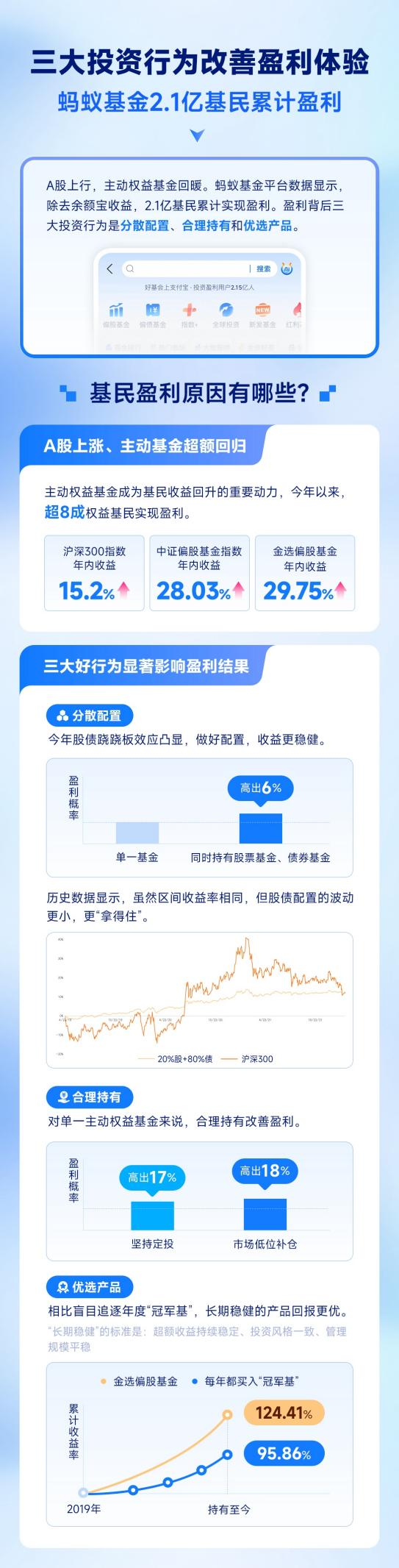
2.1亿基民盈利数据来了
Zhong Guo Ji Jin Bao· 2025-09-19 07:55
Core Insights - The article highlights that 80% of equity fund investors on the Ant Fund platform have achieved profits this year, driven by the overall recovery of the A-share market and the performance of active equity funds [2][4]. Group 1: Market Performance - The A-share market has seen a significant rise, with the CSI 300 Index increasing by 15.2% year-to-date, and over 80% of active equity funds outperforming the market, with an average return of 28.03% [2]. - The "Ant Financial Gold Selection" equity fund has an average return of 29.75% this year, surpassing the performance of similar index funds [2]. Group 2: Investor Behavior - Three key investment behaviors have been identified that improve profitability for investors: diversification, reasonable holding, and product selection [4]. - Investors who maintain a balanced stock-bond allocation have a 6% higher probability of profitability compared to those holding a single asset [4]. - Historical data shows that a classic stock-bond combination of 20% stocks and 80% bonds yielded a cumulative return of 11.85% with a maximum drawdown of only 5.04% during market transitions from April 2019 to February 2022 [4]. Group 3: Investment Strategies - Regular investment strategies, such as dollar-cost averaging, significantly enhance profitability, with those who consistently invest during market dips having a 17% higher probability of profit [4]. - The article emphasizes the importance of selecting long-term stable products over chasing annual "champion funds," with the "Gold Selection" equity fund yielding 124.41% since 2019, compared to 95.86% for those who pursued "champion funds" [5].

宝城期货资讯早班车-20250919
Bao Cheng Qi Huo· 2025-09-19 05:22
1. Macroeconomic Data Overview - GDP growth in Q2 2025 was 5.2% year-on-year, slightly down from 5.4% in the previous quarter but up from 4.7% in the same period last year [1] - In August 2025, the manufacturing PMI was 49.4%, up from 49.3% in the previous month and 49.1% in the same period last year; the non-manufacturing PMI for business activities was 50.3%, up from 50.1% in the previous month and the same as last year [1] - Social financing in August 2025 was 2566.8 billion yuan, compared to 1130.7 billion yuan in the same period last year [1] - In August 2025, M0, M1, and M2 year-on-year growth rates were 11.7%, 6.0%, and 8.8% respectively; new RMB loans were 590 billion yuan, compared to -50 billion yuan in the previous month and 900 billion yuan in the same period last year [1] - In August 2025, CPI was -0.4% year-on-year, down from 0.0% in the previous month and 0.6% in the same period last year; PPI was -2.9% year-on-year, up from -3.6% in the previous month but down from -1.8% in the same period last year [1] - As of August 2025, cumulative fixed - asset investment (excluding rural households) growth was 0.5% year-on-year, down from 1.6% in the previous month and 3.4% in the same period last year; cumulative growth of total retail sales of consumer goods was 4.64% year-on-year, down from 4.8% in the previous month but up from 3.4% in the same period last year [1] - In August 2025, export and import values were 4.4% and 1.3% year-on-year respectively, down from 7.2% and 4.1% in the previous month [1] 2. Commodity Investment Reference 2.1 Comprehensive - On the 18th, the Hong Kong Monetary Authority cut the base rate to 4.5% due to the US Fed's 25 - basis - point cut in the federal funds rate target range [2] - The US initial jobless claims last week dropped to 231,000, the largest decline in nearly four years, but continuing claims remained above 1.9 million, indicating labor market pressure [3] 2.2 Metals - Most London base metals fell. The market faces a critical supply - demand game, with potential production cuts in recycled metals due to tight scrap supply, but the traditional peak season may improve the situation [4] - After the Fed's rate cut, international gold prices dropped from above $3700/ounce to around $3650/ounce, and the Shanghai gold futures contract 2510 also declined [4] - Copper prices reached new highs but then adjusted. Short - term prices may fluctuate in a range, while long - term prices are affected by mine - end factors and have upward potential [5] - On September 17th, aluminum inventory reached a 6 - month high, while lead, copper, and zinc inventories hit multi - month lows [6] 2.3 Coal, Coke, Steel, and Minerals - The China Iron and Steel Association held a meeting to analyze the iron ore market and plan for the upcoming import iron ore port spot price index [7] - The US government plans to set up a $5 - billion mineral investment fund through a joint venture, which would be its first direct involvement in large - scale mineral trading [7] 2.4 Energy and Chemicals - China - led international standards for oil and gas pipelines were released, unifying 287 terms [9] - On September 18th, international oil prices fell slightly due to concerns about distillate inventories, economic prospects after the Fed's rate cut, and increased oil reserves in Colombia [9] - The EU is formulating measures to phase out Russian gas, including a potential ban on all Russian gas imports [9] 2.5 Agricultural Products - China launched an anti - dumping investigation on EU pork products at the request of domestic industries [11][14] 3. Financial News Compilation 3.1 Open Market - On September 18th, the central bank conducted 487 billion yuan of 7 - day reverse repurchase operations, with a net injection of 195 billion yuan [13] - The central bank will issue 60 billion yuan of 6 - month RMB central bank bills in Hong Kong on September 22nd [13] 3.2 Key News - The total issuance scale of ultra - long - term special treasury bonds in 2025 reached 1.148 trillion yuan, with an 88.3% progress rate [15] - The "Top 500 Chinese Service Enterprises in 2025" were released, with a total revenue of 51.1 trillion yuan in 2024 and an average revenue of 102.22 billion yuan [15] - Vanke adjusted its organizational structure to a flatter "headquarters - city" model [15] - Some bonds of Country Garden and Tengyue Construction will be suspended for trading to negotiate new repayment plans [16] - In July, non - US investors increased their holdings of US Treasury bonds, with Japan and the UK increasing while China and Canada decreased [16] 3.3 Bond Market Summary - After a continuous recovery, the bond market adjusted slightly, with yields of major inter - bank interest - rate bonds rising and Treasury bond futures closing down [19] - In the exchange bond market, some bonds rose while others fell, and the Wande real - estate bond 30 index and high - yield urban investment bond index rose slightly [19] - The CSI convertible bond index and Wande convertible bond equal - weight index fell, with some bonds having significant gains or losses [20] - Most money market rates, Shibor short - term rates, and inter - bank repurchase fixed - rate bonds rose [20][21][22] - European and US bond yields generally increased [23] 3.4 Foreign Exchange Market - The on - shore RMB against the US dollar closed at 7.1079, down 23 points from the previous day, and the central parity rate was 7.1085, down 72 points [24] - The US dollar index rose 0.34%, and most non - US currencies fell [24] 3.5 Research Report Highlights - CICC expects the Fed to cut rates again in October, but inflation may limit further easing [25] - CITIC Securities believes that the market's expectation of the central bank resuming Treasury bond purchases supports interest rates, and overseas bonds, especially Canadian dollar bonds, may be attractive [26] - Huatai Fixed Income notes that banks are more likely to sell old bonds with floating - profit OCI, and the bond market's institutional ecosystem is being reshaped [27] - Yangtze River Fixed Income thinks that the bond market had a recovery after economic data release in September, and the fundamentals' influence on bond pricing is increasing [27] - Hongze Fixed Income predicts a style switch in the bond market in September, with interest rates outperforming credit [27] 4. Stock Market News - A - share indices rose in the morning and then dived in the afternoon, with most stocks falling. The Shanghai Composite Index fell 1.15%, the Shenzhen Component Index fell 1.06%, and the ChiNext Index fell 1.64% [30] - The Hong Kong Hang Seng Index fell 1.35%, with cyclical stocks down and semiconductor and robot sectors up [30]
债基又现大额赎回,年内超1200只债基收益为负,是抄底还是避险?
Sou Hu Cai Jing· 2025-09-18 14:11
Group 1 - The bond market is experiencing significant pressure due to large-scale redemptions, leading to a decline in market sentiment since September [1][3] - The medium to long-term pure bond index has seen a notable drop of 0.80% over the past two months, with over 1,200 bond funds reporting negative annual returns as of September 16 [4][6] - The surge in redemptions has affected various fund companies, including those backed by brokerages, banks, and trusts, with 67 funds forced to announce adjustments to net asset value precision [6][8] Group 2 - The introduction of new regulations aims to stabilize the bond market by imposing a tiered high short-term redemption fee, discouraging speculative short-term trading [8][12] - The new rules are expected to lead to a structural adjustment in the bond fund market, particularly impacting pure bond funds that have relied on low redemption fees [17][19] - Mixed bond funds may fare better due to their flexible asset allocation, which allows them to withstand market volatility more effectively [17][23] Group 3 - The bond ETF market may see an influx of capital as investors seek liquidity, given that these products are exempt from the new redemption fee structure [14][23] - The reform is anticipated to reshape the competitive landscape of bond funds, distinguishing clear winners and losers based on their fee structures [15][23] - The overall impact of the new regulations is still uncertain, as they are currently in the proposal stage, but they represent a significant shift in the bond fund market ecosystem [21][23]

【立方债市通】河南AAA主体拟发25亿小公募/清欠专项贷款密集落地/平顶山一国企拟首次发债
Sou Hu Cai Jing· 2025-09-18 13:19
Group 1 - The core viewpoint of the news highlights the significant progress in the implementation of special loans aimed at clearing overdue accounts, with various banks across different regions actively participating in this initiative [1][2]. - In Shandong, the Industrial and Commercial Bank of China (ICBC) has successfully launched the first special loan for clearing overdue accounts in the province, marking a substantial breakthrough in financial support for this initiative [1]. - Other regions, such as Hunan and Guangxi, have also reported successful disbursements of special loans for overdue accounts, indicating a growing trend in financial institutions providing targeted support to alleviate the financial pressure on enterprises [2][1]. Group 2 - The Shanghai Stock Exchange (SSE) is enhancing financing methods for quality REITs (Real Estate Investment Trusts) and optimizing their review processes to support the development of a robust REITs market ecosystem [3]. - The SSE aims to cultivate a number of benchmark projects that investors trust and recognize, thereby creating favorable conditions for quality REITs projects [3]. Group 3 - The People's Bank of China (PBOC) announced a net injection of 195 billion yuan into the market on September 18, following a reverse repurchase operation of 487 billion yuan [5]. - The second batch of 14 science and technology innovation bond ETFs has been launched, with a total issuance scale of 40.786 billion yuan, contributing to the overall growth of bond ETFs in the market [5]. Group 4 - Inner Mongolia has successfully achieved a dual reduction in the number of financing platforms and debt scale, with a target adjustment from 148 to 300 platforms, receiving recognition from the Ministry of Finance for its debt reduction efforts [6]. - Guizhou and Anhui provinces have disclosed their refinancing bond issuance plans for the fourth quarter of 2025, with Guizhou planning to issue 62.256 billion yuan and Anhui planning to issue 10.254 billion yuan in general refinancing bonds [7]. Group 5 - The Henan Water Investment Group has received approval for a public bond issuance project amounting to 2.5 billion yuan, while the Pingdingshan Eagle City Investment Group is set to issue 1.5 billion yuan in its first bond issuance [8][9]. - The Zhumadian Urban Construction Investment Group has completed the issuance of a 600 million yuan bond at an interest rate of 2.46%, while a company in Guangdong has issued a 100 million yuan bond at a record low interest rate of 1.95% for town-level enterprises [11][13]. Group 6 - The recent appointment of Yan Bao as the new general manager of the Luohe Investment Holding Group indicates a change in leadership within the company [15]. - Country Garden Real Estate has announced plans to negotiate a new repayment scheme with investors, leading to the suspension of trading for seven of its corporate bonds [17][18]. Group 7 - The Federal Reserve's recent decision to lower the federal funds rate by 25 basis points to a range of 4.00% to 4.25% is expected to have a positive impact on China's stock and bond markets, increasing liquidity and potentially leading to lower bond yields [20]. - Analysts from various financial institutions have expressed differing views on the implications of the Fed's rate cut, with some suggesting it opens up space for domestic rate cuts while others caution about the potential for volatility in the bond market [21].

股指期货:温和上,债市曲线平
Zhong Xin Qi Huo· 2025-09-18 07:11
Report Summary Investment Rating - The investment ratings for stock index futures, stock index options, and bond futures are "oscillating bullish", "oscillating", and "oscillating" respectively [7][8][9]. Core Viewpoints - Stock index futures are expected to rise moderately, with growth stocks outperforming value stocks. Incremental funds come from leveraged funds, long - term institutional funds, and quantitative funds. The recommended configuration is to continue holding IM long positions [1][7]. - Stock index option sentiment has strengthened again. The trading volume of the option market has rebounded, the proportion of call options has increased, and implied volatility has risen. Consider reducing short - option positions if volatility continues to rise [2][7]. - Bond futures show a flattening yield curve. Although the short - end is affected by tightened funds and the stock - bond seesaw effect, the market's expectation of the central bank's restart of Treasury bond trading operations boosts bullish sentiment. Short - term opportunities for long - end arbitrage and curve steepening can be focused on [2][8][9]. Summary by Section Market Views - **Stock Index Futures**: The basis, spread, and total positions of IF, IH, IC, and IM contracts have changed. The market shows a moderately upward trend, with the GEM, STAR 50, and CSI 1000 being relatively strong. The recommended operation is to hold IM [7]. - **Stock Index Options**: The trading volume of the option market is 12939 million yuan, a 25.89% increase from the previous trading day. The proportion of call options has increased, and the PCR of open interest remains high. Consider reducing short - option positions if volatility continues to rise. The recommended strategy is a covered call [2][7]. - **Bond Futures**: The trading volume and positions of T, TF, TS, and TL contracts have changed. The central bank's net injection is 1145 million yuan, but the tax period affects the short - end negatively. The stock - bond seesaw effect also has a negative impact, but the expectation of the central bank's operations boosts bullish sentiment. Different strategies are recommended for trends, hedging, basis, and curve [7][8][9]. Economic Calendar - Data on China's social consumer goods retail sales, industrial added value, eurozone economic sentiment index, US retail sales, import price index, federal funds rate target, and Japan's CPI are presented, including previous values, predicted values, and announced values [10]. Important Information and News Tracking - The US President has extended the TikTok ban for three months until December 16. From January to August, China's general public budget revenue increased by 0.3% year - on - year, with tax revenue slightly increasing and non - tax revenue growing by 1.5%. The general public budget expenditure increased by 3.1% year - on - year [11]. Derivatives Market Monitoring - Data on stock index futures, stock index options, and bond futures are monitored, but specific data details are not fully presented in the given text [12][16][28].
宝城期货国债期货早报-20250918
Bao Cheng Qi Huo· 2025-09-18 02:04
Report Summary 1) Report Industry Investment Rating No information provided. 2) Core View of the Report The overall view of the report is that the treasury bond futures will show an oscillating trend. In the short - term, they will be mainly in an oscillating consolidation state, with an oscillating - up trend during the day, and the short - term and medium - term trends are oscillating. The futures are influenced by monetary policy expectations and stock market risk preferences, with both upward pressure and downward support [1][5]. 3) Summary According to Relevant Catalogs Variety View Reference - Financial Futures Stock Index Sector - For the TL2512 variety, the short - term view is oscillating, the medium - term view is oscillating, the intraday view is oscillating - up, and the overall view is oscillating. The core logic is that there is still an expectation of medium - and long - term interest rate cuts, but the possibility of a short - term comprehensive interest rate cut is low [1]. Main Variety Price Market Driving Logic - Financial Futures Stock Index Sector - The daily view of varieties such as TL, T, TF, and TS is oscillating - up, the medium - term view is oscillating, and the reference view is oscillating. - The core logic is that the treasury bond futures oscillated and rose yesterday. They are mainly affected by monetary policy expectations and stock market risk preferences. Based on August macro - economic data, credit data is weak, consumption growth has marginally weakened, and inflation data is weak, leading to an increasing expectation of stable demand from macro - policies in the fourth quarter. The possibility of a short - term comprehensive interest rate cut is low, but there is still an expectation of an interest rate cut in the domestic market in the fourth quarter as the overseas Federal Reserve's interest rate cut expectation is gradually realized. Additionally, the stock market risk preference is high, and the capital side suppresses the demand for treasury bonds. The year - on - year increase in non - bank deposit data in July and August indicates the stock - bond seesaw effect. Overall, the treasury bond futures have both upward pressure and downward support, and will mainly be in an oscillating consolidation state in the short term [5].
债市 短线整理蓄势
Qi Huo Ri Bao· 2025-09-17 23:09
Group 1: Industrial Production - In August, the industrial added value of large-scale enterprises grew by 5.2% year-on-year, a decrease of 0.5 percentage points from July's 5.7% [1] - Month-on-month growth in August was 0.37%, slightly lower than July's 0.38% [1] - The decline in industrial added value is primarily attributed to a decrease in external demand and cautious expansion attitudes among enterprises due to high tariffs [1] Group 2: Consumer Retail and Services - From January to August, the total retail sales of consumer goods reached 323,906 billion yuan, with a year-on-year growth of 4.6% [1] - In August alone, retail sales totaled 39,668 billion yuan, growing by 3.4% year-on-year and 0.17% month-on-month [1] - The growth in retail sales was supported by strong demand in service consumption, particularly in tourism and transportation, while the reliance on subsidies decreased [1] Group 3: Fixed Asset Investment - From January to August, fixed asset investment (excluding rural households) was 326,111 billion yuan, with a year-on-year growth of 0.5%, showing a slowdown in growth [2] - In August, manufacturing investment fell by 1.3% year-on-year, with the decline accelerating compared to the previous month [2] - Real estate development investment dropped by 19.9% year-on-year in August, with a significant increase in the rate of decline compared to July [2] Group 4: Economic Indicators and Monetary Policy - In August, the Consumer Price Index (CPI) showed weak performance while the Producer Price Index (PPI) improved [2] - There is a strong market expectation for a 25 basis point rate cut by the Federal Reserve, which may ease external constraints and open up more room for domestic monetary policy to be "moderately loose" [2] - The potential for a rate cut in the fourth quarter is increasing due to the current economic conditions [2] Group 5: Bond Market Outlook - The impact of data on the bond market has become relatively muted, with the main influencing factors being the stock-bond "see-saw" effect, policy expectations, and institutional behavior [3] - The bond market is expected to experience short-term fluctuations, but the long-term outlook remains positive due to unchanged economic fundamentals and a loose monetary environment [3]