被动投资

Search documents
南方财经编委王芳艳:我们对大资管、大财富的未来充满期待
2 1 Shi Ji Jing Ji Bao Dao· 2025-08-16 08:05
Core Viewpoint - The wealth management industry is experiencing new opportunities due to changes in resident asset allocation and the deepening development of capital markets, despite challenges posed by a low interest rate environment and fluctuating global economic conditions [1][3]. Group 1: Passive Investment Trends - The rise of passive investment has accelerated, with index-based investment becoming a significant choice for large-scale capital allocation. As of June 30, the total scale of ETFs listed in China reached 4.31 trillion yuan, an increase of over 15% since the beginning of the year [2]. - The active performance of the A-share market, which recently surpassed 3,700 points, reflects the positive impact of emerging sectors such as artificial intelligence, new consumption, and innovative pharmaceuticals [2]. Group 2: Industry Challenges and Adaptations - The wealth management industry is enhancing its research capabilities, risk pricing abilities, asset allocation skills, and investor service capabilities in response to market complexity and product diversity [3]. - The industry is shifting from a sales-driven mindset focused on scale to a service-oriented approach that emphasizes value creation and investor account returns [3]. Group 3: Future Outlook - The Chinese economy has shown strong resilience, with government initiatives aimed at boosting consumption and investment returns, which will further expand the market scale of the wealth management industry [4]. - Innovations in pension finance and digital finance are creating new growth opportunities, with a focus on developing a comprehensive pension service system that meets the wealth management needs across individuals' and families' life cycles [4]. - The acceleration of AI applications and the digital transformation of asset management institutions are expected to enhance the quality and scope of wealth management services [4].
彻底“沸了”!招行竟也出手了
Zhong Guo Ji Jin Bao· 2025-08-15 14:15
Group 1 - The core viewpoint of the article highlights the growing popularity of the ETF market, with major players like China Merchants Bank entering the space by hosting an ETF simulation investment competition [2][3] - The "Golden Sunflower Cup" ETF simulation investment competition organized by China Merchants Bank is set to begin on August 18 and will last for two months, marking the first ETF competition hosted by a commercial bank [3][6] - Participants in the competition will receive virtual funds of 1 million yuan to trade various types of ETFs, including stock, bond, cross-border, gold, and currency ETFs, with performance metrics being tracked [5][6] Group 2 - Industry insiders express surprise at the bank's involvement in the ETF competition, noting that it aims to enhance customer engagement and promote the sale of ETF-linked funds [6][7] - The competition is seen as a strategic move to leverage the growing interest in passive investment products, particularly in the context of a recovering equity market [6][7] - Other banks are also actively promoting ETF-linked products, with some offering significant discounts on fees, indicating a competitive landscape for ETF distribution [9]



彻底“沸了”!招行竟也出手了
中国基金报· 2025-08-15 14:11
Core Viewpoint - The ETF market is experiencing rapid growth, with major players like China Merchants Bank entering the space by hosting the "Jin Kui Hua Cup" ETF simulation investment competition, aimed at promoting ETF sales and enhancing customer engagement [2][4]. Group 1: ETF Competition Details - China Merchants Bank has launched the "Jin Kui Hua Cup" ETF simulation investment competition, which is currently open for registration and will run from August 18 to October 17 [4][7]. - Participants will receive virtual funds of 1 million yuan to trade a wide range of ETFs, including stock ETFs, bond ETFs, and gold ETFs, with performance metrics including gains, losses, and dividends [7][9]. - The competition includes various rewards such as experience gifts, ranking prizes, and a grand prize for the overall winner, which includes a Huawei MateBook GT14 [7][9]. Group 2: Industry Insights - The entry of banks into the ETF competition space has surprised many industry insiders, who noted that banks are increasingly focusing on selling ETF-linked funds to maintain and cultivate customer relationships [9][10]. - The rise of passive investment products like ETFs has become a trend, especially with the recent resurgence of the A-share market, prompting banks to seek a share of this growing business [9][10]. - There are speculations that the ETF competition may be linked to the future plans of Fund Connect 2.0, which currently only supports public REITs but may expand to include ETFs [10]. Group 3: Broader Market Trends - Over the past few years, the ETF market has gained significant attention, with not only brokerages but also banks and third-party institutions actively participating [12][13]. - Various banks, including China Merchants Bank, are offering discounts on ETF-linked products, with some fees as low as 10% of the standard rate, to attract investors [13]. - The competitive pricing of index funds is crucial for attracting investors, as many prefer to invest through bank apps for convenience [13].

指数基金成了 “香饽饽”,主动管理难道要 “凉了”?
Sou Hu Cai Jing· 2025-08-15 12:32
Group 1 - The core viewpoint of the articles highlights the significant shift in the investment landscape, where passive index funds, particularly ETFs, have gained prominence over active equity funds since 2021, reflecting a growing preference for beta returns over alpha returns [2][3][19] - The rise of passive index investing is attributed to its ability to provide market-average returns with lower fees and reduced volatility, making it more appealing to individual investors [10][19] - Data shows that from 2022 to 2024, active equity funds faced challenges such as net value drawdowns and shrinking scales, while passive index funds experienced substantial growth, especially during market rallies [3][19] Group 2 - The performance comparison of different types of equity funds over the past five years indicates that passive index funds have lower average maximum drawdowns and positive returns across various time frames, demonstrating their risk-return advantage [7][19] - The top-performing index funds in recent years have shown remarkable returns, with some achieving over 100% growth in one year, underscoring the effectiveness of passive investment strategies [9][16] - Active management remains relevant, as some actively managed funds have outperformed their benchmarks, particularly in volatile market conditions, suggesting that both passive and active strategies can complement each other in a diversified investment approach [15][18]

重磅年会,明日举行!
21世纪经济报道· 2025-08-15 08:34
Core Viewpoint - The 2025 Asset Management Annual Conference will focus on "Breaking the Game and Restructuring - Rebuilding Competitiveness in Asset Management" and will address topics such as multi-asset allocation, index investment, new trends in asset management, and how green productivity can support high-quality corporate development [1]. Agenda Summary - The conference will feature a series of keynote speeches and roundtable discussions, including topics like multi-asset allocation strategies and the rise of passive investment trends in asset management [2][4][7]. - Keynote speakers include prominent figures from various financial institutions, such as the People's Bank of China and BlackRock, who will share insights on industry developments [5][9]. - The event will also include discussions on ESG (Environmental, Social, and Governance) investment and its implications for financial culture and market expansion [9][10].
猛!首只突破200亿
中国基金报· 2025-08-14 06:53
Core Viewpoint - The rapid growth of the Sci-Tech Bond ETF market, with the first product surpassing 20 billion yuan, reflects strong investor demand and the effectiveness of public funds in index investment [2][3][5][7]. Group 1: Market Overview - As of August 13, the total scale of the 10 Sci-Tech Bond ETFs has exceeded 115.6 billion yuan, with 8 of them entering the "billion club" [3][6]. - The overall bond ETF market has surpassed 530 billion yuan, marking a significant increase from 174 billion yuan at the beginning of the year, representing a growth of over 208% [9][11]. - The first batch of 10 Sci-Tech Bond ETFs was launched on July 10, with an initial fundraising scale of nearly 29 billion yuan, which helped push the total bond ETF market above 400 billion yuan [6][9]. Group 2: Performance of Individual ETFs - The leading Sci-Tech Bond ETF from Harvest Fund has reached a scale of 20.22 billion yuan, followed by Huaxia and Fortune ETFs at 15.35 billion yuan and 15.18 billion yuan, respectively [5][6][7]. - The average daily turnover rate of the 10 Sci-Tech Bond ETFs is over 55%, with an average daily trading volume exceeding 5.6 billion yuan [6][7]. Group 3: Investment Focus and Strategy - Sci-Tech Bond ETFs primarily target cutting-edge sectors such as semiconductors, artificial intelligence, and new energy, aligning with national technology innovation strategies [7]. - The design of Sci-Tech Bond ETFs includes a T+0 trading mechanism and a physical redemption model, enhancing trading flexibility [6][7]. Group 4: Factors Driving Growth - The rise of passive bond investment is attributed to several factors, including declining interest rates making active investment more challenging, high transparency and low fees of passive products, regulatory support for the bond ETF market, and continuous product innovation by fund companies [11].

可转债ETF(511380)突破500亿,解码低利率时代的“攻守道”
Zhong Guo Jing Ji Wang· 2025-08-14 06:43
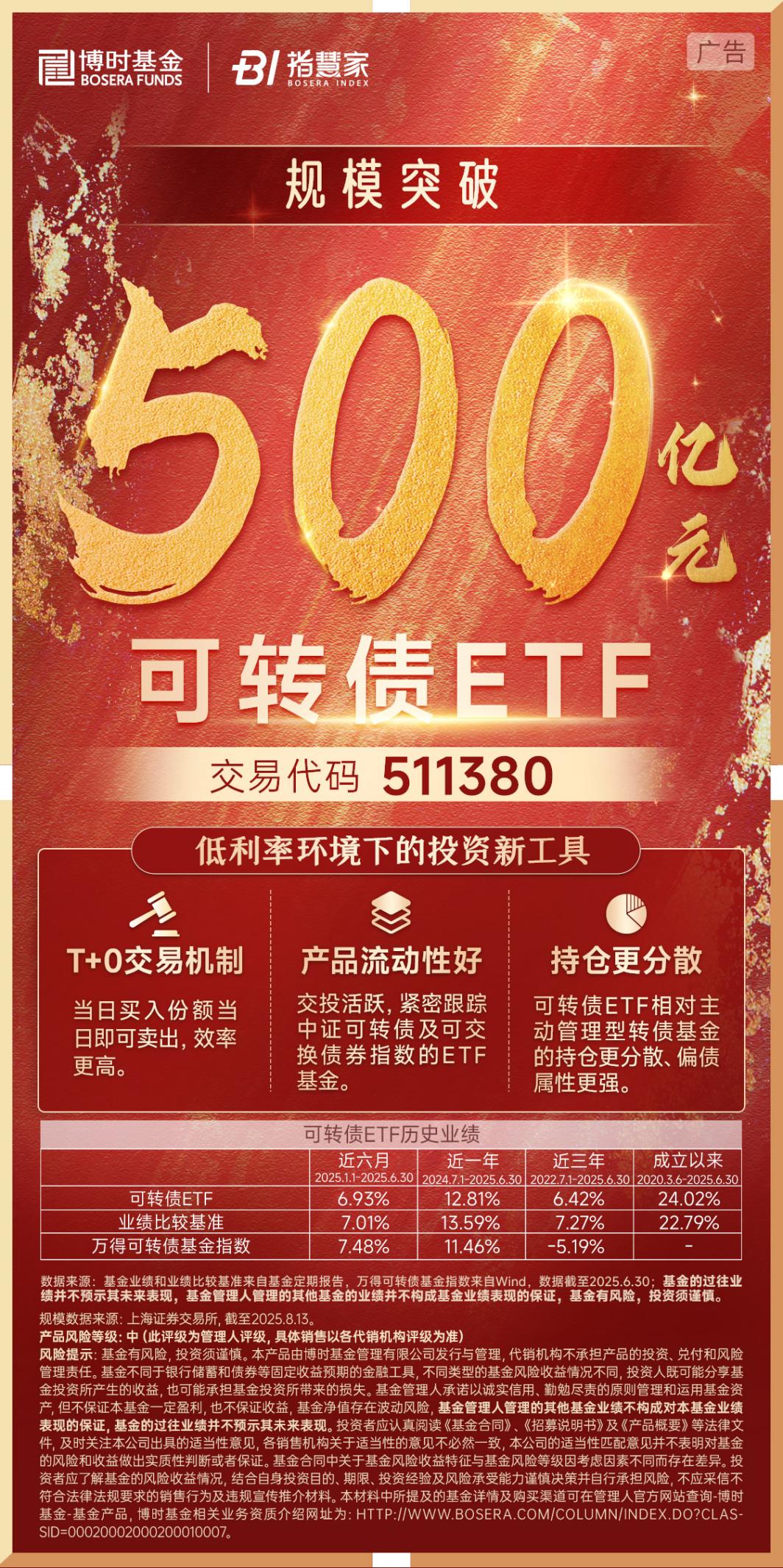
Core Insights - The BoShi Convertible Bond ETF (511380) has surpassed 50 billion yuan in scale as of August 13, 2024, reflecting its growth from a niche product to a favored investment tool in a low-interest-rate environment [1][5][11] Group 1: Performance and Growth - Since its inception on March 6, 2020, the BoShi Convertible Bond ETF has achieved a cumulative return of 24.02%, outperforming its benchmark return of 22.79% and the CSI Convertible Bond Index's return of 21.29% [6][12] - The ETF's performance over the past six months, one year, and since inception shows returns of 6.93%, 12.81%, and 24.02% respectively, indicating strong performance relative to its benchmarks [3][6] Group 2: Market Position and Strategy - The BoShi Convertible Bond ETF fills a gap in the passive investment market for convertible bonds, with only two such ETFs available in mainland China [5][11] - The ETF closely tracks the CSI Convertible Bond and Exchangeable Bond Index, with a market capitalization-weighted methodology that adjusts monthly [5][6] Group 3: Advantages of Convertible Bond ETFs - Convertible Bond ETFs offer a superior risk-return profile, combining equity-like growth potential with bond-like protection, making them attractive in both bull and bear markets [7][8] - They simplify asset allocation for investors by integrating both stock and bond characteristics into a single product, reducing the complexity of managing separate stock and bond ETFs [8][10] - The liquidity of Convertible Bond ETFs is generally higher than that of individual convertible bonds and some stock ETFs, making them suitable for both institutional and retail investors [9][10] Group 4: Broader ETF Landscape - In addition to the Convertible Bond ETF, BoShi has successfully launched other bond ETFs, with total bond ETF assets exceeding 90 billion yuan, showcasing its strong management capabilities [11][12] - The current market dynamics, influenced by stock-bond interactions and external uncertainties, highlight the importance of stable bond assets in investment portfolios [11]
2025资产管理年会议程重磅发布!
2 1 Shi Ji Jing Ji Bao Dao· 2025-08-12 08:44
"破局与重构——大资管再造竞争力" 由南方财经全媒体集团指导,《21世纪经济报道》主办、浦发银行联合主办的"2025资产管理年会"即将 于2025年8月16日在上海浦东隆重举办。 "资产管理年会"始于2008年,已经连续举办十七届, 已成为国内资管行业最具影响力的盛事之一。本 届"资产管理年会"的主题为"破局与重构——大资管再造竞争力",围绕大类资产多元配置、指数投资、 资管新趋势、绿色生产力助力企业高质量发展等议题展开,邀请资管领军者发言分享对于行业发展的洞 见。 以下为2025资产管理年会议程: 2025年8月16日 上海·浦东 上海鲁能JW万豪侯爵酒店 【议程设置】 08:30-12:302025资产管理年会:破局与重构——大资管再造竞争力 13:30-17:30主题一:与波动共舞,解锁多元资产配置之道 13:30-17:30主题二:被动投资大发展下的资管新趋势 13:30-17:30第三届"活力·ESG"创新论坛 ■ 上午 破局与重构——大资管再造竞争力 08:00-08:30嘉宾签到 08:35-08:50活动致辞 08:50-10:30主旨演讲 刘世锦 十三届全国政协经济委员会副主任、国务院发展研 ...

国内首批政策性金融债ETF获批 债券市场互联互通进一步拓展
Xin Hua Wang· 2025-08-12 06:20
Core Viewpoint - The approval of the first batch of policy financial bond ETFs in China is expected to enhance the interconnectivity between the interbank and exchange markets, improve the overall scale of bond ETFs, and meet diverse investor needs [1][2]. Group 1: Product Characteristics - The newly approved policy financial bond ETFs cover various maturity periods including 0-3 years, 1-3 years, 1-5 years, 3-5 years, and 7-10 years, all utilizing a cash subscription and redemption model [1]. - Compared to traditional policy financial bond index funds, the new ETFs allow for both cash transactions and trading on the exchange, providing greater liquidity and flexibility for investors [2][3]. Group 2: Market Necessity - The development of policy financial bond ETFs is beneficial for connecting the interbank and exchange bond markets, attracting foreign investment, reducing issuance costs for national development bonds, and enriching market investment tools [2][3]. - The introduction of these ETFs is seen as a strategic move to promote ESG investments and support the green transformation of the economy [3]. Group 3: Future Outlook - The newly approved ETFs are expected to have significant market development potential due to their low-risk profile, cost-effectiveness, and transparency [3]. - The introduction of the national development bond ETF is anticipated to provide a distinct investment and asset management tool, potentially facilitating liquidity management through repo transactions in the future [3].
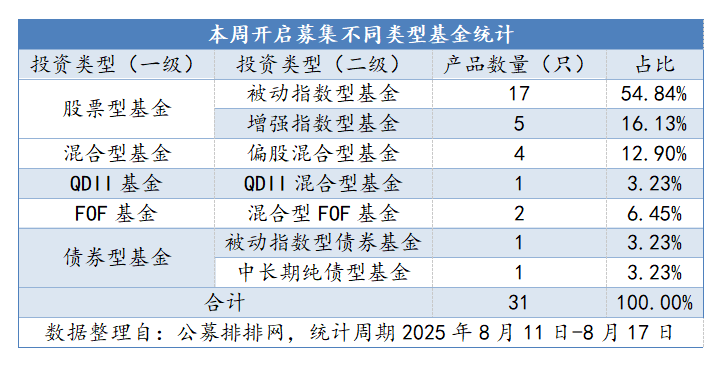
连续三周超30只新基募集,权益基金占比超八成
Guo Ji Jin Rong Bao· 2025-08-11 13:43
新基发行市场持续火爆。 公募排排网数据显示,本周(8月11日至8月17日)全市场共有31只新基启动募集,这已经是连续第 三周单周开募新基不低于30只。其中,权益基金占比超八成,股票型基金成募集主力。 对于这一现象,排排网旗下融智投资FOF基金经理李春瑜分析称,在资产配置需求升级背景下,投 资者愈发青睐运作透明、费率低廉的被动投资工具,指数基金特有的分散化投资优势恰好契合这一需 求。同时,监管层持续优化权益类公募发展环境,通过设立ETF绿色审批通道等举措,为指数化投资注 入政策动能。此外,在产业政策密集出台的窗口期,指数基金凭借其高效跟踪政策红利行业的能力,能 有效规避个股波动风险,因而获得避险资金的持续涌入。 除指数基金外,FOF基金发行也持续受到市场追捧。本周启动募集的新基中,有2只FOF基金,且 均为混合型FOF基金。今年以来,新发FOF基金数量已达36只,超过了去年全年的水平。 对此,李春瑜认为,市场环境持续优化, A股市场企稳向好,为FOF这类"专业买手"提供了更广阔 的投资运作空间。此外,FOF基金凭借其多资产配置能力,能够灵活布局港股、黄金等非A股资产及各 类ETF产品,在分散风险的同时增厚收益, ...