
M1

Search documents
2025年4月金融数据点评:政府债仍是最主要支撑项
Changjiang Securities· 2025-05-15 13:41
丨证券研究报告丨 固定收益丨点评报告 [Table_Title] 政府债仍是最主要支撑项——2025 年 4 月金融 数据点评 报告要点 [Table_Summary] 2025 年 4 月存量社融同比 8.7%,增速环比提升 0.3 个百分点,从增量结构上来看,政府债仍 为主要贡献项。2025 年 4 月 M1 同比增速为 1.5%,增速环比下降 0.1 个百分点;M2 同比增 速为 8.0%,增速环比提升 1 个百分点。存款结构方面,4 月为税收"大月",叠加政府债发行, 财政存款收大于支,对企业和居民存款形成一定的挤出效应,另外 4 月债市收益率下行或带动 居民存款分流至理财等非银机构。 分析师及联系人 [Table_Author] 赵增辉 马月 SAC:S0490524080003 SAC:S0490125010043 SFC:BVN394 请阅读最后评级说明和重要声明 %% %% %% %% research.95579.com 1 [Table_Title 政府债仍是最主要支撑项—— 2] 2025 年 4 月金融 数据点评 [Table_Summary2] 事件描述 2025 年 4 月人民币贷 ...
2025年4月金融数据点评:信贷小月预期内回落,低基数下M2提速
Shenwan Hongyuan Securities· 2025-05-15 08:44
Investment Rating - The industry investment rating is "Overweight" indicating a positive outlook for the sector compared to the overall market performance [25]. Core Viewpoints - The report highlights that in April 2025, new social financing (社融) amounted to approximately 1.16 trillion yuan, which is an increase of 1.22 trillion yuan year-on-year, with a year-on-year growth rate of 8.7% [3][4]. - The report anticipates that credit growth will remain stable throughout 2025, with an estimated annual credit increment of around 18.1 trillion yuan, leading to a credit growth rate of approximately 7.1% [4]. - The report emphasizes the importance of government bonds as a primary support for social financing, with government bond issuance in April reaching about 972.9 billion yuan, a year-on-year increase of approximately 1.07 trillion yuan [4][10]. Summary by Sections Credit Market Analysis - In April, new credit was 280 billion yuan, a decrease of 450 billion yuan year-on-year, attributed to the seasonal nature of credit in this period and the impact of debt replacement [4]. - Corporate loans saw a year-on-year decrease of approximately 2.5 trillion yuan, reflecting weak demand in the corporate sector [4][15]. - Retail credit demand remains under pressure, with a net decrease of 521.6 billion yuan in household loans, indicating a lack of sustained momentum in the housing market [4][18]. Monetary Supply - M1 increased by 1.5% year-on-year, while M2 grew by 8.0%, showing a rebound in growth rates [8][4]. - The report notes that the decline in deposits was significant, with a net decrease of 440 billion yuan in April, reflecting a shift in risk preferences among investors [4]. Investment Recommendations - The report suggests that bank stocks are attractive in both counter-cyclical and pro-cyclical contexts, with high dividend yields becoming increasingly appealing [4]. - Specific banks recommended for investment include Agricultural Bank of China (A+H), Chongqing Bank, and Suzhou Bank, among others, due to their solid provisioning and growth potential under favorable policies [4].




四月金融数据怎么看?招商宏观:社融与M2因低基数原因,增速环比明显提升
Sou Hu Cai Jing· 2025-05-15 04:23
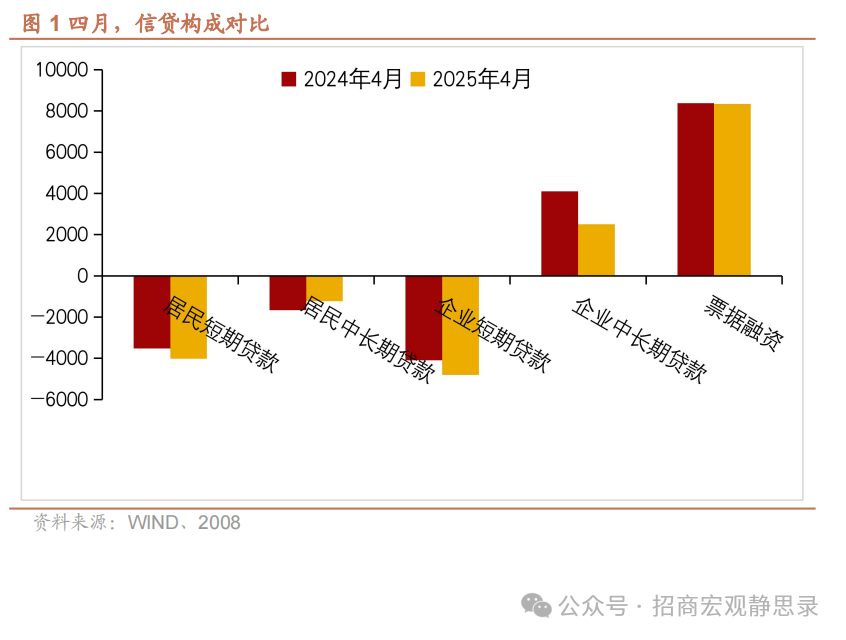
Core Viewpoint - The financial data for April indicates a significant impact on credit due to external factors, with bills becoming a major support for credit growth [2][6]. Group 1: Credit and Loans - New RMB loans in April amounted to 280 billion, a decrease of 450 billion year-on-year, falling short of market expectations [7][11]. - The corporate sector showed a more pronounced impact from tariffs, with corporate loans increasing by 610 billion, down from 860 billion year-on-year [8]. - Bills financing accounted for 297.9% of the new credit in April, highlighting its critical role in supporting credit growth [8][13]. Group 2: Deposits - Total RMB deposits decreased by 440 billion in April, with significant changes in the structure, particularly in non-bank financial institutions which saw an increase of 1.57 trillion [12]. - The increase in non-bank financial deposits is attributed to a shift in investment preferences due to volatility in the bond market [12]. Group 3: Social Financing - Social financing increased by 1.16 trillion in April, with a growth rate of 8.7%, marking a significant rise due to a low base effect [13]. - Government bonds played a crucial role, with new issuance reaching 9.76 trillion, a year-on-year increase of approximately 1.07 trillion [13]. Group 4: Conclusions and Implications - The April data reflects a seasonal decline in credit, exacerbated by tariff impacts, with expectations of a potential decline in growth rates as base effects fade [6][17]. - The central bank is responding by increasing structural relending quotas to stimulate credit demand in the service sector [17].

普林格与盈利周期跟踪:宽货币宽信用,社融脉冲新高
Tianfeng Securities· 2025-05-15 00:15
Core Insights - The report emphasizes that identifying the performance turning point is crucial for the market to move out of the bottom-seeking phase, with market bottoms typically leading performance turning points by 1-2 quarters [2] - The report highlights the importance of combining leading indicators with coincident indicators for better economic bottom assessments, as relying solely on coincident indicators may lead to delayed confirmations [2] - The key to breaking out of the bottom-seeking phase lies in the sustainability of M1 recovery, with household medium and long-term loans being a more critical indicator [2] Economic Indicators - The April manufacturing PMI significantly dropped to 49%, indicating a contraction for the first time since February, down from 50.5% [4] - M1 showed a slight year-on-year decline, while M2 increased, and the total social financing stock rose year-on-year, indicating a rebound in excess liquidity [7] - The total social financing increment in April was 1.16 trillion yuan, which is 12.243 billion yuan more than the same period last year, with a slight recovery in new government bonds but a negative year-on-year change in new RMB loans [9] Leading Indicators - The report notes that M2 leads M1, which in turn leads the stock market bottom, with M2 showing a year-on-year increase of 8% in April, up from 7% [7] - The social financing pulse increased to 26.16% in April, up from 25.41%, with new government bonds showing a slight recovery while new RMB loans turned negative [9] - The report indicates that the decline in household medium and long-term loans is closely related to the real estate sales cycle, with April showing a year-on-year decrease of 12.97% for household medium and long-term loans [12] Monetary Policy and Market Sentiment - The report discusses that the narrowing of the decline in household and corporate loans is essential for market recovery, with the April average DR007 rate marginally dropping to 1.73% [15] - The central bank's recent decision to lower the reserve requirement ratio and policy interest rates is aimed at stabilizing the market [15] - The report mentions that the recovery in social financing and M2, along with improved export performance, reflects a resilient Chinese economy despite the macroeconomic downturn [18]
短贷高增VS财政托举——3月金融数据点评
申万宏源宏观· 2025-04-14 11:42
Core Viewpoints - The recovery in March credit data is primarily driven by an increase in short-term loans from enterprises, while the growth of medium- to long-term loans, which reflect enterprise investment demand, remains relatively subdued. The total new credit in March reached 3.64 trillion yuan, significantly exceeding the market expectation of 2.93 trillion yuan, with a year-on-year increase of 550 billion yuan [2][8][47] - The year-on-year growth rate of social financing stock rebounded by 0.2 percentage points to 8.4%, mainly driven by the advance of fiscal financing, which may become a key feature of fiscal policy execution this year. In March, net financing from government bonds reached 1.48 trillion yuan, an increase of 1.02 trillion yuan year-on-year [2][14][47] Credit and Financing Data - In March, new credit totaled 3.64 trillion yuan, with a year-on-year increase of 550 billion yuan, primarily due to the rise in short-term loans from enterprises. The breakdown shows that household loans increased by 985.3 billion yuan, with short-term loans contributing 484.1 billion yuan and medium- to long-term loans adding 504.7 billion yuan [4][22][49] - The total social financing in March was 5.88 trillion yuan, a year-on-year increase of 1.05 trillion yuan, with RMB loans being the main support. Government bond net financing remained high, while corporate bond financing showed a significant decline [30][49] Monetary Aggregates - M2 remained stable at a year-on-year growth rate of 7.0%, while the new M1 showed a recovery of 1.5 percentage points to 1.6%. The deposit structure indicates that household deposits increased by 3.09 trillion yuan, and corporate deposits rose by 2.84 trillion yuan, while fiscal deposits decreased by 771 billion yuan [5][39][50]
2月金融数据点评:政府债券支撑社融,融资需求仍待提振
Great Wall Securities· 2025-03-17 03:02
Investment Rating - The report does not explicitly provide an investment rating for the industry Core Insights - In February, the new social financing scale was 2.23 trillion yuan, an increase of 737.4 billion yuan year-on-year, with a year-on-year growth rate of 8.2%, up from 8.0% in the previous month [1][7] - The new RMB loans in February amounted to 1.01 trillion yuan, an increase of 201.6 billion yuan year-on-year [1][8] - M1 growth slowed to 0.1% year-on-year from 0.4% in the previous month, while M2 maintained a year-on-year growth rate of 7.0% [1][2] - Government bond financing was strong, with net financing of government bonds reaching 1.6967 trillion yuan in February, an increase of 1.0956 trillion yuan year-on-year [8][9] Summary by Sections Deposit Side - M1 decreased year-on-year, while M2 remained stable compared to the previous month, leading to a slight recovery in the M2/M1 ratio [2][7] - The M2 growth rate was maintained at 7%, while the (M2-M1)/M1 ratio increased from 1.83 in January to 1.93, indicating a continued loose monetary policy [2][7] Financing Side - Government bond financing was robust, with a projected broad deficit scale potentially reaching 12.5 trillion yuan this year, an increase from 11.3 trillion yuan in 2024 [8][9] - Corporate loan demand was weak, with new corporate loans in February at 1.04 trillion yuan, a decrease of 3.74 trillion yuan year-on-year, marking the lowest level for the same period in six years [8][9] - The balance of inclusive small and micro loans reached 33.43 trillion yuan, growing by 12.4% year-on-year, while medium to long-term loans in the manufacturing sector reached 14.48 trillion yuan, up 10.3% year-on-year [8][9] Resident Loans - In February, both medium to long-term and short-term resident loans decreased, with medium to long-term loans at their lowest level in nearly five years [9] - The decline in medium to long-term loans coincided with a recovery in the housing market, suggesting that early repayments or increased down payment ratios may have influenced this trend [9] Overall Economic Outlook - The financing data for February was primarily driven by government financing, with weak financing willingness from both residents and enterprises [9] - The current low interest rates may support a continued recovery in the real estate market, with a gradual improvement in consumer demand expected [9]
从流动性看经济系列之一:M1开始新一轮反弹了么?
CAITONG SECURITIES· 2025-03-14 14:53
Investment Rating - The report indicates a positive outlook for M1 growth, suggesting a potential upward trend in the coming quarters [11][35]. Core Insights - M1 growth showed a rebound trend in Q4 2024, but experienced a decline again in early 2025 due to the Spring Festival effect. The report explores the factors driving M1 growth changes and whether a new upward trend has begun [11][35]. - The report identifies five key factors influencing M1 growth: fiscal policy, monetary policy, entity activity, financial system, and external factors. It highlights that fiscal policy has become the primary driver of M1 growth, especially in 2024 [20][35]. - The report emphasizes that the contribution of entity demand to M1 growth has weakened significantly since 2018, while fiscal policy's contribution has increased, reaching 7.3 percentage points in 2024 [35][41]. Summary by Sections 1. Changes in M1 - M1 growth rebounded starting October 2024, reaching 1.2% in December, but slowed to 0.4% in January 2025. The government bond issuance accelerated from August 2024, contributing to M1's recovery [11][12][35]. - The new M1 calculation includes personal demand deposits, which smooths out the impact of seasonal factors like the Spring Festival [11][13][35]. 2. Factors Driving M1 Growth: Insights from the Five-Factor Model - The report notes that the average annual contribution of entity demand to M1 growth has dropped to 2.2 percentage points in 2024, compared to an average of 10 percentage points from 2018 to 2021 [20][35]. - The financial system's contribution to M1 growth has been negative in recent years, reflecting the drag from interbank fund circulation [35][41]. 3. Is M1 Entering an Upward Cycle? - Historical data shows that M1 growth has typically rebounded significantly during previous cycles, with increases of over 10 percentage points lasting more than a year [41][45]. - The report suggests that while fiscal policy may drive M1 growth, the current recovery in entity demand remains weak, and the central bank's monetary policy focus is on stabilizing bank interest margins rather than large-scale liquidity injections [45][49].