
美联储独立性

Search documents
金荣中国:现货黄金守住隔夜反弹空间,并刷新高点至3352美元附近
Sou Hu Cai Jing· 2025-08-21 05:57
Fundamental Analysis - Gold prices have rebounded, reaching around $3,352 per ounce, with a notable increase of nearly $40 on Wednesday, closing at $3,348.20, reflecting a rise of approximately 1% [1] - The decline in the US dollar index, which fell by 0.13% to 98.20, has made gold cheaper for holders of other currencies, stimulating global demand [1] - Political pressures from President Trump on the Federal Reserve, including calls for the resignation of Governor Cook, have contributed to the weakening of the dollar, which in turn benefits gold as a hedge against political risk [2] Market Sentiment - The Federal Reserve's July meeting minutes revealed a split among decision-makers, with only two officials supporting a rate cut, while the majority preferred to maintain current rates, reinforcing market expectations for a potential rate cut in September [4] - Goldman Sachs maintains a bullish outlook on gold, predicting prices could reach $4,000 per ounce by mid-2026, driven by strong central bank demand, easing monetary policy, and a 30% chance of a recession in the next 12 months [5] Technical Analysis - Gold prices are currently trading within a consolidation range of $3,300 to $3,400, with short-term movements reflecting a triangular pattern, indicating potential volatility in the near term [8]


主席候选人泽沃斯开炮:美联储政策并不独立,鲍威尔早已站偏
Feng Huang Wang· 2025-08-20 22:39
Group 1 - David Zervos, a candidate for the Federal Reserve Chair and Chief Market Strategist at Jefferies, argues that the perception of the Federal Reserve as independent is inaccurate, stating that political pressure on the Fed has been increasing [1] - Zervos highlights that Democratic lawmakers have been pressuring monetary policymakers to lower interest rates in recent years [1] - He mentions that historically, Treasury Secretaries and the government have attempted to influence the Fed Chair behind the scenes [1] Group 2 - Zervos criticizes current Fed Chair Jerome Powell for not commenting on fiscal debates during a time of increased government spending, suggesting that Powell operates from a leftist perspective [1] - He points out that the Fed's decision to lower interest rates by 50 basis points last September occurred less than two months before the election, which some Republicans believe aided the Democrats [1] - Zervos emphasizes that the ongoing reduction of the Fed's balance sheet has made monetary policy more restrictive than many realize, reinforcing the case for interest rate cuts [2] Group 3 - Zervos defines full employment as an unemployment rate below 3.5%, which is significantly lower than the current rate of 4.2% [2] - He asserts that the Fed has a dual mandate to achieve price stability and maximize employment, which is influenced by the current economic conditions [2]
鲍威尔潜在继任者泽尔沃斯:美联储从来都不独立
Sou Hu Cai Jing· 2025-08-20 16:31
Core Viewpoint - The Federal Reserve's independence is questioned by David Zervos, a potential successor to Chairman Powell, who also suggests that Powell leans politically to the left [1] Group 1 - Zervos supports President Trump and Treasury Secretary Mnuchin's calls for interest rate cuts, arguing that the Federal Reserve's policies are too tight [1]
深度专题 | 美联储的“政治危机”与美债风险的“重估”(申万宏观·赵伟团队)
赵伟宏观探索· 2025-08-20 16:04
Group 1 - The article discusses the political crisis surrounding the Federal Reserve, particularly in the context of President Trump's influence on interest rate expectations and the potential nomination of a "shadow Fed chair" [3][4][10] - Market expectations for the next Fed chair are focused on candidates with dovish monetary policy stances, including current Fed Governor Waller and NEC Director Hassett [10][16] - The article highlights that the Federal Reserve can set but not manipulate policy rates or the yield curve, emphasizing that interest rates are endogenous and influenced by macroeconomic factors [5][47] Group 2 - The article suggests a shift in policy from "loose fiscal + loose monetary" to "tight fiscal + loose monetary" as a necessary adjustment for the U.S. government to manage its debt and fiscal deficit [7][9] - It notes that the U.S. government's fiscal and debt situation resembles a "wartime state," necessitating fiscal consolidation through either economic growth or budget cuts [9][19] - The article emphasizes that sustainable fiscal consolidation can lead to a decrease in long-term interest rates, with historical data indicating that a 1% reduction in the fiscal deficit can lower 10-year Treasury yields by 12-35 basis points [7][9]

鲍威尔的潜在继任者Zervos:美联储从来都不独立,鲍威尔政治上左倾
Sou Hu Cai Jing· 2025-08-20 15:32
美联储主席鲍威尔的潜在继任者David Zervos表示,将美联储描述为"独立的"是不准确的,并称鲍威尔 在政治上左倾。"美联储从未独立过,对美联储的政治压力始终在加大,而且还在继续增长,"Jefferies 首席市场策略师Zervos表示。他特别指出,近年来民主党议员对货币政策制定者施压,要求他们降低利 率。Zervos称,历史上有许许多多财政部长和政府"在幕后"试图影响美联储主席的案例。(CNBC) ...
特朗普怒喷鲍威尔 “灾难”,这场美联储内斗藏着多少狠招?
Sou Hu Cai Jing· 2025-08-20 03:59
Group 1 - The core issue revolves around the conflict between former President Trump and Federal Reserve Chairman Powell, with Trump criticizing Powell for maintaining high interest rates, which he claims is damaging the U.S. housing industry [2][3][4] - Trump's urgent call for interest rate cuts is driven by the significant impact of high rates on the housing market, where mortgage rates have surged above 7%, leading to a 23% drop in new home sales [5][6] - The housing industry is crucial to the U.S. economy, accounting for nearly 15% of GDP, making it a key indicator of economic health [6][7] Group 2 - Powell's resistance to lowering interest rates is based on persistent core PCE inflation at 3.2% and a robust job market, which he believes could lead to a resurgence of inflation if rates are cut [9][10] - The independence of the Federal Reserve is questioned, as historical precedents show past chairpersons have been influenced by political figures, yet Powell is determined to maintain this independence despite Trump's pressure [10][12] - The ongoing standoff between Trump and Powell poses risks not only to the U.S. economy but also to the global economy, as changes in U.S. interest rates can have widespread implications for global capital flows and economic stability [20][22][24]
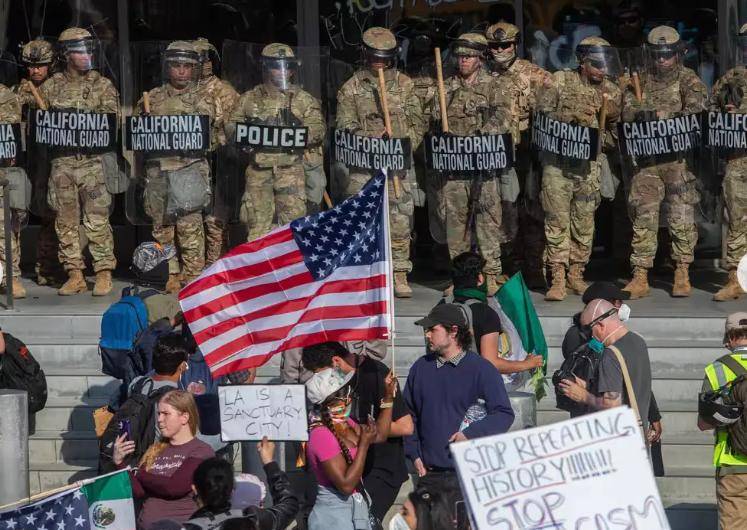
大批持枪美军接管首都,各方才反应过来,特朗普分明是要动真格了
Sou Hu Cai Jing· 2025-08-20 03:41
Group 1 - The article discusses the heightened security measures in Washington D.C., including the deployment of National Guard troops and federal law enforcement, amidst a backdrop of political tension and a recent mass arrest [1][3][12] - The initial deployment of 800 National Guard members was not met with significant concern, but as armed personnel began to gather, residents realized the situation was more complex than initially perceived [3][5] - Reports indicate that violent crime rates in Washington have been declining over the past two years, contradicting the narrative of a "dangerous city" as portrayed by the Trump administration [5][10] Group 2 - The Trump administration appears to be attempting to expand presidential power by seeking greater control over the D.C. police department, including efforts to appoint a federal official as the emergency police chief [5][12] - Tensions between Trump and Federal Reserve Chairman Jerome Powell have escalated, with Trump criticizing the Fed's renovation costs, which reportedly increased from $1.9 billion to as high as $3.1 billion, as a means to undermine the Fed's independence [6][7] - Trump is reportedly looking for Powell's successor, narrowing down candidates who support his economic policies, indicating a strategic move to reshape the Federal Reserve [7][12] Group 3 - The timing of Trump's actions, particularly the military presence in D.C. and the conflict with Powell, coincides with his meeting with Russian President Putin, suggesting a potential diversion of public attention from the meeting [8][10] - Supporters of Trump view these measures as necessary for public safety, while critics question whether the actions are genuinely about security or a test of presidential power [10][12]
美联储主席鲍威尔将被特朗普拿下了!特朗普:很快宣布新任主席!
Sou Hu Cai Jing· 2025-08-18 13:23
Core Viewpoint - The potential replacement of Federal Reserve Chairman Jerome Powell by President Trump has created significant speculation and volatility in global financial markets, reflecting a complex power struggle and economic interests [1][26]. Group 1: Trump and Powell's Relationship - The relationship between Trump and Powell has been tumultuous, with Trump desiring aggressive monetary policies to boost the economy, while Powell maintains a cautious approach to ensure the Fed's independence and stability [3][5][10]. - Trump's frustration with Powell's reluctance to lower interest rates has led to public criticism, highlighting the ongoing conflict between the administration's economic goals and the Fed's policy decisions [5][10]. Group 2: Economic Context - Current economic indicators suggest a fragile job market in the U.S., with discrepancies in reported employment data raising concerns about the true state of the economy [7][9]. - Trump's trade policies have increased costs for U.S. businesses, contributing to a lack of confidence in expanding production and hiring, which further complicates the employment landscape [9][10]. Group 3: Potential Successors - If Powell is replaced, former Treasury Secretary Steven Mnuchin is a leading candidate, known for his close relationship with Trump and understanding of Wall Street dynamics, which may lead to more accommodative monetary policies [14][15]. - Another potential candidate is economist John Taylor, known for the "Taylor Rule," which could introduce a more formulaic approach to monetary policy, though his conservative stance may not align with Trump's aggressive economic strategies [16][18]. Group 4: Implications of Powell's Replacement - The replacement of Powell could lead to significant market volatility, with potential for both positive and negative reactions depending on the new chairman's perceived competence and the independence of the Fed [20][22]. - Changes in monetary policy under a new chairman could impact bond markets and the attractiveness of the U.S. dollar, influencing foreign investment and potentially leading to capital outflows from emerging markets [24][26].
特朗普施压美联储“降息太慢” 瑞银警示罢免鲍威尔或引爆市场风险
Zhi Tong Cai Jing· 2025-08-18 06:53
Group 1 - Concerns about the independence of the Federal Reserve have been raised due to President Trump's criticism of its interest rate cuts, which could lead to increased risk premiums on U.S. Treasury bonds and weaken confidence in the dollar [1][2] - UBS predicts that the Federal Reserve will lower interest rates by 100 basis points by June 2026, driven by labor market and inflation data rather than political pressure [1][2] - Trump's dissatisfaction with the Federal Reserve's pace of rate cuts has heightened uncertainty regarding its leadership and policy direction, although UBS believes a direct challenge to the Fed's autonomy is unlikely [1][2] Group 2 - If the Federal Reserve Chair were to be dismissed, it could trigger significant market reactions and raise questions about the long-term credibility of U.S. monetary policy [3] - UBS maintains that high-quality bonds, including U.S. Treasuries, remain attractive investments despite concerns over the Fed's independence, as they offer stable returns in a potentially declining interest rate environment [2][3] - The historical context of the Federal Reserve's independence, established by the 1951 Treasury-Fed Agreement, suggests that political challenges to its autonomy have not succeeded in the past [2]

鲍威尔或迎最后的杰克逊霍尔:能否留下任期“遗产”?
Jin Shi Shu Ju· 2025-08-18 06:51
Group 1 - The Jackson Hole annual symposium, hosted by the Kansas Federal Reserve, will focus on the theme "Transforming Labor Market," addressing structural forces reshaping the U.S. job market and economy [1] - This year's meeting marks Jerome Powell's 13th attendance and potentially his last, with a significant speech scheduled for August 22, focusing on economic outlook and framework review [1][2] - The Federal Reserve's review of its monetary policy framework occurs every five years, with this year's focus on potential changes in employment assessment methods [2] Group 2 - The semantic shift from "shortage" to "deviation" in employment assessment could provide the Fed with equal justification for both rate hikes and cuts, reflecting a nuanced approach to labor market conditions [2] - Past reviews have led to lasting changes, such as establishing formal inflation targets and adjusting forward guidance, indicating that this year's review may also solidify long-term policies [2][3] - The Fed's independence is crucial, as it operates within the political system, and maintaining this independence is seen as a key aspect of Powell's legacy [3] Group 3 - Powell's tenure has been marked by significant challenges, including the rapid economic downturn due to the COVID-19 pandemic and subsequent aggressive monetary policies [4] - Inflation peaked at 9.1% in June 2022, leading to a series of rate hikes that raised interest rates from near-zero to over 5% [4] - The core Personal Consumption Expenditures (PCE) price index has decreased to 2.8%, but inflation remains above the Fed's 2% target, with unemployment rates fluctuating between 4.1% and 4.3% [4][5] Group 4 - Recent employment data shows a slowdown, with only 73,000 jobs added in July and downward revisions of over 250,000 jobs for May and June [5] - Inflation data has risen again, with tariffs beginning to increase some import prices, complicating the Fed's decision-making process [6][7] - The upcoming FOMC meeting in September is anticipated to be a critical decision point, with market expectations leaning towards a potential rate cut [7][8]