金银比

Search documents
知名经济学家盘和林:白银本轮行情结束了
Sou Hu Cai Jing· 2025-12-29 13:30
封面新闻记者 易弋力 白银到80美元每盎司就掉头向下,有人说是暂时调整,有人说是趋势结束?12月29日,知名经济学家盘和林分析认为,白银的本轮行情结束了。 当然,有人会问,铂有没有机会,钯有没有机会?盘和林称,相对于白银,这些都是配角,他们也是随大溜。在美元宽松下,一般大宗商品分为两类:和 实体经济无关的大宗商品,比如黄金,只是用来投资和避险,工业上没有太多需求。另一类是和实体经济有关,比如铜,工业需求为主,投资需求较少。 前者黄金,是经济滞胀的最佳选择,后者铜,是经济过热的最佳选择。还有一些中间的,比如铂和银,两边都能蹭到一点。所以,你首先要确定金价和铜 价的走势,才能确定这些跟风大宗商品的走势。至于金和铜怎么选?AI如果成为科技革命,那么选铜,AI如果成为泡沫,那么选黄金。 盘和林表示,"我曾分析过白银的供需,包括和黄金类似的投资属性,也包括和铜类似的工业属性,还有就是白银开采属于伴生开采,供给提升难度大。 但这些是白银的长期基本面,对本轮行情的参考意义有且只有第一条,即黄金类似的投资属性。是的,本轮白银行情其实是因为金银比。所谓金银比,就 是金价和银价的比值,一般金银比在60-80之间,而实际上,白银本 ...


突然!金价、银价,大跌!原因找到了→
Sou Hu Cai Jing· 2025-12-29 12:48
Core Viewpoint - The recent rapid increase in precious and industrial metal futures prices has led the CME Group to raise margin requirements for trading metals, significantly increasing the cost of speculative trading and causing a decline in international metal prices before the new rules take effect [1][2]. Group 1: Margin Increases and Market Impact - CME has announced an increase in margin requirements for various metals, including gold (up 10%), silver (up approximately 13.6%), and platinum (up 23%) [1]. - The increase in margin requirements is expected to raise the cost of speculative trading, prompting some investors to liquidate positions, which contributed to a decline in international metal prices on December 29 [1]. - On December 29, international gold prices fell below the $4500 per ounce mark, with significant declines observed in other metals as well [1][4]. Group 2: Historical Context and Comparisons - Analysts have drawn parallels between the current margin increase and historical instances where similar actions led to significant price drops, such as the 1980s incident involving the Hunt brothers and the 2011 silver price surge [2][4]. - The CME's past actions, including multiple margin increases during the 2011 silver price spike, forced high-leverage funds to exit the futures market, resulting in a nearly 30% drop in silver prices within weeks [4]. Group 3: Industrial Demand and Future Outlook - Unlike previous speculative-driven cycles, the current rise in silver prices is supported by its industrial applications, making it a more affordable investment option [3]. - Notable figures, including Elon Musk, have commented on the importance of silver in various industrial processes, highlighting its critical role in the transition to a "mobile world" [3][6]. - The gold-silver ratio has recently fallen to the 55-60 range, indicating that silver is becoming relatively more expensive compared to gold, which may lead to potential price corrections [6].

金价、银价大跌,原因找到了——
Sou Hu Cai Jing· 2025-12-29 11:21
央视财经12月29日报道,由于近期贵金属和工业金属期货价格快速上涨,大幅波动风险加剧,美国芝商 所集团宣布全线上调包括金、银、钯金、锂等在内的金属期货交易保证金。新规将于当地时间本周一收 盘后生效,其中,黄金期货保证金上调10%,白银期货上调约13.6%,铂金上调约23%。 大幅上调保证金将显著提升市场投机交易成本,部分投资者赶在新规生效前获利了结,引发国际金属期 货价格在29日出现多轮下跌。当天亚洲交易尾盘时段,国际贵金属价格跌幅再度扩大,国际金价跌破每 盎司4500美元整数关口。 截至北京时间29日15时35分, 分析人士: 芝商所上调保证金曾导致银价大跌 分析人士指出,CME提高保证金的操作让人们回想到了历史上的相似情形。 但也有分析人士认为和以往投机驱动的周期不同,支撑此轮白银涨势的不仅因为白银是贵金属里相对可 负担的一种投资品,还因为它在工业领域具有不可替代性,就连马斯克也对此发声。近期,马斯克在旗 下社交平台X上针对银价上涨的现象发文称:这可不好,白银被用于许多工业生产环节。 上世纪80年代左右,美国亨特兄弟试图通过囤积垄断白银市场,导致芝商所推出了"白银规则7", 大幅提高了保证金要求,导致银价 ...
金价、银价大跌,原因找到了
Xin Lang Cai Jing· 2025-12-29 10:17
Group 1: Market Reactions and Regulations - The CME Group announced an increase in margin requirements for metal futures, including gold, silver, platinum, and lithium, due to recent volatility in precious and industrial metal prices [1][8] - The margin for gold futures was raised by 10%, silver by approximately 13.6%, and platinum by 23%, significantly increasing the cost of speculative trading [1][8] - Following the announcement, international metal futures prices experienced multiple rounds of declines, with gold prices falling below $4500 per ounce [1][8] Group 2: Historical Context and Analyst Insights - Analysts noted that CME's margin increases have historically led to significant drops in silver prices, recalling past instances such as the 1980s and 2011 when similar actions caused sharp declines [3][11] - Some analysts argue that the current rise in silver prices is supported not only by its affordability compared to other precious metals but also by its irreplaceable role in industrial applications, as highlighted by Elon Musk [2][9] Group 3: Current Price Trends - As of December 29, the February delivery gold futures price was reported at $4497.9 per ounce, reflecting a decline of 1.20% [3][11] - The March delivery silver futures price was reported at $75.930 per ounce, down 1.65%, while platinum and palladium also saw declines of 5.98% and 9.11%, respectively [3][11] Group 4: Industry Perspectives - Randy Smurfit, CEO of Wheaton Precious Metals, emphasized the importance of silver in enhancing battery durability and performance, particularly in the context of the growing mobile world [5][12] - The gold-silver ratio has recently fallen to the range of 55 to 60, indicating that silver is becoming relatively more expensive compared to gold, which may lead to potential corrections [7][14]

金银比降了分析称银价或冲击300美元
Xin Lang Cai Jing· 2025-12-29 09:31
【#金银比降了##分析称银价或冲击300美元#】近期,马斯克在旗下社交平台X上针对银价上涨的现象 发文称:这可不好,白银被用于许多工业生产环节。金银比也是部分投资者在关注的指标,近期金银比 已经跌至55至60区间,金银比下降,意味着白银相对黄金更"贵",更容易出现回撤。但对此市场上有不 同的看法,知名白银分析师彼得·克劳斯认为金银比有可能会跌至15,而银价有望冲击每盎司300美元。 #银价飙涨后跳水#(央视财经) 来源:@华夏时报微博 ...
突然!金价、银价,大跌!原因找到了
Sou Hu Cai Jing· 2025-12-29 09:24
Group 1 - The Chicago Mercantile Exchange (CME) has raised margin requirements for metal futures, including gold, silver, platinum, and lithium, due to recent rapid price increases and heightened volatility [1] - The margin for gold futures has been increased by 10%, silver by approximately 13.6%, and platinum by 23%, which will significantly raise the cost of speculative trading in the market [1] - Following the announcement, international metal futures prices experienced multiple rounds of declines, with gold prices falling below $4,500 per ounce [1] Group 2 - Historical instances show that CME's margin increases have previously led to significant declines in silver prices, such as in the 1980s and 2011, where silver prices dropped dramatically after margin hikes [2] - Analysts suggest that the current rise in silver prices is supported not only by its affordability as an investment but also by its irreplaceable role in industrial applications, highlighted by comments from notable figures like Elon Musk [2][4] - The gold-silver ratio has recently fallen to the range of 55 to 60, indicating that silver is becoming relatively more expensive compared to gold, which may lead to potential corrections in silver prices [6]

白银价格预测:突破动能与美联储流动性预期为白银2026年上探100美元创造条件
Sou Hu Cai Jing· 2025-12-29 03:56
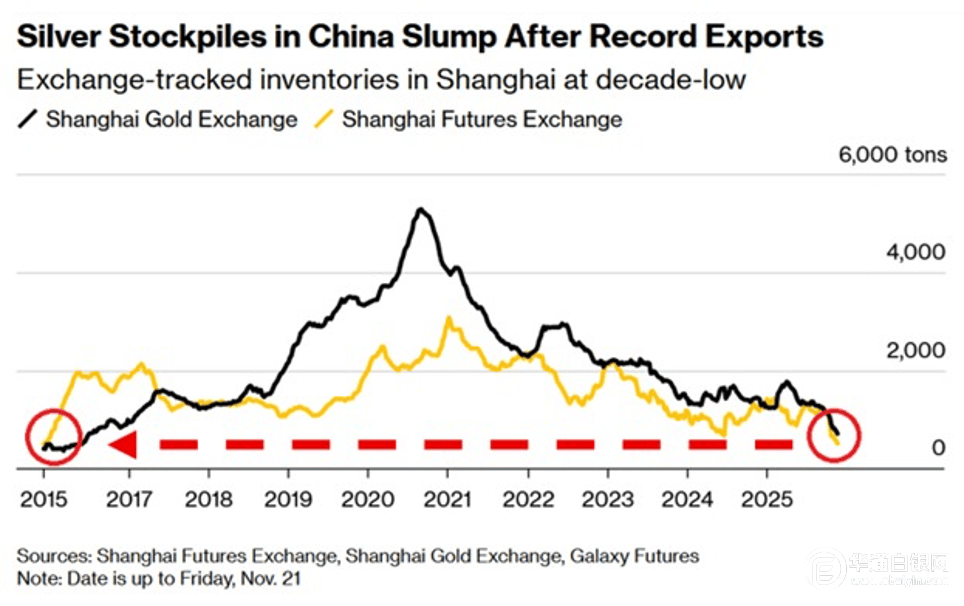
Core Viewpoint - Silver is poised to reach a target price of $100 by 2026 after breaking a 40-year consolidation pattern, driven by soaring industrial demand and the Federal Reserve's resumption of balance sheet expansion [1][21]. Group 1: Macro Forces Reshaping Silver Supply and Demand - China's silver outflow and global supply tightness are central to the current market dynamics, with Shanghai Futures Exchange silver inventories dropping to 715 tons, an 86% decline from the 2020 peak [1][4]. - Gold inventories have similarly decreased, falling 83% from their 2021 high to 519 tons, the lowest since December 2015, indicating severe shortages that are pushing precious metal prices higher [4]. - Despite rising silver prices, silver mine production remains flat, and new projects may not come online until 2027, contributing to ongoing supply constraints [4][7]. Group 2: Industrial Demand and Future Growth - Demand for solar energy is expected to dominate in the coming years, with silver being essential for photovoltaic cells, requiring 10-20 grams per panel, leading to an anticipated consumption of over 200 million ounces annually by 2026 [7][8]. - Silver's unique conductivity makes it irreplaceable in electric vehicles, AI data centers, 5G infrastructure, and high-performance electronics, resulting in sticky demand that is largely price-insensitive [7]. - The medical technology sector is increasingly recognizing silver's antibacterial properties, further solidifying its role as a critical material rather than a luxury [7]. Group 3: Monetary Policy and Liquidity Dynamics - The Federal Reserve initiated a Reserve Management Purchase (RMP) program in December 2025, purchasing $40 billion in short-term Treasury bills monthly, which is significantly higher than the previously expected $20-25 billion [8]. - This program is perceived as a form of "invisible quantitative easing," weakening the dollar and making silver more attractive as a store of value [8]. Group 4: Technical Analysis and Market Signals - Silver's long-term chart indicates a significant breakout in 2025, surpassing the $50 resistance level that had held for over 40 years, suggesting a major shift in market behavior [10][11]. - The breakout from the cup-and-handle pattern could lead to a price increase of over 700%, with potential targets of $250 to $300, contingent on maintaining above the $30-$50 accumulation zone [10][11]. - The gold-silver ratio has broken its long-term uptrend, indicating that silver may outperform gold in the coming months and years [15][17]. Group 5: Conclusion and Future Outlook - Silver's breakout above $50 confirms a structural market shift supported by tightening physical supply, sustained industrial demand, and a favorable liquidity environment [21]. - As long as silver prices remain above the $30-$50 accumulation zone, the bullish outlook is intact, with a target of $100 by 2026, potentially opening the door to $250-$300 [21].
贵金属专题20251228
2025-12-29 01:04
Summary of Key Points from the Conference Call Industry Overview - **Industry Focus**: Precious Metals and Commodities Market - **Key Drivers**: Quantitative easing, tariff policies, geopolitical uncertainties, and inflation concerns have significantly influenced the prices of precious metals since 2020 [2][4][7]. Core Insights and Arguments - **Price Trends**: Precious metals have seen a strong performance, particularly silver and platinum, driven by global economic uncertainty and inflation fears. The internal rate of return (IRR) for precious metal projects can exceed 50%, making them more attractive than copper projects, which typically have an IRR of around 20% [2][6][4]. - **Copper Price Expectations**: The market anticipates copper prices to rise to $8 per pound due to insufficient current prices ($5 per pound) to incentivize new investments and production expansions [8]. - **Shift to Safe-Haven Assets**: Post-pandemic economic recovery in the U.S. has been weak, leading to a shift of funds towards safe-haven assets like precious metals, as confidence in U.S. debt repayment capabilities diminishes [9][11]. - **Geopolitical Factors**: Geopolitical uncertainties have prompted Western countries to accelerate the development of domestic critical mineral resources, impacting supply and prices [10][30]. Additional Important Insights - **Speculative Sentiment in Silver Market**: The decline in the gold-silver ratio indicates heightened speculative sentiment, with retail investors heavily buying silver, which could lead to a reversal of bullish sentiment [5][34]. - **Outlook for Industrial Metals**: The outlook for non-ferrous metals remains optimistic, with expectations of continued leadership in the market, particularly for copper, lithium, and gold [26][29]. - **Valuation of Precious Metals**: Precious metals are currently more attractive compared to other commodities due to lower initial capital expenditures and tighter supply conditions [6][31]. - **Market Volatility**: The upcoming change in the Federal Reserve chairmanship could lead to increased market volatility, affecting interest rate policies and overall market sentiment [15]. Market Dynamics - **Investment Opportunities**: The current low valuations in the non-ferrous metals sector present significant investment opportunities, with historical data suggesting a positive correlation between low price-to-earnings ratios and market performance [31]. - **Future Price Risks**: The silver market faces potential risks from speculative buying, which could lead to sharp price corrections if sentiment shifts [40][42]. - **Impact of Retail Investors**: Retail investors are expected to play a crucial role in the silver market, potentially driving prices higher in the short term, but their speculative behavior may also lead to volatility [42][43]. Conclusion The precious metals and commodities market is currently influenced by a combination of macroeconomic factors, geopolitical uncertainties, and speculative behaviors. The outlook remains cautiously optimistic, with significant opportunities for investment, particularly in precious metals and select industrial metals. However, potential risks from market volatility and shifts in investor sentiment must be closely monitored.
年末贵金属行情火热,黄金、白银齐创新高
Huan Qiu Wang· 2025-12-28 01:24
Core Insights - Precious metals market is experiencing significant price increases, with gold, silver, and platinum reaching new historical highs as of December 26 [1][3] Price Movements - International gold and silver prices rose by 1.11% and 7.69% respectively, with gold futures reaching $4552.7 per ounce and silver futures climbing to $77.196 per ounce [3] - Platinum futures surged past $2400 per ounce for the first time, with a weekly increase exceeding 22%, while palladium prices rose approximately 13% to $2023.3 per ounce, marking a three-year high [3] Market Trends - Silver has entered an accelerated upward phase, with a monthly increase of over 40% since late November and an annual increase approaching 150% [3] - The correlation between silver and other metals like platinum, palladium, and copper has intensified, driven by liquidity and cyclical factors [3] Future Outlook - Multiple international financial institutions predict that gold prices could reach $5000 per ounce by 2026, supported by central bank purchases and expectations of Federal Reserve easing [4] - For silver, increasing photovoltaic demand and low visible inventories are expected to support prices, although potential pressure from technological substitutes should be monitored [4] - The copper futures market also saw a rise of over 4% on December 26, with optimistic macroeconomic conditions and tightening supply leading to an upward revision of the 2026 copper price target to 120,000 yuan per ton [4]

商品年末狂欢启示录:为何我们总在“恐高”中错失机会?
对冲研投· 2025-12-27 10:32
Group 1 - The core viewpoint of the article revolves around the potential for a "physical squeeze" in the silver market, particularly in London, as a result of significant borrowing and demand dynamics leading into January 2026 [2][3]. - The article highlights the unusual phenomenon of "physical squeeze" occurring outside of typical delivery months, with a notable spike in leasing rates exceeding 60% due to a sudden liquidity crunch in the London market [2][3]. - The silver market has experienced a dramatic decline in the gold-silver ratio, dropping from 104 in April to around 64, indicating a potential long-term trend favoring silver over gold [4]. Group 2 - The article discusses the implications of the current silver market dynamics on other precious metals, suggesting that copper and platinum may also present significant investment opportunities due to their strong fundamentals and supply constraints [5][4]. - The surge in silver prices has led to a remarkable premium on silver futures LOF funds, with prices exceeding 50% above net asset value, prompting a wave of retail investor interest and speculative trading [6]. - The article emphasizes the importance of understanding the broader market context, including geopolitical factors and supply chain disruptions, which are reshaping the pricing and availability of key resources like platinum and palladium [9][10]. Group 3 - The article outlines the structural challenges facing the copper market, including a consensus among analysts predicting limited price increases, which may not adequately prepare industries for potential supply shocks [16][17]. - It highlights the long-term supply constraints in the copper market due to historical underinvestment in mining and the complexities introduced by geopolitical tensions affecting supply chains [22][24]. - The article suggests that the current market dynamics may lead to a significant revaluation of copper prices, especially if supply disruptions occur alongside increasing demand from sectors like AI and renewable energy [34][33].