金铂比

Search documents
商品年末狂欢启示录:为何我们总在“恐高”中错失机会?
对冲研投· 2025-12-27 10:32
Group 1 - The core viewpoint of the article revolves around the potential for a "physical squeeze" in the silver market, particularly in London, as a result of significant borrowing and demand dynamics leading into January 2026 [2][3]. - The article highlights the unusual phenomenon of "physical squeeze" occurring outside of typical delivery months, with a notable spike in leasing rates exceeding 60% due to a sudden liquidity crunch in the London market [2][3]. - The silver market has experienced a dramatic decline in the gold-silver ratio, dropping from 104 in April to around 64, indicating a potential long-term trend favoring silver over gold [4]. Group 2 - The article discusses the implications of the current silver market dynamics on other precious metals, suggesting that copper and platinum may also present significant investment opportunities due to their strong fundamentals and supply constraints [5][4]. - The surge in silver prices has led to a remarkable premium on silver futures LOF funds, with prices exceeding 50% above net asset value, prompting a wave of retail investor interest and speculative trading [6]. - The article emphasizes the importance of understanding the broader market context, including geopolitical factors and supply chain disruptions, which are reshaping the pricing and availability of key resources like platinum and palladium [9][10]. Group 3 - The article outlines the structural challenges facing the copper market, including a consensus among analysts predicting limited price increases, which may not adequately prepare industries for potential supply shocks [16][17]. - It highlights the long-term supply constraints in the copper market due to historical underinvestment in mining and the complexities introduced by geopolitical tensions affecting supply chains [22][24]. - The article suggests that the current market dynamics may lead to a significant revaluation of copper prices, especially if supply disruptions occur alongside increasing demand from sectors like AI and renewable energy [34][33].


白银涨幅惊人,从金银比价的回归看2026年铜跟铂金的投资机会
Sou Hu Cai Jing· 2025-12-22 22:08
Group 1: Silver Market Dynamics - The inventory of silver is rapidly diminishing, with reports indicating that acquiring all immediately deliverable silver on the New York Metal Exchange could cost only $1.2 billion, a relatively small amount for major financial players, igniting a surge in silver prices [1] - By December 2025, the price of silver surpassed $68 per ounce, marking a more than 130% increase within a year, significantly outpacing traditional assets like gold and oil [3] - The gold-silver ratio reached an extreme high of 104.87 in April 2025, indicating a significant market imbalance where gold was favored over silver due to economic fears [5] Group 2: Supply and Demand Imbalance - The demand for silver is soaring, particularly due to its industrial applications, while the supply is constrained as global silver mines are producing lower quality ore, making new mining projects capital-intensive and time-consuming [8] - The current market scenario presents a stark contrast between dwindling supply and increasing demand, leading to a situation where any new buy orders could dramatically push prices higher [8] Group 3: Broader Metal Market Implications - The surge in silver prices is influencing other metals, with investors now looking at the copper market, which is also experiencing a supply-demand imbalance due to declining ore grades and increasing demand from sectors like electric vehicles and AI data centers [10] - The copper market is expected to benefit from the ongoing economic recovery and infrastructure investments, with projections indicating a significant increase in copper consumption driven by technological advancements [10] Group 4: Platinum Market Developments - Platinum is experiencing a resurgence, with prices nearly doubling in 2025, driven by a shift in demand from automotive manufacturers who are reconsidering platinum due to high palladium prices [12] - The supply of platinum is precarious, as over 70% comes from South Africa, where mining operations face challenges such as high costs and frequent power outages, leading to a tight supply situation [14]
铂、钯期货价格双双触及涨停板 再创上市以来新高
Jin Tou Wang· 2025-12-22 04:11
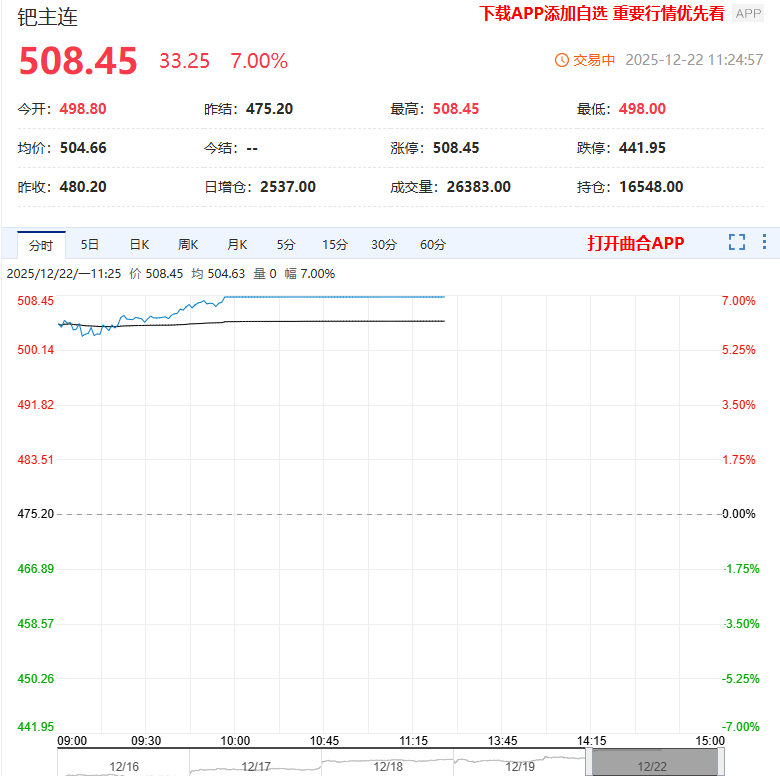
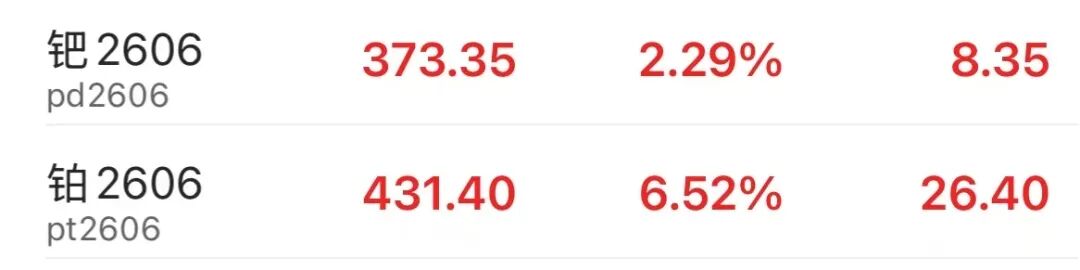
Group 1 - The core viewpoint of the articles highlights the significant increase in platinum and palladium futures prices, reaching new highs since their listing, driven by tight overseas supply and bullish sentiment in the metals sector [1][2] - As of December 22, platinum futures for the main contract PT2606 reached 568.45 yuan per gram, up 6.99%, while palladium futures for the main contract PD2606 reached 508.45 yuan per gram, up 7.00% [1] - The Dalian Commodity Exchange announced new trading limits for non-futures company members or clients, restricting daily opening positions for platinum and palladium contracts to a maximum of 500 lots starting December 23, 2025 [1] Group 2 - Analysts from Guosen Futures attribute the price surge to a combination of overseas supply shortages and increased bullish sentiment in the metals market [2] - Everbright Futures suggests that platinum and palladium prices will continue to follow gold price trends, with stronger performance, supported by the ongoing strength in gold prices and the rapid return of gold-silver ratios extending to gold-platinum and gold-palladium ratios [2] - Caution is advised regarding potential market overheating and rapid adjustments as prices rise quickly, indicating a need for careful consideration when entering high positions [2]
开局炸裂!贵金属“三剑客”狂飙续创历史新高
Jin Tou Wang· 2025-12-22 03:09
Group 1 - Precious metals opened higher on December 22, with spot gold breaking the October 20 high of $4,381.4 per ounce, reaching a new historical high of $4,383.99 per ounce, reflecting a daily increase of over 1.00% [1] - Spot silver continued its upward trend after a more than 8% increase last week, rising 2% on Monday to a historical high of $68.52 per ounce [1] - Spot platinum surged over 13% previously and continued to rise by 2.5% on Monday, surpassing the $2,000 mark and reaching a 17-year high of $2,020.80 per ounce, marking an annual increase of over 120% [1] Group 2 - The main contract for silver futures in Shanghai rose over 5%, breaking the 16,000 yuan per kilogram mark, and has accumulated an increase of over 114% this year [1] - The A-share precious metals sector experienced fluctuations, with companies like Hunan Silver and Xiaocheng Technology both rising over 4%, while others such as Western Gold and Zhongjin Gold also saw gains [1] Group 3 - According to Everbright Futures, silver, platinum, and palladium continue to follow gold's trend but are performing more strongly, with gold's sustained strength providing market confidence for bullish positions in silver, platinum, and palladium [3] - The rapid return of the gold-silver ratio has extended to the gold-platinum and gold-palladium ratios, providing strong support and momentum for platinum and palladium prices [3]
光大期货:银铂钯依然跟随金价走势 但表现更为强势
Sou Hu Cai Jing· 2025-12-22 01:37
Group 1 - The core viewpoint of the article highlights the strong performance of precious metals futures, with platinum and palladium rising over 5% and silver increasing over 4% [1] - Despite market skepticism regarding the Federal Reserve's future interest rate cuts, discussions around the potential candidates for the Fed chair and the number of rate cuts in 2016 are influencing market sentiment [1] - The current gold price is close to its historical high, with attention on whether it can effectively break through this level to open up upward potential for 2026 [1] Group 2 - Silver, platinum, and palladium continue to follow gold's trend, with stronger performance observed in these metals [1] - The sustained strength in gold prices provides market confidence for bullish positions in silver, platinum, and palladium, leading to a rapid return of the gold-silver ratio, which extends to the gold-platinum and gold-palladium ratios [1] - While prices are rising quickly, caution is advised to prevent overheating in the market, suggesting that chasing high prices should be approached with care [1]
两大贵金属期货首秀大涨!600459起飞
Shang Hai Zheng Quan Bao· 2025-11-27 02:20
Market Overview - On November 27, A-shares opened mixed with the Shanghai Composite Index up by 0.49%, Shenzhen Component Index up by 0.96%, and ChiNext Index rising over 1% [1] - Sectors such as industrial metals, photovoltaic equipment, and semiconductors showed significant gains [1] Futures Market - Platinum and palladium futures were listed for trading on the Guangzhou Futures Exchange, with benchmark prices set at 405 CNY/gram for platinum and 365 CNY/gram for palladium [1] - On the first day of trading, the main contracts opened significantly higher [1] Gold and Platinum Market Dynamics - According to a researcher from Nanhua Futures, the demand for gold is rising due to de-dollarization, geopolitical conflicts, and expectations of interest rate cuts by the Federal Reserve, leading to historical highs in gold prices [2] - Platinum, being a weaker safe-haven metal, is influenced by gold prices, with the gold-platinum ratio at historical highs, indicating a short-term trend where gold leads and platinum follows [2] - The long-term outlook suggests that platinum and palladium have substitution effects, anchoring palladium prices to platinum [2] Small Metals Sector Performance - The small metals sector in A-shares saw a rally, with Guoyan Platinum Industry (600459) rising over 8%, followed by West Mining and Cangge Mining [2] - The small metals index increased by 1.45% [3] Solid-State Battery Sector - The solid-state battery sector experienced strong fluctuations, with Yishitong (688733) hitting the daily limit up of 20%, and other companies like Lian De Equipment and Zhidongli rising over 10% [4][5] - The solid-state battery index rose by 1.99% [5]

备战新品种 | 铂钯期货上市价格与交易策略分析
对冲研投· 2025-11-26 12:01
Core Viewpoint - The article discusses the upcoming launch of platinum and palladium futures on November 27, 2025, at the Guangzhou Futures Exchange, highlighting the expected trading strategies and market dynamics for these metals. Group 1: Futures Launch and Trading Strategies - Platinum and palladium futures will be listed with initial contracts PT/PD2606 to PT/PD2610 [4] - Recommended trading strategy for the first day includes buying on dips, with PT2606 expected to trade between 390-420 CNY/gram and PD2606 between 340-370 CNY/gram [6][26] - If prices break above the upper range, short positions may be considered [6][26] Group 2: Delivery Rules and Price Anchoring - The cheapest delivery form for platinum and palladium may be powder, as it typically trades at a discount compared to ingot forms [5][7] - The delivery rules specify that registered warehouse receipts must be for domestic platinum/palladium ingots, while factory receipts can include ingots, sponge, and powder forms [7] - Futures prices are expected to anchor slightly above the spot price of platinum/palladium powder due to delivery preferences [7] Group 3: Supply and Demand Dynamics - Platinum supply is constrained, with a projected 5% year-on-year decline in mine supply to 171 tons in 2025, driven by low prices affecting mining profitability [16][18] - Recycling supply of platinum is expected to increase by 8% year-on-year to 12 tons in 2025, partially offsetting the supply shortage [16] - Palladium supply is tightening due to reduced production from mining companies, with a significant portion of palladium supply coming from recycling [23] Group 4: Market Trends and Price Outlook - The article anticipates that platinum prices will be supported by strong demand from the automotive sector, with a 21% year-on-year increase in car sales in China [17] - Palladium demand is expected to weaken due to the rising share of electric vehicles, impacting its price support [23] - The initial pricing center for platinum futures is estimated around 405 CNY/gram and for palladium around 355 CNY/gram [25]

铂钯上市系列专题二:铂钯价格深度复盘及品种间联动关系解析
Dong Zheng Qi Huo· 2025-09-02 08:12
Report Industry Investment Rating No information provided in the given content. Core Viewpoints of the Report - Platinum and palladium prices are highly sensitive to supply disruptions and capital flows, with historical volatility ranking high among metals. Their price trends are significantly influenced by the evolution of supply - demand structures and the macro - environment. Demand substitution is the long - term logic for price fluctuations, while price extremes are affected by macro - fluctuations, supply disruptions, and external event shocks [2][132]. - The cost of mining platinum and palladium forms a strong bottom - support for prices in the medium term. In 2024, the total sustaining cost of global platinum mines increased by 11.8% year - on - year to $884 per ounce. At present, the price of platinum is $1350 per troy ounce, reducing the possibility of further production cuts by mining enterprises, but higher prices may be needed to stimulate more supply [2][134]. - The platinum - palladium ratio reflects demand substitution and financial attribute premiums. The core driver of substitution is a long - term and significant relative premium, and the substitution cycle usually takes 3 - 5 years. After the spread between platinum and palladium converges from a high level, it will likely form an inversion due to the redistribution of downstream demand [2][134]. - The gold - platinum ratio can effectively isolate the safe - haven attribute of gold and the industrial attribute of platinum, essentially reflecting changes in economic prospects and market risk preferences. It is an effective leading indicator for predicting stock market returns, with a high correlation with the S&P 500's next - year cumulative return but a weak correlation with the A - share market [3][134]. - Platinum and palladium are positively correlated with gold and negatively correlated with the US dollar index due to their investment and safe - haven attributes; their prices are positively correlated with copper prices because of overlapping manufacturing demands; and platinum prices are trend - related to crude oil prices as rising oil prices push up mining costs and support platinum and palladium prices [4][134]. Summary by Directory 1. Introduction - The previous report comprehensively sorted out the platinum and palladium industry chains, global supply - demand situations, and their influencing factors. This report conducts an in - depth review of the historical prices of platinum and palladium, analyzes their key influencing factors, and explores medium - and long - term investment opportunities [14]. 2. Historical Supply - Demand Review of Platinum and Palladium Platinum - Supply: Historically, global platinum supply has shown a trend of high - speed growth followed by high - level shock and decline. South Africa has long dominated global platinum supply, with its share decreasing from 70% in 1990 to 58% in 2024. After 2005, recycled platinum supply gradually increased. From 1990 - 2006, platinum supply expanded rapidly, but then declined due to factors such as decreased mine grades and labor disputes in South Africa. After 2008, global primary platinum supply remained at a low level, while recycled platinum production mainly fluctuated [16]. - Demand: Overall, platinum demand has shown a trend of continuous increase followed by shock. Automobile, jewelry, and investment demands contribute the main marginal elasticity. From 1990 - 2008, global platinum demand continued to rise, mainly driven by jewelry demand before 1999 and automobile exhaust catalysts after 2000. After the 2008 financial crisis, investment demand increased, and after 2015, platinum demand entered a re - balancing stage [17]. Palladium - Supply: Historically, global palladium supply has generally shown a trend of shock and upward movement, with greater volatility than platinum. Primary palladium supply has evolved from near - monopoly by Russia to a bipolar oligopoly pattern of Russia and South Africa. After 2017, recycled palladium supply became an important source. From 1990 - 2000, Russia released a large amount of palladium inventory, and after 2000, supply shifted to mine output. From 2005 - 2019, recycled palladium production increased, and from 2020 - 2025, supply was relatively tight due to sanctions and production cuts [19][20]. - Demand: Overall, palladium demand increased and then decreased from 1990 - 2002 and then showed a long - term upward trend with shock. After 2020, it mainly fluctuated. The growth of palladium demand mainly comes from the automobile field. In the 1990s, palladium demand in the automobile exhaust catalyst field increased explosively, but it declined sharply in 2001. After 2015, the "Dieselgate" event and upgraded emission standards promoted the increase of palladium demand, but then it gradually declined due to the increase in the penetration rate of electric vehicles [20][21]. 3. Historical Price Review of Platinum and Palladium 1990 - 2001: Monopoly Behavior and Capital Resonance Triggered a Bubble - like Market for Palladium - From the beginning of 1990 to March 1997, platinum and palladium prices maintained a wide - range shock. After 1997, Russia restricted the export of platinum - group metals, and hedge funds hoarded goods, creating a shortage expectation. In 2000, the panic squeeze on TOCOM accelerated the rise of palladium prices, and platinum and palladium prices were significantly inverted. In 2001, Russia resumed palladium exports, and palladium prices plummeted. During this period, platinum prices mainly followed palladium prices, and the substitution effect of palladium occurred in various demand fields [22][25][26]. 2002 - 2008: Macro and Fundamental Resonance Drove Platinum to a Long - Bull Market - Palladium prices were under pressure due to long - term supply - demand surplus. In 2002, palladium prices dropped sharply, and although there was a short - term rebound in 2003, the overall situation remained weak. In contrast, platinum prices showed a long - bull trend. From 2002 - 2008, platinum supply was in short supply in most years, and the average annual price increased from $539 per ounce in 2002 to a historical high of $2192 per ounce in 2008, driven by factors such as the growth of platinum demand in the automobile and jewelry fields and the weakening of the US dollar. In 2008, the financial crisis led to a sharp decline in platinum prices [38][41][42]. 2009 - 2018: Pricing Returned from Macro to Fundamental, and Palladium Substituted Platinum in the Long - Term - Platinum prices generally rose and then fell, while palladium prices showed an upward trend with shock. From 2009 - 2012, palladium prices performed better than platinum prices. After 2013, the platinum - group metal market was affected by macro - policy changes and industry structural changes. The "Dieselgate" event in 2015 was a turning point, which led to a significant decline in platinum demand and an increase in palladium demand. From 2016 - 2018, upgraded global emission standards promoted the bull market of palladium and the weakening of platinum prices [45][50][57]. 2019 - 2025: External Factor Shocks Intensified, and Platinum and Palladium Demand Re - balanced - Palladium prices experienced a complete bull market, reaching a historical high of $3015 per ounce in March 2022 and then significantly回调. Platinum prices were relatively weak, mainly fluctuating in the range of $800 - $1000 per ounce and rebounding in 2025. During this period, global macro - fluctuations intensified, and multiple factors such as emission standard upgrades, geopolitical conflicts, and the transformation of new - energy vehicles affected the market supply - demand pattern of platinum and palladium. In 2025, platinum and palladium showed a pattern of "platinum strong, palladium weak" [62][67][73]. 4. Pricing Logic and Inter - Variety Linkage of Platinum and Palladium Mining Cost Forms Bottom Support, and Capex Has a Weak Correlation with Supply - Platinum - group metal mining is capital - intensive, and new mine development has a long cycle. The Capex of platinum and palladium mining enterprises is related to the current prices of platinum and palladium, but primary platinum and palladium supply has no obvious correlation with Capex due to external events in South Africa and Russia. Rising production costs in 2024 increased the bottom support of prices. Currently, platinum prices are at the median of the cost range, and higher prices may be needed to stimulate more supply [84][89][92]. Platinum - Palladium Ratio: Long - Term High Premium Drives Demand Substitution - The platinum - palladium ratio reflects demand substitution and financial attribute premiums. Since 1990, there have been three substitution effects between platinum and palladium. The core driver of substitution is long - term and significant relative premium, and the substitution cycle usually takes 3 - 5 years. Currently, the platinum - palladium ratio has been rising, and there is still room for further increase, but downstream substitution may be more smooth if the ratio rises significantly [98][101][108]. Gold - Platinum Ratio: An Excellent Indicator for Predicting Stock Market Returns - The gold - platinum ratio reflects changes in economic prospects and market risk preferences. Since 1990, it has gone through several stages of evolution. It is an effective leading indicator for predicting stock market returns, with a high correlation with the S&P 500's next - year cumulative return but a weak correlation with the A - share market [113][116][117]. Linkage of Platinum and Palladium with Other Indicators - Financial attribute: Platinum and palladium are positively correlated with gold and negatively correlated with the US dollar index, and platinum has a higher correlation. - Industrial attribute: Platinum and palladium prices are positively correlated with copper prices due to overlapping manufacturing demands. - Cost structure: Platinum prices are trend - related to crude oil prices. Rising oil prices push up mining costs and support platinum prices, and there is also a certain relationship between platinum demand and oil prices [126][127][128].
黄金跌势不止,“黄金平替”下半年还能涨吗?
Xin Hua Cai Jing· 2025-06-24 12:55
Core Viewpoint - Platinum is experiencing a significant price increase, with a cumulative rise of 33% from May 15 to June 24, 2023, and over 44% since the beginning of the year, contrasting with gold's 26.8% increase during the same period [1][3]. Market Dynamics - The recent surge in platinum prices is driven by a combination of supply shortages and a shift in investor sentiment, as geopolitical instability and tariff uncertainties have widened the price gap between gold and platinum [1][3]. - The World Platinum Investment Council (WPIC) forecasts a supply deficit of 30 tons in the global platinum market for 2025, primarily due to insufficient long-term investment in South African mines and challenges in recycling automotive catalysts [3][10]. Demand Trends - Platinum demand saw a 10% increase in Q1 2025, with jewelry demand rising by 9% and investment demand surging by 28% to 14 tons. Notably, China's platinum bar demand grew by 140%, surpassing North America as the largest retail investment market [3][10]. - The jewelry market for platinum is recovering, with increased consumer interest as gold prices rise, leading to a resurgence in platinum jewelry sales [3][5]. Technical Analysis - The Gold-Platinum Ratio is currently around 2.75, indicating that platinum may be undervalued, which is attracting more investment [4][9]. - Recent data shows a significant increase in platinum futures positions, with total open interest rising from 70,592 contracts on May 22 to 77,787 contracts by May 30, reflecting a warming market sentiment [4][9]. Future Outlook - Analysts suggest that while there is a reasonable narrative for a bullish trend in platinum, caution is advised as the market may not sustain linear growth. The automotive industry's demand decline and potential supply increases could limit long-term price growth [9][10]. - The supply-demand balance for platinum is projected to show a deficit of approximately 41.2 tons in 2025, with demand growth expected at 10.8% [10].
TradeMax:黄金走到“牛尾巴”了吗?未来将有两件大事决定生死!
Sou Hu Cai Jing· 2025-05-06 01:54
Core Viewpoint - The gold market has experienced significant volatility, with prices soaring from $2500 per ounce in mid-2024 to a peak of $3500 by April 2025, followed by a sharp correction of over 7% within weeks, raising concerns about the sustainability of the bull market [1][4]. Group 1: Market Indicators - The gold-to-silver ratio has reached an extreme of 100:1, significantly above the historical average of 70:1, indicating potential for either a downward adjustment in gold prices or a strong rally in silver prices [3]. - The gold-to-platinum ratio has climbed to 3.5, whereas it typically fluctuates between 1 and 2 over the past 20 years, suggesting that gold may be severely overvalued relative to platinum [3]. Group 2: Drivers of Gold Price Surge - The surge in gold prices from 2022 to 2023 was driven by escalating global geopolitical tensions, leading central banks, including those of China and Poland, to significantly increase their gold reserves, thereby boosting demand [4]. - The announcement of tariffs by the Trump administration heightened trade tensions and market uncertainty, prompting investors to seek gold as a safe-haven asset [4]. - Expectations of the Federal Reserve shifting to a loose monetary policy in 2025 further enhanced gold's appeal as a non-yielding asset, reducing its opportunity cost compared to other investments [4]. Group 3: Changing Market Dynamics - Recent positive signals from the White House regarding trade negotiations have reduced market risk aversion, while a strong rebound in the dollar index has put downward pressure on gold prices [5]. - The 10-year U.S. Treasury yield has risen to 4.23%, with real yields approaching 2%, diminishing gold's attractiveness as an investment [5]. Group 4: Future Outlook - Key upcoming events include the decision on whether to reinstate tariffs after the 90-day pause and the timing of potential interest rate cuts by the Federal Reserve, both of which will significantly influence market sentiment and gold prices [5]. - Despite short-term pressures, analysts maintain a long-term optimistic outlook for gold, citing the U.S. federal debt surpassing $36 trillion and ongoing geopolitical complexities as factors that will continue to support gold's value as a safe-haven asset [5].