
AI硬件

Search documents
长江大宗2026年1月金股推荐
Changjiang Securities· 2026-01-04 11:39
Group 1: Metal Sector - Yun Aluminum Co. (000807.SZ) is projected to achieve a net profit of CNY 44.12 billion in 2024, increasing to CNY 75.75 billion by 2026, with a PE ratio decreasing from 25.82 to 15.04[9] - The company has a comprehensive production capacity of 305,000 tons of green aluminum and 140,000 tons of alumina, positioning it as a leader in the green aluminum sector[18] - The company's debt-to-asset ratio is expected to decrease to 23% by 2024, maintaining a strong ROE of 15.6%[24] Group 2: Construction Materials - Huaxin Cement (600801.SH) is forecasted to have a net profit of CNY 24.16 billion in 2024, growing to CNY 36.58 billion by 2026, with a PE ratio dropping from 18.60 to 12.29[9] - China National Materials (002080.SZ) is expected to see its net profit rise from CNY 8.92 billion in 2024 to CNY 25.87 billion in 2026, with a PE ratio decreasing from 68.38 to 23.57[9] Group 3: Transportation Sector - SF Holding (002352.SZ) is projected to achieve a net profit of CNY 101.70 billion in 2024, increasing to CNY 124.78 billion by 2026, with a PE ratio declining from 18.82 to 15.34[9] - The Beijing-Shanghai High-Speed Railway (601816.SH) is expected to see a slight increase in profit, with a PE ratio of 1973.38 in 2024, dropping to 1758.94 by 2026[9] Group 4: Chemical Sector - Senqcia (002984.SZ) is forecasted to have a net profit of CNY 21.86 billion in 2024, with a PE ratio of 10.03, expected to rise to CNY 21.26 billion by 2026[9] - Yara International (000893.SZ) is projected to achieve a net profit of CNY 9.50 billion in 2024, increasing to CNY 39.34 billion by 2026, with a PE ratio decreasing from 46.64 to 11.27[9]



公司问答丨高华科技:公司已建立与中国运载火箭技术研究院、蓝箭航天等下游重点客户的配套合作 目前在手订单充足 预计未来交付有序
Ge Long Hui· 2026-01-04 09:48
Core Viewpoint - The company is leveraging its technological advantages in the Long March rocket series and its early entry into the commercial aerospace sector to steadily advance its business, with a strong order backlog and plans for future growth in 2026 [1] Group 1: Commercial Aerospace - The company has established partnerships with key downstream clients in the commercial aerospace sector, including China Academy of Launch Vehicle Technology, Shanghai Academy of Spaceflight Technology, and several others [1] - The company anticipates a steady increase in orders for commercial aerospace by 2026, focusing on seizing industry opportunities and enhancing technological research and development [1] Group 2: Robotics and AI - The company is actively monitoring developments in humanoid robotics, quantum technology, and AI hardware, indicating a commitment to innovation in these fields [1] - A collaboration has been signed with Southeast University to establish a "Joint Laboratory of Intelligent Force Sensing Technology," aimed at advancing key technologies in embodied intelligence applications [1] Group 3: Mergers and Acquisitions - The company will adhere to strict decision-making and information disclosure procedures for any future merger and acquisition plans, with specific details to be announced as necessary [1]
OpenAI首款硬件定型为笔!网友:就叫oPen吧
量子位· 2026-01-04 07:25
Core Viewpoint - OpenAI's first AI hardware product is an "AI pen," which exceeds expectations and aims to enhance user interaction with AI technology [1][6][12]. Group 1: Product Features - The AI pen is designed to facilitate two-way communication with ChatGPT through paired devices like smartphones [4][10]. - It is described as being similar in size to an iPod Shuffle, weighing approximately 10-15 grams [7]. - The pen is expected to run OpenAI's custom models locally, converting handwritten content into text and allowing users to sync this information with ChatGPT for further inquiries [10][11]. Group 2: Design and Development - The pen's design involves collaboration with Jony Ive, former Chief Design Officer at Apple, indicating a focus on professional design expertise [3][13]. - OpenAI's acquisition of Jony Ive's hardware company for approximately $6.5 billion last year marks a significant step in its hardware development strategy [14]. Group 3: Strategic Implications - The choice of a pen as the first hardware product reflects OpenAI's long-term vision to create a seamless AI experience that minimizes distractions and enhances user interaction [19][22]. - This product aims to fill a gap in the current ecosystem, reducing reliance on major platforms like Apple and Google, and potentially opening new revenue streams through hardware and services [25][27].


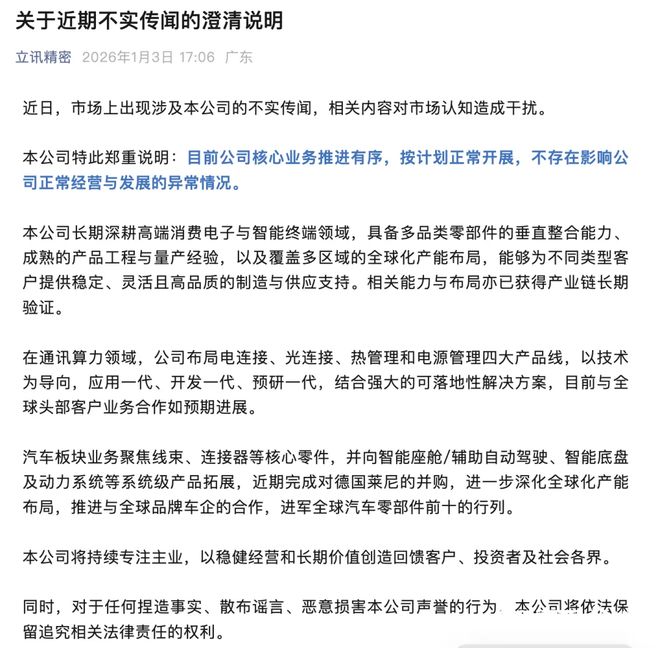
疑回应丢单传闻,立讯精密澄清:公司核心业务按计划正常开展
Nan Fang Du Shi Bao· 2026-01-04 05:28
Core Viewpoint - The company, Luxshare Precision, has issued a clarification regarding recent false rumors that have affected market perception, asserting that its core business operations are proceeding as planned without any abnormal situations impacting its normal operations [1] Group 1: Business Operations - The company emphasizes that its core business is progressing smoothly and as scheduled, with no disruptions to its operations [1] - In the communications and computing power sector, Luxshare Precision is focusing on four product lines: electrical connections, optical connections, thermal management, and power management, and is collaborating with leading global clients as expected [3] Group 2: AI Hardware and Competition - Recent reports indicated that OpenAI's first AI hardware product, initially planned to be manufactured by Luxshare Precision, has been shifted to Foxconn due to production location considerations, raising concerns about Luxshare's competitiveness in the AI hardware sector [3] - The new AI product is expected to take the form of a smart pen or portable audio device, with a design phase currently underway and a planned launch in 2026 or 2027 [3] Group 3: Automotive Business Development - Luxshare Precision has disclosed advancements in its automotive sector, focusing on core components such as wiring harnesses and connectors, and expanding into system-level products like smart cockpits and smart chassis [4] - The company has completed the acquisition of Germany's Leoni to enhance its global production capacity, aiming to rank among the top ten global automotive parts suppliers [4] Group 4: Market Performance - As of December 31, 2025, Luxshare Precision's stock closed at 56.71 yuan per share, reflecting a decline of 2.34%, with a market capitalization of 413.2 billion yuan [5]

OpenAI硬件产品代工生变?立讯精密发布澄清说明 产业人士:重大创新型终端临时更换供应安排不合常识
Mei Ri Jing Ji Xin Wen· 2026-01-04 03:01
Group 1 - The company, Luxshare Precision (SZ002475), issued a clarification on January 3, addressing recent false rumors and stated that its core business is progressing smoothly and operating normally without any unusual circumstances affecting its operations and development [1] - Media reports indicated that OpenAI's first AI terminal hardware product was initially planned to be manufactured by Luxshare Precision but was later exclusively entrusted to Foxconn due to production location considerations. This product is currently in the design phase and is expected to launch between 2026 and 2027 [3] - An industry insider noted that significant innovative terminal products typically maintain a stable assembly and core supply chain system during the prototype and mass production preparation stages, and sudden changes in supply arrangements without substantial reasons are not consistent with industry norms [3] Group 2 - Luxshare Precision previously mentioned in an investor relations activity record from November 2025 that no single product form has perfectly matched AGI (Artificial General Intelligence) yet. It highlighted that glasses and earphones are currently considered the closest hardware products to AI carriers, with many clients actively exploring new attempts in these categories, expecting various product forms to emerge in 2026 [4] - The evolution of the final product form is still in the exploratory stage and is closely related to the development cycle of AI technology. Current AI capabilities may match specific hardware forms, and as AI enters a new development cycle in the next 3 to 5 years, hardware forms may also change accordingly. Significant transformations and explosive growth in AI hardware are anticipated between 2026 and 2027 [4]

腾讯研究院AI速递 20260104
腾讯研究院· 2026-01-03 16:01
Group 1 - DeepSeek team released a new paper titled "Manifold-Constrained Hyper-Connections," co-authored by founder Liang Wenfeng, proposing the mHC scheme to stabilize large model training and enhance scalability [1] - The mHC scheme projects the residual mapping matrix onto a double-random matrix manifold space, preserving topological expressiveness while restoring the identity mapping property, controlling the signal amplification factor from 3000 to 1.6 [1] - Experiments with a 27B model show that mHC outperforms traditional HC across tasks like BBH and DROP, introducing only a 6.7% training time overhead, with a maximum improvement of 2.3 percentage points [1] Group 2 - Claude Code, launched 6 months ago, generated nearly $1 billion in annualized revenue, with project lead Boris Cherny confirming that 100% of code was completed by Claude Code in the past 30 days [2] - Key configurations include running 5 Claude instances in parallel on terminals, 5-10 Claude instances on the web, utilizing the Opus 4.5 model, and team collaboration through CLAUDE.md files integrated via GitHub actions [2] - Important techniques involve planning mode, slash command encapsulation for workflows, sub-agent handling of repetitive tasks, and PostToolUse hook for code formatting, with feedback loops for Claude to validate its work [2] Group 3 - Tesla's FSD V14.2 successfully completed a cross-country drive from Los Angeles to South Carolina in a 2025 Model 3, covering 2732.4 miles with zero human intervention, including parking and charging [3] - FSD V14.2 or pre-installed Grok shows significant enhancements in driving performance, perception capabilities, and decision-making logic, handling complex intersections and lane changes more decisively, resulting in a more human-like driving rhythm [3] - Tesla's end-to-end architecture contrasts with Waymo's modular approach, as demonstrated by a power outage in San Francisco that disrupted Waymo's operations, while Tesla's FSD remained largely unaffected [3] Group 4 - OpenAI is developing its first AI hardware, potentially a pen-shaped device or portable audio device, codenamed "Gumdrop," which integrates a microphone and camera to convert handwritten notes into text for ChatGPT [4] - The device is similar in size to an iPod Shuffle and aims to become the "third core device" following the iPhone and MacBook, initially planned for production by Luxshare Precision, later shifted to Foxconn, with manufacturing expected in Vietnam or the US [4] - OpenAI is also working on a new audio model architecture set to launch in Q1 2026, promising more natural emotional voices, more accurate and in-depth responses, and improved interruption handling capabilities [4] Group 5 - TSMC's N2 technology is set to enter mass production in Q4 2025, utilizing the first-generation nanosheet transistor (GAA) technology, achieving a 10%-15% performance improvement at the same power level compared to N3E, and a 25%-30% reduction in power consumption at the same speed [6] - The N2 process employs gate-all-around nanosheet transistors that wrap around the current channel, combined with SHPMIM capacitors, resulting in approximately a 20% increase in transistor density and over a 2x increase in capacitance density compared to N3E [6] - TSMC is expanding production simultaneously at its Kaohsiung and Hsinchu fabs, catering to both mobile and AI/HPC chip markets, with N2P and A16 expected to enter mass production in the second half of 2026 [6] Group 6 - Zhiyuan announced the launch of a "small-sized full-body force-controlled humanoid robot," named Q1, standing approximately 0.8 meters tall and capable of fitting into a 30-35L backpack, utilizing innovative materials and control algorithms to shrink QDD joints to "smaller than an egg" while maintaining full-size force control performance [7] - The Q1 robot employs advanced composite material technology for durability and is only 1/8 the size and weight of full-sized robots, with an open-source SDK and HDK supporting 3D printing for custom appearances [7] - It features the "Zhiyuan Lingxin" AI platform for natural conversation and encyclopedic Q&A, and through the "Zhiyuan Lingchuang" platform, users can arrange actions and logic like building blocks, positioning it as a desktop robot for individual creators [7] Group 7 - Elon Musk announced that Neuralink will begin large-scale production of brain-machine interface devices in 2026, transitioning to a streamlined, nearly fully automated surgical process, with electrode wires passing through the dura mater without the need for removal [8] - The new minimally invasive technology reduces costs, lowers risks, and shortens recovery times, making standardization more accessible; as of September 2025, Neuralink had served only 12 patients, increasing to 20 by December [8] - Founded in 2016, Neuralink focuses on treating neurological disorders such as paralysis, muscular atrophy, and Parkinson's disease, with the first patient, Noland Arbaugh, able to post and play games using only the brain chip post-surgery [8] Group 8 - Meta faced criticism from Turing Award winner LeCun after his departure, alleging that Llama 4's testing results were manipulated by using different models on various benchmarks to achieve better scores, leading to a loss of confidence from Zuckerberg in the original AI team [9] - LeCun criticized his 28-year-old supervisor, Alexandr Wang, for lacking research experience and understanding of research methodologies, asserting that Meta's hiring practices have led to a team overly influenced by large language models [9] - LeCun has founded AMI Labs, focusing on world models, with plans to release a "baby-level" model with preliminary physical intuition within 12 months, emphasizing the need for models to understand the physical world's operations rather than relying solely on language [9]

报道:OpenAI首款“AI硬件”是“智能笔”或“音频设备”,由鸿海独家代工,预计今年或明年推出
硬AI· 2026-01-02 07:48
Group 1 - The core viewpoint is that Hon Hai has successfully achieved a comprehensive order coverage for OpenAI, from "cloud" (AI servers) to "end" (terminal devices), leading the contract manufacturing industry in establishing a closed-loop layout for the OpenAI ecosystem [2][7]. - OpenAI's first "AI hardware" is expected to be exclusively manufactured by Hon Hai, with a market launch anticipated in 2026 or 2027 [3]. - The new product is likely to be a "smart pen" or a wearable audio device, designed by the renowned former Apple designer Jony Ive [4][9]. Group 2 - The hardware project, internally named "Gumdrop" by OpenAI, was initially planned to be manufactured by Luxshare Precision but was ultimately secured by Hon Hai [6]. - Production is confirmed to take place in Hon Hai's Vietnam factory, with the possibility of utilizing its U.S. factory as well [7]. - The product is characterized by its compact size, similar to an iPod Shuffle, and features such as a microphone and camera to perceive user environments [13].

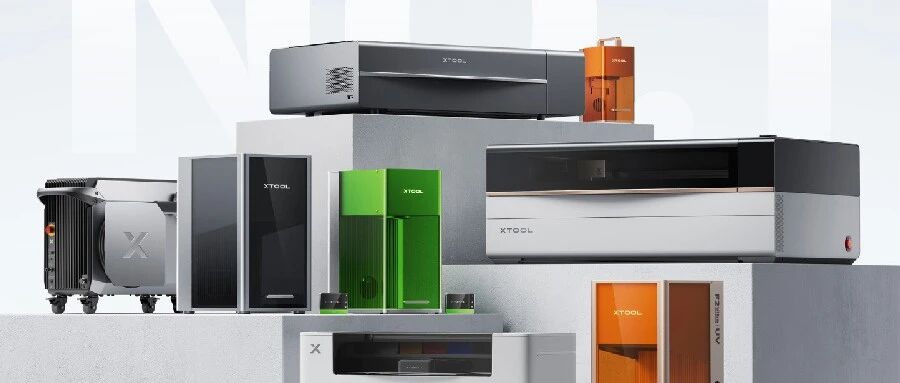
xTool冲刺港交所:全球最大的激光类个人创意工具品牌,海外收入占比97%
IPO早知道· 2026-01-02 01:39
Core Viewpoint - xTool Innovate Limited is set to go public on the Hong Kong Stock Exchange, aiming to leverage its strong market position in the high-end consumer technology sector, particularly in laser engraving and cutting tools, to attract investment and expand its global footprint [2][3]. Company Overview - Founded in 2013, xTool focuses on providing intelligent laser tools and material printers for individual consumers, small business owners, and retail stores, enabling creative production from digital to physical [3]. - As of September 30, 2025, xTool has sold over 405,000 connected devices globally, with a significant market presence in the laser product segment [3]. Market Position - xTool holds the largest market share in the global laser personal creative tools sector, with a 37% share based on GMV for the first three quarters of 2025, and dominates the laser engraving and cutting machine market with a 47% share, significantly outpacing its competitors [4]. - The company has achieved a high level of brand recognition, with 97% of its revenue coming from overseas markets, primarily in developed regions [4]. Product and Technology - xTool's products are priced 10%-30% higher than the industry average due to their advanced technology and precise product definitions, allowing the brand to maintain high sales volumes and premium pricing [4]. - The company integrates advanced optical technology, intelligent CNC control, and AI algorithms to enhance product innovation and user experience, with a focus on continuous improvement through its AI-driven platform, AIMake [6]. Financial Performance - xTool's revenue for 2023 and 2024 was 1.457 billion yuan and 2.475 billion yuan, respectively, reflecting a year-on-year growth of 70%. For the first three quarters of 2025, revenue grew by 18.6% to 1.777 billion yuan [7]. - The company has demonstrated strong gross margins of 59.2%, 54.4%, and 56.0% for 2023, 2024, and the first three quarters of 2025, respectively, with a notable seasonal revenue pattern peaking in the fourth quarter [7]. Community Engagement - xTool emphasizes community engagement, with 80% of users utilizing their devices at least once a month and 40% daily. The company has established a vibrant online community with over 212,000 active users [5]. - The brand has also created 470 offline communities across 32 countries, enhancing customer interaction and product experience [5]. Investment and Future Growth - xTool has attracted significant investment from notable firms, completing a $200 million Series D funding round in the second half of 2025, led by Tencent [8]. - The company plans to use IPO proceeds to enhance R&D, expand its user community, improve manufacturing capabilities, and strengthen its supply chain resilience [8]. - The global market for technology-enabled personal creative tools is projected to grow at a compound annual growth rate of 33.8% from 2024 to 2030, reaching $39.1 billion by 2030 [8].
从运动相机到会议硬件,影石跨界联手腾讯,重构音频体验?
Cai Jing Wang· 2025-12-31 14:26
Core Viewpoint - The collaboration between Insta360 and Tencent aims to address audio challenges in indoor meetings, remote collaboration, and professional content creation through the launch of the Wave AI omnidirectional microphone [1][2]. Group 1: Product Development and Features - The Wave AI microphone integrates Tencent's Tianlai Inside solution, focusing on enhancing online communication experiences that often lag behind in-person interactions due to issues like echo and noise [1]. - The product is designed to excel in complex acoustic environments, balancing clarity and intelligibility of speech across different distances and scenarios [4]. - The development process spanned over 600 days, involving more than ten hardware iterations and over 100 software version updates, indicating a rigorous approach to product refinement [4]. Group 2: Strategic Collaboration - Insta360 chose to partner with Tencent rather than building its own algorithm modules, leveraging Tencent's expertise in AI technologies such as directional sound pickup, noise reduction, and echo cancellation [2]. - Both companies share a commitment to craftsmanship and quality, with Tencent focusing on ecosystem development and Insta360 bringing extensive experience in audio-visual technology [3]. - The collaboration allows for a comprehensive solution that meets the complex demands of the meeting industry, positioning both companies to effectively serve users' needs [3][4]. Group 3: Market Positioning and User Engagement - Insta360's entry into the B2B meeting sector is supported by a strategy that emphasizes providing complete solutions rather than standalone products, catering to user needs through partnerships with agents and integrators [4]. - The core logic behind product development remains consistent across different environments, focusing on delivering value that encourages customer purchase [4].

主动权益基金年度榜单揭晓:永赢科技智选A以年度回报233.29%折桂,东吴新趋势价值线三年回报274%问鼎
Xin Lang Cai Jing· 2025-12-31 14:13
Group 1 - The annual report of public funds for 2025 shows significant performance, with the top fund, Yongying Technology Smart A, achieving a return of 233.29% and a scale of 11.52 billion [1][9] - The second and third positions are held by Zhonghang Opportunity Leading A with a return of 168.92% and Hongtu Innovation Emerging Industry A with a return of 148.64%, with scales of 13.23 billion and 14.86 billion respectively [1][9] - The total scale of public funds reached 35.89 trillion, an increase of 3.65 trillion from the beginning of the year, with a total of 13,610 funds [5][13] Group 2 - Looking ahead to 2026, the core theme of market opportunities is expected to be driven by AI-induced industrial transformation, with a focus on fundamental verification rather than liquidity-driven optimism [2][10] - The cloud computing sector is anticipated to see sustained growth in demand due to the acceleration of AI applications, alongside stable competition in core areas like optical communication and PCB [2][10] - The investment focus is shifting from AI hardware to application sectors, particularly in smart driving, AI hardware (such as AI phones and AR glasses), and humanoid robots [3][11] Group 3 - The performance of funds over the past three years shows Dongwu New Trend Value Line leading with a cumulative return of 273.85%, followed by Dongwu Mobile Internet A at 262.23% and Huaxia North Exchange Innovation Small and Medium Enterprises Selection at 260.42% [3][11] - The bottom performers include Huafu Medical Innovation A with a return of -26.15% and CITIC Construction Low Carbon Growth A with a return of -51.87% over three years [4][12] - The public fund market has experienced sharp performance differentiation amid macro narrative changes, highlighting the potential for high-quality growth in the coming years [8][15]
