
流动性管理

Search documents
央行:开展6000亿元MLF操作 期限为1年期
Di Yi Cai Jing· 2025-09-24 09:29
Core Viewpoint - The People's Bank of China (PBOC) is conducting a 600 billion MLF operation to maintain liquidity in the banking system with a one-year term [1] Group 1 - The PBOC will implement a fixed quantity, interest rate tender, and multiple price bidding method for the MLF operation [1] - The operation is scheduled for September 25, 2025, which is a Thursday [1] - The total amount for the MLF operation is set at 600 billion yuan [1]
债市日报:9月24日
Xin Hua Cai Jing· 2025-09-24 08:30
Core Viewpoint - The bond market is experiencing a correction, with government bond futures declining and interbank bond yields rising, indicating tightening liquidity as the month-end approaches [1][2]. Market Performance - Government bond futures closed lower across the board, with the 30-year main contract down 0.41% to 114.070, marking a new closing low since March 19 [2]. - Interbank bond yields mostly increased, with the 30-year government bond yield rising 1.3 basis points to 2.112% and the 10-year government bond yield up 1.4 basis points to 1.812% [2]. Overseas Bond Market - In North America, U.S. Treasury yields fell across the board, with the 10-year yield down 4.06 basis points to 4.106% [3]. - In Asia, Japanese bond yields also decreased, while in the Eurozone, the 10-year French bond yield rose by 0.4 basis points to 3.561% [3]. Primary Market - The Ministry of Finance's weighted average bid yields for 91-day and 182-day government bonds were 1.2473% and 1.3405%, respectively, with bid-to-cover ratios of 2.84 and 2.31 [4]. Liquidity Conditions - The central bank conducted a 7-day reverse repo operation of 401.5 billion yuan at a rate of 1.40%, resulting in a net withdrawal of 17 billion yuan for the day [5]. - Short-term Shibor rates increased, with the overnight rate rising 2.1 basis points to 1.434% [5]. Institutional Perspectives - Citic Securities noted that the urgency for the central bank to restart government bond trading is not strong in the short term, but the increased bond purchases by state-owned banks reflect a relatively loose liquidity environment [6]. - China International Capital Corporation (CICC) observed that while the bond market is experiencing volatility, credit bonds in the short to medium term are performing relatively well [7].
当前持有货基的正确姿势:流动性管理>收益预期
Xin Lang Ji Jin· 2025-09-23 05:37
Group 1 - The core value of money market funds is not high returns but liquidity management, especially in a low-interest-rate environment [1] - Money market funds are characterized as low-risk, low-return, and high liquidity investment tools suitable for short-term fund management [1] - Compared to bank fixed deposits, money market funds offer superior liquidity, allowing for immediate purchase and redemption without prior appointment [1] Group 2 - Despite the overall decline in money market fund yields, investors can adopt reasonable management strategies to optimize the use of "liquid funds" [1] - Funds needed in the short term can be placed in money market funds for easy access, while funds that may not be used for three months or longer can be allocated to slightly less liquid but higher-yield products [1] - The integration of money market funds into daily life through services like Yu'ebao and WeChat's "零钱通" enhances their utility for both payment and investment [1]
央行14天期逆回购操作调整,银行ETF天弘(515290)涨超1.2%,港股通央企红利ETF天弘(159281)换手率居同标的第一
2 1 Shi Ji Jing Ji Bao Dao· 2025-09-23 02:53
Group 1 - The A-share market saw a collective decline in the three major indices on September 23, while the banking sector experienced an increase, with the Tianhong Bank ETF (515290) rising by 1.21% and trading volume exceeding 450 million yuan [1] - Notable individual stocks within the banking sector included Nanjing Bank, which rose over 4%, along with Industrial and Commercial Bank of China, Suzhou Bank, Qilu Bank, and Hangzhou Bank also showing gains [1] - The Tianhong Bank ETF (515290) closely tracks the CSI Bank Index, which consists of up to 50 banking stocks from the CSI All Share Index, reflecting the overall performance of the banking sector [1] Group 2 - The People's Bank of China announced on September 19 that it would adjust the 14-day reverse repurchase operations to fixed quantity, interest rate bidding, and multiple price level bidding to maintain ample liquidity in the banking system [2] - This adjustment aims to enhance the policy status of the 7-day reverse repurchase operation rate and allows for flexible management of liquidity based on market conditions and institutional needs [2] - According to Wanlian Securities, 42 listed banks reported a year-on-year net profit growth of 3.0% for Q2 2025, with total assets growing by 9.6% year-on-year as of mid-2025 [2] Group 3 - Dongfang Securities believes that while the index may experience short-term fluctuations, the medium-term upward trend remains intact, with a focus on high-end manufacturing and low-cycle dividend themes [3] - The macroeconomic environment is currently at a low point for PPI, with expectations of recovery in PPI and industry profitability [3] - Companies with supply clearing and profit elasticity in industries undergoing policy changes may present attractive dividend opportunities [3]
银河证券:银行基本面积极因素持续积累,中期业绩改善,拐点可期
Zheng Quan Shi Bao Wang· 2025-09-23 00:35
Core Viewpoint - The adjustment of the 14-day reverse repurchase operation aims to strengthen the position of the 7-day reverse repurchase policy rate, enhancing liquidity management precision, with smaller banks expected to benefit less than larger banks [1] Group 1: Policy Adjustments - The adjustment in reverse repurchase operations is designed to improve liquidity management and reinforce the importance of the 7-day reverse repurchase rate [1] - The focus on enhancing liquidity management is expected to lead to a more precise control of monetary policy [1] Group 2: Market Impact - The ongoing consumer stimulus policies are being intensified, contributing to the accumulation of positive factors in the banking sector [1] - Mid-term performance improvements are anticipated, with a potential turning point in the banking sector's performance [1] Group 3: Future Considerations - Attention should be paid to the effectiveness of policies being released, as well as the demand for retail business and improvements in risk management [1] - Upcoming events such as the 20th Central Committee's Fourth Plenary Session and the 15th Five-Year Plan reform measures are crucial for future developments [1]

央行时隔8个月重启14天期逆回购操作 时点提前呵护资金面
Shang Hai Zheng Quan Bao· 2025-09-22 23:35
Core Viewpoint - The central bank has resumed 14-day reverse repo operations after an 8-month hiatus, indicating a moderately accommodative monetary policy stance to ensure liquidity ahead of the upcoming holidays [1][2]. Group 1: Central Bank Operations - The central bank conducted a 300 billion yuan 14-day reverse repo operation and a 240.5 billion yuan 7-day reverse repo operation, aimed at providing liquidity before the holiday [1]. - The initiation of the 14-day reverse repo operation is earlier than in previous years, which helps alleviate the preventive funding needs of institutions before the quarter-end and holiday [2]. - The 14-day reverse repo operation has shifted to a "American-style bidding" process, allowing for fixed quantity, interest rate bidding, and multiple price bids, which is expected to enhance liquidity management [2][3]. Group 2: Market Liquidity and Challenges - Despite the central bank's efforts to inject liquidity, the market still faces significant liquidity pressure due to large-scale fund expirations and various disruptive factors [4]. - The upcoming week will see 1.83 trillion yuan in expiring funds, with significant expirations on specific days, which may impact overnight funding rates [4]. - Additional liquidity pressures arise from the listing of a new entity, expected to freeze around 600 billion yuan, and the expiration of a 300 billion yuan 1-year MLF [4]. Group 3: Future Outlook - Experts anticipate that the central bank will flexibly combine long, medium, and short-term operations to smooth out liquidity injection and absorption rhythms, leading to more precise and efficient liquidity management [6]. - The frequency of 14-day reverse repo operations is expected to normalize, potentially reducing the weighted cost of bank liabilities [6]. - The central bank is likely to continue using various policy tools, including reverse repos and MLF, to inject medium-term liquidity and limit the upward pressure on mid-to-long-term market interest rates [6].
什么信号?3000亿元,央行首次出手
Zhong Guo Ji Jin Bao· 2025-09-22 23:05
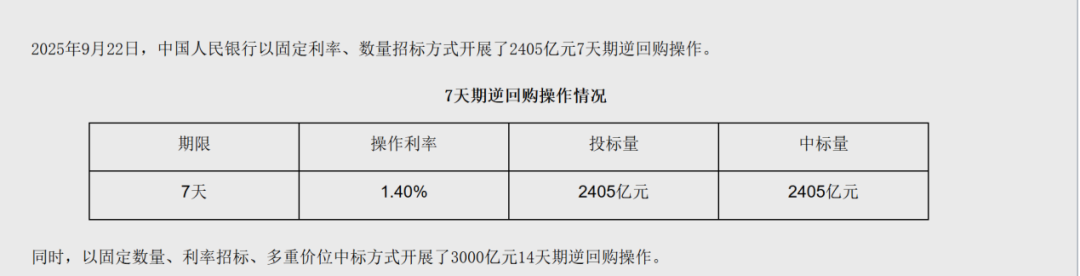
Core Viewpoint - The People's Bank of China (PBOC) has conducted a significant reverse repurchase operation, indicating a proactive approach to manage liquidity in the banking system, particularly ahead of the quarter-end and holiday periods [1][12]. Group 1: Reverse Repo Operations - On September 22, the PBOC conducted a 7-day reverse repo operation amounting to 240.5 billion yuan at a fixed rate of 1.40% [1][3]. - The PBOC also initiated a 14-day reverse repo operation for the first time in eight months, amounting to 300 billion yuan, using a multi-price bidding method [1][3]. - The adjustment in the bidding method for the 14-day reverse repo aims to enhance market pricing capabilities and better match differentiated funding needs [3][12]. Group 2: Market Reactions - On the same day, the treasury reverse repo rates surged, with 1-day, 2-day, and 3-day rates increasing by over 20% [4]. - Market liquidity has improved due to the PBOC's continuous net injection through open market operations, although cross-quarter factors may still cause disturbances [11]. Group 3: Future Implications - The PBOC's adjustment to the 14-day reverse repo operation is expected to provide more regular liquidity support, particularly during tax periods and month-end [12][13]. - The move is seen as a way to strengthen the 7-day reverse repo rate's position as a key policy rate, aiding in macro-prudential management of the bond market [12][13]. - The PBOC aims to create a more stable and transparent liquidity environment, showcasing a forward-looking and flexible monetary policy approach [13].

什么信号?央行首次出手!
中国基金报· 2025-09-22 14:33
Core Viewpoint - The People's Bank of China (PBOC) has initiated a 300 billion yuan 14-day reverse repurchase operation, marking a significant adjustment in its liquidity management strategy to better meet the differentiated funding needs of various institutions [2][10]. Summary by Sections Reverse Repo Operations - On September 22, the PBOC conducted a 240.5 billion yuan 7-day reverse repo operation and a 300 billion yuan 14-day reverse repo operation, the latter being the first since the adjustment of operational rules announced on September 19 [2][3]. - The adjustment allows for a multi-price bidding method for the 14-day reverse repo, enhancing market-driven pricing and better matching of diverse funding demands [3][10]. Market Reactions - On the same day, the treasury reverse repo rates surged, with 1-day, 2-day, and 3-day rates increasing by over 20% at one point [5]. - Market liquidity has improved due to the PBOC's continuous net injection, although cross-quarter factors may still cause disturbances [8]. Implications of the New Rules - The new operational framework for the 14-day reverse repo aligns it with the rules for Medium-term Lending Facility (MLF) and other reverse repos, reinforcing the 7-day reverse repo rate as a key policy rate [10]. - This change is expected to alleviate pressure on banks' net interest margins and lower their funding costs, while also ensuring liquidity remains ample during critical periods such as tax deadlines and holidays [11]. Future Outlook - The PBOC is likely to regularize the frequency of 14-day reverse repo operations to support liquidity needs around tax periods and month-end [10][11]. - The timing of this operation is slightly earlier than in previous years, indicating a proactive approach to managing seasonal liquidity demands [11].
一周流动性观察 | 央行重启14天逆回购护航跨季跨节资金 流动性压力预计边际缓解
Zhong Guo Jin Rong Xin Xi Wang· 2025-09-22 02:55
Core Viewpoint - The People's Bank of China (PBOC) is actively managing liquidity through various monetary policy tools, including reverse repos, to maintain stability in the financial system amid seasonal pressures and external factors [1][2][3]. Group 1: Monetary Policy Operations - On September 22, the PBOC conducted a 240.5 billion yuan 7-day reverse repo operation at an interest rate of 1.40% and a 300 billion yuan 14-day reverse repo operation using a fixed quantity, interest rate bidding, and multiple price bidding method [1]. - The net injection of liquidity in the open market for the week of September 15-19 was 562.3 billion yuan, with a total net injection of 300 billion yuan for the month [1][2]. - The PBOC's adjustment of the 14-day reverse repo operation to a fixed quantity and multiple price bidding is aimed at better reflecting the differentiated funding needs of institutions and may effectively lower interest rates [3][4]. Group 2: Market Reactions and Expectations - The liquidity pressure in the market increased during the tax payment period, with R001 and R007 rates rising to 1.55% and 1.56%, respectively, before the PBOC increased its liquidity injection to alleviate the pressure [2]. - Analysts expect that the PBOC will continue to maintain a supportive stance through reasonable open market operations, with the month-end 7-day funding rate likely to be around 10-20 basis points above the reverse repo rate [3][4]. - The recent stability in the Loan Prime Rate (LPR) reflects the current macroeconomic conditions, with expectations for potential interest rate cuts in the fourth quarter to stimulate domestic demand [5].
14天期逆回购机制迎调整 央行释放何种信号
Jin Rong Shi Bao· 2025-09-22 01:03
Core Viewpoint - The People's Bank of China (PBOC) has announced adjustments to the 14-day reverse repurchase operations, shifting to a fixed quantity, interest rate bidding, and multiple price bidding, indicating a moderately loose monetary policy approach [1][2]. Group 1: Monetary Policy Adjustments - The initiation of the 14-day reverse repurchase operation ahead of the National Day holiday aims to provide liquidity for institutions, ensuring ample funds across the holiday period [1]. - The actual occupation period for this operation has been extended to 17 days, which is earlier than in previous years, enhancing liquidity management before the holiday [1]. - The PBOC has already injected 300 billion yuan through reverse repos, which helps alleviate the preventive funding needs of institutions before the quarter-end and holiday [1]. Group 2: Changes in Operation Framework - The 14-day reverse repurchase operation has transitioned from a fixed interest rate to an American-style bidding process, reinforcing the policy rate status of the 7-day reverse repurchase rate [2]. - This change allows for a more market-driven pricing mechanism, reflecting the differentiated funding needs of institutions, as the previous operation had a uniform bidding rate [2]. - The PBOC's announcement indicates that the timing and scale of the 14-day reverse repurchase operations will be determined based on liquidity management needs, allowing for more flexible and efficient liquidity management in the future [2].