硅光技术

Search documents
通信光芯片行业自主可控通信光芯片行业自主可控
2025-05-12 01:48
Summary of the Conference Call on Optical Chip Industry Industry Overview - The optical chip industry is experiencing a shift towards self-sufficiency, with global production capacity expected to ease from 30 million units in the early AI boom to over 90 million units by 2024, meeting market demand, although high-end optical chips (100G and above) still rely on suppliers from the US and Japan [1][2][20]. Key Points and Arguments - **Market Position**: Domestic optical module manufacturers hold a significant position in the global market, but they lag in high-end optical chip technology, particularly in indium phosphide substrates and Vixel special processes, with a technological gap of approximately 3 to 5 years compared to international leaders [1][3][27]. - **Market Evolution**: The optical module market is evolving towards optoelectronic integration solutions to address power consumption and heat dissipation issues in data centers, with silicon photonics expected to play a crucial role in high-speed data communication [1][5][6]. - **Domestic Production**: Progress in domestic production of 25G and below optical chips is satisfactory, but self-sufficiency in 25G and above remains low, with a domestic production rate of less than 5% for 100G and above products [1][10][11]. - **Challenges for Domestic Companies**: Companies like Yuanjie Technology and Shijia Photon face challenges such as insufficient mass production capacity and low yield rates, leading to higher costs and difficulties in competing with international firms [1][12][27]. - **Emerging Technologies**: Silicon photonics is seen as a key future direction, with major players like TSMC and Intel investing heavily in this area. The integration of optical components into CMOS technology is expected to enhance data center capabilities [6][14][18]. Additional Important Insights - **Global Competition**: The global optical chip market is dominated by five companies (Broadcom, Lumentum, Coherent, and Japan's Sumitomo and Mitsubishi), which collectively hold over 90% market share. The production capacity for 100G and above optical chips is primarily led by US and Japanese manufacturers [2][20][26]. - **Domestic Market Dynamics**: Domestic companies are increasingly investing in upstream industries and independent research to adapt to future market changes, with a focus on high-end and high-speed product development [16][17]. - **Market Demand**: Demand for optical chips is concentrated in data centers, telecom operators, and AI data centers, with significant needs from companies like Alibaba, Tencent, and Huawei [19][20]. - **Production Capacity and Yield**: The production capacity for 25G optical chips in China is around one million units annually, but still falls short of the ten million mark. The self-sufficiency rate for 25G is approximately 50%, while it is about 20% for 50G [9][10][22]. - **Future Projections**: By 2028, silicon photonics is expected to mature, capturing over 50% of the market share in high-speed communication, while traditional optical modules will continue to dominate in lower-speed applications [13][14]. This summary encapsulates the critical insights from the conference call regarding the optical chip industry, highlighting the current state, challenges, and future directions of the market.

罗博特科(300757) - 300757罗博特科投资者关系管理信息20250509
2025-05-09 02:00
Group 1: Company Performance and Financial Outlook - In Q1 2025, the company's revenue declined by 63%, with a net loss of over 26 million [6] - The company anticipates that the optical electronics business will gradually improve its revenue and net profit due to ongoing projects and orders [7] - The company expects to see a significant increase in production capacity to meet customer delivery requirements after the acquisition of ficonTEC is completed [4] Group 2: ficonTEC Acquisition and Integration - The acquisition of ficonTEC has been approved by the China Securities Regulatory Commission, and it will become a wholly-owned subsidiary of the company [4][13] - The integration of ficonTEC is expected to enhance operational efficiency and reduce production costs, contributing positively to the company's performance [3][4] - The company plans to implement a "dual headquarters" global layout to better serve customers in the Asia-Pacific region while expanding overseas [4] Group 3: Market Demand and Customer Orders - ficonTEC has secured orders from major clients, including Tesat-Spacecom GmbH, a subsidiary of Airbus, and other leading companies in the satellite communication sector [3] - The company is actively expanding its service capabilities in Southeast Asia, Taiwan, and South Korea to meet the growing demand for Co-Packaged Optics (CPO) and optical transceiver technologies [7] - The domestic market for ficonTEC's equipment is expected to grow significantly, with increasing collaboration with major Chinese companies like Huawei and others [11] Group 4: Technology and Product Development - ficonTEC has developed equipment to enhance yield rates in wafer and chip manufacturing, which has been showcased at industry events [13] - The company is focusing on advancing its technology in the photonics field, with applications in data communication, AI, and quantum computing [13] - The company is a core member of the Taiwan Silicon Photonics Industry Alliance, collaborating with top semiconductor companies to promote the commercialization of silicon photonics technology [13] Group 5: Challenges and Market Conditions - The company faces challenges due to cyclical demand fluctuations in the photovoltaic industry, which have impacted its equipment segment [6][24] - Concerns have been raised regarding the low yield rates of the CPO project with NVIDIA and TSMC, but the company assures that measures are in place to improve these rates [6] - The company is closely monitoring geopolitical situations, such as the India-Pakistan tensions, to mitigate any potential impacts on its operations in India [15]

中际旭创(300308):盈利能力持续提升 高速光模块持续放量
Xin Lang Cai Jing· 2025-04-29 02:50
Core Viewpoint - The company reported significant revenue and profit growth for 2024 and Q1 2025, driven by high-end product sales and improved operational efficiency [1][2][3] Financial Performance - In 2024, the company achieved revenue of 23.863 billion yuan, a year-on-year increase of 122.64%, and a net profit of 5.171 billion yuan, up 137.93% [1] - For Q1 2025, revenue reached 6.674 billion yuan, growing 37.82% year-on-year, with a net profit of 1.583 billion yuan, an increase of 56.39% [1] - The gross margin for 2024 was 33.80%, up 0.81 percentage points, while the net margin was 22.51%, an increase of 1.91 percentage points [1] - Q1 2025 gross margin was 36.70%, a quarter-on-quarter increase of 1.62 percentage points, and net margin was 25.33%, up 2.42 percentage points [1] Cost Management - Sales expense ratio decreased to 0.84%, down 0.32 percentage points year-on-year; management expense ratio was 2.85%, down 1.19 percentage points; R&D expense ratio was 5.21%, down 1.69 percentage points [1] Product Development and Market Trends - The company is experiencing increased demand for 800G and 400G products, with significant growth in shipments due to both domestic and overseas customer demand [2][3] - The introduction of new tariff policies has allowed for zero tariffs on shipments from Thailand, enhancing the company's competitive position [2] - The company has developed advanced technologies in silicon photonics and coherent optics, with a focus on high-end products [3] Future Outlook - The company is positioned as a leader in the optical module market, with expectations for rapid adoption of 800G products domestically and potential demand for 1.6T and 3.2T products overseas [4] - Projected net profits for 2025-2027 are 7.256 billion yuan, 9.163 billion yuan, and 10.542 billion yuan, respectively, with corresponding EPS of 6.57 yuan, 8.29 yuan, and 9.54 yuan [4]

研判2025!中国光通信系统行业产业链、市场规模及重点企业分析:技术迭代加速及算力升级,驱动千亿市场新增长[图]
Chan Ye Xin Xi Wang· 2025-04-27 01:25
Industry Overview - The Chinese optical communication system industry is experiencing market scale expansion, accelerated technological iteration, diversified competitive landscape, and strengthened policy support, showing steady overall development [1][13] - The market size of the optical communication system industry in China is projected to reach 215.4 billion yuan in 2024, with a year-on-year growth of 1.07% [1][13] - Technological advancements are moving towards ultra-high speed, large capacity, and low latency, with 400G optical networks already in commercial use and 800G/1.6T optical modules gradually being deployed [1][13] Technological Developments - Innovations such as silicon photonics and co-packaged optics (CPO) are driving power consumption reductions of over 50% [1][13] - The integration of quantum communication with optical communication provides new pathways for secure information transmission, while integrated optical technologies enhance device intelligence [1][13] Policy and Market Drivers - National policies such as "Broadband China" and "Three Networks Integration" are significantly promoting industry growth [1][13] - Emerging applications in computing networks and smart cities are expanding the boundaries of application, with AI model training driving the demand for upgraded computing infrastructure, further boosting the optical communication system market [1][13] Industry Development History - The optical communication system industry in China has undergone four main stages: early exploration (1970s), technological breakthroughs (1980s), rapid development and industrialization (1990s), and technological upgrades and globalization (2000s to present) [6][7] Industry Chain - The upstream of the optical communication system industry includes core components and basic materials, while the midstream involves R&D and production, and the downstream applications span telecommunications, data communications, consumer electronics, and more [9] Key Companies - Major players in the optical communication system industry include Huawei, ZTE, and FiberHome, which dominate the core markets of optical transmission and access equipment [15] - Companies like Zhongji Xuchuang and Xinyi Technology are gaining traction in the optical module and device segments through technological innovation and differentiated products [15] Market Trends - Technological innovation is the core driving force for the development of the optical communication system industry, with a focus on high speed, high integration, and low power consumption [21] - New application scenarios are expanding, including IoT and smart city initiatives, which will further increase the demand for optical communication devices [22][23] - International competition is intensifying, with Chinese optical communication companies needing to enhance their competitiveness in the global market [24]






中际旭创(300308):业绩符合预期 高端产品持续放量
Xin Lang Cai Jing· 2025-04-23 12:50
事件:公司发布2024 年业绩,2024 年公司实现营收238.6 亿元,同比+122.6%;归母净利润51.7 亿,同 比+137.9%;毛利率33.8%,同比+0.8pct。 4Q24 公司实现营收65.5 亿,同比+77.6%,环比+0.5%;归母净利润14.2亿,同比+61.7%,环比+1.8%。 1Q25 公司实现营收66.7 亿,同比+37.8%,环比+1.9%;归母净利润15.8 亿,同比+56.8%,环比 +11.6%。公司业绩符合市场预期。 投资要点 公司有望深度受益于2025 年800G、1.6T 需求高景气+硅光加速渗透。 我们认为2025 年产业需求有以下趋势:1)云厂在推理需求凸显+算力卡供应扩张+自建网络迭代三重趋 势下,2025 年对800G 光模块的需求将充分释放;2)英伟达继续保持软硬件系统在训练、训推一体上 的优势,同时自身客户结构持续优化,将进一步引领1.6T 等前沿产品的迭代与应用;3)硅光模块具备 缓解光芯片等物料短缺、承接硅基共封装趋势、降低成本三层产业逻辑,有望加速渗透。公司作为与大 客户联系紧密的全球头部厂商,能够对接到主流客户需求,同时扩产有序推进,在上游物料 ...
中际旭创(300308):2024年报及2025一季报点评:业绩符合预期,高端产品持续放量
Soochow Securities· 2025-04-23 11:35
Investment Rating - The investment rating for the company is "Buy" (maintained) [1] Core Views - The company's performance in 2024 met market expectations, with total revenue reaching 23.86 billion yuan, a year-on-year increase of 122.64%, and a net profit attributable to shareholders of 5.17 billion yuan, up 137.93% year-on-year [7] - The growth in the company's optical module shipments and prices is driven by increasing demand from AI computing [7] - The company is expected to benefit significantly from the high demand for 800G and 1.6T products in 2025, as well as the accelerated penetration of silicon photonics [7] Financial Summary - Total revenue forecast for 2024 is 23.86 billion yuan, with a projected growth rate of 122.64% [8] - Net profit attributable to shareholders for 2024 is forecasted at 5.17 billion yuan, with a year-on-year growth of 137.93% [8] - The company's earnings per share (EPS) for 2024 is estimated at 4.68 yuan, with a price-to-earnings (P/E) ratio of 17.10 [1][8] - The gross margin for the optical module business is expected to improve to 34.6% in 2024, up 0.5 percentage points year-on-year [7] - The company has a total market capitalization of approximately 88.45 billion yuan [5]
威腾电气:拟与深度湾、上海磐星设立合资公司 开展高速光模块/组等光通信产品业务
news flash· 2025-04-11 09:34
Core Viewpoint - The company plans to establish a joint venture named "Shanghai Weipu Xinguang Technology Co., Ltd." with Shanghai Deep Bay Technology and Shanghai Panxing Enterprise Management Partnership, with a registered capital of 30 million yuan [1] Group 1 - The company will contribute 15.3 million yuan, holding a 51% stake in the joint venture [1] - The joint venture will focus on the research, development, production, sales, and application of optical communication products based on silicon photonics technology and processes, including high-speed optical modules [1]

AI算力系列之CPO:光电融合渐成熟,规模化应用加速
Tianfeng Securities· 2025-04-03 01:54
Industry Rating - The industry investment rating is maintained at "Outperform the Market" [1] Core Viewpoints - CPO technology integrates ASIC chips and optical engines on the same high-speed motherboard, reducing signal attenuation, system power consumption, and costs while achieving high integration, applicable in data centers, high-performance computing, AI, and virtual reality [2] - The CPO market is expected to grow rapidly, with Yole predicting a market size of $2.6 billion by 2033, driven by AI demand and requiring collaboration across the industry chain [2] - Major overseas companies are leading the CPO industry development, with significant advancements from Broadcom, Marvell, TSMC, and NVIDIA [2][3] Summary by Sections 1. CPO Technology and Development Trends - CPO technology addresses bandwidth and power challenges, with a 25%-30% reduction in total power consumption for 51.2T switches compared to traditional solutions [12] - CPO technology offers low power consumption, low latency, high bandwidth, improved system performance, and cost-effectiveness [15] - Silicon photonics is becoming the main path for CPO technology due to its high integration and compatibility with CMOS processes [18] 2. CPO Market Size and Major Drivers - The CPO market is projected to grow at a CAGR of 69% from $600,000 in 2022 to $287 million in 2033, while OIO is expected to grow at a CAGR of 81% from $500,000 to $2.3 billion [31] - Major players in the CPO market include Broadcom, Intel, NVIDIA, and Marvell, with significant contributions from laser manufacturers and silicon photonics foundries [35] 3. CPO Switch Internal Structure - CPO switches consist of key components such as ASIC chips, optical engines, external light sources, and flexible optical backplanes [63] - The optical engine is crucial for optical-electrical conversion, with various packaging methods impacting performance and integration [67] 4. Recommended Companies to Watch - Companies actively involved in CPO technology include: - Zhongji Xuchuang, focusing on high-end optical communication modules and CPO-related products [96] - Xinyi Sheng, leveraging silicon photonics technology for CPO applications [101] - Tianfu Communication, developing multiple projects related to CPO components [106] - Taichuang, specializing in optical communication devices and flexible boards [111] - Yuanjie Technology, providing CW light sources for CPO applications [116] - Shijia Photon, offering components for CPO packaging [121] - Guangxun Technology, launching CPO ELS light source modules [126] - Robotech, focusing on silicon photonics and CPO packaging equipment [131] - Ruijie Network, releasing CPO switches with significant market presence [136]


英伟达,开启硅光新纪元
半导体行业观察· 2025-03-22 03:17
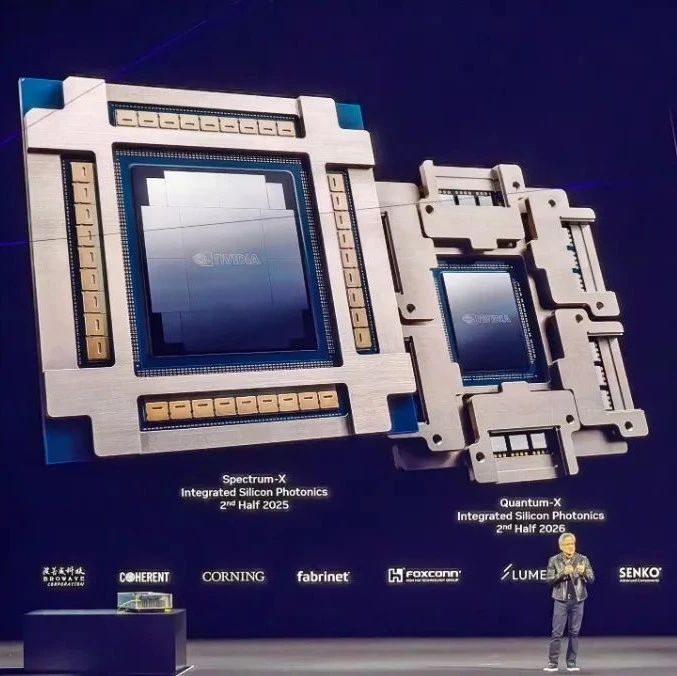
Core Viewpoint - NVIDIA's introduction of silicon photonics technology, specifically the Co-Packaged Optics (CPO), is set to revolutionize data center infrastructure by significantly reducing power consumption and enhancing network efficiency for AI computing clusters [1][11]. Group 1: NVIDIA's Innovations - NVIDIA announced its groundbreaking silicon photonics technology at the GTC2025 conference, which is expected to reduce data center power consumption by 40 megawatts [1]. - The Spectrum-X and Quantum-X silicon photonic network switches integrate electronic circuits with optical communication technology, enabling AI factories to interconnect millions of GPU clusters while lowering energy consumption and operational costs [1][2]. Group 2: Spectrum-X and Quantum-X Specifications - Spectrum-X offers configurations with up to 128 ports at 800 Gb/s or 512 ports at 200 Gb/s, achieving a total bandwidth of up to 100 Tb/s [2]. - Quantum-X features a throughput of 115.2 Tb/s with 144 ports, utilizing advanced cooling and silicon photonics technology to double AI computing speeds compared to previous generations [2][4]. Group 3: CPO Technology Advantages - CPO technology integrates ASIC and optical components, eliminating the need for separate DSP chips, which enhances overall module performance and significantly reduces data center power consumption [6]. - Compared to traditional pluggable optical modules, CPO can reduce power consumption by 30% in high-capacity switches [6]. Group 4: Challenges and Market Position - CPO modules face challenges such as fixed configurations that may limit flexibility, as failures in CPO systems require replacing the entire module rather than just the faulty part [8]. - Despite the advantages of CPO technology, pluggable optical modules remain the market standard due to their flexibility and established standardization [9]. Group 5: Future Outlook - The CPO technology marks the beginning of a transformative phase in the semiconductor and switching markets, with potential for accelerated growth in AI infrastructure as the technology matures [11]. - In the short term, CPO may be piloted in specific scenarios, while pluggable modules will continue to dominate; however, a hybrid "CPO + pluggable" architecture may emerge to meet varying application needs [11].
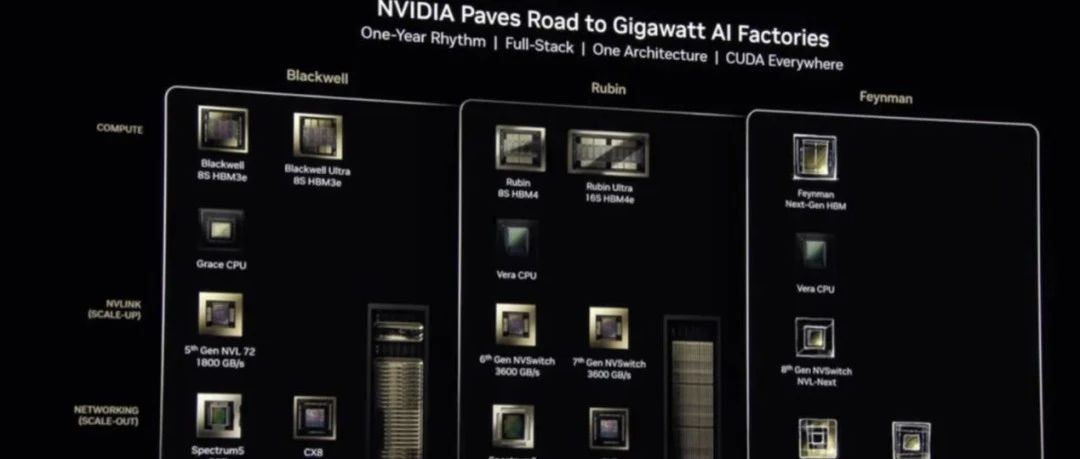
下一代GPU发布,硅光隆重登场,英伟达还能火多久?
半导体行业观察· 2025-03-19 00:54
Core Insights - The GTC event highlighted NVIDIA's advancements in AI and GPU technology, particularly the introduction of the Blackwell architecture and its Ultra variant, which promises significant performance improvements over previous models [1][3][5] - NVIDIA's CEO, Jensen Huang, emphasized the rapid evolution of AI technology and the increasing demand for high-performance computing in data centers, projecting that capital expenditures in this sector could exceed $1 trillion by 2028 [1][42][43] Blackwell Architecture - NVIDIA has announced that the four major cloud providers have purchased 3.6 million Blackwell chips this year, indicating strong demand [1] - The Blackwell Ultra platform features up to 288 GB of HBM3e memory and offers 1.5 times the FP4 computing power compared to the previous H100 architecture, significantly enhancing AI inference speed [3][4][5] - The Blackwell Ultra GPU (GB300) is designed to meet the needs of extended inference time, providing 20 petaflops of AI performance with increased memory capacity [3][4] Future Developments - NVIDIA plans to launch the Vera Rubin architecture in 2026, which will include a custom CPU and GPU, promising substantial performance improvements in AI training and inference [7][8][11] - The Rubin Ultra, set for release in 2027, will feature a configuration capable of delivering 15 exaflops of FP4 inference performance, significantly surpassing the capabilities of the Blackwell Ultra [12][81] Networking Innovations - NVIDIA is advancing its networking capabilities with the introduction of co-packaged optics (CPO) technology, which aims to reduce power consumption and improve efficiency in data center networks [14][17][21] - The Quantum-X and Spectrum-X switches, expected to launch in 2025 and 2026 respectively, will utilize CPO to enhance bandwidth and reduce operational costs in AI clusters [89][90] Market Context - Major companies like OpenAI and Meta are investing heavily in NVIDIA's technology, with OpenAI reportedly spending $100 billion on infrastructure that could house up to 400,000 NVIDIA AI chips [30] - Despite the technological advancements, NVIDIA's stock has faced volatility, with a notable decline following the GTC event, raising questions about the sustainability of its market dominance [31][32]