红利板块

Search documents
杠铃策略转向成长风格 ETF止盈资金寻找新方向
Zhong Guo Zheng Quan Bao· 2025-08-17 22:07
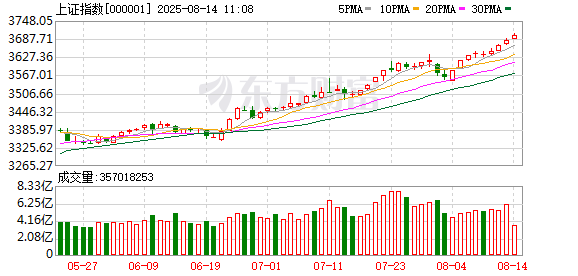
Market Overview - The A-share market remained active from August 11 to August 15, with the Shanghai Composite Index closing near 3700 points, marking a new high since September 2021 [1] - Financial technology, securities, battery, and optical module sectors showed strong performance, while banking and dividend-themed ETFs weakened [1][2] - The total trading volume of ETFs approached 2 trillion yuan, indicating a significant increase in trading activity [3] ETF Performance - Over 20 ETFs related to financial technology, securities, batteries, and optical modules rose over 10% last week, with individual stocks like Yingwei Ke, Xinyi Sheng, and Tonghuashun increasing over 20% [2] - The top-performing ETFs included those from Huaxia Fund, Bosera Fund, and E Fund, focusing on financial technology and new energy sectors [2] - Conversely, banking-themed ETFs experienced declines of around 3%, with some dividend and aerospace ETFs dropping over 1% [2] Fund Flow Trends - There is a noticeable trend of profit-taking in ETF funds, with significant outflows from ETFs like Huaxia's and Jiashi's technology-focused products, despite their price increases [3] - The total trading volume for stock and bond ETFs exceeded 500 billion and 700 billion yuan, respectively, with the E Fund's Hong Kong Securities ETF reaching a record weekly trading volume of nearly 120 billion yuan [3] - Funds have been flowing into leading broad-based and popular Hong Kong stock ETFs, indicating a shift in investor focus [3] Investment Strategy Shifts - The market has transitioned from a "bank + micro-disk" approach to pricing based on fundamental trends, particularly favoring growth sectors [4] - Analysts suggest a shift in investment strategies towards growth styles, with a notable switch between large-cap and small-cap stocks driven by valuation differences [4] - The focus is now on sectors with strong industrial trends, as growth leaders are attracting more investor attention due to their profitability potential [4] Future Market Outlook - Short-term market strategies may focus on "bull market synchronous assets," particularly in brokerage, insurance, military, and rare earth sectors [5] - The Hong Kong market is viewed positively, with a focus on pricing trends indicating it may offer better value in the short to medium term [5] - The market is currently experiencing a phase of concentrated hot spots across various sectors, with potential mainline directions including domestic technological breakthroughs and high global market share manufacturing [5]
A500指数周涨2.75%!38只基金全红丨A500ETF观察
2 1 Shi Ji Jing Ji Bao Dao· 2025-08-15 11:43
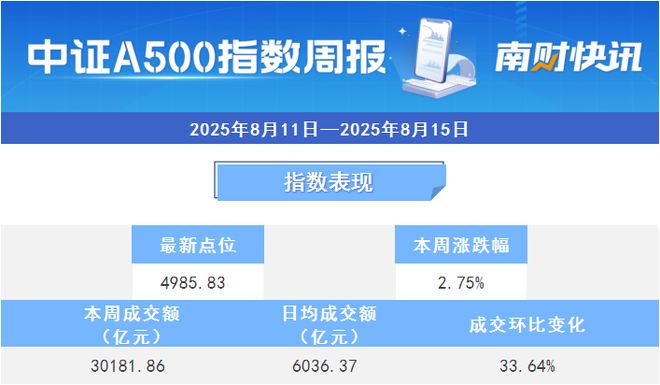
Index Performance - The CSI A500 Index increased by 2.75% this week, closing at 4985.83 points on August 15 [5] - The average daily trading volume for the week was 6036.37 billion yuan, with a week-on-week increase of 33.64% [5] Component Stocks - The top ten gainers this week included: - Cambrian (688256.SH) with a rise of 33.33% - Quzhou Development (600208.SH) up by 33.01% - Filihua (300395.SZ) increased by 30.81% [3] - The top ten losers included: - Hongdu Aviation (600316.SH) down by 6.12% - Transsion Holdings (688036.SH) decreased by 6.08% - Light Media (300251.SZ) fell by 5.96% [3] Fund Performance - All 38 CSI A500 funds rose by over 1% this week, with Huabao Fund leading at 3.32% [5] - The total scale of CSI A500 funds reached 1798.01 billion yuan, showing an increase compared to last week [5] - The top three funds by scale are: - Huatai Baichuan with 197.22 billion yuan - E Fund with 180.44 billion yuan - Guotai Fund with 178.60 billion yuan [5] Market Outlook - CICC's report suggests that the current market sentiment is optimistic, indicating that the ongoing rally may not be over, comparing it to an "enhanced version of 2013" [5] - The report highlights that the market structure this year resembles that of 2013, with small-cap and growth styles prevailing, but overall performance is expected to be better than in 2013 [5] - Recommendations include focusing on sectors with high prosperity and performance verification such as AI/computing power, innovative pharmaceuticals, military, and non-ferrous metals [5] Broader Market Sentiment - Debon Securities believes that the current market breadth and depth exceed previous bull markets, driven by a combination of policy, fundamentals, and liquidity, characterizing it as a "slow bull" market [6] - The report emphasizes the transformation of industrial momentum, with technology growth sectors like semiconductors and robotics leading the way, indicating a rapid development opportunity for emerging industries [6]




红利板块回调获资金逆势布局,恒生红利低波ETF(159545)半日净申购超2800万份
Sou Hu Cai Jing· 2025-08-15 05:01
Group 1 - The CSI Dividend Index rose by 0.03% while the CSI Dividend Value Index fell by 0.2% and the CSI Dividend Low Volatility Index decreased by 0.6% as of midday close [1] - The Hang Seng High Dividend Low Volatility Index dropped by 1%, and the Hang Seng Dividend Low Volatility ETF (159545) saw a net subscription of over 28 million units in the first half of the day [1] - The composition of the dividend-paying stocks reflects high dividend levels and low volatility, with the banking, transportation, and construction industries accounting for approximately 70% [5] Group 2 - The Hang Seng Dividend Low Volatility ETF tracks the Hang Seng High Dividend Low Volatility Index [6] - The index consists of 50 liquid stocks within the Stock Connect that have a history of continuous dividends, moderate dividend payout ratios, and low volatility, with financial, industrial, and energy sectors making up nearly 70% [7] - The Dividend Value ETF tracks the CSI Dividend Value Index, which includes 50 stocks characterized by high dividend yields and value traits [7]
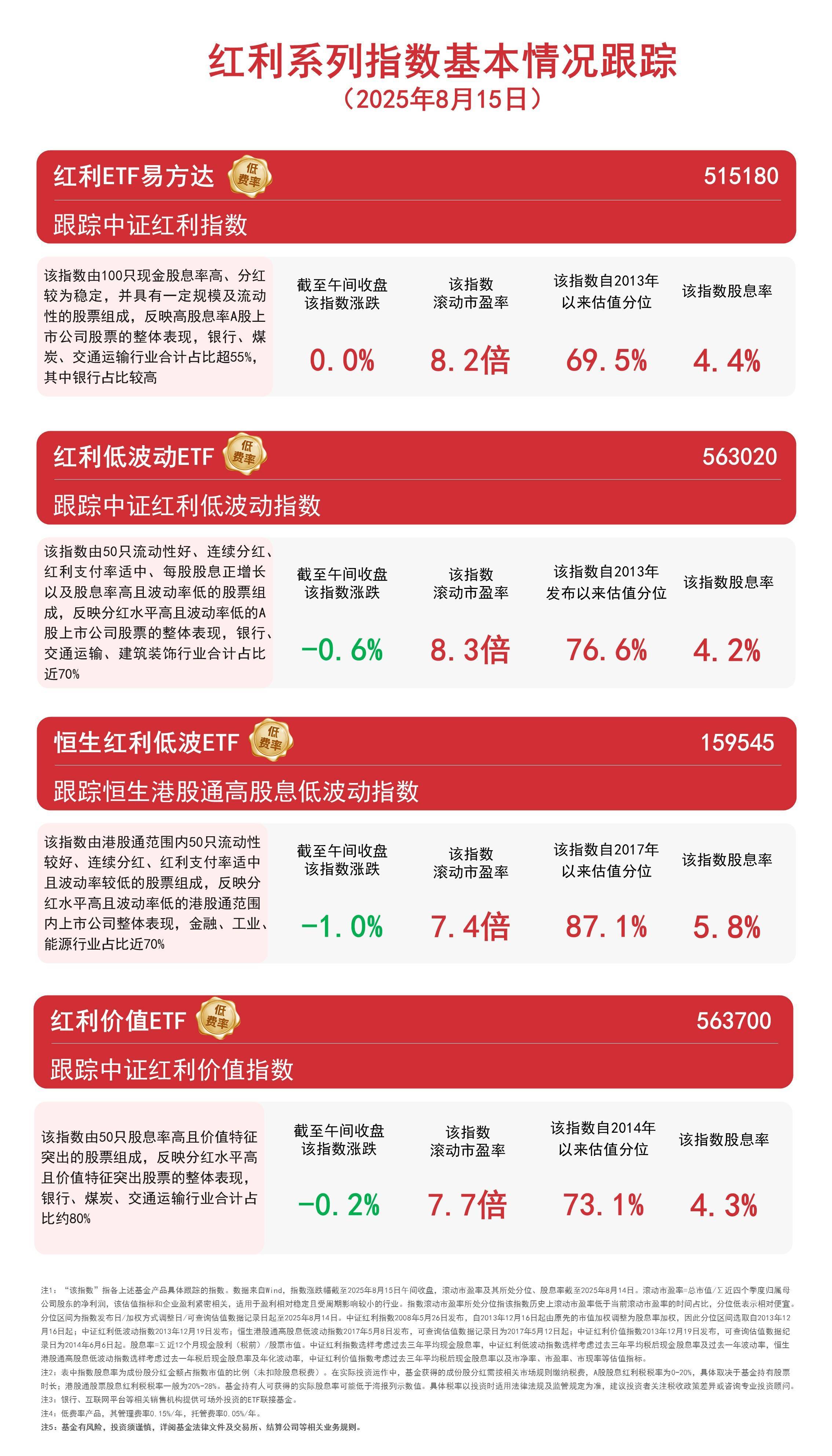
午评:创业板指涨超2%,券商板块大幅拉升,PCB概念等活跃
Zheng Quan Shi Bao Wang· 2025-08-15 04:40
Core Viewpoint - The A-share market is experiencing a bullish trend, with significant gains across major indices and sectors, indicating a continuation of the current market rally, reminiscent of the enhanced version of 2013 [1] Market Performance - Major stock indices rose again, with the ChiNext Index up over 2% and the North Securities 50 Index soaring nearly 3% [1] - As of the midday close, the Shanghai Composite Index increased by 0.47% to 3683.58 points, the Shenzhen Component Index rose by 1.19%, and the ChiNext Index climbed by 2.14% [1] - The total trading volume across the Shanghai, Shenzhen, and North markets reached 1.3273 trillion yuan [1] Sector Analysis - The brokerage sector saw significant gains, along with notable increases in the chemical, non-ferrous metals, automotive, real estate, and semiconductor sectors [1] - Active sectors included liquid cooling servers, PCB concepts, new battery technologies, and photolithography concepts [1] Investment Outlook - According to China International Capital Corporation (CICC), the optimistic sentiment suggests that the current market rally is not yet over, with expectations for better overall performance compared to 2013 [1] - The market structure this year resembles that of 2013, favoring small-cap and growth styles, but with an anticipated overall performance improvement [1] - Future market movements may see increased index volatility due to elevated valuations and new capital inflows, but the ongoing rally since last year's "9.24" is expected to continue [1] Recommended Sectors - Investment focus is recommended on sectors with high prosperity and verified performance, including AI/computing power, innovative pharmaceuticals, military industry, and non-ferrous metals [1] - The brokerage and insurance sectors are highlighted for their high earnings elasticity and benefits from increased retail investor participation [1] - Dividend sectors are expected to continue showing differentiated performance [1]

增量资金入市 交易热度攀升
Jin Rong Shi Bao· 2025-08-15 01:11
Market Performance - A-shares have shown a strong upward trend since August, with the Shanghai Composite Index reaching a new high of 3683.46 points on August 13, surpassing the previous peak after the "9·24" market event [1] - On August 14, the index briefly exceeded 3700 points, with a peak of 3704.77 points, and the total market turnover exceeded 2 trillion yuan for two consecutive days, reaching a record high of 2.31 trillion yuan on August 14 [1] - Analysts attribute the strong performance to improved policy expectations, increased liquidity, and a decrease in external risks [1] Fund Inflow - The recent market rally is significantly driven by accelerated inflow of incremental funds from various sources, including insurance, pension funds, public and private equity funds, as well as individual investors [2] - Since the "9·24" market event, the M1-M2 growth rate gap has been narrowing, indicating enhanced liquidity and a marginal recovery in consumer and investment sentiment [2] - The average monthly new account openings on the Shanghai Stock Exchange have increased by 80% compared to the first nine months of 2024, reflecting a rising risk appetite among individual investors [2] Margin Trading - As of August 5, the margin trading balance in the A-share market exceeded 2 trillion yuan for the first time in 10 years, indicating increased investor engagement [4] - By August 13, the margin trading balance reached 20,462.51 billion yuan, with the margin trading balance accounting for 2.08% of the A-share market's circulating market value [4] - The current margin trading levels are significantly lower than the peak levels seen in 2015, suggesting a more stable market environment [4][5] Sector Focus - Analysts recommend focusing on sectors with high growth potential and strong performance, such as AI, computing power, innovative pharmaceuticals, military, and non-ferrous metals [5] - The report highlights the importance of sectors that are expected to benefit from increased retail investment, including brokerage and insurance industries [5] - The market is anticipated to continue experiencing volatility, but the overall trend remains positive due to loose liquidity and earnings recovery [5]
沪指挑战3700点,2.3万亿成交额暗藏玄机,该加仓还是离场
21世纪经济报道· 2025-08-14 14:46
Core Viewpoint - The A-share market experienced a significant fluctuation with the Shanghai Composite Index briefly surpassing 3700 points before closing lower, indicating a potential shift in market sentiment and the need for further analysis on the sustainability of the "slow bull" market trend [1][4][5]. Market Performance - On August 14, the Shanghai Composite Index closed at 3666.44 points, down 0.46%, while the Shenzhen Component Index and the ChiNext Index fell by 0.87% and 1.08% respectively, with over 4600 stocks declining throughout the day [1][2]. - The total trading volume reached 2.31 trillion yuan, marking a new high for the year and an increase of over 130 billion yuan compared to August 13 [3][4]. Sector Analysis - There was a notable divergence in sector performance, with sectors like humanoid robots and optical modules experiencing declines, while financial leaders showed resilience [3][4]. - The Wind indices for stable currency, insurance, digital currency, and GPU saw increases of 4.21%, 2.64%, 1.66%, and 1.50% respectively, while sectors such as cultivated diamonds and military information technology faced declines exceeding 3.6% [4]. Market Sentiment and Future Outlook - Analysts suggest that the market may need to consolidate around the 3700-point level, with a focus on maintaining trading volumes above 2 trillion yuan and continued policy support for consumption and technology sectors [5][6]. - The current market dynamics indicate a potential "slow bull" phase, driven by increased investor participation and a shift of household savings into the capital market [5][6]. Institutional Perspectives - Different institutions have varying strategies; some are reducing positions in overvalued stocks while increasing exposure to undervalued sectors like consumption and internet [8]. - Others maintain a full or near-full position, focusing on long-term holdings in sectors such as liquor, pharmaceuticals, and technology, indicating a belief in the continued growth potential of these areas [8]. Investment Strategies - Institutions recommend focusing on high-growth sectors with strong earnings potential, such as AI, innovative pharmaceuticals, and military technology, while also considering dividend-paying stocks for stability [12][14]. - The market is expected to experience increased volatility, and investors are advised to balance their portfolios to adapt to rapid sector rotations [12][14].

A股突然下跌,原因何在?机构:年底有望冲击4000点!
天天基金网· 2025-08-14 10:57
Core Viewpoint - The A-share market experienced fluctuations, with the three major indices closing lower after briefly surpassing 3700 points, indicating a normal technical adjustment within a slow bull market [1][4][12]. Market Analysis - The A-share market's recent downturn is attributed to profit-taking near the 3700-point resistance level, where historical trapped positions exist, leading to a sell-off in popular sectors like military and new energy [5][4]. - Despite the short-term volatility, the overall market sentiment remains optimistic, with analysts suggesting that the current market resembles an "enhanced version of 2013," indicating potential for continued upward movement [9][10]. Bull Market Dynamics - Analysts believe the current bull market has strong foundations due to several factors: robust development in new economies, stabilization of traditional economic momentum, support for the private sector, and improved corporate governance [8][10]. - The market's upward momentum is expected to persist, with the Shanghai Composite Index potentially challenging the 4000-point mark by the end of 2025, contingent on broader profit improvements and optimized capital structures [13][12]. Investment Strategies - In light of ongoing market conditions, institutions recommend focusing on three main investment directions: technology growth sectors (AI, robotics, semiconductors), sectors with strong earnings certainty (consumer electronics, brokerage, non-ferrous metals), and anti-involution sectors (photovoltaics, lithium batteries, steel) [19][20]. - Investors are advised to select core sectors with certainty, manage volatility effectively, and maintain a rational approach to long-term investments, avoiding impulsive trading behaviors [20][18].

收盘丨沪指一度突破3700点,创业板指2500点得而复失
Di Yi Cai Jing· 2025-08-14 07:33
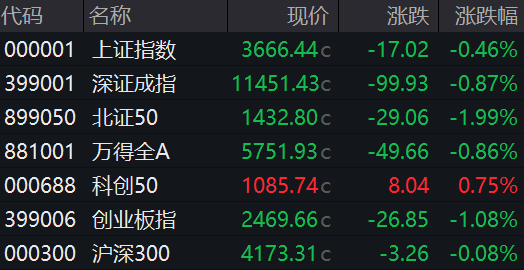
Market Overview - The trading volume of the Shanghai and Shenzhen stock markets has exceeded 2 trillion yuan for two consecutive days [3] - On August 14, the A-shares experienced a pullback after reaching highs, with the Shanghai Composite Index briefly surpassing 3700 points before closing down 0.46% [1][2] Index Performance - Shanghai Composite Index closed at 3666.44, down 17.02 points or 0.46% [2] - Shenzhen Component Index closed at 11451.43, down 99.93 points or 0.87% [2] - ChiNext Index closed at 2469.66, down 26.85 points or 1.08% [2] Sector Performance - The market showed a broad decline across sectors, with notable drops in military, CPO, medical devices, and steel sectors [7] - The brain-computer interface sector saw some stocks hitting the daily limit up, with notable performances from Botao Bio and Nanjing Panda [8] - The digital currency concept stocks experienced a pullback after initial gains, with several stocks reaching the daily limit up [8] Capital Flow - Main capital inflows were observed in the computer, non-bank financial, and food and beverage sectors, while outflows were noted in defense, automotive, and medical sectors [10] - Specific stocks with net inflows included Ningde Times and Huasheng Tiancheng, while stocks like Changcheng Military Industry faced significant net outflows [11][12] Institutional Insights - Guodu Securities noted that the recent rise in the Shanghai Composite Index is attributed to abundant liquidity and improved global risk appetite, suggesting potential short-term pullbacks [13] - CICC highlighted that while index volatility may increase, the current market trend since last year's "9.24" remains intact, recommending focus on sectors like AI, innovative drugs, and military [13]
沪指站上3700点,机构称A股行情尚未结束!科创创业50ETF(159783)一度涨近2%
Mei Ri Jing Ji Xin Wen· 2025-08-14 06:15
Group 1 - The Shanghai Composite Index surpassed 3700 points for the first time since December 2021, with AI chips, digital sentinels, and digital currency concepts leading the gains [1] - The ChiNext 50 ETF (159783) saw a nearly 2% increase in early trading, with notable performers including Cambrian, Haiguang Information, SanHuan Group, Loongson Technology, CATL, and SMIC, with Cambrian rising over 12% and its total market value exceeding 400 billion [1] - Morgan Stanley reported that foreign capital inflow has turned positive since June, with a total net inflow reaching 2.7 billion in July, indicating a potential acceleration of foreign investment in the Chinese stock market post-summer [1] Group 2 - China International Capital Corporation (CICC) noted that the current market sentiment suggests the ongoing rally is reminiscent of an "enhanced version of 2013," with small-cap and growth styles prevailing [2] - The market is expected to perform significantly better than in 2013, with potential for increased index volatility due to elevated valuations and new capital entering the market [2] - CICC recommends focusing on sectors with high prosperity and verified performance, such as AI/computing power, innovative pharmaceuticals, military industry, and non-ferrous metals, as well as brokerage and insurance industries benefiting from increased retail investment [2]
沪指突破3700点 机构:沪指年底有望冲击4000点
2 1 Shi Ji Jing Ji Bao Dao· 2025-08-14 03:08
Market Overview - The Shanghai Composite Index (沪指) rose over 0.48% and broke the 3700-point mark for the first time since December 2021 [2] - The FTSE China A50 Index futures surged, increasing by 1.18% [2] - The semiconductor sector saw significant gains, with the Wind Chip Index rising by 2% and Cambricon Technologies (寒武纪) experiencing a peak increase of over 12%, reaching a total market value exceeding 400 billion yuan [2] Investment Sentiment - There is a strong bullish sentiment in the A-share market, with the financing balance returning to 2 trillion yuan for the first time in ten years [6] - Analysts suggest that the current market is not solely driven by leverage, contrasting it with the 2015 market dynamics [7][8] - The financing funds are now more evenly distributed, with 66% directed towards information technology, industrial, and materials sectors, and over 45% focused on hard technology sectors like semiconductors and new energy [8] Future Outlook - Analysts believe that the Shanghai Composite Index could challenge the 4000-point mark by year-end if three conditions are met: broad improvement in earnings, optimized capital structure, and alignment of domestic policies with global economic cycles [4] - The current market is transitioning from being driven by liquidity to being driven by profitability, indicating a more sustainable growth trajectory [8] - The overall market is expected to maintain a steady upward trend, with a gradual formation of a slow bull market due to improved capital market positioning and ongoing policy support [8]