经济增长

Search documents
亚洲增长最快国家,又变了
创业邦· 2026-01-16 03:43
Core Viewpoint - Vietnam is emerging as the fastest-growing economy in Asia, with a projected GDP of approximately $514 billion in 2025 and an actual growth rate of 8.02%, significantly surpassing initial expectations of 6.1%-6.5% [6][9]. Economic Growth Drivers - The rapid economic growth of Vietnam is primarily driven by three main factors: consumption, investment, and exports [17]. - Vietnam's foreign trade volume exceeded $900 billion last year, with exports reaching $475 billion, marking a 17% year-on-year increase [20]. - The country is benefiting from the global supply chain shift, with tariff negotiations reducing U.S.-Vietnam tariffs from over 40% to 20%, allowing for cost absorption through currency depreciation and supply chain optimization [21]. Industrial Development - Vietnam's industrial and construction sectors are expected to grow by 8.95% by 2025, increasing their share of the economy to 37.65%, establishing Vietnam as a new emerging industrial nation [22]. - The manufacturing sector remains labor-intensive, focusing on electronics, textiles, and footwear, while still being dependent on imported intermediate goods from China for exports [23][24]. Real Estate and Infrastructure - Real estate prices in Vietnam have surged, with prices in Hanoi and Ho Chi Minh City rising over 30% in the first three quarters of the year, and a 59% increase over the past five years, outpacing other countries [31]. - Infrastructure investment is projected to reach $189 billion by 2025, a historical high, with significant projects like the North-South High-Speed Railway aimed at enhancing connectivity [33][35]. Challenges and Comparisons - Despite rapid growth, Vietnam faces challenges such as power shortages and a heavy reliance on foreign investment, particularly from China [27][36]. - Vietnam's GDP per capita is expected to exceed $5,000 by 2025, comparable to Indonesia but only about one-third of China's level, indicating room for growth [37]. - The country is adopting various strategies from China's development model, including administrative reforms and economic planning, while maintaining a stable policy environment favorable to foreign investment [39].


摆脱两年衰退 德国经济去年实现小幅增长
Jing Ji Guan Cha Wang· 2026-01-16 02:19
经济观察网 据央视新闻消息,德国联邦统计局15日公布的初步数据显示,经价格调整后,2025年德国 国内生产总值比上年实际增长0.2%,结束了连续两年的萎缩态势。德国联邦统计局局长鲁特·布兰德当 天表示,德国经济在经历两年衰退后实现小幅增长,主要归因于家庭和政府消费支出增加,但0.2%的 经济增长率在主要经济体中仍处于低位,目前德国经济增长动力仍然不足。此外,受美国提高关税、欧 元走强等不利因素影响,德国出口再次下滑。 ...
重磅年度经济数据即将发布 5%左右目标有望较好实现
Di Yi Cai Jing· 2026-01-15 23:01
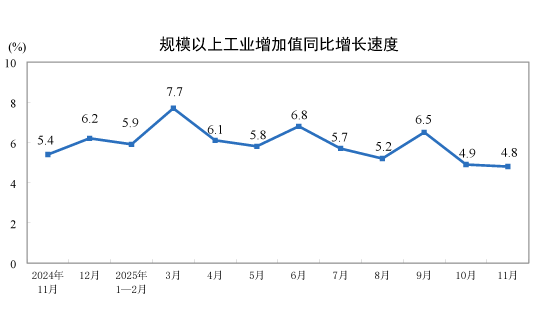
备受市场关注的2025中国经济年报即将揭晓。 国家统计局将于1月19日发布2025年度经济数据。机构预计,2025年,稳增长政策持续加力,5%左右的 经济增长目标有望较好实现。虽然2025年四季度GDP增速或回落,但12月份内需相关指标有望企稳回 升。 第一财经研究院发布的最新一期"第一财经首席经济学家信心指数"为50.32,较上月回升,维持景气状 态。经济学家们认为,2025年我国经济运行稳中有进,顺利收官。2026年,逆周期政策将加大力度维稳 房地产,推动投资回升并进一步刺激消费,内需将逐步趋向改善。 稳中有进、进中承压 从先行指标来看,2025年12月份制造业采购经理指数(PMI)为50.1%,比上月上升0.9个百分点,在连 续8个月运行在50%以下后升至扩张区间。 中国物流与采购联合会特约分析师张立群认为,12月份PMI指数出现较明显回升,表明市场预期进一步 向好。同时也要看到,市场引导的需求收缩力度仍大,企业产品销售面对的困难仍多。 兴业银行首席经济学家鲁政委表示,临近年末企业冲刺生产目标,赶工效应或支撑2025年12月工业增加 值增速季节性走高。2025年12月重点电厂煤炭日耗环比大幅增加14.5 ...
2025年德国经济同比增长0.2%
Xin Lang Cai Jing· 2026-01-15 15:17
Group 1 - Germany's GDP is projected to grow by 0.2% in 2025, marking the first growth after two consecutive years of recession [1] - In 2024, Germany's economy is expected to decline by 0.5%, following a 0.9% decline in 2023 [1] - The growth in 2025 is primarily driven by increased consumption from private households and government spending [1] Group 2 - Germany's export value is anticipated to decrease by 0.3% in 2025, continuing a three-year decline [1] - Investment remains weak, with both equipment and construction investments lower than the previous year [1] - Economic confidence among German businesses has declined for two consecutive months, indicating a cautious outlook for 2026 [1] Group 3 - Economists predict a potential economic growth of about 1% in 2026, supported by increased working days and government investments in military and infrastructure [2] - A significant economic recovery may not occur until 2027, when the effects of large-scale government investments are expected to materialize [2] - Structural reforms are deemed essential to ensure that fiscal spending does not become a temporary measure after relaxing debt brakes [2]
【环球财经】摆脱两年衰退 德国经济2025年实现小幅增长
Xin Hua Cai Jing· 2026-01-15 14:39
Economic Growth - After two consecutive years of recession, the German economy is projected to grow by 0.2% in 2025 according to preliminary calculations by the Federal Statistical Office of Germany [1] Consumption and Investment - Household consumption is expected to increase by 1.4%, while government consumption is projected to rise by 1.5% in 2025 [2] - Total asset investment in Germany is forecasted to decline by 0.5%, with construction investment decreasing by 0.9% for the fifth consecutive year [1][2] Export and Import Trends - German exports are anticipated to decrease by 0.3% in 2025, marking the third consecutive year of decline, while imports are expected to grow significantly by 3.6% after two years of decline [2] Sector Performance - The manufacturing sector is expected to see a continuous output decrease for the third year, with a year-on-year decline of 1.3%, particularly in the automotive and mechanical engineering industries [1] - The construction industry is projected to decline by 3.6% due to high construction costs, while the service sector shows mixed results with certain industries like sports and entertainment declining, but trade, transportation, accommodation, and food services growing by 1.2% [1]
德国经济自2022年以来首年实现增长 受支出提振
Xin Lang Cai Jing· 2026-01-15 12:57
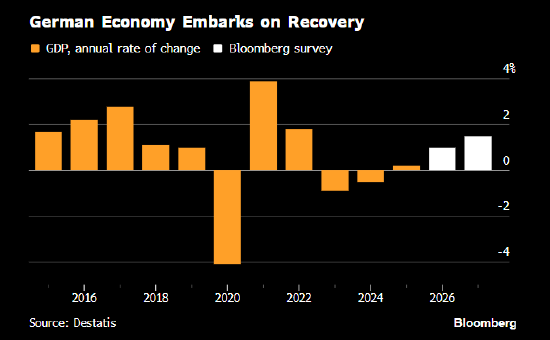
Core Insights - The German economy has achieved growth for the first time since 2022, aided by significant government spending that helped the country emerge from a prolonged industrial recession [1][3] - After two consecutive years of economic contraction, the GDP is projected to grow by 0.2% in 2025, aligning with the median forecast from Bloomberg survey analysts [1][3] - The fourth quarter also recorded a growth of the same magnitude, indicating a consistent recovery trend [1][3]
摆脱两年衰退 德国经济2025年实现小幅增长
Sou Hu Cai Jing· 2026-01-15 12:36
Core Viewpoint - Germany's GDP is projected to grow by 0.2% in 2025, marking the end of two consecutive years of economic contraction [1] Economic Performance - The growth is primarily attributed to increased household and government consumption expenditures [1] - Household consumption expenditure is expected to rise by 1.4%, while government consumption expenditure is projected to increase by 1.5% [1] Trade and Exports - Exports are anticipated to decline by 0.3% in 2025, marking the third consecutive year of decline, influenced by factors such as increased tariffs from the U.S. and a stronger euro [1] - Imports are expected to grow by 3.6% [1] Industry Insights - The manufacturing sector's value added is projected to decrease by 1.3%, continuing a three-year trend of contraction, with significant declines in the automotive and machinery manufacturing sectors [1] Employment - The number of employed individuals in Germany is expected to remain stable at approximately 46 million, showing no significant change from the previous year [1]
英国去年11月经济环比增长0.3%
Sou Hu Cai Jing· 2026-01-15 09:34
11月份,英国经济表现超出市场预期。此前市场预测经济在11月份仅略微增长0.1%。英国财政部在去 年11月份公布新的财政预算报告,有关财政政策的不确定影响了市场。(新华财经) 英国国家统计局1月15日公布的数据显示,2025年11月份,英国经济环比增长0.3%。同时,9月份的经 济增速由此前的萎缩0.1%,上调至增长0.1%,10月份的增长数据暂未调整,仍为环比萎缩0.1%。 服务业和制造业成为推动英国经济在11月份恢复增长的主要动力。数据显示,11月份,英国服务业环比 增长0.3%,制造业环比增长1.1%。而建筑业继续拖后腿,环比萎缩1.3%。 ...
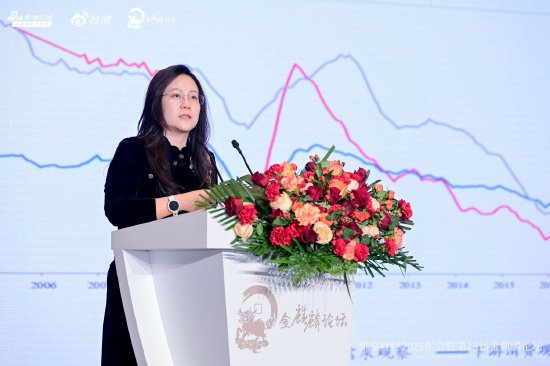
从“三驾马车”看2026,华创证券张瑜:出口成核心引擎,中游制造景气可持续
Xin Lang Cai Jing· 2026-01-15 08:59
Core Viewpoint - The chief economist of Huachuang Securities, Zhang Yu, predicts that the nominal GDP growth rate for 2026 will be around 4.5%-4.6%, with the real GDP growth rate expected to be in the range of 4.8%-5.0% [7][10]. Group 1: Economic Growth Analysis - Exports are expected to become the core driving force of economic growth, with growth rates likely to exceed the overall economic growth, providing crucial support for overall price levels and industrial prosperity [3][9]. - Consumption is viewed as a stabilizing force in the economy, with growth rates not being strong but also not too low, serving as a central stabilizing power [4][10]. - The main challenge lies in fixed asset investment, which is deeply tied to real estate and traditional economies, with growth rates expected to fall into a low range of 0-1%, posing downward pressure on the economy [4][10]. Group 2: Investment Insights - The prosperity of the midstream manufacturing sector is expected to be sustainable, driven by exports, and is not a short-term phenomenon. This trend is likely to continue for two to three years, leading to new market value structures and investment opportunities [5][10]. - The consumption sector holds value for allocation. Although consumption growth is stabilizing and lacks high growth potential, when valuations are adjusted appropriately and cost-effectiveness is highlighted, its stable high dividend characteristics will make it a valuable allocation choice [5][10].