通胀风险

Search documents
国际金融市场早知道:8月21日
Sou Hu Cai Jing· 2025-08-20 23:58
Group 1: Federal Reserve Insights - The July meeting minutes indicate that most officials believe inflation risks outweigh concerns about the labor market, with a consensus that "upward inflation risks are more severe" [2] - The Federal Budget Committee forecasts a federal budget deficit of $22.7 trillion over the next decade, nearly $1 trillion higher than earlier predictions by the Congressional Budget Office [1] Group 2: Central Bank Actions - The New Zealand Reserve Bank lowered its interest rate by 25 basis points to 3.00%, aligning with expectations [3] - The Bank of Indonesia unexpectedly cut its rate by 25 basis points to 5%, marking the fourth rate cut of the year [4] - The Swedish central bank maintained its benchmark interest rate at 2%, consistent with expectations [5] Group 3: Economic Indicators - Eurozone economic growth may slow down this quarter, according to ECB President Lagarde, despite reduced uncertainty from US-EU agreements [2] - The UK's July CPI rose by 3.8% year-on-year, surpassing the previous value of 3.6%, marking the fastest growth since January 2024 [5] - Japan's July exports fell by 2.6% year-on-year, the largest decline since February 2021, with a significant drop in automobile exports by 28.4% [5]
美联储会议纪要:大多数FOMC委员认为通胀风险甚于就业担忧
Sou Hu Cai Jing· 2025-08-20 18:35
Core Viewpoint - The majority of Federal Reserve officials at the July monetary policy meeting emphasized that inflation risks outweigh concerns about the labor market, leading to increasing divisions within the Federal Open Market Committee (FOMC) [1] Group 1: Inflation Concerns - Officials acknowledged worries about rising inflation and weak employment, but "the majority of participants believed that the risk of rising inflation is greater" [1] Group 2: Labor Market - There is a recognition of concerns regarding the labor market, but these concerns are secondary to inflation risks among most FOMC members [1]
美联储:多数委员认为通胀风险大于就业风险。
Sou Hu Cai Jing· 2025-08-20 18:07
Group 1 - The core viewpoint of the article indicates that the majority of Federal Reserve members believe that the risks associated with inflation outweigh those related to employment [1] Group 2 - The article highlights the Federal Reserve's focus on inflation management as a priority in their monetary policy decisions [1] - It suggests that the current economic environment is prompting a reassessment of the balance between inflation control and employment stability [1]
美联储会议纪要:多数官员恩威,通胀风险超过就业风险,多数人提到关税的影响全面显现出来需要一段时间
Hua Er Jie Jian Wen· 2025-08-20 18:04
Core Viewpoint - The Federal Reserve's meeting minutes indicate that most officials prioritize inflation risks over employment risks, suggesting a shift in focus towards managing inflationary pressures [1] Summary by Relevant Categories Inflation Risks - Majority of officials expressed that inflation risks are currently more significant than employment risks, indicating a potential tightening of monetary policy to combat inflation [1] Tariff Impact - Many officials noted that the effects of tariffs are becoming more apparent and will require time to fully manifest, suggesting ongoing economic adjustments related to trade policies [1]
这一事件或成黄金市场转折点
Jin Tou Wang· 2025-08-19 03:23
Group 1 - The focus of investors is on the upcoming Federal Reserve annual symposium in Jackson Hole, Wyoming, particularly the speech by Chairman Powell on Friday, which is expected to be a significant turning point for the gold market [2] - The release of the July Federal Reserve policy meeting minutes on Wednesday may provide further insights into the interest rate path, with concerns about the labor market increasing due to recent weaker-than-expected data [2] - If economic slowdown signals strengthen, expectations for interest rate cuts may rise, benefiting gold prices; conversely, a hawkish tone from Powell could compress gold's rebound potential [2] Group 2 - Currently, gold prices are experiencing weak support around $3,330, with a potential for a slight breakdown leading to further downward movement [1][4] - Technical analysis indicates that gold is under pressure, with a formation of a descending triangle pattern on the 4-hour chart, and attention is on the support level around $3,310 [4] - The daily trend shows a narrow range of fluctuations, with short-term moving averages indicating a weak trend, suggesting a cautious approach to gold price movements [4]
锌:承压下行
Guo Tai Jun An Qi Huo· 2025-08-19 01:45
Report Summary 1) Report Industry Investment Rating - The zinc industry is rated as "Pressured Downward" [1] 2) Core View of the Report - The zinc market is under pressure and showing a downward trend, with various indicators such as prices and spreads reflecting this situation [1] 3) Summary by Relevant Catalogs **Fundamental Tracking** - **Prices**: The closing price of SHFE zinc main contract was 22,360 yuan/ton, down 0.64%; the closing price of LME zinc 3M electronic disk was 2,796.5 dollars/ton, down 1.62% [1] - **Trading Volume**: The trading volume of SHFE zinc main contract was 95,738 lots, an increase of 12,516 lots; the trading volume of LME zinc was 10,973 lots, an increase of 3,256 lots [1] - **Open Interest**: The open interest of SHFE zinc main contract was 96,755 lots, an increase of 20,408 lots; the open interest of LME zinc was 193,998 lots, an increase of 3,010 lots [1] - **Premiums and Discounts**: Shanghai 0 zinc premium/discount was -50 yuan/ton, unchanged; LME CASH - 3M premium/discount was -5.22 dollars/ton, down 4.69 dollars/ton [1] - **Inventory**: SHFE zinc futures inventory was 32,538 tons, an increase of 12,518 tons; LME zinc inventory was 75,850 tons, a decrease of 475 tons [1] **News** - At the Jackson Hole central bank annual meeting, different institutions have different expectations for Powell's speech. Nomura expects no "clear commitment", BofA expects a hawkish stance, and Morgan Stanley expects emphasis on inflation risks [2] **Trend Intensity** - The trend intensity of zinc is -1, indicating a weak bearish outlook [2][3]
中辉有色观点-20250819
Zhong Hui Qi Huo· 2025-08-19 01:36
1. Report Industry Investment Ratings - Gold: Bullish, recommended to buy on dips and hold for the long - term [1] - Silver: Bullish, recommended to buy on rebounds and hold for the long - term [1] - Copper: Bullish, recommended to buy on dips and hold for the long - term [1] - Zinc: Bearish, recommended to hold short positions in the short - term and sell on rallies in the long - term [1] - Lead: Bearish, price under short - term pressure [1] - Tin: Bearish, price rebound under pressure [1] - Aluminum: Bearish, price under short - term pressure [1] - Nickel: Bearish, price under short - term pressure [1] - Industrial Silicon: Cautiously Bullish [1] - Polysilicon: Bullish, recommended to hold long positions [1] - Lithium Carbonate: Bullish, recommended to hold long positions [1] 2. Core Views of the Report - In the short - term, the geopolitical situation is seeking a truce, reducing risk - aversion sentiment. The market is waiting for the Jackson Hole Global Central Bank Annual Meeting, with expectations that Fed Chairman Powell may take a hawkish stance, which will suppress the Fed's interest - rate cut expectations and cause the US dollar to rebound. This has an impact on the prices of precious metals and base metals. In the long - term, factors such as global monetary easing, the decline of the US dollar's credit, and the reshaping of the geopolitical pattern will support the prices of precious metals, especially gold. For base metals, supply - demand relationships, strategic resource attributes, and industry development trends will affect their price trends [1][3] 3. Summary by Related Catalogs Gold and Silver - **Market Review**: Global parties are seeking a cease - fire in geopolitical conflicts, and the Jackson Hole Global Central Bank Annual Meeting is highly anticipated. Gold and silver are trading in a narrow range [2] - **Basic Logic**: The market is waiting for Powell's speech at the Jackson Hole meeting. Different institutions have different expectations for his stance. There are also signs of a cease - fire in the Russia - Ukraine conflict and the Hamas situation. In the short - term, it is difficult for gold to break through the range, but in the long - term, it may be in a long - term bull market [3] - **Strategy Recommendation**: Gold may find support around 770, and long - term positions can be considered after stabilization. Silver's short - term trading range is between 9150 - 9400, and it is recommended to go long in the long - term. Attention should be paid to the US - Russia - Ukraine tripartite meeting [4] Copper - **Market Review**: The fluctuation of Shanghai copper has converged, and it closed with a doji star after narrow - range trading [6] - **Industry Logic**: Recently, there have been disruptions in copper mines, but the supply of domestic copper concentrate raw materials has improved marginally. The output of electrolytic copper in July increased, but it may decline marginally in August - September due to smelting maintenance. It is currently the consumption off - season, but demand is expected to pick up with the arrival of the peak season. The overall copper inventory overseas has increased slightly, and the domestic social inventory has also risen slightly. The annual copper supply - demand is in a tight balance [6] - **Strategy Recommendation**: As the global central bank annual meeting approaches, the US dollar index has rebounded, and copper prices are under pressure. It is recommended to buy copper on dips. Enterprises can wait for high - level opportunities to sell and hedge to lock in reasonable profits. In the long - term, copper is a strategic resource in the Sino - US game, and there is a long - term bullish outlook. The attention range for Shanghai copper is [78000, 80000] yuan/ton, and for LME copper is [9650, 9950] US dollars/ton [7] Zinc - **Market Review**: Shanghai zinc has been oscillating weakly, testing the support of the lower level [9] - **Industry Logic**: In 2025, the supply of zinc concentrate is abundant. The output of refined zinc in China in July and August increased. The processing fee of zinc concentrate has risen, and smelter enthusiasm has increased. On the demand side, due to factors such as Vietnam's tariff increase on galvanized steel and the domestic consumption off - season, the start - up rate of galvanizing enterprises is expected to decline. The spot market trading is dull, and domestic zinc inventories have increased [9] - **Strategy Recommendation**: In the short - term, due to the off - season of demand and inventory accumulation, zinc is oscillating weakly. It is recommended to hold short positions and take partial profits on dips. In the long - term, with supply increasing and demand decreasing, wait for opportunities to sell on rallies. The attention range for Shanghai zinc is [22000, 22600] yuan/ton, and for LME zinc is [2700, 2800] US dollars/ton [10] Aluminum - **Market Review**: Aluminum prices have declined under pressure, and alumina has also shown a downward trend [12] - **Industry Logic**: For electrolytic aluminum, there are still uncertainties in overseas macro - trade policies. The cost has decreased, and the inventory has increased. The demand side has seen a slight increase in the start - up rate of downstream processing enterprises. For alumina, the rainy season in Guinea may affect the arrival volume in August, and domestic alumina plants have increased their loads. The inventory of electrolytic aluminum plants has accumulated, and the short - term supply - demand is expected to be loose [13] - **Strategy Recommendation**: It is recommended to sell on rallies for Shanghai aluminum in the short - term, paying attention to the change of aluminum ingot inventory during the off - season. The operating range of the main contract is [20000 - 20900] [14] Nickel - **Market Review**: Nickel prices have been running weakly, and stainless steel has been under pressure [16] - **Industry Logic**: Overseas macro - environment is still uncertain. The price of nickel ore in the Philippines is weak, and NPI smelters are facing cost inversion. The output of refined nickel in China has increased, and the inventory has accumulated during the off - season. For stainless steel, the effect of production cuts is weakening, and there is still over - supply pressure during the off - season [17] - **Strategy Recommendation**: It is recommended to sell on rallies for nickel and stainless steel, paying attention to the change of downstream inventory. The operating range of the main nickel contract is [120000 - 123000] [18] Lithium Carbonate - **Market Review**: The main contract LC2511 opened higher and moved higher, with increased positions throughout the day, rising more than 4% [20] - **Industry Logic**: Although the overall inventory and output have decreased slightly, the absolute quantity is still at a high level in recent years. After CATL confirmed production suspension, the market expects synchronous production suspension of other mines in Jiangxi. With the arrival of the peak demand season, downstream material factories have started the stocking cycle. The inventory structure will amplify price elasticity. The main contract of lithium carbonate is expected to rise further after the de - stocking expectation is strengthened [21] - **Strategy Recommendation**: The supply speculation expectation still exists, and long positions should be held in the range of [88500 - 91000] [22]
杰克逊霍尔央行年会,鲍威尔关键发声,为何华尔街一致“示警”
华尔街见闻· 2025-08-18 10:44
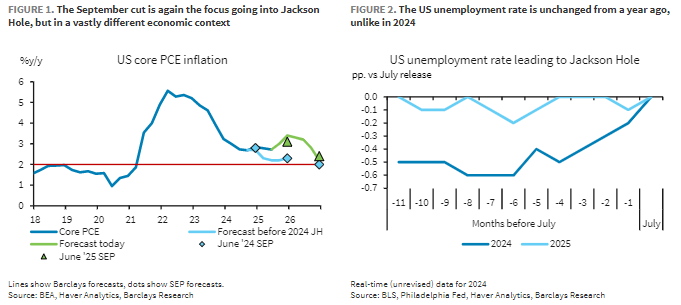
Core Viewpoint - The upcoming Jackson Hole meeting is highly anticipated, with Fed Chair Powell's speech expected to provide significant insights into future monetary policy, especially in the context of current market expectations for easing [1] Group 1: Market Expectations and Economic Context - Market confidence in a September rate cut is seen as overly optimistic, with Barclays analysts suggesting Powell's speech may challenge this view [2] - The economic backdrop is markedly different from a year ago, with current policy rates 100 basis points lower and core PCE inflation expected to rise above 3% [3][4] - Retail sales data shows resilience in consumer spending, and financial conditions are looser compared to last year, indicating weaker support for rate cuts [4][6] Group 2: Inflation and Labor Market Dynamics - Despite slowing job growth, improvements in labor supply have not weakened household income resilience, suggesting Powell has reasons to maintain a hawkish stance [10] - Core inflation remains above 3%, with recent data indicating a rise in core CPI to 3.1%, which may lead to upward pressure on prices as businesses pass on tariff costs [8][9] - There is insufficient evidence to suggest inflation has peaked, with expectations for core PCE to rise further, diverging from the Fed's 2% target [9] Group 3: External Factors and Policy Review - External factors, such as tariffs, are contributing to rising inflation expectations, as consumer confidence surveys indicate increased concerns about price hikes [12] - Political dynamics surrounding the U.S. Bureau of Labor Statistics (BLS) raise concerns about the integrity of future economic data, particularly after significant revisions to employment reports [12] - The Fed's ongoing policy framework review may lead to a re-evaluation of its inflation targeting approach, potentially abandoning the flexible average inflation targeting framework [14]

杰克逊霍尔央行年会,鲍威尔关键发声,为何华尔街一致“示警”
Hua Er Jie Jian Wen· 2025-08-18 06:06
全球金融市场正屏息以待周五的杰克逊霍尔"全球央行年会",美联储主席鲍威尔将在当天晚间发表致 辞。 近年来,鲍威尔曾多次在这一场合发表过对市场影响巨大的政策声明,而在当前市场宽松预期高涨的背 景下,鲍威尔这次讲话释放的任何信号将显得尤为关键。 尽管交易员相信疲软的就业市场已为鲍威尔"放鸽"打开大门,但多家华尔街大行却纷纷出面"唱反调"。 巴克莱和美银均认为,当前支持美联储降息的理由并不充分,因为劳动力市场仍具韧性,而在关税政策 的扰动下,通胀仍有上行风险。 考虑到距离9月会议还有一系列数据尚未公布,野村预计鲍威尔不会在周五给出"明确承诺",美银甚至 预计鲍威尔会秉持强硬的鹰派立场,与市场的宽松预期相悖。大摩则预计,鲍威尔会在讲话中继续强调 通胀风险,抵制市场的降息预期。 巴克莱:市场过于自信了,降息背景和去年截然不同 因此,报告认为,从经济数据看,今年支持降息的理由远不如去年充分。 报告还指出,鲍威尔在7月会议后的鹰派言论,似乎并未被后续的经济数据所推翻。他当时已预警,考 虑到修正因素,就业增长的实际速度可能接近于零,并强调失业率仍处于低位——而7月的就业报告恰 好印证了这一观点。 巴克莱银行分析师Christ ...
9月大幅降息悬了?美联储32年罕见内讧后,分歧升级
Wind万得· 2025-08-14 22:51
Core Viewpoint - The article discusses the increasing divergence in market expectations regarding interest rate cuts by the Federal Reserve, with significant internal disagreements among Fed officials and external pressures from the White House [1][2]. Group 1: Federal Reserve's Position - San Francisco Fed President Mary Daly opposes aggressive rate cuts, suggesting that a 50 basis point cut in September would send the wrong signal, as the labor market, while weakening, does not require urgent measures [4]. - Daly maintains a forecast of two rate cuts this year, emphasizing that businesses have absorbed tariff costs and that inflation from goods is moderate, indicating a preference for gradual policy adjustments [4]. Group 2: External Pressures - U.S. Treasury Secretary Janet Yellen called for a 50 basis point cut in September, suggesting that rates should be lowered by 150-175 basis points [6]. - Market expectations for a September rate cut are high, with a 94% probability, including a 62.9% chance for a 25 basis point cut and a 22.5% chance for a 50 basis point cut, creating a dilemma for the Fed [6]. Group 3: Inflation Data - The latest data shows that the U.S. Producer Price Index (PPI) rose by 3.3% year-on-year in July, the highest level since February, and 0.9% month-on-month, significantly above the expected 0.2% [8]. - Core PPI also increased by 3.7% year-on-year, exceeding expectations, indicating persistent upstream price pressures [8]. Group 4: Divergence Among Wall Street Firms - Major investment banks like Goldman Sachs and Citigroup predict a 50 basis point cut in September, while JPMorgan forecasts cuts in both September and November, totaling 125 basis points for the year, citing a rapidly deteriorating job market [10]. - In contrast, Bank of America argues for maintaining rates until 2026, prioritizing inflation risks over employment concerns [10]. Group 5: Internal Disagreements within the Fed - The July Fed meeting saw the first dual dissenting votes since 1993, with officials advocating for an immediate 25 basis point cut, highlighting a split within the committee [12]. - The decision-making process is expected to be contentious leading up to the September meeting, influenced by upcoming employment and inflation data [12].