马太效应

Search documents
自营等业务挑大梁 42家上市券商上半年赚千亿
Bei Jing Shang Bao· 2025-09-01 00:14
Core Viewpoint - The overall performance of listed securities firms in the A-share market showed significant recovery in the first half of 2025, with both revenue and net profit experiencing substantial growth compared to the previous year [1][2]. Revenue and Profit Growth - In the first half of 2025, the total operating revenue of 42 directly listed securities firms reached 251.87 billion yuan, an increase of 11.37% year-on-year, while the net profit attributable to shareholders amounted to 104.02 billion yuan, reflecting a year-on-year growth of 65.08% [2][3]. - Among these firms, CITIC Securities led with a revenue of 33.04 billion yuan, followed by Guotai Junan with 23.87 billion yuan. Other notable firms included Huatai Securities and GF Securities, both exceeding 15 billion yuan in revenue [2]. Business Segment Performance - The self-operated and brokerage businesses were the main drivers of the high growth in performance, with self-operated business net income totaling 112.35 billion yuan, up 53.53% year-on-year, and brokerage business net income reaching 63.45 billion yuan, an increase of 43.98% [4][5]. - Wealth management also contributed significantly, with Guotai Junan reporting a 92% increase in revenue from this segment, reaching 9.77 billion yuan [6]. Investment Banking Growth - The investment banking sector also saw steady growth, with total income from this business reaching 15.53 billion yuan, a year-on-year increase of 18.11%. Notably, CITIC Securities and CICC were among the top performers in this area [7][8]. Market Outlook - The overall market environment is expected to continue improving, with projections indicating sustained growth in trading volumes and further enhancements in the performance of securities firms. The industry is anticipated to trend towards specialization and the strengthening of leading firms, with the "Matthew Effect" becoming more pronounced [1][8].


超1130亿元,增长20.52%
中国基金报· 2025-08-31 14:26
Core Viewpoint - The public fund industry in China experienced significant growth in management fees, trading commissions, custody fees, and sales service fees, totaling over 1130 billion yuan in the first half of 2025, marking a year-on-year increase of 20.52% [2]. Management Fees - The total management fee income for the first half of 2025 reached 616.03 billion yuan, a 1.98% increase from 604.09 billion yuan in the same period of 2024 [3][4]. - The public fund management scale hit a record high of 34.39 trillion yuan by the end of June 2025, with an increase of 1.56 trillion yuan in the first half [4]. - Mixed funds generated the highest management fees at 177.49 billion yuan, accounting for 28.81% of total income, although this represents an 8.26% decrease from 193.47 billion yuan in 2024 [4]. - Money market and bond funds were the main contributors to management fee income, generating 173.19 billion yuan and 144.56 billion yuan respectively, with year-on-year growth of 9.36% and 4.26% [4]. Performance of Different Fund Types - QDII funds, other funds, and commodity funds saw substantial increases in management fees, with growth rates of 22.92%, 103.18%, and 169.41% respectively [5]. - Among 162 public fund managers, 21 had management fee incomes exceeding 10 billion yuan, up from 20 in 2024 [7]. - Leading fund companies included E Fund with 39.27 billion yuan, followed by Huaxia Fund and GF Fund with 32.67 billion yuan and 29.15 billion yuan respectively [7]. Client Maintenance Fees - Client maintenance fees amounted to 182.84 billion yuan, reflecting a year-on-year increase of 12.79% [10][12]. - After deducting client maintenance fees, the net management fee income for fund companies was approximately 433.19 billion yuan, a decrease of 1.99% from 441.99 billion yuan in the previous year [12]. Sales Service Fees - Sales service fees totaled 152.16 billion yuan, up 13.44% from 134.12 billion yuan in 2024 [14]. - Money market funds accounted for 76.34% of total sales service fees, with 116.16 billion yuan collected [14][15]. - The highest sales service fee income was recorded by Tianhong Fund at 11.88 billion yuan, with several other companies exceeding 5 billion yuan [15]. Custody Fees - Custody fee income reached 137.69 billion yuan, a 2.36% increase from 134.51 billion yuan in 2024 [16]. - Four commercial banks generated over 10 billion yuan in custody fees, with ICBC leading at 20.35 billion yuan [17]. - Securities firms' custody business remains low, with a total of only 3.08 billion yuan from 24 companies [18].


金融中报观|42家上市券商大赚超千亿,经纪、自营业务“挑大梁”
Bei Jing Shang Bao· 2025-08-31 12:07
Core Viewpoint - The overall performance of listed securities firms in A-shares has significantly improved in the first half of 2025, with both revenue and net profit showing substantial growth compared to the previous year [1][3]. Revenue and Profit Growth - In the first half of 2025, the total operating revenue of 42 listed securities firms reached 251.87 billion yuan, a year-on-year increase of 11.37% [3]. - The total net profit attributable to shareholders was 104.02 billion yuan, reflecting a remarkable year-on-year growth of 65.08% [3][4]. - Notably, CITIC Securities led with a revenue of 33.04 billion yuan, followed by Guotai Junan with 23.87 billion yuan [3]. Business Segment Performance - The self-operated and brokerage businesses were the main drivers of the high growth in performance, with self-operated business net income reaching 112.35 billion yuan, up 53.53% year-on-year [5]. - Brokerage business net income totaled 63.45 billion yuan, marking a 43.98% increase compared to the previous year [5]. Wealth Management and Investment Banking - Wealth management has emerged as a significant contributor to revenue growth, with Guotai Junan reporting a 92% increase in wealth management revenue to 9.77 billion yuan [6]. - The investment banking sector also saw steady growth, with total revenue reaching 15.53 billion yuan, a year-on-year increase of 18.11% [7]. Market Outlook - The overall market environment has improved, with expectations of continued growth in trading volume and securities firm performance in the latter half of 2025 [9]. - The industry is anticipated to exhibit trends of specialization, centralization, and personalization, with the Matthew effect becoming more pronounced [1][8].

公募公司业绩大分化:头部6家均实现盈利增长,中小机构困境中摸索出路
Xin Lang Cai Jing· 2025-08-31 10:40
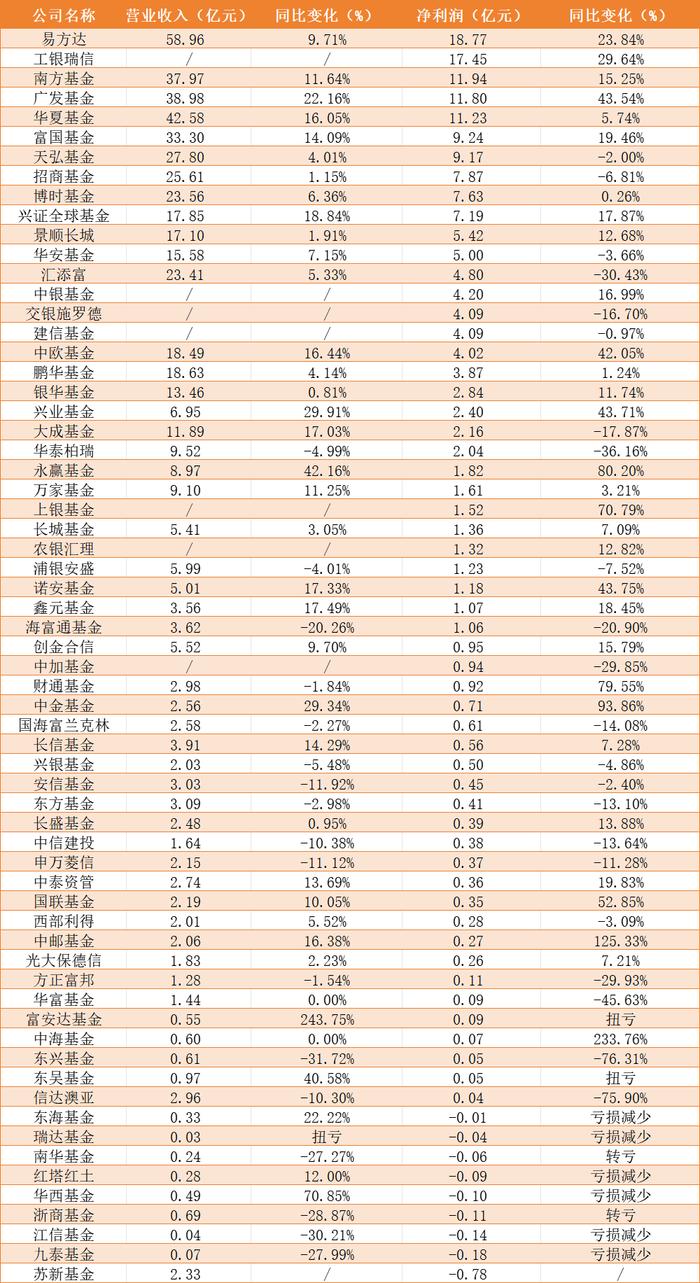
Core Insights - The A-share listed companies' semi-annual reports have shown a significant divergence in the operating and net profit situations of 64 public fund companies, with many larger firms recovering while smaller firms continue to struggle [1] Group 1: Company Performance - E Fund leads the industry with a revenue of 58.96 billion yuan, a year-on-year increase of 9.71%, and a net profit of 18.77 billion yuan, up 23.84% [2][3] - Other notable companies include Huaxia Fund with 42.58 billion yuan in revenue, and GF Fund, Southern Fund, and Fortune Fund all exceeding 30 billion yuan in revenue [3] - GF Fund reported the highest net profit growth among major firms at 43.54%, with a net profit of 11.8 billion yuan [3] Group 2: Small and Medium Fund Companies - Several small public funds have shown improvement, with Ruida Fund achieving revenue of 281.5 thousand yuan, marking a return to profitability [4] - However, many medium-sized firms like Tianhong Fund, China Merchants Fund, and Huitianfu Fund experienced declines in net profit, with decreases of 2%, 6.81%, and 30.43% respectively [4] - The industry continues to face challenges, particularly for small and medium-sized firms, which are struggling with revenue and profit declines [5] Group 3: Industry Trends - The public fund industry has maintained rapid growth, with total assets exceeding 35 trillion yuan as of July [5] - The industry is experiencing a "Matthew effect," where larger firms benefit from scale and show stronger resilience against market pressures [5] - Experts suggest that smaller firms should focus on niche markets and enhance their research capabilities to adapt to ongoing challenges [5]
券业上半年净利同比增40%,42家上市券商贡献超九成
Di Yi Cai Jing· 2025-08-31 10:37
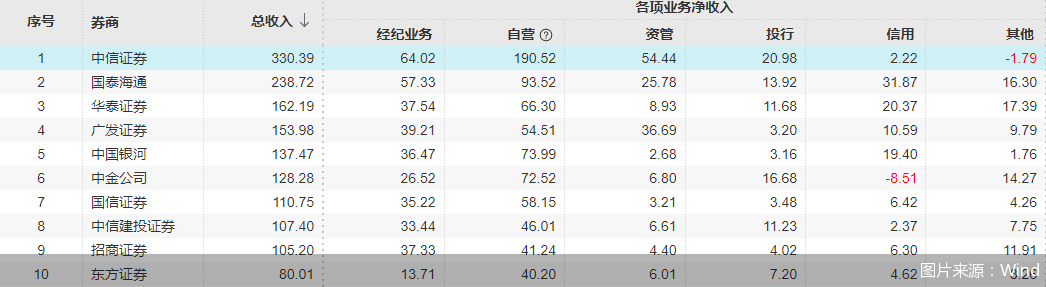
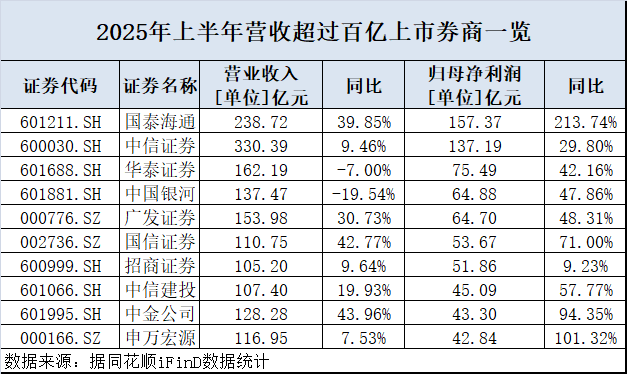
Core Viewpoint - The performance of listed securities firms in the first half of 2025 shows a significant recovery, with notable growth in revenue and net profit across the industry, indicating a positive trend in the brokerage and proprietary trading businesses [2][3]. Group 1: Overall Industry Performance - In the first half of 2025, 42 listed securities firms achieved a total revenue of 2518.66 billion yuan, representing a year-on-year growth of 11.37% [2][3]. - The total net profit for these firms reached 1040.17 billion yuan, marking a substantial increase of 65.08% compared to the previous year [2][3]. - The net profit of listed firms accounted for 92.64% of the overall net profit in the securities industry, indicating a concentration of earnings among the top firms [3][9]. Group 2: Revenue and Profit Breakdown - Among the listed firms, 10 achieved revenues exceeding 10 billion yuan, with CITIC Securities leading at 330.39 billion yuan [3][6]. - The largest revenue growth was seen in Guolian Minsheng, which reported a 269.40% increase, while Dongxing Securities experienced the most significant decline at 53.90% [4]. - In terms of net profit, Guotai Junan and CITIC Securities were the only firms to exceed 10 billion yuan, with Guotai Junan's net profit growing by 213.74% [4][5]. Group 3: Business Segment Performance - The brokerage and proprietary trading segments saw significant revenue growth, with the net income from agency trading reaching 688.42 billion yuan, up 48.22% year-on-year [7][8]. - The investment consulting and interest income also showed strong growth, with increases of 25.09% and 23.68% respectively [7]. - However, the asset management business faced challenges, with a year-on-year decline of 4.68% in net income [7][8]. Group 4: Market Concentration and Future Outlook - The industry is experiencing a "Matthew Effect," with increasing concentration of profits among the top firms, as over 60% of revenue and 70% of net profit come from the top ten firms [9]. - Regulatory changes are expected to further enhance this concentration, as new classification regulations aim to support stronger firms while limiting the growth of weaker ones [9][10].



“存款搬家”加速!2万亿规模的理财公司,达到6家了
券商中国· 2025-08-29 15:03
Core Viewpoint - The phenomenon of "deposit migration" accelerated in July, with a significant portion of residents' deposits shifting towards funds, wealth management, and other asset management products [1] Group 1: Financial Data and Trends - In July, the new deposits from the resident sector decreased by 1.1 trillion yuan, while deposits from non-bank institutions increased by 2.14 trillion yuan [2] - The scale of bank wealth management increased by approximately 2 trillion yuan month-on-month to 32.67 trillion yuan, exceeding the average growth of 1.75 trillion yuan for July from 2018 to 2024 [2] - The top 14 wealth management companies, each with a scale exceeding 1 trillion yuan, collectively saw a net inflow of about 1.77 trillion yuan in July, with the four major state-owned banks' wealth management companies contributing significantly [2][3] Group 2: Company Performance - Among the wealth management companies, Agricultural Bank's wealth management saw a growth of over 310 billion yuan in July, marking an 18% increase, the highest among 32 companies [3] - Other notable performers included Construction Bank's wealth management with over 200 billion yuan growth (14.5% increase) and Industrial Bank and Bank of China, both exceeding 170 billion yuan in net growth [3] - By the end of July, six wealth management companies surpassed the 2 trillion yuan mark, including Agricultural Bank, Industrial Bank, and Bank of China, indicating a narrowing gap among them [3] Group 3: Market Dynamics - The rapid growth in the wealth management market has intensified the "Matthew Effect," where licensed wealth management institutions are experiencing significant net increases, while small and medium-sized banks without such licenses face pressure to reduce their scale [4] - Some regional small and medium-sized banks are considering collaboration to establish wealth management companies in response to regulatory pressures [5] - As of June, 61 out of 68 small and medium-sized banks reported a decrease in their wealth management scale, with 20 banks experiencing declines exceeding 20% [5]

2025年上半年归母净利润增长约四成中芯国际市值能否突破万亿元大关
Xin Lang Cai Jing· 2025-08-28 21:12
Core Viewpoint - Semiconductor industry is experiencing a "stronger gets stronger" effect, with SMIC positioned as the second-largest pure wafer foundry globally, following TSMC [1][2] Financial Performance - In the first half of 2025, SMIC reported revenue of 32.348 billion yuan, a year-on-year increase of 23.1% [1] - The net profit attributable to shareholders was 2.301 billion yuan [1] - EBITDA (Earnings Before Interest, Taxes, Depreciation, and Amortization) for the same period reached 17.418 billion yuan, reflecting a 26.5% year-on-year growth [1][2] Production and Capacity - SMIC's wafer sales volume increased by 19.9%, from 3.907 million pieces in the same period last year to 4.682 million pieces [1] - The company added nearly 20,000 pieces of 12-inch standard logic monthly capacity in the first half of 2025, maintaining a leading overall capacity utilization rate [3] Market Trends - The global semiconductor industry continues to grow, with diverse downstream application scenarios influencing different segments [3] - The consumer electronics market is gradually releasing demand for upgrades in smartphones, computers, and wearable devices [3] - The automotive electronics sector shows signs of recovery, with ongoing localization of the supply chain [3] Future Outlook - For the second half of 2025, SMIC aims to focus on annual performance growth, new application development, and deep cooperation in research and education [4] - The company anticipates challenges from U.S. tariff policies and geopolitical uncertainties, while also observing the recovery of emerging market demand [4] - The fourth quarter is traditionally a slow season for the industry, but SMIC's overall capacity is expected to remain in demand despite potential slowdowns in urgent orders [4]

强者愈强:海天味业增长,竞品们下滑
2 1 Shi Ji Jing Ji Bao Dao· 2025-08-28 14:51
Core Viewpoint - The condiment market is exhibiting a Matthew effect, with leading companies like Haitian Flavor Industry showing significant growth while others like Qianhe Flavor and Zhongju High-tech are experiencing declines in revenue and profit [1][3]. Group 1: Company Performance - Haitian Flavor Industry reported a revenue increase of 7.6% to RMB 15.23 billion and a net profit increase of 13.3% to RMB 3.91 billion for the first half of 2025 [1][2]. - In contrast, Qianhe Flavor's revenue declined by 17.1% to RMB 1.32 billion, and net profit fell by 30.8% to RMB 170 million [1][5]. - Zhongju High-tech also faced challenges, with a revenue drop of 18.6% to RMB 2.13 billion and a net profit decrease of 26.6% to RMB 260 million [1][5]. Group 2: Sales Breakdown - Haitian's soy sauce sales grew by 9.1% to RMB 7.93 billion, driven by health-oriented products and increased digital marketing efforts [4]. - The sales of oyster sauce increased by 7.7% to RMB 2.50 billion, supported by health product growth and improved penetration in certain channels [4]. - Qianhe's soy sauce and vinegar sales fell by 16.1% and 21.5%, respectively, due to negative publicity and increased competition [5]. Group 3: Profitability and Cost Management - Haitian's gross profit rose by 17.1% to RMB 5.98 billion, with a gross margin increase of 3.2 percentage points to 39.3%, aided by lower material costs and improved production efficiency [4]. - Qianhe's gross margin decreased by 2.5 percentage points to 32.6% in the second quarter, despite a 1 percentage point increase in the first half due to lower raw material prices [5]. - Zhongju High-tech's gross margin improved by 2.4 percentage points to 39.0% [6]. Group 4: Strategic Initiatives - Haitian is focusing on core product categories and expanding its offerings in vinegar and cooking wine, while also enhancing its product line to meet consumer trends [7]. - The company is optimizing its distribution network by reducing the number of underperforming distributors and enhancing channel management through digital systems [8]. - Haitian is also seeking growth in overseas markets, having raised RMB 10.13 billion from its Hong Kong listing, with plans to allocate 20% of the funds for international expansion [9].

强者愈强:海天味业增长,竞品们下滑丨食饮财报观察
2 1 Shi Ji Jing Ji Bao Dao· 2025-08-28 14:51
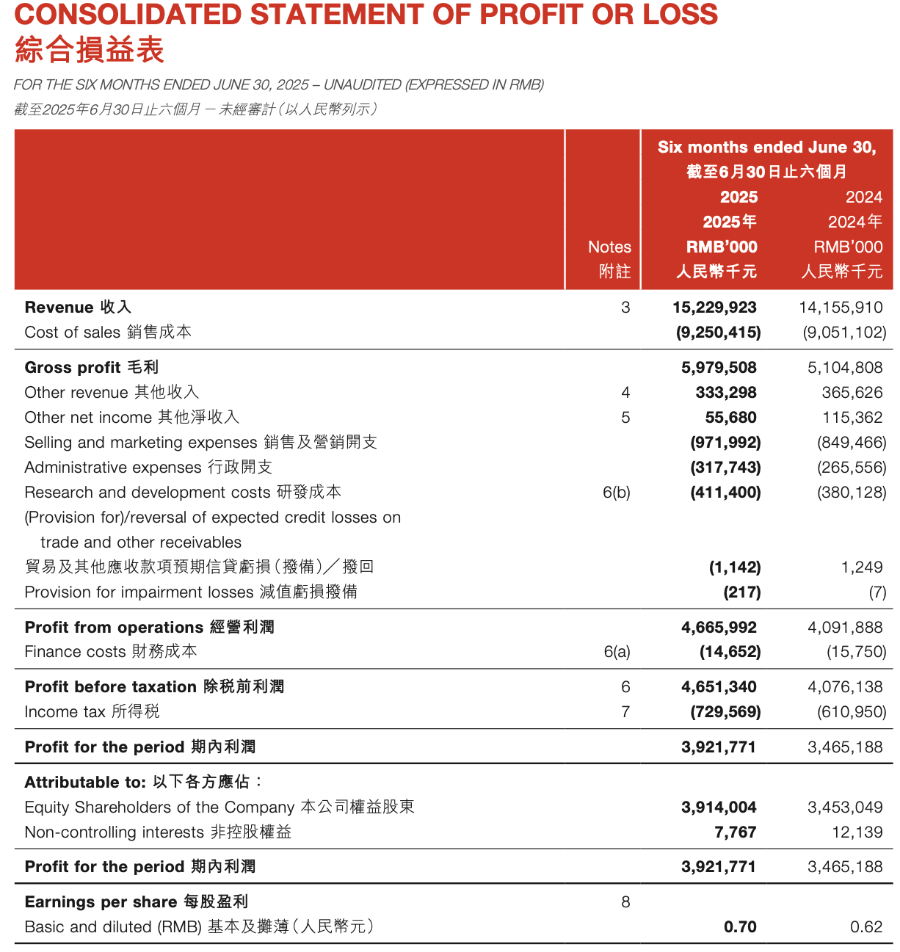
Core Viewpoint - The condiment market is exhibiting a Matthew effect, with leading companies like Haitian Flavor Industry showing strong performance while others struggle [1][3]. Company Performance - Haitian Flavor Industry reported a revenue increase of 7.6% year-on-year to 15.23 billion yuan and a net profit increase of 13.3% to 3.91 billion yuan in the first half of 2025 [1]. - In contrast, Qianhe Flavor Industry experienced a revenue decline of 17.1% to 1.32 billion yuan and a net profit decline of 30.8% to 170 million yuan [2]. - Zhongju High-tech also faced challenges, with a revenue drop of 18.6% to 2.13 billion yuan and a net profit drop of 26.6% to 260 million yuan [2]. Sales Growth Drivers - Haitian's soy sauce sales grew by 9.1% to 7.928 billion yuan, driven by health-oriented products like organic and low-salt soy sauce [4]. - Oyster sauce sales increased by 7.7% to 2.502 billion yuan, supported by health product growth and improved penetration in certain channels [4]. - The sales of seasoning sauces rose by 12.0% to 1.626 billion yuan, aided by the introduction of regional specialty products [4]. - Overall, Haitian's gross profit increased by 17.1% to 5.98 billion yuan, with a gross margin improvement of 3.2 percentage points to 39.3% [4]. Challenges Faced by Competitors - Qianhe's soy sauce and vinegar revenues fell by 16.1% to 840 million yuan and 21.5% to 160 million yuan, respectively, due to negative publicity and increased competition [5]. - Zhongju High-tech's various product lines also saw significant revenue declines, particularly in cooking oil, which dropped by 49.4% [5]. Strategic Adjustments - Haitian is focusing on five core product categories and expanding its vinegar and cooking wine offerings, while also developing more health-oriented products [8]. - The company is enhancing its production flexibility and optimizing its distribution channels to address inventory issues and stabilize pricing [9]. - In 2023, Haitian reduced the number of distributors by 1,253 while increasing the number by 672, indicating a strategic shift in its distribution approach [9]. Market Expansion Plans - Haitian Flavor Industry is seeking growth in overseas markets, having raised 10.129 billion HKD from its Hong Kong listing, with plans to allocate 20% of these funds for international expansion [9].
头部公司日入千万元,尾部日入万元!“马太效应”下小型公募挣扎求生
Hua Xia Shi Bao· 2025-08-27 09:12
本报(chinatimes.net.cn)记者张玫 北京报道 某头部公募基金人士表示,头部基金的营业收入包含多个方面,既包括公募业务的管理费收入,也包括 机构专户业务的收入,还有一部分自有资金投资的收益(包括基金自购后的盈利等)。 值得注意的是,头部机构与中小基金公司业绩差距悬殊。华夏基金单日营收(按上半年181天计算)可 达2300余万元,几乎相当于南华基金整个上半年的总收入。而瑞达基金等小型公募机构日均收入仅维持 在万元水平,半年收入约为头部公司日均收入的十分之一。 渠道、资源、人才"关关难过" "小公司的成本大头应该就是系统,每年光人力、系统维护的成本几千万是要有的。尤其是系统费用, 不论是大型公募基金或是小型公募基金,其成本都差不多。因此,在小型公募基金中,系统费用的占比 就显得较高。营收较低,股东持续投入好几年也看不到盈利的希望,只能苦苦支撑。"一家小型公募基 金公司的高管向记者坦言。 2025年上半年A股走出修复性行情,市场的暖意并未均匀洒向每一家基金管理人。头部公司业绩与规模 齐升,小公募基金却并没有那么好过。 截至8月25日,部分公募基金上半年业绩数据陆续披露。已披露的数据显示,一家头部公募基 ...