
即时零售

Search documents
外卖大战日单量冲击2亿单 美团淘天京东谁胜出
Bei Jing Shang Bao· 2025-07-07 14:09
Core Insights - The article highlights a significant surge in daily orders for food delivery services, with Taobao Flash Purchase and Ele.me reporting over 80 million daily orders and more than 200 million active users, while Meituan's daily orders exceeded 100 million [1][7][10] - The competition among e-commerce giants has intensified, particularly in the food delivery sector, driven by substantial subsidies aimed at attracting younger consumers and boosting order volumes [1][6][10] E-commerce Competition - Taobao Flash Purchase and Ele.me launched a massive subsidy campaign, with Taobao offering a total of 50 billion yuan in subsidies, leading to a spike in orders and user engagement [7][10] - Meituan reported that its instant retail orders surpassed 120 million, with food delivery orders exceeding 100 million, indicating a strong consumer response to the subsidy initiatives [6][10] Consumer Behavior - The article notes a trend of consumers sharing their experiences on social media, showcasing the benefits of the subsidies, such as receiving multiple drinks for little to no cost [8][9] - The demand for milk tea has been particularly effective in driving sales, as it appeals to younger demographics and has a high frequency of purchase [9][11] Impact on Merchants and Delivery Personnel - Merchants and delivery personnel are experiencing overwhelming order volumes, with reports of some stores receiving over 300 orders in an hour, leading to challenges in fulfilling orders promptly [8][9] - Delivery personnel have reported significant increases in earnings due to the subsidies, with some earning over 1,000 yuan in a single day [8][9] Strategic Implications - The ongoing subsidy wars are seen as a strategic battle for high-frequency traffic and market share in the trillion-yuan instant retail market, with companies aiming to create a closed-loop ecosystem that connects food delivery with other high-value services [10][11] - Experts suggest that while subsidies can drive short-term growth, they may not be sustainable in the long run, potentially leading to a "prisoner's dilemma" scenario within the industry [10][12]


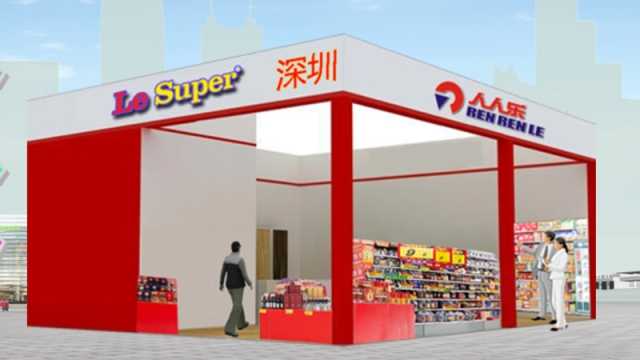
人人乐退市、家乐福资产遭甩卖:传统零售业洗牌潮要来了?|乐言商业
Di Yi Cai Jing· 2025-07-07 13:50
Core Viewpoint - The delisting of Renrenle reflects the severe challenges faced by the traditional retail industry and the competitive pressure brought by the rise of new business models [1] Group 1: Company Overview - Renrenle, once known as the "first private supermarket stock," has been delisted from the Shenzhen Stock Exchange, with its stock being terminated on July 4 [1] - The company has experienced continuous losses over the years, leading to store closures as a damage control measure, but this has not significantly improved its performance, ultimately resulting in its delisting [1][4] - As of the end of 2024, Renrenle had 32 stores, all of which were direct-operated, having opened 1 new store, closed 45, and transferred 15 stores [5] Group 2: Financial Performance - Renrenle's financial reports indicate a continuous decline, with net profits being negative for three consecutive fiscal years from 2021 to 2023, and a significant drop in revenue of 49.86% in 2024, amounting to 1.43 billion yuan [4] - The company's market capitalization has severely decreased, with its stock price at 0.36 yuan per share as of July 3, 2023, leading to a total market value of approximately 158 million yuan, a stark contrast to its peak market value of over 10 billion yuan [5] Group 3: Industry Challenges - The traditional retail sector is under significant pressure due to the rise of e-commerce and new retail formats such as membership stores and discount stores, which have diverted business from traditional retailers [3][6] - Competitors like Carrefour have also faced challenges, with many of their stores closing in the Chinese market, indicating a broader trend of decline in traditional retail [6] - The emergence of instant retail has intensified competition, with companies like Meituan and Alibaba engaging in aggressive pricing strategies, making it difficult for traditional retailers to compete [8] Group 4: Future Outlook - Industry experts predict that more traditional retailers may face store closures or the need to transform their business models in the coming year, as the competitive landscape continues to evolve [8] - The pressure on traditional retailers to adapt to new market conditions is increasing, with suggestions for them to learn from successful models in service, delivery, and supply chain management [8]

阿里加码外卖大战,美团的“围城”时刻
2 1 Shi Ji Jing Ji Bao Dao· 2025-07-07 13:44
Core Insights - The competition in the instant retail market has intensified, with Meituan and Alibaba launching aggressive subsidy campaigns to capture market share [2][5][11] - Alibaba announced a direct subsidy of 50 billion yuan to consumers and merchants over the next 12 months, while Meituan responded with significant coupon distributions [2][4] - The rapid increase in order volumes indicates a shift in consumer behavior and heightened competition among platforms [5][9] Group 1: Company Strategies - Meituan's daily order volume for instant retail surpassed 120 million, with non-food orders showing significant growth [5][9] - Alibaba's Taobao Flash Sale reported over 80 million orders within three days of launching its subsidy program, with a focus on enhancing its local service capabilities [5][6] - Both companies are leveraging their existing platforms to drive traffic and improve conversion rates, with Alibaba integrating Ele.me into its local services strategy [5][6] Group 2: Market Dynamics - The instant retail market is characterized by a high frequency of orders, with Meituan's non-food category growing at a rate of 23% year-on-year [5][6] - High delivery costs are expected to pressure profitability across the industry, as platforms compete for user acquisition through subsidies [6][11] - The market share of the top three players has decreased from 82% in 2020 to 67%, indicating increased competition and fragmentation [11] Group 3: Consumer Behavior - Consumers are benefiting from the competitive landscape, with reports of increased order volumes and promotional offers leading to a surge in demand for various products [8][9] - The influx of orders has created challenges for merchants in fulfilling demand, highlighting the need for efficient logistics and delivery systems [8][9] - The competition has empowered merchants, allowing them to negotiate better terms with platforms due to increased options [9][10]
即时零售是长期事业 平台冲流量也要护“生态”
Mei Ri Jing Ji Xin Wen· 2025-07-07 13:00
Core Insights - Instant retail in China has seen a significant surge, with Meituan reporting over 120 million orders on July 5, surpassing last year's peak of 90 million orders, indicating a highly competitive landscape among major platforms [1] - The competition among JD, Alibaba, and Meituan has intensified, with each platform implementing aggressive strategies to capture market share [2] Group 1: Market Dynamics - Instant retail is defined as the ability for consumers to receive goods or services shortly after placing an order online, with food delivery being a major component [1] - The market is expanding into various categories such as fresh produce, pharmaceuticals, and groceries, making instant retail a critical strategic area for e-commerce giants [1] - The competition is characterized by high intensity, as evidenced by JD's entry into the food delivery market and the subsequent strategic adjustments made by Alibaba and Meituan [2] Group 2: Short-term Strategies - Platforms are leveraging substantial subsidies to attract users, with JD offering high-quality restaurant options and significant incentives for full-time delivery personnel [2] - Alibaba has launched a substantial subsidy program totaling 50 billion yuan to enhance user engagement on its platforms [2] - Meituan's recent promotional activities have resulted in record order volumes, showcasing the market's potential [2] Group 3: Sustainability Concerns - The current state of high subsidies is not sustainable, as profitability is essential for long-term operations [3] - The surge in orders has led to resource wastage and operational strain on businesses, highlighting the challenges of maintaining service quality under high demand [3] - Historical patterns indicate that subsidy wars typically do not result in lasting competitive advantages, often leading to market consolidation [3] Group 4: Long-term Outlook - Instant retail is viewed as a long-term endeavor, with the impact of subsidy wars on market structure being limited [4] - A significant portion of recent orders remains concentrated in the food sector, suggesting that the effectiveness of subsidies may be restricted to existing market segments rather than expanding into new ones [4] - Moving forward, platforms need to focus on building a sustainable ecosystem that empowers merchants and delivery personnel to ensure a consistent supply of quality services [4]
晚点独家丨外卖混战升级:淘宝投入资源比肩双 11,美团第一次全面反击
晚点LatePost· 2025-07-07 12:28
Core Insights - The article discusses the intense competition in the food delivery market, particularly between Alibaba's Taobao Flash Sale and Meituan, highlighting a significant increase in order volumes during a promotional event [5][17]. Group 1: Market Dynamics - On July 5, Meituan reported over 1.2 billion orders, with more than 1 billion being food delivery orders, while Taobao Flash Sale announced over 80 million orders two days later [5][17]. - The overall food delivery market saw a surge from an average of 1 billion daily orders to approximately 2.2 billion on that day, driven by aggressive subsidies and promotional strategies from both platforms [6][8]. Group 2: Competitive Strategies - Alibaba initiated a 100-day growth plan, dubbed "Huaihai Campaign," aiming to create a new promotional event similar to "Double 11," with significant budget allocations and marketing efforts [9][8]. - Meituan mobilized thousands of employees and merchants to counter Alibaba's efforts, resulting in a rapid increase in order fulfillment capabilities [4][10]. Group 3: Consumer Behavior - Consumers responded to the promotions by purchasing a wide range of products, including fast-moving consumer goods, with some even stocking up on items like bottled water and snacks [7][8]. - The promotional event led to a notable increase in order volumes for categories such as grains, frozen foods, and personal care products, with some categories experiencing over 100% growth compared to previous periods [8][7]. Group 4: Operational Challenges - The surge in orders caused significant strain on delivery capabilities, with many merchants unprepared for the volume, leading to system crashes and delays in order fulfillment [4][12]. - Meituan's logistics infrastructure, including its extensive network of riders and delivery tools, played a crucial role in managing the increased demand, although it faced challenges due to the overwhelming order volume [10][11]. Group 5: Financial Implications - The competition has led to substantial financial commitments from both companies, with estimates suggesting that nearly 100 billion yuan will be spent on subsidies across the platforms [13][19]. - The article notes that the current market environment is characterized by intense competition and a lack of growth, making it difficult for platforms to sustain profitability while engaging in aggressive subsidy wars [19][18].
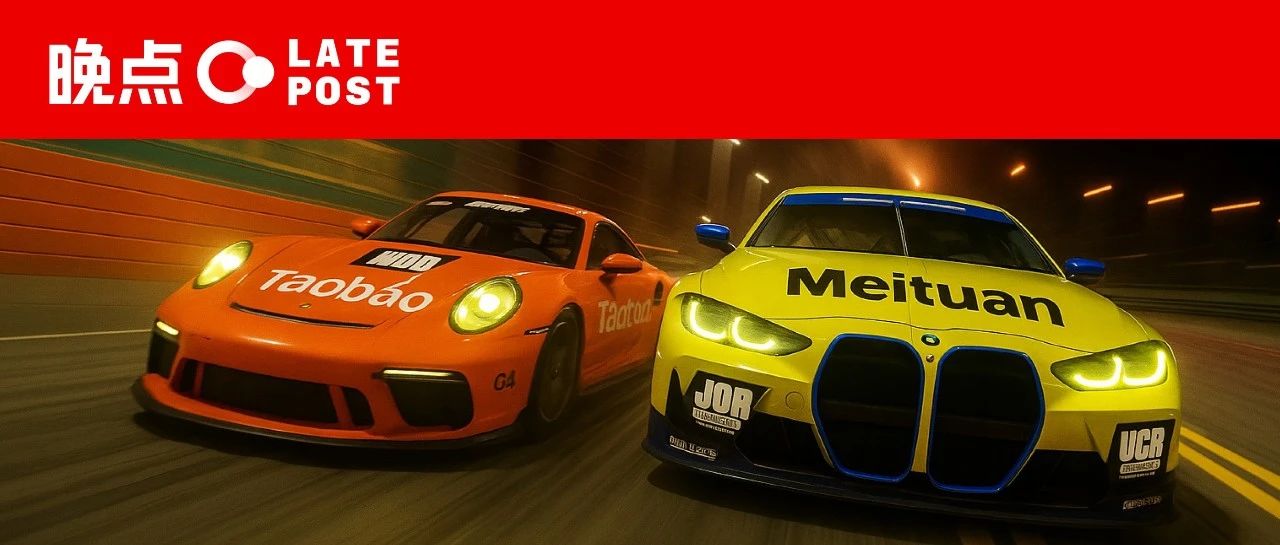
美团、淘宝“杀疯了”
财联社· 2025-07-07 12:27
Core Viewpoint - A significant subsidy war has erupted among instant retail platforms, leading to a surge in order volume, with daily orders increasing from approximately 100 million in May to 200 million currently, driven by substantial financial incentives from platforms like Taobao Flash Sale and Meituan [1][6][7]. Group 1: Market Dynamics - The recent subsidy war involves a broader range of categories and merchants, including independent coffee shops, fast food, bakeries, and community fresh food stores, unlike previous subsidy battles that focused mainly on chain brands [4]. - Taobao Flash Sale announced a direct consumer and merchant subsidy of 50 billion yuan over 12 months, significantly boosting its daily order volume and user engagement [6][7]. - As of July 5, Meituan reported over 1.2 billion daily orders, with more than 1 billion being food delivery orders, indicating a strong competitive response to Taobao's initiatives [7]. Group 2: Competitive Landscape - JD's entry into the market with a 10 billion yuan subsidy has also intensified competition, with JD's daily order volume surpassing 25 million and capturing over 31% of the national food delivery market [6]. - The instant retail market in China is rapidly growing, with a projected scale of 6.5 trillion yuan in 2023, reflecting a year-on-year growth of 28.89%, and expected to exceed 20 trillion yuan by 2030 [7][8]. Group 3: Operational Challenges - Merchants have expressed challenges in handling the sudden influx of orders due to the unexpected nature of the subsidy campaigns, leading to operational strains [4][5]. - Delivery personnel have reported increased workloads and delays in order fulfillment, highlighting the logistical challenges posed by the surge in demand [5].

新消费派|“外卖大战”愈演愈烈,即时零售“三国杀”拼什么?
Xin Hua Cai Jing· 2025-07-07 11:48
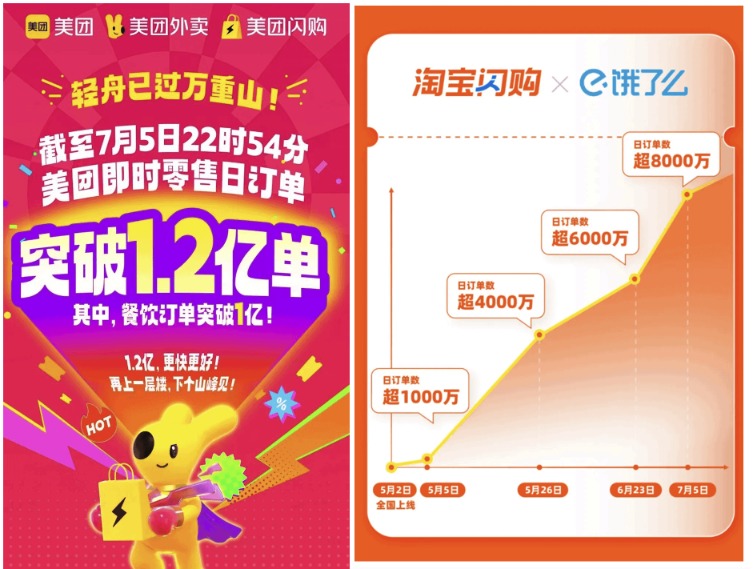
在刚刚过去的周末,比天气更热的或许是阿里和美团间的"外卖补贴"大战。 新华财经获悉,淘宝闪购7月5日的日订单数超8000万,其中非餐饮订单超1300万,美团则在7月5日深夜宣布其即时零售日订单量突破1.2亿单大关,其中, 餐饮订单超过1亿单。 以外卖为流量入口,美团、阿里系(淘宝闪购和饿了么)、京东三大巨头盯上的是"最后一公里"之争。相比外卖市场的存量竞争,如何重塑即时零售在消费 者心中的认知,成了2025年下半年各大平台竞争的关键。 阿里、美团打响 "史诗级"外卖大战 7月2日,淘宝闪购宣布启动规模高达500亿元的补贴计划,强势加入美团和京东的外卖角逐,形成"三国杀"。次日,阿里巴巴计划发行本金总额约120亿港 元、2032年到期的零票息可交换债券,市场认为阿里此举某种程度也是为了"外卖大战"提供弹药。 7月5日,淘宝、美团两大平台放出了大量且大额的外卖红包券。淘宝闪购放出包括"满25减21""满25减20""满16减16"等多张无门槛的外卖券;美团火速回 敬"0元自取"奶茶券。 多位消费者在社交平台上晒出"零元购"订单,大量用户涌入平台下单,致使美团在5日傍晚一度宕机。"美团崩了"的话题冲上微博热搜榜第一 ...
美团和淘宝闪购的一次正面较量,复盘周末外卖补贴战
雷峰网· 2025-07-07 10:45
Core Viewpoint - The article discusses the intense subsidy war in the food delivery industry, particularly between Meituan and Taobao Flash Sale, highlighting the strategies and outcomes of their promotional campaigns [2][4][8]. Group 1: Subsidy Strategies - Meituan launched a series of aggressive subsidies, including 0 yuan and 1 yuan purchases, leading to a record of 120 million orders in a single day, with over 100 million being food delivery orders [2][4]. - Taobao Flash Sale and Ele.me responded with their own subsidies, achieving over 80 million orders, although they did not meet their internal expectations [6][8]. - Both platforms set ambitious week-over-week growth targets for their internal teams and service providers, aiming for 15% to 20% increases in order volume [2][6]. Group 2: Market Impact - The subsidy competition resulted in a significant increase in order volumes, with Meituan and Taobao Flash Sale both reaching new peak order numbers [6][8]. - The article notes that the competition has led to a surge in stock prices for several tea brands, with increases of over 5% for companies like Mixue Group and 11% for Cha Baidao [8][9]. - Industry analysts suggest that while the subsidies drive immediate order growth, the long-term effects on user retention and market penetration remain uncertain [9]. Group 3: Challenges for Small Businesses - Smaller businesses face higher costs during the subsidy wars, as they often have to absorb a significant portion of the discounts offered by platforms [9]. - The article indicates that while the overall order volume has increased, the profitability for smaller merchants is questionable, as they struggle to cover the costs associated with the subsidies [9].
长红30多年,全球第一的冰淇淋公司要IPO
创业邦· 2025-07-07 10:27
Core Viewpoint - The article discusses the recent developments in the ice cream market, particularly focusing on the independence of Magnum Ice Cream Company from Unilever and the competitive landscape in China's ice cream industry. Group 1: Company Developments - On July 1, Magnum Ice Cream Company officially completed its separation from Unilever, which previously held a 20% global market share in the ice cream sector with brands like Cornetto and Magnum [5][6]. - The new company plans to go public with an IPO in Amsterdam by Q4 2025, with additional listings in London and New York [8]. - The ice cream market in China is projected to reach a scale of 183.5 billion yuan in 2024, indicating significant growth potential [18]. Group 2: Market Competition - The article highlights the competitive dynamics in the Chinese ice cream market, where local brands like Yili and Mengniu are gaining market share against Unilever [16]. - In 2024, the top three companies in the Chinese ice cream market by retail sales are Yili, Unilever, and Mengniu, with the leading brands being Chao Le Zi (Yili), Yili, and Kele Duo (Unilever) [16]. - The market is experiencing a surge in new entrants, with over 41,200 ice cream-related companies registered as of May 2023, indicating a rapidly evolving competitive landscape [21]. Group 3: Consumer Trends - The article notes that consumer preferences are shifting, with new tea and coffee brands entering the ice cream space, offering products at lower price points [31]. - Instant retail is becoming a significant channel for ice cream sales, with a projected sales scale of over 63 billion yuan by 2026 [34]. - The diversification of consumption scenarios for ice cream, including workplace snacks and outdoor activities, is becoming a trend, suggesting that brands need to adapt to changing consumer behaviors [34].




淘宝闪购携500亿入局,即时零售开启“三国杀”
Huan Qiu Lao Hu Cai Jing· 2025-07-07 10:07
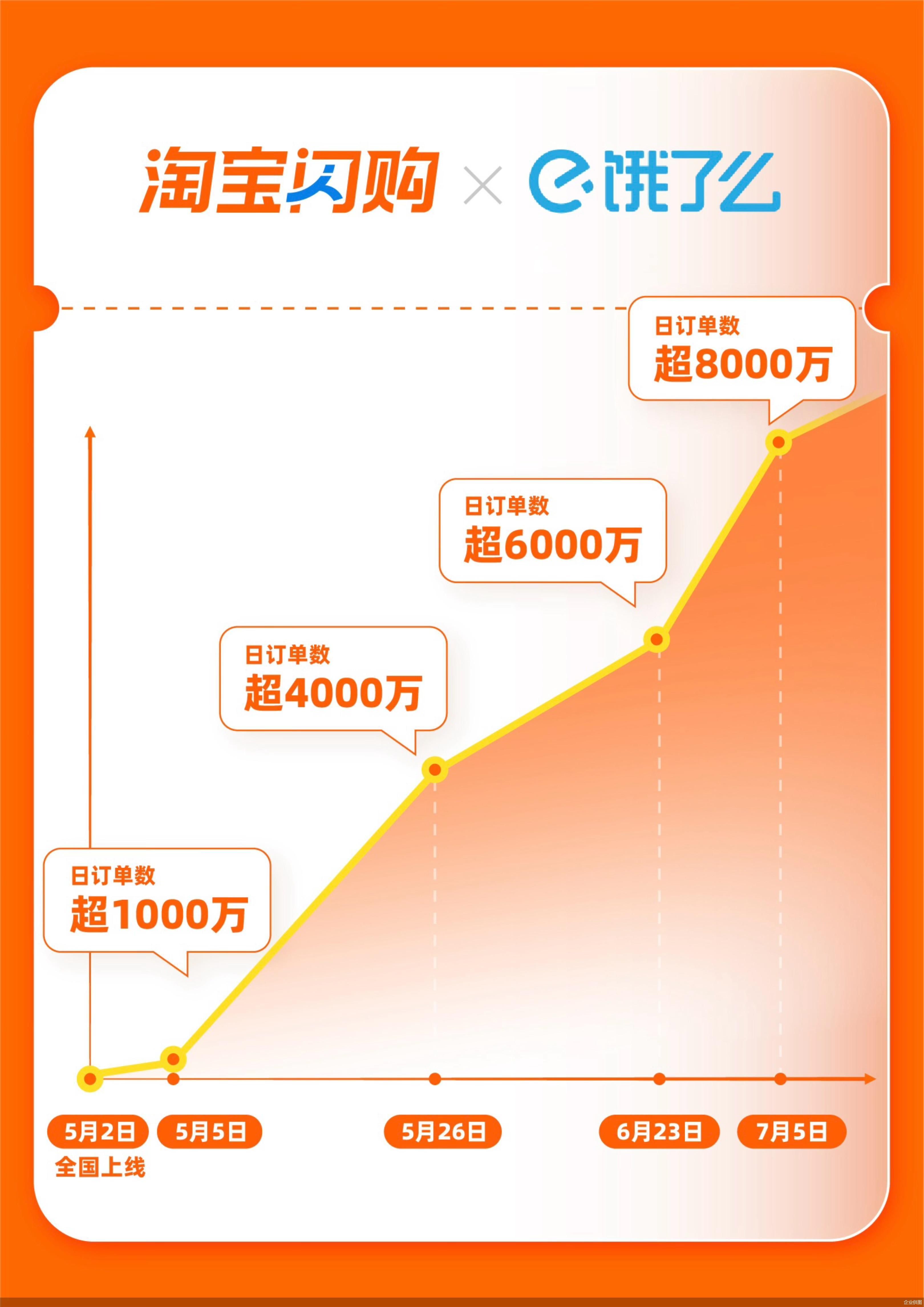
具体来看,7月2日,淘宝闪购宣布启动规模高达500亿元的补贴计划,该计划将在未来12个月内,通过 直补消费者及商家的方式展开。 淘宝闪购自5月2日正式上线以来,发展势头迅猛。5月底,其日订单量就超过了4000万;到6月底,日订 单量突破6000万。7月7日,淘宝闪购与饿了么联合宣布,日订单数已超过8000万,其中非餐饮订单超过 1300万,日活跃用户超过2亿。 与此同时,其他两大平台在即时零售领域也成绩斐然。7月5日,美团即时零售日订单突破1.2亿单,其 中餐饮订单超过1亿单,创造了新的历史纪录。京东方面,在6月18日的2025京东618媒体开放日上,京 东外卖日订单量已突破2500万单。 在即时零售领域,美团一直是"守擂者"。它拥有庞大的骑手网络和日均千万订单的配送能力,在市场中 占据着重要地位。然而,随着京东和阿里的强势入局,美团面临的守擂压力陡然增大。为了应对竞争, 美团不得不加大投入,通过补贴等方式吸引消费者和商家。 而阿里系原外卖平台饿了么在激烈的市场竞争中处境愈发艰难。为此,阿里将淘宝"小时达"升级为"淘 宝闪购",并将其置于淘宝App首页一级入口,同时整合饿了么、菜鸟驿站与盒马资源,形成"货盘+ ...