银发经济

Search documents
金活医药集团(1110.HK):产品矩阵深化扩容,韧性生长
Ge Long Hui· 2025-08-29 02:33
Economic Overview - In the first half of 2025, China's GDP grew by 5.3% year-on-year, with retail sales of consumer goods increasing by 5.0% and per capita disposable income rising by 5.4%, indicating a stable economic foundation [1] - The healthcare sector is undergoing a significant transformation, with per capita healthcare spending increasing by 3.4% and accounting for 9.2% of total consumption expenditure, highlighting the rigid nature of health demand [1] Company Performance - In the first half of 2025, the company achieved revenue of approximately 405 million yuan, driven by product mix optimization and channel efficiency improvements [3] - The company has focused on enhancing channel efficiency, with flagship stores established for its products, including 191 stores for the "Laba" brand and 400 stores for the "Yima" brand, significantly improving brand visibility [3][6] Drug Distribution - The drug distribution segment generated stable sales revenue of 266 million yuan in the first half of 2025, utilizing a big product strategy and scenario-based marketing to accelerate omnichannel penetration [5] - The "Kyoto Nanchuan" product has seen significant growth of 443.2% year-on-year, supported by research confirming its effectiveness, indicating strong market potential [5] New Product Development - The company has developed a product matrix centered around core new products, with the "An Gong Niu Huang Wan" experiencing explosive growth, recording sales of 1.5 million yuan and a year-on-year increase of 315.4% [8] - The Innopharm fish oil series has exceeded expectations, leveraging targeted marketing on platforms like Xiaohongshu and sponsorship of sports events to penetrate the younger consumer demographic [9] Future Outlook - Looking ahead to the second half of 2025, the company plans to optimize product structure around core products, enhance digital transformation, and build a collaborative ecosystem in the health industry [11] - The company aims to leverage its global pharmaceutical supply chain resources and channel advantages to create a synergistic framework that extends health consumption scenarios [11]
A 股教育股冰火三重天:转型的赢家、困局与边缘
3 6 Ke· 2025-08-29 00:53
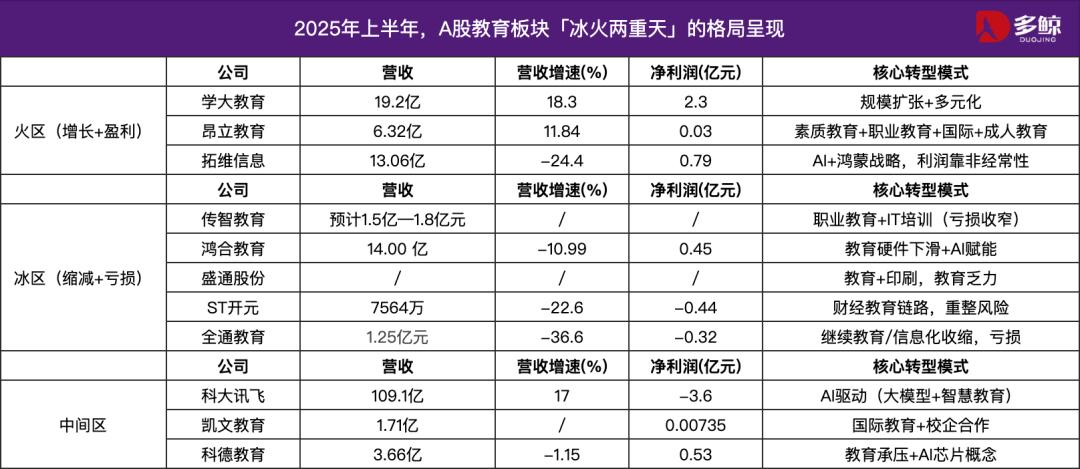
Core Viewpoint - The A-share education sector in the first half of 2025 continues to exhibit a "polarized" pattern, with some companies thriving while others struggle, reflecting the complex and changing market environment [1][20]. Group 1: "Fire Zone" Companies - Companies in the "fire zone" such as Xueda Education, Angli Education, and Tuo Wei Information show significant growth and profitability, driven by different strategies: scale expansion, comprehensive transformation, and technology-driven approaches [3][20]. - Xueda Education achieved revenue of 1.92 billion with a growth rate of 18.3% and a net profit of 230 million, focusing on personalized education and national expansion [4][20]. - Angli Education reported revenue of 632 million, up 11.84%, and turned a profit of 2.88 million, diversifying into multiple educational sectors including quality education and vocational training [6][20]. - Tuo Wei Information's revenue was 1.306 billion, down 24.42%, but net profit surged to 78.81 million due to non-recurring gains, highlighting a reliance on financial adjustments rather than core business growth [8][20]. Group 2: "Ice Zone" Companies - Companies in the "ice zone" like Quantu Education, Honghe Education, and ST Kaiyuan face severe challenges, including significant revenue declines and ongoing losses, reflecting the harsh realities of the education industry [10][20]. - Quantu Education's revenue fell to 125 million, down 36.58%, with a net loss of 32.3 million, struggling with policy tightening and reduced client payment capabilities [11][20]. - Honghe Education reported revenue of 1.4 billion, down 10.99%, with a net profit of only 45 million, as its core interactive whiteboard business continues to decline [12][20]. - ST Kaiyuan's revenue dropped to 75.64 million, down 22.6%, with a net loss of 44.36 million, facing severe financial distress and potential delisting risks [16][20]. Group 3: "Middle Zone" Companies - Companies like Keda Xunfei, Kewen Education, and Kede Education are positioned in the middle zone, showing both growth potential and structural challenges [20][24]. - Keda Xunfei achieved revenue of 10.91 billion, up 17%, but reported a net loss of 360 million, indicating a struggle to convert growth into profitability [21][20]. - Kewen Education's revenue was 171 million, with a net profit of 735,000, reflecting a strong brand in international education despite its small scale [23][20]. - Kede Education's revenue declined to 366 million, down 1.15%, while its net profit fell by 15.16%, showcasing a dual narrative of declining core business and capital market interest due to its AI chip investments [22][20].





谁为银发经济买单?
Mei Ri Shang Bao· 2025-08-28 22:12
Core Viewpoint - The concept of "micro-economy" revolves around everyday life and consumption patterns, highlighting various activities and experiences that contribute to a larger economic landscape [2] Group 1: Micro-Economy Observations - The micro-economy is illustrated through diverse examples such as trendy streets, popular stores among youth, community group purchases for middle-aged individuals, travel experiences for seniors, and cultural events for enthusiasts [2] - Each individual action in the micro-economy, when multiplied by large numbers, contributes to significant market dynamics and overall public welfare [2] Group 2: Focus Areas - The series of reports aims to identify key growth points within the micro-economy, explore new business models, and analyze consumer experiences [2] - The initiative seeks to uncover new market opportunities and address congestion points within the micro-economy to stimulate vibrant economic activity [2]

中央发布重磅文件 明确城市高质量发展“路线图” 优化现代化城市体系 培育壮大城市发展新动能
Shang Hai Zheng Quan Bao· 2025-08-28 19:39
Core Viewpoint - The document outlines the "Opinions on Promoting High-Quality Urban Development" released by the Central Committee of the Communist Party of China and the State Council, emphasizing the need for significant progress in modern urban construction by 2030 and the establishment of a modern urban system by 2035 [1] Group 1: Key Tasks - The opinions focus on seven key tasks, including optimizing the modern urban system, fostering new urban development momentum, creating high-quality urban living spaces, promoting green and low-carbon urban transformation, enhancing urban safety resilience, fostering cultural prosperity, and improving urban governance capabilities [1] - The document advocates for the development of group-style and networked modern urban clusters, supporting world-class urban clusters in regions like Beijing-Tianjin-Hebei, Yangtze River Delta, and Guangdong-Hong Kong-Macao Greater Bay Area [1][2] Group 2: Urban Development Momentum - The opinions suggest enhancing urban development dynamics through tailored strategies, activating existing urban resources, establishing a sustainable urban construction and operation financing system, and improving urban openness and cooperation [2] - It emphasizes the need to implement national strategic emerging industry cluster development projects and to cultivate advanced manufacturing clusters [2] Group 3: Resource Activation and Financing - The document calls for a comprehensive inventory of urban assets, including buildings and land, and the renovation of old factories and inefficient buildings [3] - It proposes the establishment of a sustainable financing system for urban construction, involving local government responsibilities and innovative financial policies to attract social capital [3] Group 4: High-Quality Living Spaces - The opinions advocate for systematic promotion of quality housing and complete community construction, aiming to meet diverse housing needs and support the renovation of old residential areas [3] Group 5: Implementation and Impact - The opinions serve as a top-level design to implement the spirit of the Central Urban Work Conference, providing a clear roadmap for urban high-quality development, which is expected to drive urban structure optimization and quality enhancement [4]

中共中央、国务院:发展首发经济、银发经济、冰雪经济、低空经济,培育消费新场景
Xin Hua She· 2025-08-28 16:18
Group 1 - The central government emphasizes enhancing urban development momentum through tailored policies based on local resources and conditions [1] - There is a focus on cultivating an innovation ecosystem to stimulate entrepreneurial activity and original innovation [1] - The strategy includes strengthening the collaboration between technological innovation and industrial innovation, while promoting the transformation and upgrading of traditional industries and the growth of emerging industries [1] Group 2 - The plan aims to accelerate the construction of international and regional technology innovation centers [1] - It highlights the implementation of national strategic emerging industry cluster development projects [1] - The initiative seeks to foster advanced manufacturing clusters and develop modern construction industry chains [1] Group 3 - There is a strong push for the development of productive service industries and the enhancement of living service industries [1] - The government aims to promote new consumption scenarios through the development of various economies, including the silver economy and low-altitude economy [1] - The initiative also includes deepening the construction of international consumer center cities [1]
日赚十亿!五大上市险企高光背后的近喜与远虑
Bei Jing Shang Bao· 2025-08-28 14:47
Core Viewpoint - The performance of China's five major listed insurance companies in the first half of 2025 shows a slight increase in net profit, driven by a recovery in the capital market and strong growth in new business value for life insurance [1][3]. Group 1: Overall Performance - The five major listed insurance companies in A-shares achieved a total net profit of 178.19 billion yuan in the first half of 2025, averaging a daily profit of 984 million yuan, reflecting a slight year-on-year increase [1][3]. - China Ping An led the net profit among the five companies with 68.05 billion yuan, while New China Life Insurance recorded the highest growth rate at 33.53% [3][5]. - Other companies reported net profits of 40.93 billion yuan for China Life, 26.53 billion yuan for China Property & Casualty, and 27.88 billion yuan for China Taiping, with year-on-year growth rates of 6.93%, 16.94%, and 10.95% respectively [3][5]. Group 2: Investment Performance - The recovery of the capital market has significantly boosted investment income, with many insurance companies reporting a noticeable increase in total investment returns compared to the first half of 2024 [3][4]. - China Ping An achieved a non-annualized comprehensive investment return rate of 3.1%, up 0.3 percentage points year-on-year, while China Property & Casualty reported an annualized total investment return rate of 5.1%, an increase of 1 percentage point [4]. Group 3: Life Insurance New Business Value - The life insurance sector experienced significant growth in new business value, with China Property & Casualty achieving a new business value of 4.978 billion yuan, a growth rate of 71.7% [5][6]. - New China Life's new business value grew by 58% to 6.182 billion yuan, while Ping An Life and China Life reported new business values of 22.335 billion yuan and 28.546 billion yuan, both with over 20% year-on-year growth [5][6]. Group 4: Cost Optimization in Property Insurance - The comprehensive cost ratios of major property insurance companies continued to improve, with China Property & Casualty, Ping An Property & Casualty, and China Taiping reporting ratios of 95.3%, 95.2%, and 96.3% respectively, reflecting decreases of 1.5, 2.6, and 0.8 percentage points [7][8]. - The optimization of cost ratios is attributed to the application of technology to control expenses and improve business quality [7]. Group 5: Focus on New Energy Vehicle Insurance - The competition in the traditional auto insurance market is intensifying, leading companies to focus on the new energy vehicle insurance market, with China Property & Casualty reporting a 36.8% year-on-year increase in the number of new energy vehicles insured [8]. - Ping An Property & Casualty reported a 46.2% year-on-year increase in original insurance premium income from new energy vehicle insurance, amounting to 21.7 billion yuan, while also achieving underwriting profitability in this segment [8].




2025深圳智慧养老展暨首届深圳康养机器人大赛于9月举办
Nan Fang Du Shi Bao· 2025-08-28 10:50
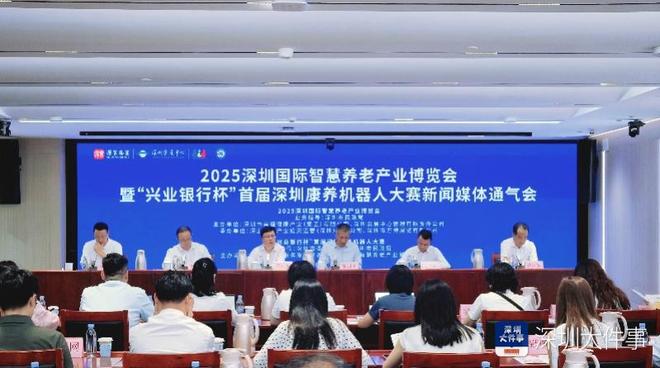
Core Insights - The Shenzhen International Smart Elderly Care Industry Expo will take place from September 12 to 14, 2025, at the Shenzhen Convention and Exhibition Center, showcasing advancements in elderly care technology and services [1][3]. Group 1: Industry Development - Shenzhen is prioritizing the development of the elderly care industry, implementing policies to support high-quality growth in the silver economy, including the introduction of investment support measures [3][4]. - The city aims to leverage its strengths in advanced manufacturing and technological innovation to create platforms such as the Smart Elderly Care Expo and the Silver Economy Industrial Park [3][4]. Group 2: International Collaboration - The expo will feature a "Double City Joint Exhibition" strategy with Hong Kong, facilitating resource sharing and collaboration in elderly care services [4]. - An international exhibition area will host over 30 organizations from Hong Kong, showcasing cross-border elderly care financial services and smart care systems [4]. Group 3: Product Showcase - The expo will gather over 200 elderly care enterprises, displaying more than 2,000 innovative products that integrate AI, IoT, and robotics, covering the entire elderly care service chain [5][6]. - Seven themed exhibition areas will highlight breakthroughs in smart elderly care technologies, including care robots and smart medical devices [6]. Group 4: Forums and Discussions - The main forum will focus on "Technology Empowerment, Activating New Dynamics in the Silver Economy," featuring discussions on creating a smart elderly care ecosystem [7]. - Various specialized forums will provide platforms for sharing insights and exploring industry trends, including a forum on financial empowerment in the elderly care sector [8]. Group 5: Innovation and Competitions - The expo will introduce the "Xingye Bank Cup" inaugural Shenzhen Elderly Care Robot Competition, focusing on practical applications of robots in elderly care scenarios [9][10]. - The competition aims to bridge the gap between expert recognition and market acceptance, facilitating the transition of innovative technologies into real-world applications [10].

中国光大控股(00165)发布中期业绩,股东应占溢利3.99亿港元 同比扭亏为盈
智通财经网· 2025-08-28 10:28
Core Viewpoint - China Everbright Holdings reported a significant recovery in profitability, achieving a net profit of HKD 399 million for the six months ending June 30, 2025, compared to a loss of HKD 1.282 billion in the same period last year, despite a 7.51% decline in revenue to HKD 2.801 billion [1] Group 1: Financial Performance - The company achieved a revenue of HKD 2.801 billion, a decrease of 7.51% year-on-year [1] - The net profit attributable to shareholders was HKD 399 million, a turnaround from a loss of HKD 1.282 billion in the previous year [1] - Earnings per share were HKD 0.237, with an interim dividend proposed at HKD 0.05 per share [1] Group 2: Strategic Initiatives - The company established two new funds with a total scale of RMB 2.5 billion, focusing on sectors like new energy and marine technology [1] - A total exit amount of HKD 2.018 billion was achieved, with a MOIC of approximately 2.78 times, enhancing the performance of multiple funds [2] - Investments in strategic emerging industries totaled approximately HKD 264 million, focusing on AI, semiconductor, and biomedicine sectors [3] Group 3: Operational Efficiency - The company issued RMB 3 billion in medium-term notes at a record low interest rate of 2.09%, reducing overall financing costs by 133 basis points to 3.14% [3] - Business and management expenses decreased by 10%, contributing to significant cost reduction and efficiency improvements [3] Group 4: Social Responsibility and ESG - The company enhanced its ESG framework, maintaining an MSCI ESG rating of A and receiving the "BEST ESG(S)" award from HKIRA [6] - The company actively engaged in community service, supporting various initiatives that benefited over 10,000 individuals [5] - The company’s commercial projects created approximately 37,700 jobs and served nearly 121 million consumers in the first half of 2025 [4]
一头抓好科技创新成果转化,一头对接产业生态完善 “双轮驱动” 绵阳提速创新产业发展
Si Chuan Ri Bao· 2025-08-28 07:36
Core Insights - The article highlights the advancements in robotics and magnetic materials in Mianyang, showcasing local innovations and their impact on industry development [1][2][3][4][5][6][7][8] Group 1: Robotics Innovations - A new robot capable of cooking rice noodles has been developed, demonstrating the precision required in each step of the cooking process [1] - Mianyang's focus on integrating technology and industry is evident in the establishment of a rapid prototyping service center for robotics, which significantly reduces production cycles for complex components [7] - The local government has identified Mianyang as a key area for the development of artificial intelligence and other strategic industries, aiming to strengthen the robotics sector [5][6] Group 2: Magnetic Materials Breakthrough - A new magnetic steel product has been introduced that reduces costs by 15%-20% without compromising performance, marking a significant breakthrough for Mianyang's magnetic materials industry [1] - The magnetic materials sector is expanding to support the robotics industry, particularly in the production of motors, which require specific types of magnetic materials [7] Group 3: Innovation and Investment Ecosystem - The Mianyang Technology City Innovation Center has established a comprehensive system for technology transfer, connecting research institutions with industry needs [2][3] - The collaboration between the Tianfu Industrial Technology Research Institute and Mianyang Technology City Innovation Investment Co. aims to address funding challenges in high-risk technology sectors [3] - The investment fund has reached a scale of 1 billion yuan, facilitating the integration of innovation, industry, and capital [3] Group 4: Future Projections - The Mianyang robotics industry is projected to exceed 3 billion yuan in output by 2025, indicating strong growth potential [8] - By 2027, the seven identified specialty industrial tracks are expected to double in scale, achieving a total output value of 65 billion yuan [8] - The overall scale of the five main industrial chains in Mianyang is anticipated to surpass 250 billion yuan, contributing to the city's industrial growth [8]

读懂养老需求 撬动银发“经济圈”
Xiao Fei Ri Bao Wang· 2025-08-28 02:41
Core Insights - The silver economy is evolving beyond traditional concepts of elderly care, encompassing diverse consumer scenarios such as health management, entertainment, and smart products [1][4] - There is a significant gap in service standards and market regulations within the silver economy, leading to mismatches between products and the actual needs of elderly consumers [1][4] Market Growth - According to the latest data from the State Taxation Administration, the number of entities engaged in the production of silver products is expected to grow by 14.1% year-on-year by mid-2025 [1] - Revenue from the manufacturing of elderly fitness equipment, rehabilitation aids, and nutritional health products has increased by 14.7%, 12.1%, and 6.9% year-on-year, respectively, surpassing the average growth rates of the manufacturing industry by 9.5, 6.9, and 1.7 percentage points [1] Consumer Challenges - Many elderly consumers find smart wearable devices cumbersome, with issues such as inconvenient charging and lack of usability leading to low adoption rates [2][4] - Elderly travel groups often provide generic itineraries that do not cater to the varying physical capabilities of participants, resulting in dissatisfaction among travelers [2][4] Need for Adaptation - Experts emphasize that the silver economy must transition from merely providing "elderly care" to enhancing the "enjoyment of aging" [4][5] - True adaptation for elderly consumers involves rethinking technology and services from their perspective, ensuring ease of use and integration into their daily lives [5] Government and Industry Initiatives - The government is increasing support for the silver economy, with initiatives such as the "Silver Travel" train service and upgrades to public transportation to better accommodate elderly passengers [6] - There is a call for greater involvement of elderly individuals in the development of products and services, suggesting a shift from user interviews to collaborative creation [6] Future Opportunities - The silver economy presents opportunities to address higher-level needs of elderly individuals, such as social engagement, skill training, and mental health services [8] - The potential for mixed services combining AI companionship with human therapists could lead to significant market growth in the mental health sector for the elderly [6][8]