
信用债配置

Search documents
国债期货盘中涨幅扩大,调整后的中短久期信用债品种初具一定配置性价比,聚焦信用债ETF基金(511200)、科创债ETF华夏(551550)布局机会
Mei Ri Jing Ji Xin Wen· 2025-07-31 02:51
Group 1 - The Shanghai Composite Index opened lower and saw an expanded decline, while the ChiNext Index reversed its early 1% gain, indicating a clear "stock-bond seesaw" effect [1] - China's official manufacturing PMI for July was reported at 49.3, a decrease of 0.4 percentage points month-on-month, indicating a decline in manufacturing sentiment [1] - Huachuang Securities believes that there are no signs of a trend reversal in the economic fundamentals, and the central bank's stance remains supportive, suggesting no trend adjustment risk in the bond market [1] Group 2 - The Credit Bond ETF (511200) includes large-scale, AAA-rated bonds listed on the Shanghai Stock Exchange, with 245 underlying bonds covering a maturity range of 0-30 years, reflecting a comprehensive yield curve [2] - The Science and Technology Innovation Bond ETF (551550) selects AAA-rated and above bonds from technology innovation companies listed on the Shanghai and Shenzhen exchanges, indicating a strong quality of underlying assets, with state-owned enterprises accounting for about 99% of the issuance [2]
信用策略周报20250720:成分券“超涨”了多少bp?-20250721
Tianfeng Securities· 2025-07-20 23:30
Group 1 - The report highlights that the bond market is currently experiencing fluctuations, with interest rates on government bonds mostly declining, particularly in the short end, while the long end, especially the 30-year government bonds, is under adjustment pressure [1][9] - The launch of the Sci-Tech Innovation Bond ETF has led to a significant increase in trading demand for credit bonds, particularly for the related component bonds, resulting in a decrease in credit bond yields and credit spreads [1][9] - The report notes that the average valuation yield of high-grade short-end component bonds is lower than that of 1-year AAA time deposits by 3-5 basis points, indicating limited trading space and potential risks of negative carry [4][35] Group 2 - The report indicates that the secondary capital bonds with a 5-year yield of 1.9% have regained value for funds, with funds being the main buyers of these bonds, particularly in the long end [2][11] - The component bonds have shown significant trading activity, with some experiencing an "over-increase" of more than 20 basis points, while perpetual bonds, especially those with subordinate attributes, have seen limited increases, mostly within 5 basis points [3][33] - The report suggests that in the context of crowded trading in component bonds, there may be opportunities to select non-component bonds from the same issuers, which could have price differences of up to 20 basis points compared to component bonds [4][35] Group 3 - The report emphasizes that the recent surge in the scale of the Sci-Tech Innovation Bond ETF, which increased by nearly 600 billion yuan in the week following its launch, has catalyzed a rush for component bonds [3][18] - The trading volume of component bonds has been notably higher than that of benchmark market-making component bonds and non-component bonds, indicating a strong market interest [22][29] - The report also highlights that the average valuation and credit spreads of component bonds are generally lower than those of non-component bonds, with significant differences observed in the long end compared to the short end [29][33] Group 4 - The report suggests that for other credit varieties, assets with a maturity of around 2 years may still be selected, as the funding environment remains favorable for the bond market [5][44] - It notes that the yield of short-term perpetual bonds has declined, and the yield curve has steepened, opening up space for riding strategies [5][44]
渤海证券研究所晨会纪要(2025.05.14)-20250514
BOHAI SECURITIES· 2025-05-14 00:53
Fixed Income Research - The issuance rates for credit bonds mostly increased, with an overall change range of 0 BP to 8 BP during the period from May 5 to May 11 [2] - The issuance scale of credit bonds increased on a month-on-month basis, with corporate bonds showing zero issuance while other varieties saw an increase in issuance amounts [2] - The net financing amount for credit bonds increased month-on-month, with corporate bonds showing negative net financing while other varieties showed positive net financing [2] - In the secondary market, the transaction amount of credit bonds increased month-on-month, with all varieties seeing an increase in transaction amounts [2] - The yield of credit bonds decreased across the board, with a relatively larger decline in the short end [2] - The credit spread showed differentiation among various types of bonds, with short-term spreads widening and medium to long-term spreads narrowing overall [2] - The report suggests that despite market fluctuations, the conditions for a comprehensive bear market in credit bonds are not sufficient, and future yields are expected to enter a downward channel [2] Industry Research - Metals - The steel industry is under significant profit pressure, with a projected year-on-year decline of 131.74% in net profit for 2024, while Q1 2025 shows a substantial recovery with a year-on-year increase of 549.88% [5] - The non-ferrous metals industry is expected to see a year-on-year net profit growth of 1.77% in 2024, with a significant increase of 68.55% in Q1 2025 [6] - The precious metals sector performed well, with a year-on-year net profit increase of 40.68% in 2024 and 44.88% in Q1 2025, supported by geopolitical factors and central bank gold purchases [6][11] - The report highlights the strategic value reassessment of medium and heavy rare earths due to export control policies, leading to price increases in the overseas market [8][11] - The investment strategy suggests focusing on high-quality state-owned enterprises and bonds with strong guarantees, as well as considering opportunities in undervalued real estate bonds [3][5] Industry Research - Light Industry & Textiles - The light industry and textile sectors outperformed the CSI 300 index, with the light industry gaining 3.02% and textiles gaining 3.47% during the period from May 5 to May 9 [12][13] - The report indicates a positive outlook for the home furnishing sector, with a significant increase in contract liabilities and cash flow from operating activities in Q1 2025 [14] - The easing of US-China tariff risks is expected to benefit export-oriented companies, improving export data and capacity utilization [13][14]
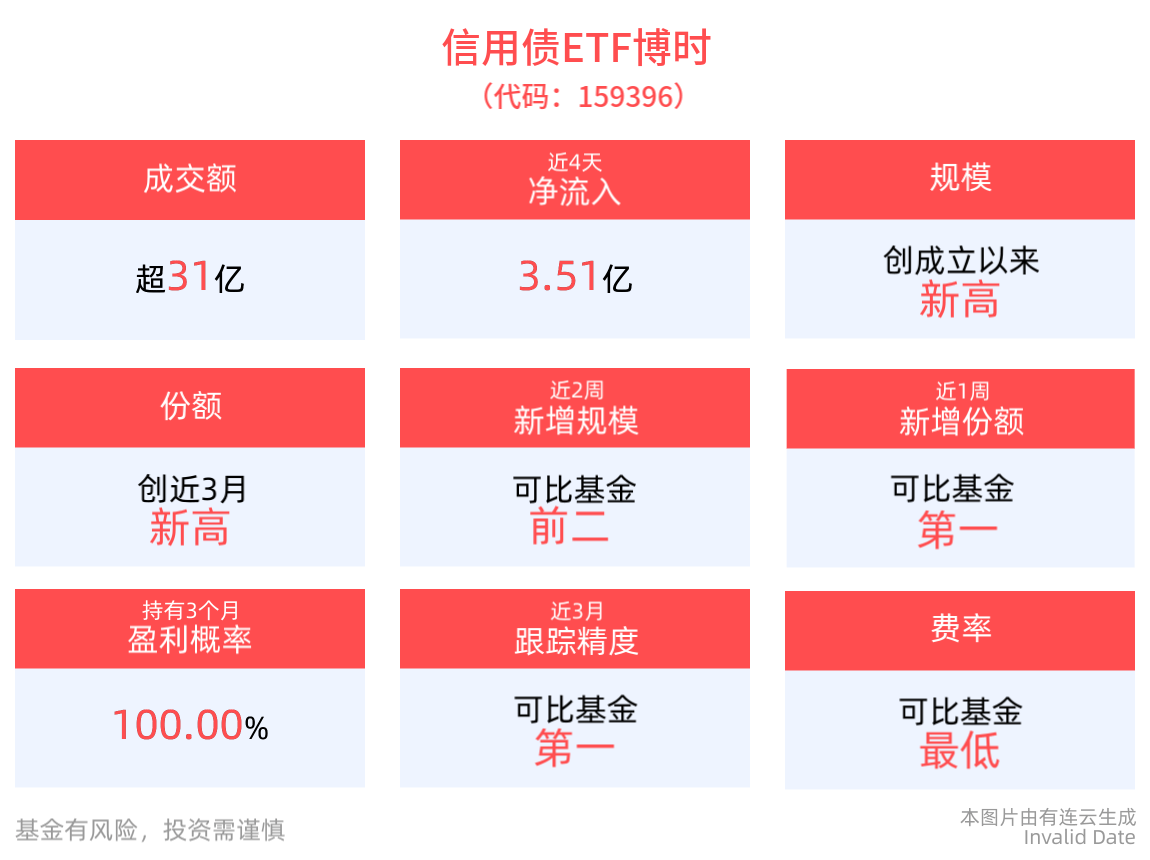
机构建议积极把握调整后的信用债配置价值,信用债ETF博时(159396)交投活跃,成交额放量超31亿元
Sou Hu Cai Jing· 2025-05-12 03:51
Core Viewpoint - The credit bond ETF from Bosera has shown active trading and a significant increase in scale and shares, indicating a positive market sentiment and potential investment opportunities in the credit bond sector [3][4]. Group 1: Market Performance - As of May 12, 2025, the Bosera credit bond ETF (159396) decreased by 0.10%, with a latest price of 100.52 yuan [3]. - The ETF recorded a turnover of 56.3% during the trading session, with a total transaction volume of 3.127 billion yuan, reflecting active market participation [3]. - The average daily transaction volume over the past month reached 2.072 billion yuan as of May 9, 2025 [3]. Group 2: Yield and Investment Strategy - Credit bond yields experienced a rapid decline in early April, influenced by improved liquidity and U.S. tariff policies, but later followed a "V" shaped trend with most yields rising [3]. - The outlook suggests that credit bond yields may decline in line with interest rates due to expected easing in the financial environment, recommending a gradual shift in credit bond allocation from short to long durations [3]. - The ETF closely tracks the Shenzhen benchmark market-making credit bond index, reflecting the operational characteristics of the credit bond market in Shenzhen [3]. Group 3: Fund Metrics - The latest scale of the Bosera credit bond ETF reached 5.837 billion yuan, marking a new high since its inception and ranking it in the top quarter among comparable funds [4]. - The ETF's latest share count reached 58.1031 million, also a new high in the past three months [4]. - The fund has seen a net inflow of 286 million yuan recently, with three out of the last four trading days showing net inflows totaling 351 million yuan [4]. Group 4: Performance and Fees - Since its inception, the Bosera credit bond ETF has recorded a maximum drawdown of 0.89%, with a recovery period of 26 days [4]. - The fund's management fee is 0.15% and the custody fee is 0.05%, both among the lowest in comparable funds [4]. - The tracking error over the past three months is 0.008%, indicating the highest tracking precision among comparable funds [4].

信用债配置思路:把握波段机会
Huafu Securities· 2025-04-28 07:39
1. Report Industry Investment Rating No relevant content provided. 2. Core Viewpoints of the Report - Since the beginning of the year, banks have faced certain pressure on their liabilities. The central bank has a strong desire to maintain a tight balance of liquidity in the short - term, with the capital interest rate running higher than the policy rate. The market has re - priced the previously optimistic liquidity expectations. Currently, the yield of credit bonds is at a relatively low percentile since 2022, while the credit spread is relatively high. After the Politburo meeting on April 25, it can be inferred that interest rate cuts and reserve requirement ratio cuts may not be urgent for the time being. The economic fundamentals are in a relatively good state, and the capital market may maintain a tight balance in the short - term. Investors should pay attention to the possible impact of tariffs in the second quarter, domestic demand policies, monetary policies, stock market trends, and changes in the risk appetite of the bond market. The allocation value of credit bonds has become prominent after the valuation recovery. It is recommended to strengthen the flexibility of the portfolio and seize trading opportunities based on the expected timing of capital loosening [3][16]. 3. Summary According to the Directory 3.1 Credit Bond Market Adjustment - Last week (April 18 - 25), the bond market adjusted. The 2 - 5 - year Treasury bonds had relatively large adjustment amplitudes, such as a 3.7BP adjustment for the 3 - year Treasury bond. Credit bonds also adjusted with a relatively larger amplitude. For example, among medium - term notes, the 3 - year AAA medium - term note had the largest valuation increase of 5.5BP, the 10 - year AA + medium - term note had the largest valuation increase of 6BP, and the 2 - year AA medium - term note had the largest valuation increase of 6.3BP. Since April 7, 2025, the 30 - year Treasury bond has had the largest adjustment amplitude, while medium - term notes generally show that the longer the term, the larger the adjustment amplitude, and the valuations of many varieties within one - year have even slightly narrowed [2][10][12]. - As of April 25, the yields of 1 - year, 3 - year, and 5 - year AAA - rated medium - term notes were 1.82%, 1.94%, and 2.04% respectively; the yields of 1 - year, 3 - year, and 5 - year AA + - rated medium - term notes were 1.9%, 2.1%, and 2.2% respectively. From April 7 to April 25, the credit spreads of credit bonds also slightly widened [11]. 3.2 Credit Bond Trading Characteristics - Recently, the trading proportion of credit bonds within one - year has significantly increased, while the trading proportion of long - term credit bonds has significantly decreased, especially for those over 5 - year. The trading proportion of 3 - 5 - year credit bonds has been relatively volatile and slightly decreased compared to March 2025. The reason may be that investors' credit bonds over 5 - year are generally issued by high - credit - rated and high - quality entities with relatively good liquidity, which are more likely to be sold during the adjustment period. The 3 - 5 - year period combines relatively short duration and many high - yield entities, making it the main range for market band trading [2][12]. 3.3 Individual Bond Analysis - The valuations of entities such as AVIC Industry Finance Holdings Co., Ltd., Zunyi Tourism Investment (Group) Co., Ltd., Guangxi Liuzhou Investment Holding Group Co., Ltd., and Zoucheng City Assets Holding Group Co., Ltd. are mostly high, with large adjustment amplitudes. The valuations of many bonds of entities such as Jiangsu Hanrui Investment Holding Co., Ltd., China Resources Power Investment Co., Ltd., and Chongqing Longfor Enterprise Development Co., Ltd. have narrowed [2][13]. 3.4 Investment Recommendations - Investors can choose secondary perpetual bonds with better liquidity, urban investment bonds with good liquidity, central and state - owned enterprise real estate, central and state - owned enterprise energy materials, central and state - owned enterprise cultural and tourism bonds, and individual bonds with large previous adjustment amplitudes, and seize trading opportunities based on the expected timing of capital loosening [3][16]. - For institutions with high return requirements, they can focus on high - quality entities at the provincial level in Yunnan, the municipal level in Kunming, the provincial level in Shandong, and the municipal level in Weifang, as well as central and state - owned enterprise real estate and steel within three - year. Some entities have large previous adjustment amplitudes and can be appropriately deployed on the left side. They can also consider district and county entities in regions with strong debt - resolution efforts, such as districts and counties in Tianjin and Guangxi. In the cultural and tourism sector, some central and state - owned enterprise entities can be selected based on the support from shareholders [4][17].
国泰海通固收|信用债配置正当时
2025-04-17 15:41
Summary of Key Points from Conference Call Records Industry Overview - The conference call primarily discusses the credit bond market, particularly focusing on the second quarter of 2025 and the dynamics of local government financing platforms [1][2][3]. Core Insights and Arguments - **Credit Bond Market Dynamics**: The second quarter is expected to experience a mismatch in supply and demand for credit bonds, influenced by seasonal factors and tightening policies. The demand side benefits from the expansion of wealth management products and the development of credit ETFs, suggesting that credit bonds may outperform interest rate bonds [1][4]. - **Investment Strategy**: It is recommended to extend the duration of credit bonds to 3-5 years to achieve higher yields, while also being cautious of market volatility risks due to tariff disturbances since April [1][5]. - **Technology Innovation Bonds**: Despite being labeled as "technology innovation" bonds, most issuers do not possess true innovation attributes. The majority serve mature quality entities transitioning, with state-owned enterprises dominating and private enterprises having lower participation [1][6][9]. - **Use of Proceeds**: Funds raised through technology innovation bonds are primarily used for repaying old debts and enhancing liquidity, with a low proportion directed towards equity fund investments and project construction [1][10]. - **Pricing and Liquidity**: The pricing gap between technology innovation bonds and ordinary credit bonds is minimal, with private enterprise bonds showing a premium of 10-15 basis points. Recent liquidity levels are comparable to the overall credit bond sector [1][12]. Additional Important Content - **Future Development of Technology Innovation Bonds**: The future direction includes supporting small and medium enterprises by quality entities and fostering high-yield characteristics in small enterprises' technological innovations. The involvement of banks may compress the valuation of technology innovation bonds, similar to trends observed in the green loan market [1][13][14]. - **Local Government Financing Platforms**: The management of local government debt is characterized by a simultaneous increase in central leverage and a decrease in local leverage, with strict regulation on hidden debts. The supply of urban investment bonds may be tight due to these regulatory measures [2][17][21]. - **Market Performance of Urban Investment Bonds**: Urban investment bonds are expected to have limited new issuance, with a focus on refinancing existing debts. The market for these bonds remains constrained due to regulatory scrutiny and the need for local governments to manage their financing carefully [21][22]. This summary encapsulates the critical insights and trends discussed in the conference call, providing a comprehensive overview of the credit bond market and local government financing dynamics.
深市4只唯一,信用债ETF博时(159396)成功入选交易所两融标的
Sou Hu Cai Jing· 2025-04-14 05:55
Core Viewpoint - The Shenzhen Stock Exchange has announced the inclusion of the credit bond ETF Boshi (159396) in the margin trading list, marking it as the only fund among four tracking the Shenzhen benchmark market-making credit bond index to be included [1] Group 1: Market Sentiment and Trends - The market is experiencing heightened risk aversion, leading to a significant increase in bond market sentiment due to a more relaxed funding environment and changes in the central bank's stance [1] - Recent macroeconomic fluctuations and tariff issues have contributed to a broad asset market volatility, further boosting the bond market's performance [1] - Short-term market adjustments are expected, with a potential shift in sentiment from macro narratives to central bank operations and specific funding prices, which may introduce volatility [1] Group 2: Investment Recommendations - Investors are advised to maintain a positive outlook on credit bonds while closely monitoring market sentiment and marginal changes in funding [2] - The current credit bond market is transitioning from an independent trend to following the overall bond market, suggesting a gradual shift from short to medium-term credit bond allocations as interest rates decline [2] - The credit bond ETF Boshi (159396) closely tracks the Shenzhen benchmark market-making credit bond index, reflecting the operational characteristics of the Shenzhen credit bond market [3]

【财经分析】机构建议把握4月配置时点 信用债布局仍可优选城投各券
Xin Hua Cai Jing· 2025-04-11 21:00
Core Viewpoint - The current environment is favorable for credit bonds, with analysts suggesting that the time for the central bank to implement a selective easing policy has arrived, driven by tariff impacts and positive market sentiment [1][2]. Group 1: Credit Bond Market Performance - Credit bonds have shown strong performance, with yields declining significantly due to a shift towards a looser funding environment and the impact of unexpected U.S. tariff policies [2]. - As of April 1, the AA-rated one-year credit spread narrowed by 27 basis points (BP), while mid to long-term lower-rated bonds saw spreads narrow by over 10 BP [2]. - City investment bonds have outperformed the overall credit bond market, with three-year bonds across all ratings narrowing by over 10 BP [2]. Group 2: Future Outlook for Credit Bonds - April is typically a window for credit bond allocation in the second quarter, with historical data indicating that credit spreads often narrow from April to May [3]. - Increased market demand and reduced supply are expected to contribute to the narrowing of credit spreads during this period, with over 1 trillion yuan in growth in wealth management products historically observed in April [3]. - Analysts suggest that if the central bank's easing policy is implemented in the second quarter, April is likely to be a key period for credit bond allocation [3]. Group 3: Institutional Preferences - City investment bonds are favored by institutions due to their perceived lower risk and improved credit binding with local governments following debt resolution policies [4]. - The trading volume of lower-rated city investment bonds has increased significantly, particularly in regions like Hebei, Shaanxi, Jiangxi, and Chongqing, with monthly turnover rates exceeding 15% [4]. - Analysts recommend a "downward strategy" for city investment bonds, particularly focusing on bonds from central provinces while being cautious of high-profile regions [4]. Group 4: Investment Strategies - Institutions are advised to actively position themselves in credit bonds, leveraging the current favorable conditions for potential capital gains [6][7]. - Suggested strategies include focusing on AA-rated bonds with maturities of three years or more for short-term capital gains, and a "long duration + moderate downward" strategy for broader credit bond allocation [7]. - For risk-averse investors, AAA or AA+ rated bonds with maturities of five to seven years are recommended, balancing potential returns with risk management [7].
单日成交额超45亿元居同标的产品第一,信用债ETF(511190)周涨超41BP
Sou Hu Cai Jing· 2025-03-31 01:51
Group 1 - The bond market is gradually recovering due to the central bank's continuous net injection and the rising expectations of reserve requirement ratio cuts [1] - Hai Fu Tong Fund is currently the largest and most diverse fund company managing bond ETFs in the market, with its credit bond ETF (511190) increasing over 41 basis points in the past week [1] - The credit bond ETF (511190) has seen a net inflow of over 2.22 million yuan in the past week, with a total growth in scale of 2.32 million yuan [1] Group 2 - Industrial Securities suggests that holding short-duration credit bonds is a good choice in the short term, considering the fluctuating funding environment and market volatility [2] - The recommendation is to gradually shift from short to long credit bond allocations as the interest rate downtrend becomes clearer [2]
【财经分析】信用债或步入配置机遇期 短端品种票息保护相对充足
Xin Hua Cai Jing· 2025-03-25 15:44
债市情绪好转 三月初债市遭遇"倒春寒",但进入中下旬,牛市氛围生变的情况发生好转。 尤其聚焦信用债市场,3月17日至3月21日,资金面"先紧后松",为了应对税期因素扰动,央行增加 了逆回购投放,释放呵护信号,债市做多情绪得以提振。信用债继续修复,收益率下行、利差收窄,1 年至3年期品种表现占优,利差收窄幅度在9BP至11BP之间。 以城投债为例,1年至3年期收益率下行幅度较大,在7BP至10BP之间;5年期品种的下行幅度在 3BP至5BP之间;15年和20年期超长端高等级品种的利率下行幅度在4BP左右。 不仅如此,截至3月25日收盘,银行间信用债市场同样不改向好走势,收益率整体下行。具体来 看,中债中短期票据收益率曲线(AAA)3M期限下探1BP至1.95%,3年期收益率回落1BP至2.02%,5 年期收益率下行3BP至2.11%。中债中短期票据收益率曲线(A)1年期下行1BP至7.53%。 "信用债的买盘热度在持续回升,目前城投债和产业债的成交笔数环比增加,TKN占比已升至75% 左右。"华西证券研究所固收分析师姜丹指出,"不仅如此,城投债的成交呈现出了'拉久期+下沉'趋 势。上周3年至5年期的城投债成交占 ...