关税合法性

Search documents
特朗普不知所措,关税战不但没打赢中国,美国可能要倒赔2万亿
Sou Hu Cai Jing· 2025-11-11 23:23
Core Viewpoint - The article discusses the potential legal and financial repercussions of the U.S. Supreme Court's upcoming decision regarding the legality of tariffs imposed by the Trump administration, which could lead to significant compensation claims from international investors [1][3][19]. Group 1: Legal Implications - The focus of the Supreme Court case is whether President Trump abused the "national security" justification for imposing tariffs, which could redefine the boundaries of presidential power [3][8]. - If the tariffs are deemed illegal, it could invalidate numerous investment agreements made under duress, potentially leading to claims for compensation from affected countries [4][19]. - The case is not initiated by the Democrats but by various industry associations that argue the tariffs have led to increased costs and reduced orders, highlighting a shift in support from Trump to legal opposition [7][21]. Group 2: Financial Risks - Trump has suggested that the potential compensation claims could amount to $2 trillion, a figure he uses to create panic regarding the court's decision [1][19]. - The U.S. Treasury is reportedly assessing the financial implications of a ruling against the tariffs, including the possibility of initiating a refund mechanism, raising questions about funding sources [17][19]. - The risk of a compensation wave from international investors is significant, as many entered the U.S. market based on the aggressive trade policies of the Trump administration [19][21]. Group 3: Political Consequences - The outcome of the Supreme Court's decision could serve as a critical juncture for U.S. foreign policy, particularly regarding the use of national security as a rationale for trade actions [26]. - The article suggests that if the court rules against the tariffs, it may undermine the legitimacy of Trump's trade strategies and affect future negotiations with other countries [16][26]. - The legal battle reflects broader challenges to the U.S. constitutional order and the balance of power between the presidency and the judiciary [8][21].

日度策略参考-20251107
Guo Mao Qi Huo· 2025-11-07 06:35
Report Industry Investment Rating No relevant content provided. Core Viewpoints of the Report - The current macro - level is in a relatively vacuum period, A - shares lack a clear upward main line, market trading volume remains low, and the stock index continues to fluctuate, accumulating momentum for the next round of upward movement. Meanwhile, with policy support and abundant macro - liquidity, there is still strong support below the stock index [1]. Summary by Related Catalogs Macro Finance - **Treasury Bonds**: Asset shortage and weak economy are beneficial to bond futures, but the central bank has recently warned of interest - rate risks, suppressing the upward space, showing an oscillating trend [1]. - **Copper**: The tight pattern of US dollar liquidity has eased, market risk appetite has recovered, and copper prices have stopped falling [1]. - **Aluminum**: Recently, the industrial - side driving force is limited, and the macro - level benefits have been digested, so aluminum prices are oscillating [1]. - **Alumina**: With still a small profit in production, domestic alumina production capacity is continuously released, and both production and inventory are increasing, putting pressure on the spot price. Recently, attention should be paid to the cost support [1]. - **Zinc**: The US government shutdown has reached the longest historical record, and market risk - aversion sentiment has increased. The LME zinc inventory has been continuously decreasing, and the short - squeeze movement has driven zinc prices higher. However, considering the domestic oversupply, caution is needed when chasing high prices [1]. Non - ferrous Metals - **Nickel**: The better - than - expected US ADP data has alleviated concerns about the US economic recession, but the expectation of the Fed's interest - rate cut has been suppressed, and market risk appetite has fluctuated. Indonesia has recently restricted the approval of nickel - related smelting projects again, but the approved projects are not affected. In the fourth quarter, attention should be paid to the approval of nickel - ore quotas in 2026. Nickel prices may oscillate in the short term, and high inventory pressure should be watched out for. It is recommended to trade within a short - term range, and the long - term surplus pattern of primary nickel will continue [1]. - **Stainless Steel**: The better - than - expected US ADP data has alleviated concerns about the US economic recession, but the expectation of the Fed's interest - rate cut has been suppressed, and market risk appetite has fluctuated. Indonesia has restricted the approval of nickel - related smelting projects again, but the approved projects are not affected. In the fourth quarter, attention should be paid to the progress of the approval of Indonesian nickel - ore quotas, and the premium at the ore end is currently stable. The price of raw - material ferronickel has weakened slightly, the social inventory of stainless steel has decreased slightly, and the steel mills' production plan for October is stable. Macro - sentiment is fluctuating, steel mills have recently lifted price limits, and stainless - steel futures are oscillating at the bottom. It is recommended to trade short - term and look for opportunities to sell on rallies [1]. - **Tin**: Recently, the positive macro - sentiment has been digested. Considering that the raw - material end of tin has not recovered and the new - quality demand is expected to be good, it is still recommended to pay attention to the opportunity of going long on dips in the long - term [1]. Precious Metals and New Energy - **Precious Metals (Gold and Silver)**: Judges of the high - court generally question the legitimacy of tariffs, increasing market uncertainty and supporting precious - metal prices. However, the resilience of US economic data has disrupted the interest - rate cut expectation. Precious metals are expected to oscillate within a range in the short term [1]. - **Industrial Silicon**: The production capacity in the northwest is continuously resuming, the start - up in the southwest is weaker than in previous years, and the impact of the dry season is weakened [1]. - **Polysilicon**: In the long - term, there is an expectation of production - capacity reduction. In the fourth quarter, the terminal installation will increase marginally. The anti - involution policy has not been implemented for a long time, and market sentiment has faded [1]. - **Lithium Carbonate**: The traditional peak season for new - energy vehicles is approaching, the energy - storage demand is strong, but the hedging pressure is large [1]. Ferrous Metals - **Rebar**: There are concerns about the potential weakening of industrial demand in the off - season. After the macro - sentiment is realized, attention should be paid to the upward pressure. It is advisable to participate in the out - of - the - money accumulative put option strategy [1]. - **Hot - Rolled Coil**: The off - season effect of the industry is not obvious, but the industrial structure is still loose. Similarly, attention should be paid to the upward pressure on prices after the macro - sentiment is realized [1]. - **Iron Ore**: Near - month production is restricted, but the commodity sentiment is good, and there is still an upward opportunity for far - month contracts [1]. - **Sulfur**: The direct demand is good, and there is cost support, but the supply is high, inventory is accumulating, and the sector is under pressure, with limited price rebound space [1]. - **Coke and Coking Coal**: Coking coal is struggling near the previous high, repeatedly testing the support. The high point of the coke futures price has included the expectation of five rounds of price increases, but the actual three - round price increase has been delayed, and the game is intense. Based on the tight supply, coke and coking coal are relatively strong, but considering the weakening of steel prices and the potential weakening of steel demand in November, the futures prices of coke and coking coal are likely to return to the oscillating range after a false breakout. In the short - term, it is advisable to wait and see, and in the long - term, it is still advisable to go long at low prices. Industrial customers can consider selling hedging [1]. Agricultural Products - **Palm Oil**: In the short term, palm oil still faces the dual pressures of seasonal production increase and weak exports. However, starting from November, Malaysia enters the traditional production - reduction cycle. If export data improve significantly, it may trigger a staged rebound [1]. - **Soybean Oil**: According to the China - US negotiation agreement, China will purchase 12 million tons of US soybeans in the next two months, which may bring a loose expectation for soybean oil in the fourth quarter, and the rebound momentum is insufficient. The actual impact needs to be observed [1]. - **Rapeseed Oil**: The meeting between Chinese and Canadian leaders has brought the expectation of Sino - Canadian relaxation, and the bumper harvest of Canadian rapeseed has put pressure on the futures price [1]. - **Cotton**: Although the production capacity in Xinjiang is expanding, the production capacity in the inland may decrease marginally. At the same time, due to the thinning of spinning profits in Xinjiang, the operating rate may also be affected. The contradiction between the expansion of Xinjiang's production capacity and the reduction of spinning profits makes the cotton demand in the new year highly uncertain. The current futures price has fully priced in the selling pressure of new crops, and the downward space is limited, but under the background of a record - high production of new crops, the basis and futures price may continue to be under pressure [1]. - **Sugar**: Typhoons before and after the National Day have had an adverse impact on the sugar - cane harvest and production in South China. There is a seasonal upward impetus for sugar prices in the short term. In the medium - term, considering the good growth of sugar cane this year, the rebound space after the new - sugar listing is expected to be limited [1]. - **Soybeans and Soybean Meal**: The domestic soybean purchase and crushing profit is poor, and the domestic futures price is undervalued. With the expectation of China's purchase of US soybeans, the import cost of US soybeans is expected to rise, and the domestic futures price is expected to rebound in the short term to repair the crushing profit. However, the current loose supply of domestic soybean - meal spot and the expected loose global soybean supply in the long - term limit the rebound height [1]. - **Paper Pulp**: The current trading logic of paper pulp is related to the trading of old warehouse receipts for the November contract. With weak downstream demand, the futures price is under great pressure. It is recommended to conduct a reverse spread between the November and January contracts [1]. - **Log**: The fundamentals of logs have declined, but the spot price is firm. After a sharp decline in the futures price, the risk - return ratio of short - selling is low. It is recommended to wait and see [1]. - **Live Pigs**: In the past half - month, the spot price has risen alternately in the north and south due to secondary fattening, frozen - product storage, and reluctance to sell, which has postponed the production capacity. There is still pressure on the November slaughter. In the short term, the futures price is at the same level as the spot price, and the futures price will follow the spot price to stabilize and then weaken [1]. Energy and Chemicals - **Crude Oil**: OPEC+ plans to continue a small - scale production increase in December, the short - term geopolitical speculation has cooled down, and the suspension of some China - US trade - tariff policies has eased market sentiment [1]. - **Fuel Oil**: Similar to crude oil, the short - term supply - demand contradiction is not prominent, and it follows the trend of crude oil. The demand for the 14th Five - Year Plan construction rush is likely to be falsified, and the supply of Venezuelan crude oil is sufficient. The profit of asphalt is high [1]. - **Natural Rubber**: There is strong support from raw - material costs, the mid - stream inventory is continuously decreasing, and the commodity - market atmosphere is positive [1]. - **BR Rubber**: The decline of crude - oil prices has reduced the cost support of butadiene, and the supply of synthetic rubber is loose. High - production and high - inventory have not suppressed the price, and the mainstream supply price has been continuously reduced [1]. - **PTA**: Gasoline profit and low benzene price support PX. The gasoline cracking price has risen above $15, prompting refineries to increase gasoline production and reduce the feed of aromatic - hydrocarbon units. Overseas device failures and the decline of the operating load of some domestic reforming units, as well as the rotation inspection of large domestic PTA devices, have led to a decline in domestic PTA production [1]. - **Ethylene Glycol**: The decline of crude - oil prices has led to a decline in ethylene - glycol prices, while the rise of coal prices has slightly strengthened the cost support of domestic ethylene glycol. The "Golden September and Silver October" of the polyester industry is coming to an end, and the domestic demand has not significantly declined [1]. - **Short - Fiber**: Gasoline profit and low benzene price support PX. The rebound of PTA prices has strengthened the basis of short - fiber. Short - fiber prices continue to fluctuate closely with costs [1]. - **Styrene**: The Asian benzene price is still weak, the operating rates of STDP and reforming units have declined, the arbitrage window from Northeast Asia to the US is still closed, the profit of domestic styrene has decreased, the number of styrene - device overhauls has gradually increased, and crude - oil prices have continued to fall [1]. - **Urea**: The export sentiment has eased slightly, and the limited domestic demand restricts the upward space. There is support from anti - involution and cost - end factors [1]. - **PE**: Under high - supply, the inventory pressure is large, the intensity of overhauls has weakened, and the downstream demand is slowly increasing, but the peak season is not prosperous [1]. - **PP**: The support from overhauls is limited, and the new - device production has increased the supply pressure. The downstream improvement is less than expected, and the futures price has returned to the fundamentals, showing a weak - oscillating trend [1]. - **PVC**: The overhauls have decreased compared with the previous period, and the new production capacity has been released, increasing the supply pressure. The rise of coal prices has strengthened the cost support of PVC [1]. - **Caustic Soda**: Many alumina projects in Guangxi are planned to be put into production, the subsequent concentration of overhauls will decrease, the high - concentration caustic soda is at a negative premium, the absolute price is low, and the near - month warehouse receipts are limited, so there is a risk of short - squeeze [1]. - **LPG**: The international oil - gas fundamentals are continuously loose, the CP/FEI prices have weakened, the valuation of the domestic LPG futures price has been repaired, and the domestic spot fundamentals are stable due to short - term cooling and chemical rigid demand [1]. Others - **Container Shipping (European Route)**: The positive macro - sentiment has been gradually digested, the expectation of price increases in the peak season has been priced in advance, and the shipping capacity supply in November is relatively loose [1].
美联储降息新信号
Sou Hu Cai Jing· 2025-11-06 04:11
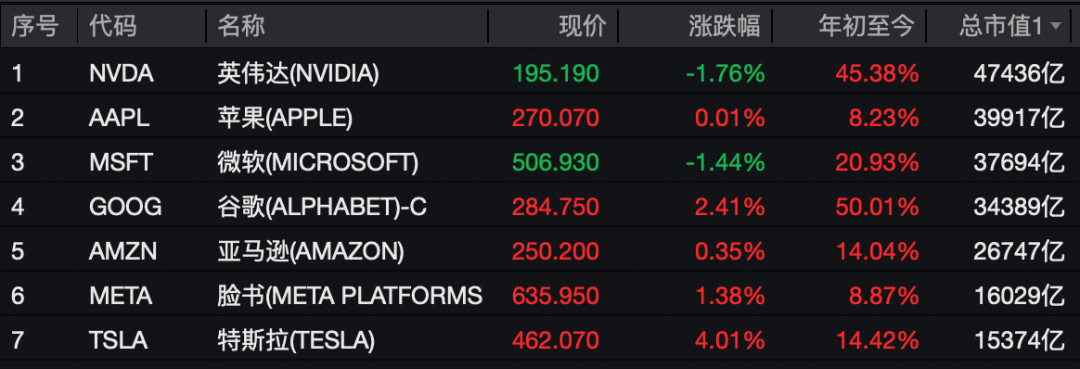
Market Performance - On November 5, U.S. stock indices closed higher, with the Dow Jones Industrial Average rising by 225.76 points, or 0.48%, to 47,311.00 points; the Nasdaq increased by 151.16 points, or 0.65%, to 23,499.80 points; and the S&P 500 rose by 24.74 points, or 0.37%, to 6,796.29 points [1] - Major tech stocks mostly saw gains, with Google rising over 2% to reach a record closing high, Tesla up over 4%, and Intel increasing by over 3%. Facebook rose over 1%, while Microsoft fell by over 1% and Nvidia dropped nearly 2% at the close [1] Stock Performance - Nvidia (NVDA) closed at $195.19, down 1.76% year-to-date, with a market cap of $474.36 billion [2] - Apple (AAPL) closed at $270.07, up 0.01% year-to-date, with a market cap of $399.17 billion [2] - Microsoft (MSFT) closed at $506.93, down 1.44% year-to-date, with a market cap of $376.94 billion [2] - Google (GOOG) closed at $284.75, up 2.41% year-to-date, with a market cap of $343.89 billion [2] - Amazon (AMZN) closed at $250.20, up 0.35% year-to-date, with a market cap of $267.47 billion [2] - Tesla (TSLA) closed at $462.07, up 4.01% year-to-date, with a market cap of $153.74 billion [2] International Market Trends - The Nasdaq China Golden Dragon Index rose by 0.17%, with Pinduoduo up 1.8%, JD up 0.6%, NetEase up 0.5%, Alibaba up 0.3%, and Baidu down 1.3% [2] - Alibaba (BABA) closed at $164.81, up 0.31% year-to-date, with a market cap of $39.32 billion [3] - NetEase (NTES) closed at $139.09, up 0.51% year-to-date, with a market cap of $8.81 billion [3] - JD Group (JD) closed at $32.04, up 0.69% year-to-date, with a market cap of $5.11 billion [3] - Baidu (BIDU) closed at $123.31, down 1.34% year-to-date, with a market cap of $4.24 billion [3] Commodity Prices - International oil prices weakened, with WTI crude oil near-month contract falling by 1.59% to $59.60 per barrel, and Brent crude oil near-month contract down 1.43% to $63.52 per barrel [5] - Gold prices rebounded due to risk aversion, with COMEX gold futures for November delivery rising by 0.83% to $3,980.30 per ounce [6] Economic Indicators - The ADP private employment data exceeded expectations, with 42,000 jobs added in October, surpassing the Dow Jones consensus estimate of 22,000 jobs [7] - The ISM services economic reading also came in stronger than expected, indicating a positive trend in the employment market [7] - Federal Reserve Governor Milan suggested that the current interest rate policy may be too restrictive and that further rate cuts are reasonable [7]
广告引爆美加贸易?美国加征10%关税,数百万观众目睹争端升级
Sou Hu Cai Jing· 2025-10-27 16:43
Core Points - The trade dispute between the U.S. and Canada was ignited by a controversial television advertisement from the Ontario provincial government, which criticized U.S. tariff policies and used a speech by former President Ronald Reagan [1][10] - The U.S. government responded with a threat to impose a 10% tariff, which is higher than what Canada currently pays, emphasizing the potential economic impact on American consumers [1][2] Economic Impact - The proposed 10% tariff could lead to hundreds of billions of dollars in additional costs, which would ultimately be passed on to U.S. consumers, resulting in price increases of 5%-10% for various automotive products [4][2] - Canada's GDP contracted by 1.6% in Q2 2025, largely due to a significant drop in exports, particularly in the automotive and energy sectors, which are heavily reliant on the U.S. market [6] - The Ontario province, home to over 70% of Canada's auto parts manufacturers, is experiencing order cancellations and production cuts due to concerns over the tariff [6][8] Industry Responses - The American Automotive Manufacturers Association has warned that increased tariffs would undermine the price competitiveness of U.S. automakers in the global market [7] - The Canadian Steel Association predicts that prolonged tariffs could lead to nearly 20% of the Canadian steel industry's capacity being idle, affecting over 15,000 jobs [8] Political Dynamics - The advertisement's timing during a major U.S. sporting event was seen as a strategic move to influence public opinion against U.S. tariffs, which the U.S. government labeled as "deliberate fraud" [2][10] - The Ontario government has expressed a desire to maintain pressure on the U.S. regarding tariff impacts, while the Canadian federal government has advocated for dialogue to resolve trade differences [12][13] International Reactions - Mexico's economy minister has warned that escalating trade tensions could destabilize the North American supply chain, urging for dialogue rather than unilateral actions [20] - The European Union criticized the U.S. for undermining international trade rules through unilateral tariffs, raising concerns about a potential global trade protectionism wave [20] Future Considerations - The outcome of the U.S. Supreme Court's upcoming ruling on the constitutionality of presidential tariff powers will significantly influence the future of U.S.-Canada trade relations [22][15] - Canada is looking to diversify its trade partnerships beyond the U.S., aiming to double its non-U.S. export share over the next decade as a strategic response to the current trade tensions [20][26]

宏观经济周报-20251020
工银国际· 2025-10-20 06:02
Economic Indicators - The ICHI Composite Economic Index slightly declined this week but remains in the contraction zone, indicating stable economic fundamentals[1] - The Consumer Confidence Index has rebounded, returning to the expansion zone, driven by strong holiday consumption in accommodation, dining, transportation, and cultural tourism[1] - The Investment Confidence Index has slightly increased but is still in the contraction zone, with manufacturing investment supported by structural upgrades and technology innovation[1] Inflation and Prices - In September 2025, the CPI increased by 0.1% month-on-month, driven by seasonal price rises in fresh vegetables, eggs, and fruits, while service prices fell by 0.3% due to holiday effects[2] - Year-on-year, the CPI decreased by 0.3%, with a narrowing decline of 0.1 percentage points from the previous month, primarily due to a 4.4% drop in food prices[2] - The core CPI rose by 1.0% year-on-year, marking the first return to 1% in 19 months, indicating a continued recovery in domestic demand[2] Industrial Prices - The PPI remained flat month-on-month in September but decreased by 2.3% year-on-year, with the decline narrowing by 0.6 percentage points from the previous month[3] - Upstream industry prices stabilized, with notable improvements in coal processing (+3.8%) and black metal smelting (+0.2%) sectors[3] - The year-on-year decline in PPI was mitigated by the advancement of a unified national market and structural support from high-end and green manufacturing developments[3] Global Economic Context - The Federal Reserve is experiencing internal disagreements on the pace of interest rate cuts, with some officials advocating for gradual cuts while others suggest a more aggressive approach[7] - The U.S. government is facing a budget impasse, which could lead to a government shutdown, affecting federal operations and potentially dragging down Q4 economic performance[8]
海外高频 | 特朗普关税合法性遭遇司法挑战(申万宏观·赵伟团队)
赵伟宏观探索· 2025-06-03 14:27
Group 1 - The article discusses the recent judicial challenge to Trump's tariffs, where the U.S. International Trade Court ruled that the tariffs imposed under the IEEPA were illegal, infringing on Congress's trade legislative authority [31] - Following the ruling, Trump appealed to the Federal Circuit Court, which issued a stay on the lower court's decision, allowing the tariffs to remain in effect during the appeal process [31] - The article highlights the performance of major asset classes, noting that U.S. stock indices, including the Nasdaq and S&P 500, saw increases of 2.0% and 1.9% respectively, while the Nikkei 225 rose by 2.2% [2][3] Group 2 - The article reports that the U.S. 10-year Treasury yield fell by 10 basis points to 4.41%, indicating a decline in bond yields across developed markets [13] - The dollar index increased by 0.3% to 99.44, while the offshore yuan strengthened to 7.2065 against the dollar [17][24] - Commodity prices generally declined, with WTI crude oil down 1.2% to $60.8 per barrel and COMEX gold down 1.8% to $3289.4 per ounce [26][29] Group 3 - The article notes that the April PCE inflation in the U.S. was in line with market expectations, with a year-on-year increase of 2.1% and a month-on-month increase of 0.1% [37] - The meeting between Powell and Trump did not include discussions on interest rate cuts, emphasizing that the Fed's decisions are independent of presidential influence [33][55] - The article mentions that initial jobless claims in the U.S. were slightly below expectations, while continuing claims were higher than anticipated, indicating potential upward pressure on the unemployment rate [43]