加班文化

Search documents
俞敏洪回应员工写信吐槽996加班:已要求调查,有问题会立刻纠正
Guan Cha Zhe Wang· 2025-12-06 06:54
Core Viewpoint - The founder of New Oriental, Yu Minhong, addressed concerns regarding employee treatment and internal complaints, assuring that employees are safe and their issues will be investigated [1][2]. Group 1: Employee Concerns - A long message from a course consultant in Hangzhou highlighted excessive working hours, stating that the team has been trapped in a "996 single day off" cycle, working from 9:30 AM to 9:30 PM, which exceeds ten hours daily [2]. - The message also pointed out that the promised double days off in the employment contract are rarely realized, and the eight-hour workday mandated by labor laws has become unattainable [2]. - Employees expressed gratitude for Yu Minhong's previous communication, which encouraged open expression of concerns, motivating them to voice their difficulties [2]. Group 2: Company Response - A staff member from Hangzhou confirmed that the message was indeed sent by an employee but was deleted shortly after due to improper communication methods, as the company has established reporting mechanisms [3]. - Yu Minhong's recent communications, including an apology letter sent from Antarctica, emphasized the responsibility of employees to uphold the company's image and resolve issues through internal channels [3]. - The company encourages open feedback but advises caution regarding extreme statements made on social media, as the stability of the company is essential for employees' peace of mind [3].


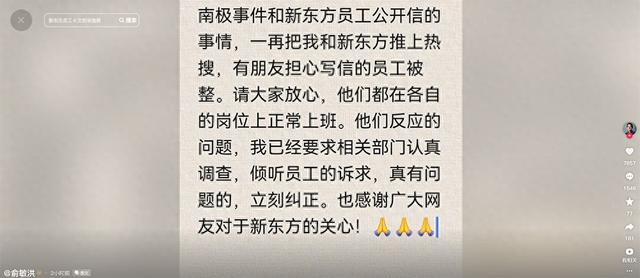
传新东方员工发内部信吐槽“加班严重”后,账号光速被锁
凤凰网财经· 2025-12-04 15:24
Core Viewpoint - The controversy surrounding the internal email from a New Oriental employee expressing dissatisfaction with the company's overtime culture continues to escalate [3][4]. Group 1: Employee Concerns - An employee highlighted issues such as encroachment on rest time, unrealistic performance indicators, and excessive non-core tasks, leading to fatigue [3][5]. - The employee described the "996 single rest day" work model, where work hours extend from 9:30 AM to beyond 9:30 PM, making long working hours a norm [4]. - Despite the labor contract stipulating weekends off, the employee noted that actual implementation is rare, and the eight-hour workday mandated by labor laws has become an unattainable luxury [5]. Group 2: Management and Company Culture - The employee expressed dissatisfaction with management and a desire for a more respectful work environment that honors basic labor rights and work planning [5]. - The employee referenced Yu Minhong's statement that a company that continuously harms its employees is not a good company, urging a return to prioritizing educational quality and employee rights [6]. - The email emphasized Yu Minhong's encouragement of freedom of expression, which inspired the employee to voice their concerns [7]. Group 3: Company Response - Yu Minhong responded to the controversy regarding his trip to Antarctica, stating that allowing employees to voice complaints is a tradition at New Oriental and that he encourages employees to express dissatisfaction [10][12]. - He mentioned plans to take a select group of outstanding employees to Antarctica, highlighting a commitment to recognizing and rewarding employee contributions [13].

完整的假期该如何定义?
Hu Xiu· 2025-10-10 13:39
Core Viewpoint - The article discusses the pervasive culture of working during holidays in China, highlighting the impact of technology, particularly WeChat, on work-life balance and the differences in communication styles between Chinese and Western workplaces [5][8][22]. Group 1: Work Culture and Technology - Many industries, including self-media, public relations, and finance, experience a lack of complete holidays due to ongoing work demands [4][24]. - The use of WeChat as an all-in-one tool integrates work and life, leading to a blurred line between personal time and work obligations [9][10]. - The legal ruling that handling work via WeChat during holidays constitutes overtime has sparked debate about the nature of work and compensation [5][7]. Group 2: Communication Styles - Chinese companies often require synchronous communication, expecting immediate responses, which contributes to the disruption of personal time [14][16]. - In contrast, Western companies favor asynchronous communication, allowing employees to respond at their convenience, which promotes a clearer separation between work and personal life [15][22]. - The fragmented communication style in China leads to a fragmented holiday experience, where employees feel compelled to remain connected to work [21][18]. Group 3: Management Practices - To improve work-life balance, companies should consider adopting tools designed for separation, such as email, and reduce reliance on WeChat [25]. - Establishing asynchronous communication processes can minimize unnecessary real-time interruptions [26]. - Management should shift from equating work hours with efficiency to a results-oriented approach, allowing employees to have uninterrupted time off [27][24].
上市在即再发“加班令” 奇瑞门店营业时间延长至22点
Xi Niu Cai Jing· 2025-09-14 03:12
Core Viewpoint - Chery is facing scrutiny due to its recent overtime notification, which contradicts previous apologies from its chairman regarding employee time value, raising concerns about its management practices during a critical period leading up to its IPO [2][3] Group 1: Management Practices - Chery has issued a notice to extend test drive hours until 22:00 to meet customer needs, requiring adequate staffing and consistent service standards [2] - The company has tightened its attendance regulations, mandating employees to arrive by 8:30 AM, with penalties for tardiness and unapproved overtime [2] - This shift in management approach appears contradictory to the chairman's earlier acknowledgment of the importance of employee time [2] Group 2: Financial Performance - Chery's financial performance is strong, with projected revenue of 269.9 billion yuan for 2024, a 65.4% increase year-on-year, and a net profit of 14.3 billion yuan, up 37.2% [3] - The company expects to sell over 2.3 million vehicles globally in 2024, marking a 49.4% increase [3] - In August 2025, Chery sold 242,736 vehicles, a 14.6% increase, with 71,218 of those being electric vehicles, reflecting a 53.1% growth [3]

“最快女护士”心酸流泪背后,“加班文化”可以休矣!
第一财经· 2025-09-05 02:42
Core Viewpoint - The article discusses the challenges faced by nurses in balancing their professional responsibilities with personal interests, highlighting the case of Zhang Shuihua, a nurse and marathon runner, who faced public backlash after expressing her struggles with work-life balance during an interview [3][4]. Group 1: Zhang Shuihua's Case - Zhang Shuihua achieved a personal best of 2 hours 35 minutes 27 seconds in the women's group at the Harbin Marathon but faced criticism for her emotional response during an interview about her work-life balance [3]. - Despite the backlash, further insights reveal that Zhang typically submits her shift change requests well in advance and does not frequently disrupt the schedule, indicating her commitment to both her job and her passion for running [4]. - Zhang's experience reflects a broader issue within the nursing profession, where 91% of nurses work over 8 hours daily, and many face challenges in taking time off due to staffing shortages [6][7]. Group 2: Work Culture and Overtime - The article highlights a pervasive "overtime culture" across various industries, where employees feel pressured to work beyond regular hours, often leading to burnout and reduced personal time [7][8]. - This culture is particularly pronounced in high-income sectors, where employees may feel compelled to work extra hours to maintain job security or enhance earnings, despite the negative impact on their well-being [8][9]. - The Chinese government has recognized the issue, with initiatives aimed at improving workers' rights to rest and vacation, emphasizing the need to address the root causes of overtime culture [8][9]. Group 3: Recommendations for Change - To combat the overtime culture, it is suggested that companies focus on improving productivity rather than extending working hours, which requires collaboration between employers, society, and the government [9]. - Enhancing management practices, optimizing workflows, and upgrading equipment are essential steps for companies to reduce the need for excessive overtime [9]. - A cultural shift is necessary to redefine the perception of dedication in the workplace, moving away from the notion that overtime equates to commitment [9].

壹快评|“最快女护士”的眼泪,流给为“加班文化”所累的职场人
Di Yi Cai Jing· 2025-09-04 17:52
Group 1 - The article highlights the issue of "overtime culture" in various industries, particularly in healthcare, where nurses like Zhang Shuihua face significant challenges in balancing work and personal interests [4][5][6] - It discusses the collective dilemma faced by nurses, who typically only get four days off per month, with a high percentage working over 8 hours daily, indicating a systemic problem in labor rights and work-life balance [4][6] - The article emphasizes the need for improved labor laws and the effective implementation of paid annual leave to protect workers' rights and enhance their well-being [5][6] Group 2 - The prevalence of "overtime culture" is attributed to low base salaries, forcing workers to rely on overtime for additional income, and outdated management practices that shift costs onto employees [6] - The article suggests that addressing "overtime culture" requires a multi-faceted approach, including increasing income through productivity improvements rather than longer hours, and promoting a healthier work culture [6] - It calls for a collaborative effort from employers, society, and the government to create a sustainable work environment that values both productivity and personal fulfillment [6]
钉钉 CEO 无招:有团队每天睡觉应该不超过 5 小时。网友:要不让欧盟记录在案吧?
程序员的那些事· 2025-08-27 03:13
Core Viewpoint - The article discusses the recent activities of DingTalk, highlighting the intense work culture and the launch of a new product, which has raised concerns about employee well-being and work-life balance [1][5]. Group 1: Product Launch - DingTalk held a product launch event on August 25, as anticipated [3]. - The CEO of DingTalk, Wu Zhao, was interviewed following the product launch, indicating a focus on the company's future direction [4]. Group 2: Employee Work Culture - Reports indicate that around 40 to 50 employees have been working under extreme conditions, with less than 5 hours of sleep per night over the past four months to develop the new product [5]. - Although the term "overtime" was not explicitly mentioned in the CEO's interview, the context suggests a culture of excessive work hours [5].
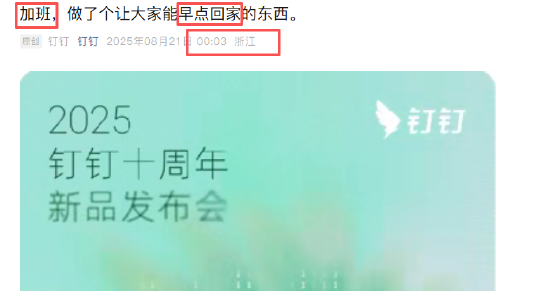
被曝凌晨查岗后,钉钉凌晨发文秀加班
Xin Lang Ke Ji· 2025-08-21 02:34
Group 1 - The core message of DingTalk's recent communication emphasizes the theme of overtime work, highlighting a new initiative aimed at allowing employees to leave work earlier [1] - DingTalk's official account has been actively promoting the idea of overtime, even mentioning that the gifts for a lottery were "made during overtime" [1] - The CEO of DingTalk, Wu Zhao, reportedly criticized employees for leaving work early, questioning the lack of presence in the office during late hours [4] Group 2 - There are claims circulating about potential optimization measures targeting executives who do not support overtime, with reports indicating that four P10 and fifteen P8 level employees may be affected within three months [4] - DingTalk's representatives have denied the authenticity of the claims regarding the CEO's late-night office inspections and the subsequent criticism of employees [4] - The company has also refuted rumors about the optimization of executives, stating that the information is not accurate [4]
奇瑞要求周六不开会,董事长为加班道歉;许家印香港豪宅建地牢;“亮证女”被行政拘留5日;民企起诉县政府讨要4000万|| 大件事
Sou Hu Cai Jing· 2025-08-06 08:57
Group 1 - Chery Automobile has mandated a 30% reduction in company-level meetings and participants to improve efficiency and respect employees' time [3] - Chairman Yin Tongyue acknowledged past management practices as inhumane and apologized, emphasizing the need for a cultural shift within the company [3][4] - The company has faced criticism for its overtime culture, with reports of mandatory late hours and performance management practices that some interpreted negatively [5][6] Group 2 - Evergrande Group's former chairman Xu Jiayin's Hong Kong properties have been revealed to have significant unauthorized constructions, including a "dungeon" [8][9] - The properties, originally purchased for HKD 2.5 billion, are now being sold at a significant loss, with one listed at HKD 900 million, reflecting a 60% drop in value [9] - Xu Jiayin's assets are under scrutiny, with multiple luxury items and properties being managed by creditors due to the company's financial troubles [9] Group 3 - Hema X, a membership store under Hema, will close all locations by the end of August as part of a strategic shift, focusing on core business areas [10][12] - The membership store concept, launched in 2020, has not gained sufficient traction in the Chinese market, leading to a strategic retreat [16] - Hema aims to achieve a GMV target of RMB 100 billion by the end of 2024, having reported profitability for the first time in the fiscal year 2025 [10][16] Group 4 - Jin Dalai Environmental Protection Co. is pursuing legal action against the local government for unpaid compensation related to a wastewater treatment project, totaling approximately RMB 40.8 million [20][21] - The company has experienced a decline in revenue and profit, with a 19% drop in revenue year-on-year for 2024 [21][22] - Jin Dalai's accounts receivable have reached RMB 780 million, indicating potential liquidity issues [22]


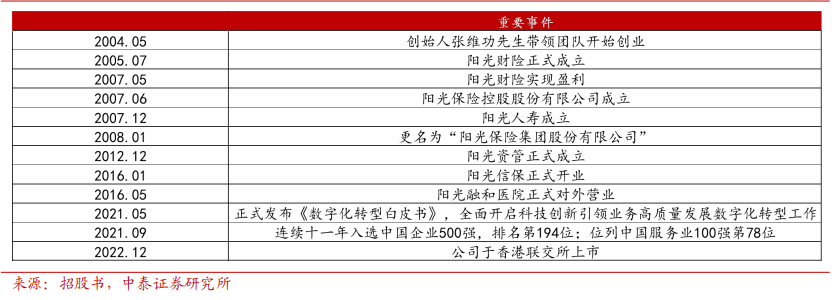
使劲开会,阳光保险就能提效了么?
Hu Xiu· 2025-05-23 05:58
Core Viewpoint - The recent controversy surrounding Sunshine Insurance's late-night meetings reflects a deeper issue of management anxiety over business performance, as the company faces significant operational challenges and declining profits [1][12]. Group 1: Company Performance - Sunshine Insurance's net profit for 2022 was 4.881 billion yuan, a year-on-year decrease of 23.61%, marking the first negative growth since 2019 [9]. - The company's net profit declined from 5.883 billion yuan in 2021 to 3.738 billion yuan in 2023, with a compound annual growth rate of -20.29% [12]. - Despite a projected recovery in 2024 with a net profit of 5.449 billion yuan, this figure still lags behind pre-2022 levels [12]. Group 2: Business Challenges - The company has been experiencing a decline in premium income, with a 3.62% drop in total premium income in January 2025 compared to January 2024 [15]. - Sunshine Insurance's reliance on the bancassurance channel, which accounts for about 60% of its sales, has been negatively impacted by new regulations that reduced commission rates [17]. - The company's flagship product, "Zhenxin Lifetime Life Insurance," has been discontinued, further affecting premium income [18]. Group 3: Management and Cultural Issues - The late-night meetings at Sunshine Insurance are indicative of a "founder culture" driven by founder Zhang Weigong's intense work ethic, which has been ingrained in the company's operations [2][4]. - Zhang Weigong is known for his demanding work schedule, often working over 15 hours a day, which has set a precedent for the company's culture [4][5]. - The company's "overtime culture" has been criticized, yet it may be seen as a necessary response to the current business pressures [12][30]. Group 4: Future Outlook - The insurance industry is facing a challenging environment, with increasing competition and rising costs impacting profitability [20][23]. - Sunshine Insurance's combined cost ratio is approaching 100%, indicating significant risk exposure that could further strain profits [20]. - The company's investment income, which has been a significant driver of revenue, is subject to market volatility, raising concerns about future performance [29].