
劳动力市场放缓

Search documents
美国劳动力动能骤减 企业裁员创20余年同期新高
Xin Hua Cai Jing· 2025-11-18 23:54
Core Viewpoint - The U.S. labor market experienced a significant slowdown in October, with a surge in layoffs and a net loss of jobs, indicating a weakening employment momentum [1][2]. Group 1: Layoff Trends - In October 2025, U.S. companies announced layoffs totaling 153,000, marking the highest figure for this period in over two decades [1]. - Approximately 39,006 employees received advance notices of mass layoffs under the WARN Act, the fourth highest since 2006 [1]. - ADP Research reported an average weekly job loss of 11,250 in the private sector for the four weeks ending October 25, suggesting a potential loss of about 45,000 jobs in the second half of October, the largest monthly decline since March 2023 [2]. Group 2: Employment Data and Indicators - Revelio Labs reported a net decrease of 9,100 jobs in the U.S. for October 2025, marking the second worst monthly performance of the year [2]. - Goldman Sachs' alternative economic indicators model predicts a potential negative growth of about 50,000 jobs in the upcoming official non-farm payroll report for October [2]. - The frequency of the term "layoff" in earnings call transcripts for Russell 3000 companies has significantly increased, indicating rising concerns about employment stability [2]. Group 3: Unemployment Claims and Public Sentiment - For the week ending October 18, the number of initial unemployment claims was 232,000, remaining roughly stable compared to mid-September levels [3]. - A survey conducted from October 23 to 25 revealed that 55% of employed Americans expressed concerns about job security, reflecting a decline in labor market confidence [3]. - Federal Reserve officials have identified the degree of slowdown in the labor market as a key consideration for future monetary policy decisions [3].
高盛:金价2026年底或升至4900美元
Xin Lang Cai Jing· 2025-11-18 11:25
Group 1: Market Insights - Goldman Sachs predicts that central banks may significantly increase gold purchases in November, with gold prices potentially rising to $4,900 by the end of 2026 [3] Group 2: Macroeconomic and Policy News - China's fiscal revenue from January to October reached 18.65 trillion yuan, a year-on-year increase of 0.8%, while fiscal expenditure was 22.58 trillion yuan, up 2% [4] - In October, China's foreign exchange settlement by banks was $214.2 billion, with a surplus of $17.7 billion, indicating a net inflow of cross-border funds [4] - The real estate market in China is stabilizing, with second-hand home transactions dominating, showing a 4.7% year-on-year increase in transaction area from January to October [4] Group 3: Employment and Inflation - Federal Reserve Vice Chairman Jefferson noted an increase in downside risks to employment, while inflation risks may have slightly decreased [5] - The White House's National Economic Council Director Hassett indicated mixed signals in the labor market, suggesting a potential slowdown [5] Group 4: International Economic Data - Japan's GDP contracted by 0.4% quarter-on-quarter in Q3, marking the first negative growth since Q1 2024, primarily due to weak exports and residential investment [6] - The European Commission forecasts a faster-than-expected economic expansion in the Eurozone, with GDP growth projected at 1.3% for the year [6] - India's trade deficit widened to a record $41.68 billion in October, influenced by increased gold imports and decreased exports to the U.S. [6] Group 5: Commodity and Industry News - Indonesia plans to implement an export tax of 7.5% to 15% on gold products starting next year [6] - Mysteel reported a decrease in iron ore arrivals in China, with total arrivals at 2,369.9 million tons, down 399.4 million tons week-on-week [7] - The coal market is experiencing a decline in operational rates, with a reported drop in production and inventory levels [8]


美国白宫国家经济委员会主任哈塞特:目前劳动力市场有所放缓 政府停摆对经济的影响远比预期的严重
Xin Hua Cai Jing· 2025-11-07 13:50
Core Insights - The U.S. labor market is experiencing a slowdown, with the impact of the government shutdown being more severe than previously anticipated [1] Group 1 - The Director of the National Economic Council, Hassett, highlighted the current slowdown in the labor market [1] - The economic effects of the government shutdown are significantly worse than expected [1]
就业网站Indeed数据:美国10月职位空缺跌至2021年4月以来最低
Sou Hu Cai Jing· 2025-11-04 20:38
Group 1 - The core viewpoint of the articles highlights a significant decline in job opportunities in the U.S. labor market due to the ongoing government shutdown, reaching the lowest level in four and a half years [1][2] - Indeed's job vacancy index dropped to 101.9 as of October 24, marking the lowest level since early February 2021, with a decrease of approximately 0.5% from the beginning of the month and about 3.5% from mid-August [1] - The last JOLTS report indicated that job vacancies in August remained at 7.23 million, roughly unchanged from July, but down about 7% from January of this year [1] Group 2 - The weakening labor market has raised concerns among Federal Reserve officials, leading to a decision to lower the benchmark interest rate by 25 basis points to a target range of 3.75%-4% [2] - Federal Reserve Governor Lisa Cook noted that hiring is slowing down, as evidenced by Indeed's data, and emphasized the importance of monitoring real-time data rather than solely relying on unemployment reports [2] - The October non-farm payroll report, originally scheduled for release, has been postponed due to the government shutdown, with economists predicting a decrease of 60,000 jobs and an increase in the unemployment rate to 4.5% [2]
美联储米兰:但在劳动力市场方面,它确实显示出放缓迹象。
Sou Hu Cai Jing· 2025-11-03 12:32
Core Viewpoint - The Federal Reserve indicates signs of a slowdown in the labor market [1] Group 1 - The labor market is showing signs of deceleration, which may impact economic growth [1]
鲍威尔最新发声,美联储有望继续降息
Zheng Quan Shi Bao· 2025-10-09 23:10
Core Points - Federal Reserve Chairman Jerome Powell emphasized the importance of community banks in the U.S. financial system, highlighting their close ties to local economies and customers [3] - New York Fed President John Williams expressed support for further interest rate cuts to address potential risks in the labor market, noting a gradual cooling trend in employment [6][10] - Investors widely expect the Federal Reserve to lower interest rates by 25 basis points in the upcoming meeting, with a high probability of further cuts by December [10] Group 1 - Powell did not address the current economic situation or monetary policy in his remarks [4] - Williams noted that while the labor market is cooling, it has not raised concerns about an imminent recession [6] - The latest indicators show a moderate cooling in the overall job market without signs of accelerated deterioration [6] Group 2 - Williams mentioned that tariffs have raised import prices, contributing to inflation, but the impact is less than previously expected [6][7] - He estimated that tariffs have increased inflation by 0.25 to 0.5 percentage points, but overall inflation risks have stabilized [6][7] - The Federal Reserve's decision-making is based on data analysis rather than political considerations, emphasizing the importance of central bank independence [7]
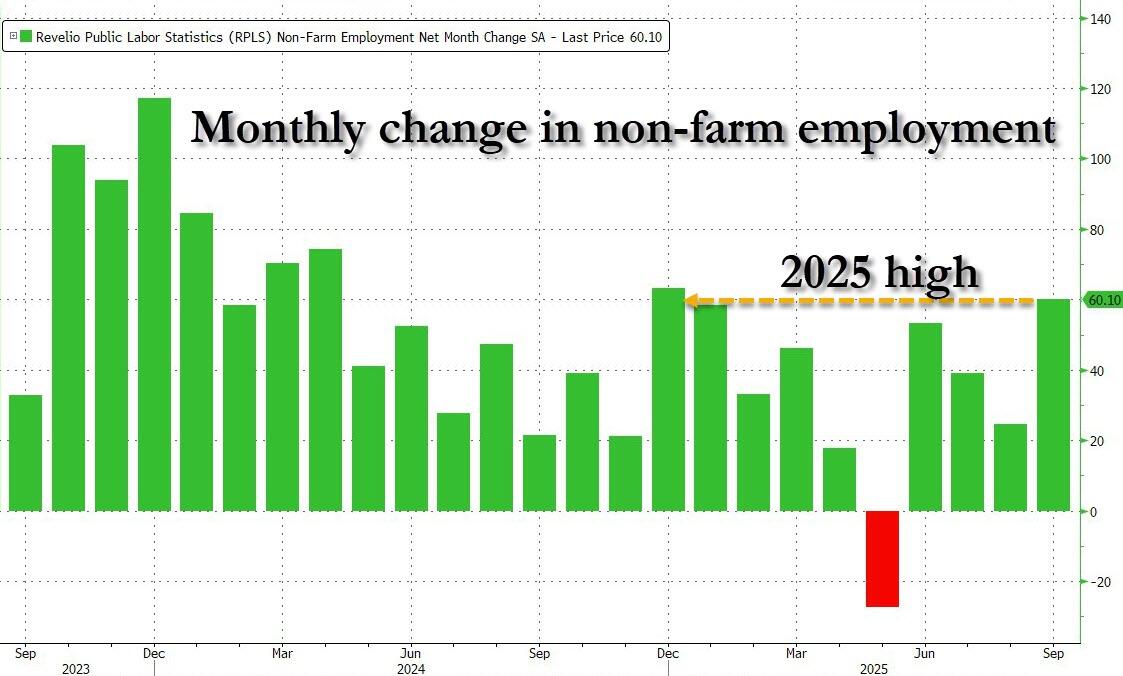
劳动力衰退担忧缓解:美国“民间非农”9月新增就业6万超预期,创今年最佳
Hua Er Jie Jian Wen· 2025-10-04 03:33
Core Insights - The U.S. labor market showed signs of resilience with the addition of 60,000 jobs in September, surpassing previous reports of job losses, alleviating concerns about a labor recession [1][3][4] Group 1: Employment Data - Revelio Labs reported a job growth of 60,000 in September, which is the best performance for 2025, contrasting with ADP's report of a loss of 32,000 jobs [1] - The employment growth was primarily driven by the education, healthcare, and retail sectors, indicating a structural improvement in the job market [4] - Despite the positive job growth, the overall labor market is showing signs of a slowdown, as indicated by declining hiring rates and wages [3][4] Group 2: Economic Implications - The data supports the narrative that the Federal Reserve is dealing with an economic slowdown rather than a recession, providing room for potential interest rate cuts [8] - Revelio Labs' data, based on over 100 million U.S. user profiles, offers a clearer view of labor dynamics, tracking employment levels, wages, and job transitions [8] - The absence of official data due to the government shutdown has made alternative data sources like Revelio Labs crucial for market transparency [9]
全线跳水!
中国基金报· 2025-10-01 11:15
Group 1 - The U.S. government shutdown has led to a decline in the stock market, with S&P 500 futures down 0.6% and Nasdaq 100 futures down 0.75% [2] - The shutdown threatens to interrupt the S&P 500's 14% increase this year, raising concerns about the resilience of the labor market [5] - Research indicates that the shutdown could increase the U.S. unemployment rate from 4.3% to 4.7%, with potential mass layoffs by Trump exacerbating economic pain [5] Group 2 - Historical data shows that the stock market generally reacts mildly to government shutdowns, but defense contractors and airlines may face higher volatility due to reduced government revenue and federal employee travel [5] - Citigroup emphasizes that the duration of the shutdown is critical; longer shutdowns typically weaken stocks and strengthen bonds [6] - The Congressional Budget Office estimates that approximately 750,000 federal employees will be forced to take leave due to the shutdown [6] Group 3 - The absence of key economic data, particularly the non-farm payroll report, raises concerns among investors about the labor market's health [6] - Historically, stock markets have tended to rise during government shutdowns, with the S&P 500, mid-cap 400, and small-cap 600 indices averaging over 3% gains during the last five shutdowns [6]

英国劳动力市场三大痼疾:成本高企、监管趋严和技能不足
Xin Hua Cai Jing· 2025-09-18 01:36
Core Points - The UK labor market is continuing to slow down, with employee wages rising by 4.8% year-on-year from May to July, down from 5% in the previous quarter [1] - There is a significant decline in labor demand across various industries, with 9 out of 18 industrial categories experiencing reduced demand [1] - The unemployment rate has reached 4.7%, the highest level in four years, indicating a slowdown in hiring momentum [1] Group 1: Labor Market Trends - The UK labor market has been experiencing a prolonged slowdown due to both cyclical economic factors and structural issues related to skill shortages [2] - Approximately 73% of surveyed companies believe that rising labor costs pose a significant threat to the competitiveness of the UK labor market [2] - The increase in labor costs is attributed to rising national insurance contributions and minimum wage hikes, costing businesses over £24 billion annually [2] Group 2: Regulatory Environment - Stricter regulations post-Brexit have made it more challenging for industries reliant on EU labor, such as hospitality and agriculture, to recruit suitable employees [3] - The Employment Rights Bill, which expands employee rights, is perceived by 78% of businesses as a potential hindrance to economic growth and investment [3] - Over 86% of respondents indicated that unfair dismissal rights could lead to increased legal challenges during the probationary period, prompting employers to be more cautious in hiring [3] Group 3: Skills Mismatch - Despite a soft labor market, many skill-intensive sectors are struggling to find qualified talent, with 76% of companies facing recruitment difficulties in Q1 [4] - The construction industry is particularly affected, with 76% of firms unable to find the necessary skilled workers, and 84% acknowledging a severe skills shortage [4] - The UK construction sector needs to recruit 239,300 new employees by 2029 to meet government housing targets [4] Group 4: Economic Implications - The interplay of insufficient labor demand and structural skill shortages is leading to a potential decline in wage growth, which may fall to around 4% by the end of the year [1][4] - The ongoing issues in the labor market are expected to contribute to further slowdowns in the coming months, posing challenges for the Bank of England in managing inflation [4]
高盛策略师:2026年美股将再度加速
Ge Long Hui A P P· 2025-09-15 09:39
Core Viewpoint - The stock market is beginning to overlook weak labor data, with expectations for stock prices to accelerate again next year [1] Group 1: Market Sentiment - Investors are optimistic that the recent slowdown in the labor market will be temporary [1] - The anticipated interest rate cuts by the Federal Reserve are expected to further support the stock market [1] Group 2: Economic Indicators - A cooling labor market is seen as a "tailwind" for corporate profits [1] - The relationship between labor costs and profit margins is highlighted, indicating that a 100 basis point change in labor cost growth will impact S&P 500 earnings per share by 0.7% [1]
