
商业化落地

Search documents
宁德时代打样,人形机器人变身流水线“蓝领”,2035年市场空间或破480亿
硬AI· 2025-12-18 14:05
Core Insights - Humanoid robots are accelerating their integration into factories, primarily focusing on logistics and quality inspection as initial commercial paths. The key challenge lies in achieving a return on investment (ROI) within two years, necessitating a price reduction to around 100,000 yuan [2][5] - The introduction of the humanoid robot "Xiao Mo" by CATL marks a significant milestone in the application of embodied intelligence in smart manufacturing, achieving a stable connection success rate of over 99% and tripling daily output compared to skilled workers [2][5] Group 1: Complementary Positioning - Humanoid robots are not intended to replace highly automated industrial robots but to fill the gap between traditional automation and human labor. They are designed to replace human positions rather than industrial robots [7] - The complementary nature of humanoid and industrial robots is evident in their capabilities: humanoid robots possess autonomous mobility, can adapt to unstructured environments, and are suited for flexible, small-batch tasks, while industrial robots excel in high-speed, high-load, and precise repetitive tasks [8][10][11] Group 2: Implementation Roadmap - In the initial phase, humanoid robots will start with "short-chain tasks," focusing on logistics and quality inspection due to their semi-flexible characteristics and high human involvement [14] - Basic assembly tasks are still in preliminary testing stages for humanoid robots, with a focus on tasks like screw pre-tightening and component installation [15] - The choice of robot form is crucial, with wheeled robots being favored for their stability, long endurance, and speed in industrial settings [16] Group 3: ROI and Technical Bottlenecks - The large-scale commercialization of humanoid robots faces two main obstacles: economic viability and technical limitations. To achieve a two-year ROI, the price of humanoid robots must drop to around 100,000 yuan, while current prices range from 300,000 to 500,000 yuan [20][21] - Two significant technical challenges include the underdevelopment of embodied intelligence for complex tasks and the need for improved dexterity and control in fine operations [22] Group 4: Market Potential - Despite challenges, the outlook for humanoid robots in industrial applications is promising, driven by global labor shortages and the need for safer working environments. By 2030, a labor shortage of nearly 8 million is expected in global manufacturing [25] - By 2035, the demand for humanoid robots in China's industrial sectors, including automotive manufacturing, electronics, and logistics, is projected to reach 484,000 units, with a market potential of 48.36 billion yuan [25][26] Group 5: Role of Automotive Companies - Automotive manufacturers like Tesla and XPeng are crucial in advancing humanoid robots, leveraging their technological and supply chain advantages to validate applications in their production lines [27][28] - These companies can repurpose AI, perception, and control technologies from the smart automotive sector to humanoid robots, providing valuable application scenarios and training data [28] - Tesla's Optimus and XPeng's IRON are already testing humanoid robots in their factories, with plans for large-scale production by 2026 [29][30]



红杉中国杨云霞:下一代疗法风口下,坚守长期投资逻辑 | 投资人说
红杉汇· 2025-12-15 00:04
Core Viewpoint - The article presents an interview with Yang Yunxia, a partner at Sequoia China, who discusses the value judgment framework for the next stage of the biopharmaceutical industry, emphasizing that Biotech will remain a mainstream investment direction in healthcare, particularly focusing on the iteration of "second-generation technology paradigms" [4][7]. Group 1: Investment Trends and Opportunities - Biotech is highlighted as a key investment direction, with a focus on advancements such as ADC drugs evolving from single-target to dual-target and the development of more complex antibody technologies [7][8]. - The Chinese biopharmaceutical industry is transitioning from being a global observer to a significant participant, characterized by strong iteration capabilities and efficient execution [9][10]. - By 2024, China is expected to account for 18% of the global share of new molecular entities, ranking as the second-largest country for new drug listings [9]. Group 2: Market Dynamics and Challenges - The overall pharmaceutical industry saw a 16.72% increase from early 2025 to November, outperforming the CSI 300 index by 1.68 percentage points, driven by breakthroughs in innovative drugs and active business development (BD) transactions [7]. - The article notes that while there are many opportunities, the industry must also confront challenges, including the need for improved commercialization capabilities and the risk of resource wastage due to blind competition [10][11]. Group 3: Strategic Insights for Investment - Yang Yunxia emphasizes the importance of selecting early-stage projects based on two criteria: the team and the asset, which are crucial for maximizing value returns [15]. - The article discusses the significance of BD transactions as a means to enhance capital, brand, and capabilities, which are essential for the growth of Biotech companies [11][12]. - It is noted that the pricing of Chinese Biotech assets in overseas transactions is often lower, highlighting the need for a shift in perception regarding the value of Chinese assets in global markets [11][12]. Group 4: Future Outlook - Yang Yunxia maintains an optimistic yet cautious outlook on the capital market cycle for 2026, emphasizing that the core standard for assessing enterprise value lies in fundamentals [8][14]. - The article concludes that the Chinese biopharmaceutical industry must focus on quality, differentiate its offerings, and balance speed with value to strengthen its competitive position globally [15].

高交会观察:中国创新力“大爆炸”
Jing Ji Guan Cha Wang· 2025-11-17 14:08
Core Insights - The 27th China International High-Tech Achievements Fair (CIHTAF) concluded in Shenzhen, showcasing over 5,000 companies and achieving a transaction intention amount exceeding 170 billion yuan [1] - The event highlighted the integration of technology and application, emphasizing the need for clear and quantifiable commercial outcomes from innovations [1] Commercialization Focus - China Aerospace Science and Technology Corporation (CASC) showcased the Long March 8 rocket model, which aims to address the critical issue of reducing launch costs for commercial space endeavors [2] - The rocket has a payload capacity of 7 tons to a 700 km sun-synchronous orbit, indicating advancements in launch capabilities [2] - Beijing Jun Tian Hang Yu Technology Co., Ltd. presented the "Jun Tian No. 1 04A satellite," designed for urban management applications, showcasing the urgency for practical applications in the commercial space sector [2] Low-altitude Economy - Shenzhen Daohe Tongtai Robotics Co., Ltd. introduced an "air-ground integration" solution that significantly reduces inspection time for cross-sea bridges from 15 days to 3 days [3] - The solution utilizes a smart inspection platform called "Avant Hub," enabling coordinated operations between drones and ground robots, enhancing traffic efficiency by 42% and reducing carbon emissions by 18% [3][4] - The company plans to focus on smart transportation, smart parks, and smart energy sectors for short-term revenue generation, transitioning from selling equipment to providing services and platforms [4] Specialized Drone Applications - The China Academy of Launch Vehicle Technology showcased specialized drones for emergency rescue and security detection, indicating a shift in industry demand towards precise security and emergency response solutions [5] - The "Eagle" drone is designed for physical countermeasures, while the "Ming Die" emergency rescue system is equipped for critical area operations [5] Computing Power Infrastructure - The Huawei booth featured the "Ascend 384 Super Node" computing cluster, capable of 300 PFLOPS, aimed at supporting large-scale model training [6] - The cluster's architecture can enhance efficiency by over three times for specific models, addressing the growing demand for computational power [6] Energy Efficiency Solutions - Chaoju Technology Co., Ltd. presented the FusionPoD for AI liquid-cooled cabinet, addressing the energy consumption challenges associated with high-density computing [7] - The liquid cooling technology is essential for managing the power density exceeding 20 kW in AI applications, aiming to balance computational expansion with energy costs [7] Industrial IoT Systems - Beijing Aerospace Topology Technology Co., Ltd. showcased the "Ran Hong" industrial IoT system, which utilizes an open-source operating system to improve operational efficiency in the gas industry [8] - The system addresses fragmentation and coordination issues in traditional industrial control systems, demonstrating a shift towards full-stack domestic solutions [8] Robotics and Automation - Shenzhen Cyborg Robotics Technology Co., Ltd. focused on practical applications of robotics, demonstrating core component load testing rather than flashy performances [9] - The company aims to meet specific industrial needs with robots designed for precision and efficiency, moving away from merely aesthetic designs [11] - The trend in robotics is shifting towards adopting automotive manufacturing standards, ensuring higher reliability and performance in industrial applications [12]
小马智行港股挂牌首日再破发 股价下跌超9%
Zheng Quan Ri Bao Wang· 2025-11-06 09:58
Core Viewpoint - The recent listing of four new stocks on the Hong Kong Stock Exchange, including Xiaoma Zhixing, has seen mixed results, with Xiaoma Zhixing experiencing a significant drop in share price, raising concerns about its commercialization capabilities and financial health [1][2]. Group 1: Stock Performance - Among the four newly listed stocks, only Wangshan Wangshui-B saw a substantial increase in share price, closing up 145.73% at 82 HKD per share [1]. - Xiaoma Zhixing's share price fell 9.28% from its issue price of 139 HKD, closing at 126.1 HKD, with an intraday drop of 14.53% [1]. - Xiaoma Zhixing's initial public offering (IPO) in the U.S. also faced challenges, with its first-day closing price at 12 USD per share, down 7.69% [1]. Group 2: Financial Performance - Xiaoma Zhixing's total revenue projections for 2022 to 2025 are 0.68 million USD, 0.72 million USD, 0.75 million USD, and 0.35 million USD respectively [1]. - The company reported net losses of 1.48 million USD, 1.25 million USD, and 2.74 million USD for the years 2022 to 2024, with the 2024 loss exceeding total revenue for the previous three and a half years [2]. - In the first half of 2025, Xiaoma Zhixing's net loss increased by 87.24% to 0.96 million USD [2]. Group 3: Research and Development Expenditure - Xiaoma Zhixing's R&D expenses from 2022 to 2024 were 1.54 million USD, 1.23 million USD, and 2.40 million USD, totaling over 5.17 million USD, while total revenue during the same period was only 2.15 million USD [2]. - In the first half of 2025, R&D spending reached 96.5 million USD, accounting for 272.3% of the revenue of 35.43 million USD [2]. Group 4: Cash Flow and Market Sentiment - The company experienced a cash outflow from operating activities of 1.1 million USD in 2024 and 0.8 million USD in the first half of 2025, indicating challenges in cash generation [2]. - Industry experts suggest that Xiaoma Zhixing's continued losses and high R&D costs, coupled with weak revenue growth and tight cash flow, reflect skepticism in the market regarding its ability to convert technological advancements into commercial profitability [2].
千里科技、哈啰入局Robotaxi,印奇:规模达到1000台时有望跑通基础商业模型
Cai Jing Wang· 2025-10-09 03:42
Core Insights - The Robotaxi industry is witnessing significant developments with companies like Qianli Technology and Hello Inc. announcing ambitious plans for the next 18 months, including the launch of L4 autonomous driving solutions and the deployment of over 1,000 Robotaxis in single cities [1][2] - The global Robotaxi market is projected to reach $40-45.7 billion by 2030, with an annual growth rate exceeding 60%, indicating a shift from technical feasibility discussions to commercialization strategies [2] - Cost reduction and profitability challenges remain critical for existing players in the Robotaxi space, as evidenced by substantial losses reported by companies like Xiaoma Zhixing and WeRide [6][7] Company Strategies - Qianli Technology aims to leverage its "latecomer advantage" by focusing on a model-driven approach with a core emphasis on pure vision technology, while also incorporating innovative sensors to reduce costs in extreme scenarios [2][3] - Hello Inc. is pursuing a dual strategy of full-stack self-research and collaboration with Horizon Robotics to develop L4 products, ensuring both autonomy and complementary capabilities [3] - Both companies emphasize the importance of integrating technology and operations to optimize profitability, with Qianli highlighting the need for stable operations with at least 1,000 vehicles to establish a viable business model [4][5] Market Dynamics - The Robotaxi sector is characterized by a structural contradiction where hardware costs are decreasing rapidly, yet operational and maintenance costs remain high, hindering profitability [6][7] - Companies like Baidu's Luobo Kuaipao have reported significant order growth, yet still struggle to achieve overall revenue that covers comprehensive investments, indicating the challenges of scaling operations [7] - The future of profitability in the Robotaxi market may hinge on deep integration with traditional transportation sectors rather than isolated efforts, as suggested by Baidu's strategy to collaborate with taxi companies and third-party fleet operators [7][8]

10上市8亏损! 智驾投资人们悄悄“逃离”
Xin Lang Cai Jing· 2025-09-15 02:33
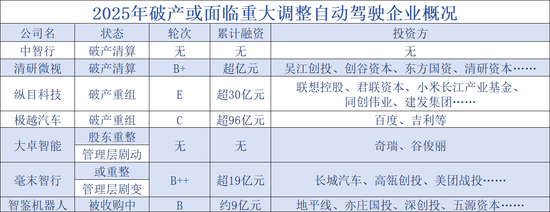
Core Insights - The recent bankruptcy of Zhongzhixing Technology, founded by Wang Jin, highlights the challenges faced by the autonomous driving industry, with many companies struggling financially and undergoing significant changes [1][3][4] - The industry is experiencing a shift towards commercialization, with a growing number of companies preparing for IPOs, while others face liquidation or restructuring [1][6][9] Industry Overview - In 2023, two autonomous driving companies have declared bankruptcy, while two others are undergoing restructuring, indicating a trend of financial distress within the sector [3][4] - A total of ten mainstream autonomous driving companies have reported their mid-year financials for 2025, with only two achieving profitability, while eight remain in a loss-making position [1][6] Company Status - Zhongzhixing Technology has entered bankruptcy liquidation due to an inability to repay debts, reflecting broader issues in the industry [2][3] - Other companies facing similar fates include Qingyan Weishi and Zongmu Technology, which are undergoing bankruptcy restructuring, and Jiyue Automotive, which has also faced significant financial challenges [2][4] Market Dynamics - The autonomous driving sector is witnessing a bifurcation, where some companies are thriving and preparing for IPOs, while others are struggling to survive [1][9] - Investment in the autonomous driving sector is declining, with many investors shifting focus to other areas, indicating a potential saturation of the market [5][9] Financial Performance - Among the ten listed autonomous driving companies, only two have turned profitable, while the remaining eight continue to report losses, although the loss margins are narrowing [6][7] - Companies like Xinshiqi are preparing for IPOs, with significant deployment of autonomous vehicles, indicating potential growth opportunities in the market [8][9]
小红书电商变了,悄悄内测新功能
Sou Hu Cai Jing· 2025-08-29 12:10
Core Insights - Xiaohongshu is launching a new feature that allows users to directly upload files such as PDF, Word, and PPT in their posts, which is expected to change the content creation landscape and reduce information asymmetry [2][3][6] - The new file-sharing feature is currently in beta and is limited to product promotion accounts, with a file size limit of 100MB, and only one file can be uploaded per post during the testing phase [3][4] - The platform's algorithm will favor posts that include files, potentially altering the flow of traffic and encouraging businesses to adapt their strategies accordingly [6][10] User Experience and Content Strategy - The process for users to attach files is straightforward, enhancing user experience by eliminating the cumbersome "private message for materials" approach [3][6] - The introduction of file uploads may force content creators to rethink their strategies, moving away from simply exchanging materials for attention to providing deeper value [6][10] - A new content strategy termed "content sandwich" has been proposed, which emphasizes structuring posts to maximize engagement and conversion [8] Market Position and Commercialization Challenges - Xiaohongshu is facing challenges in commercializing its platform effectively, as evidenced by its lower ranking in advertising effectiveness compared to competitors like Douyin [11][12] - The platform's e-commerce performance is significantly behind Douyin and Kuaishou, with a projected GMV of around 100 billion yuan for 2024 [11] - The establishment of a "Big Commercial Sector" aims to enhance collaboration between advertising and e-commerce departments to improve overall user experience and business outcomes [12][13] Future Implications - If file sharing becomes mainstream, Xiaohongshu could see an increase in high-density, practical content such as industry reports and study notes, moving beyond traditional image and text formats [9][10] - The new feature may open up new pathways for monetization, allowing creators to offer free content to attract users and then guide them to paid versions [10] - The success of these initiatives will depend on Xiaohongshu's ability to balance user experience with creator incentives while addressing existing interface and flow issues [12][13]

人形机器人“奥运会”即将开幕!谁将引领万亿级智能革命?
Sou Hu Cai Jing· 2025-08-13 18:35
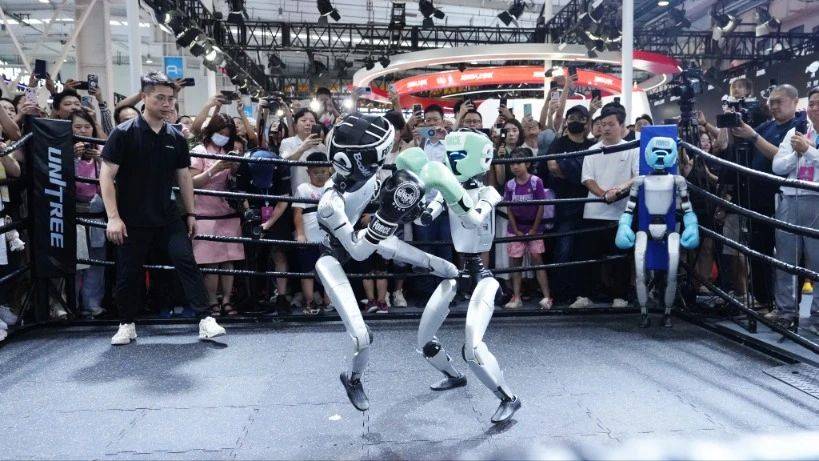
Core Viewpoint - The 2024 World Humanoid Robot Games in Beijing represents a significant shift from laboratory testing to real-world applications, showcasing the potential for commercial opportunities and industry restructuring in the humanoid robotics sector [1]. Event Highlights - The event features diverse project settings that closely resemble real-world applications, including tasks like hotel cleaning, factory material handling, and hospital drug sorting, indicating a move from "showcase" to "practical" robots [3][4]. - A unique "global first humanoid robot half marathon" tests robots' endurance, battery life, and coordination, highlighting technological integration and energy efficiency [3]. Participating Teams - Leading companies such as Xinghaitu, backed by Meituan, are providing exclusive robot solutions for the event, indicating strategic investments in end-service robotics [5]. - Yushu Technology is establishing itself as a foundational player in the industry with its open hardware ecosystem, akin to the Android model in smartphones [5]. - A diverse array of domestic companies, including Tiangong, Jiasu Jinhua, and Fourier, showcases China's multifaceted approach to humanoid robotics [5]. - Academic institutions and international teams from 15 countries are participating, emphasizing the integration of research and global competition in the field [5]. Technological Breakthroughs - Advances in visual recognition and modeling techniques are being demonstrated, such as a high-reflective object detection model developed by a team from Hefei [7]. - Yushu robots are noted for their stability and dynamic control during competitions, showcasing advancements in motion control [8]. - The R1 Pro from Xinghaitu exemplifies the potential of service robots through its ability to understand task processes and execute actions effectively [8]. Industry Trends - The humanoid robotics industry is transitioning from technology validation to commercial application, marking a pivotal moment for market entry [9]. - Capital is increasingly concentrating on a few leading companies, indicating a potential reshaping of the competitive landscape in the next 3-5 years [10]. - Collaboration across the supply chain, including sensors, motors, AI, and operating systems, is essential for success in the humanoid robotics sector [11]. Investment Logic - Attention should be directed towards foundational technology suppliers, such as those providing servo motors and visual recognition chips, which are critical to robotic functionality [12]. - Investment in platform companies like Yushu Technology and UBTECH, which offer robotic platforms and ecosystems, is recommended due to their growth potential [12]. - Companies focused on specific applications, such as Xinghaitu and Fourier, are positioned for clear commercial pathways and profitability [12].

按下“需求驱动”快进键 机器人产业迸发新动能
Zheng Quan Ri Bao· 2025-08-05 15:44
Core Viewpoint - The Chinese robotics industry is entering a new development stage driven by both technological innovation and consumer demand, as evidenced by significant events like the World Robot Conference and the E-Town Robot Consumption Festival [1][2]. Group 1: Industry Events and Trends - The World Robot Conference in Beijing will feature over 200 domestic and international robotics companies showcasing more than 1,500 exhibits, including over 100 new product launches [1]. - The E-Town Robot Consumption Festival aims to stimulate consumer interest by offering exclusive vouchers, with individual purchases of robotic products eligible for subsidies up to 1,500 yuan [1]. Group 2: Shift from Technology-Driven to Demand-Driven - The industry is transitioning from a "technology-driven" narrative to a "demand-driven" approach, creating a complete feedback loop of "research—application—feedback—optimization" [2]. - This shift allows companies to accurately capture consumer needs and encourages consumers to participate in technological iterations, ensuring that innovations are market-oriented [2]. Group 3: Policy and Ecosystem Development - To build a demand ecosystem, it is essential to establish a long-term mechanism for "demand-driven innovation," including tax incentives for first-time purchases of domestic robots and creating a "demand matching platform" [2][3]. - The establishment of safety standards for household service robots and compatibility standards for industrial robots is crucial for orderly competition and market demand release [2]. Group 4: Consumer Activation Strategies - Beyond direct subsidies, breaking the perception of robots as high-end consumer goods is necessary, with initiatives like community experience zones for elderly care robots and educational robots in shopping areas [3]. - A comprehensive service system for small household robots, including trial, purchase, and after-sales support, can lower consumer decision-making barriers [3]. Group 5: Industry-Specific Applications - The industry should focus on "defining technology from scenarios" rather than "finding applications for technology," with tailored robotic solutions for specific manufacturing processes and service industry needs [3]. - For instance, delivery robots in the restaurant sector must adapt to complex layouts, while sorting robots in logistics need to recognize irregular packages and optimize routing [3]. Group 6: Future Outlook - With ongoing policy benefits, an awakening consumer market, and targeted technological breakthroughs, the Chinese robotics industry is poised for significant advancement in the global value chain [4].
智谱再获10亿融资,推出会看“苏超”的开源新模型
Guan Cha Zhe Wang· 2025-07-03 10:30
Core Insights - The article highlights the recent advancements by Zhipu AI in the field of artificial intelligence, particularly the launch of the new visual language model GLM-4.1V-Thinking, which enhances reasoning capabilities and supports multimodal inputs including images and videos [1][7][10] - Zhipu AI has secured a strategic investment of 1 billion yuan to bolster its operations in Shanghai and contribute to the development of a supercomputing resource pool known as the "Ten Thousand Card Cluster" [3][5] - The company is focusing on commercializing its AI models, with significant increases in daily token usage and revenue, indicating a growing demand for AI applications across various industries [12][14] Group 1: Product Development - Zhipu AI introduced the GLM-4.1V-Thinking model, which supports complex cognitive tasks and has shown superior performance in various benchmarks compared to larger models [7][8][10] - The model's capabilities include understanding dynamic video content and performing reasoning tasks, which expands its application potential in real-world scenarios [9][11] - The lightweight version, GLM-4.1V-9B-Thinking, has achieved outstanding benchmark scores, demonstrating the potential of smaller models to perform at high levels [8][10] Group 2: Strategic Investments and Collaborations - Zhipu AI has completed its 16th financing round, securing a total of 1 billion yuan from strategic investors, which will support its growth in the AI sector [3][5] - The company is collaborating with Shanghai's state-owned enterprises to develop a new AI infrastructure that integrates energy, computing power, and AI models [5][6] - The "Ten Thousand Card Cluster" aims to create a supercomputing resource pool to meet the increasing demand for AI computational power in various industries [5][6] Group 3: Commercialization Efforts - Zhipu AI's daily token usage has increased nearly 30 times year-on-year, with a 52% rise in daily expenditure, reflecting the growing adoption of its AI solutions [12][14] - The company has significantly reduced API prices, with some models seeing price cuts of up to 90%, making AI services more accessible [14][15] - Zhipu AI is focusing on providing agent capabilities to businesses, allowing them to integrate AI without the need for extensive in-house development [15][16]
