
基建投资

Search documents
热卷日报:增仓下跌-20260224
Guan Tong Qi Huo· 2026-02-24 11:21
Report Industry Investment Rating No relevant information provided Core View of the Report The hot-rolled coil futures market is in a stage of "weak reality, strong expectation" game. The fundamentals are dominated by inventory accumulation and weak demand, putting short-term pressure on prices. However, improved export profits, the resilience of steel mill production, and policy expectations form a bottom support, limiting the downside space. The market as a whole maintains a weak oscillating trend [6]. Summary by Directory Market Review - The main contract of hot-rolled coil futures had an increase of 18,657 lots in open interest on Tuesday, with a trading volume of 373,301 lots, showing an increase in volume compared to the previous trading day. The intraday low was 3,181 yuan, and the high was 3,230 yuan. It closed at 3,195 yuan/ton, down 28 yuan or 0.87%. The short-term moving average fell below the 5-day, 30-day, and 60-day moving averages [1]. - The spot price of hot-rolled coils in Shanghai, a mainstream area, was reported at 3,230 yuan/ton, down 10 yuan from the previous trading day [2]. - The basis between futures and spot was 35 yuan [3]. Fundamental Data - **Supply**: The output of hot-rolled coils decreased slightly, with a weekly output of 3.0776 million tons in the week of February 13, 2026, a decrease of 0.014 million tons from the previous week. The capacity utilization rate remained at a high level of 79.14%, indicating strong production resilience of long-process steel mills [4]. - **Demand**: Affected by the Spring Festival holiday, terminal demand significantly shrank, and the apparent consumption continued to weaken. Before the festival, the inventory trend changed from destocking to stockpiling, and the supply-demand contradiction shifted to the circulation link [4]. - **Inventory**: The inventory accumulation accelerated, and the pressure was concentrated on the social side. As of February 13, 2026, the national social inventory of hot-rolled coils was 2.8045 million tons, an increase of 0.0212 million tons from the previous week; the steel mill inventory was 0.7875 million tons, an increase of 0.015 million tons from the previous week; the total inventory reached 3.592 million tons, showing an obvious accumulation compared to before the festival [4]. - **Policy**: Domestically, as the "14th Five-Year Plan" is about to start and the Two Sessions are approaching, market expectations for policies such as infrastructure investment, equipment renewal, and trade-in are rising, but the actual project implementation rhythm after the festival is unclear. Internationally, the United States imposed a 10% tariff on imported goods starting from February 24, triggering concerns about global trade frictions and potentially suppressing export-oriented steel products. The People's Bank of China conducted a 1 trillion yuan 6-month outright repurchase on February 13, releasing medium- and long-term liquidity and providing marginal support to market sentiment [5]. Market Driving Factors Analysis - **Bullish factors**: Supply contraction, demand resilience, and policy support ("14th Five-Year Plan", infrastructure investment) [6]. - **Bearish factors**: Slow demand realization, drag from the raw material end, inventory accumulation suppressing prices, and increased macro disturbances [6].
四威科技股价上涨受板块强势及技术面因素推动
Xin Lang Cai Jing· 2026-02-23 04:48
来源:经济观察网 量价配合:当日成交量为15.6万股,较近期明显放量(量比2.34),且股价突破布林带上轨(1.309港 元),短期动能增强[工具内容]。均线支撑:股价站上5日、10日及20日均线(分别位于1.222港元、 1.211港元、1.157港元),技术形态偏强[工具内容]。 市场环境 外部政策利好:美国最高法院推翻部分关税政策,缓解全球贸易紧张预期,叠加AI应用与基建投资主 题升温,资金向低估值板块轮动。个股流动性特征:四威科技总市值仅4.88亿港元,平日成交清淡(日 均成交额常低于10万港元),少量资金流入即可推动股价波动[工具内容]。 公司基本面 基本面承压:公司市盈率(TTM)为负值(-641.50),显示盈利能力尚未改善;当日主力资金净流入 为0,上涨主要依赖散户资金(净流出2.02万港元),持续性待观察[工具内容]。 以上内容基于公开资料整理,不构成投资建议。 经济观察网 四威科技(01202.HK)今日股价上涨主要受所属板块强势表现、技术面因素及市场情绪回 暖共同推动。具体原因如下: 板块变化情况 电讯网路基建设施板块大涨:截至2026年2月23日早盘,该板块整体涨幅达11.87%,显著 ...
十万亿化债资金开闸!财政组合拳重塑建材板块逻辑,建材ETF(159745)早周期配置窗口开启
Sou Hu Cai Jing· 2026-02-12 03:28
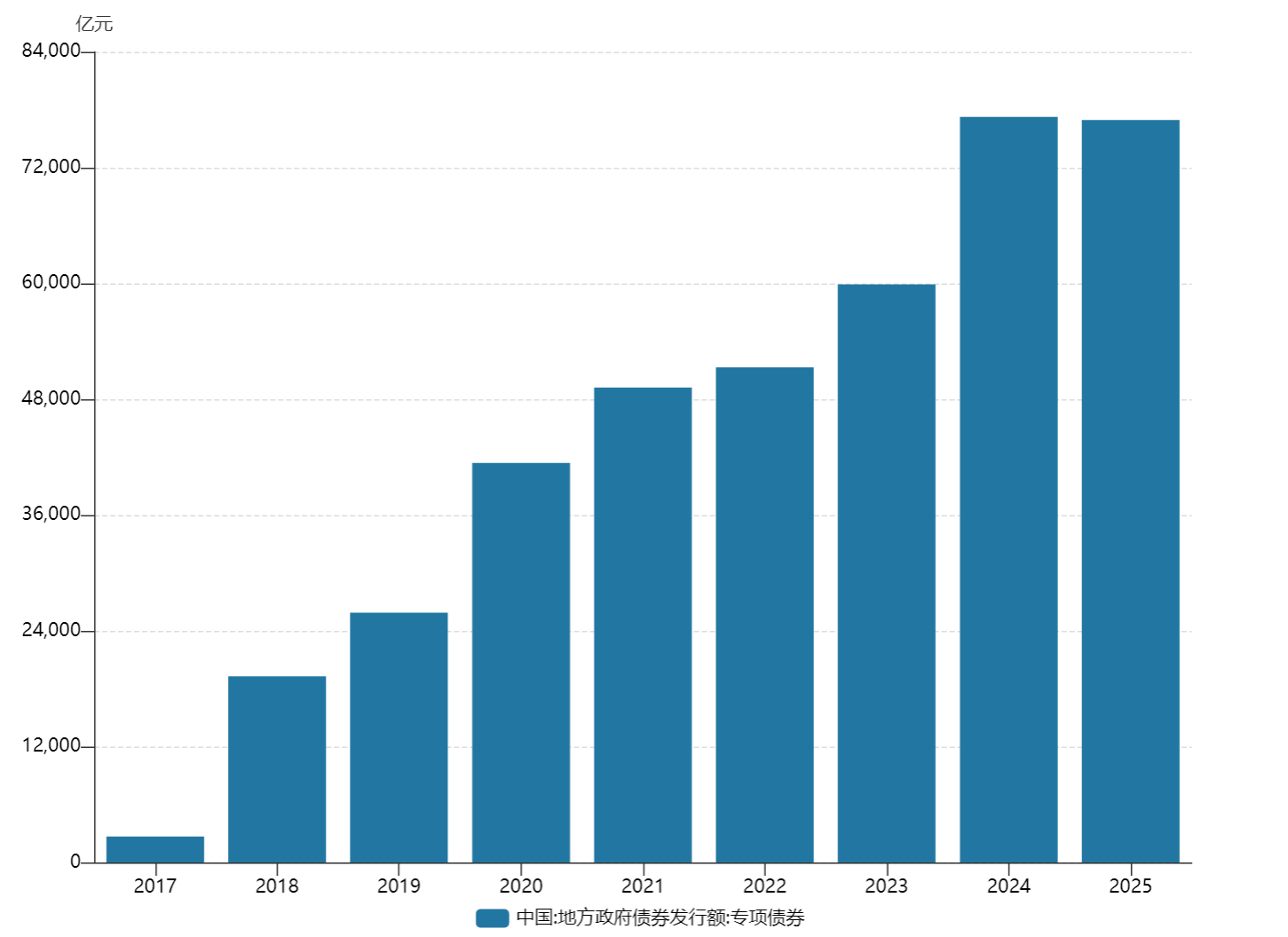
Core Viewpoint - The construction materials industry is experiencing a sustainable growth momentum due to unprecedented debt resolution actions, which are expected to improve market expectations and drive investment recovery in infrastructure and real estate sectors [1] Fiscal Perspective - The current debt resolution measures, including debt swaps and the expansion of special bonds, have systematically alleviated liquidity constraints for local governments, improving fiscal space for infrastructure investments [1] - Special bonds issued by local governments have been increasing annually since 2017, with projections for 2024 and 2025 to exceed 7 trillion yuan, and the total issuance in 2025 expected to surpass 10 trillion yuan for the first time in history [1][4] Infrastructure Investment - The issuance of special bonds is expected to lead to a significant increase in construction activity in transportation, municipal, and water conservancy sectors, with a projected surge in physical work volume in the first half of 2025 [4][6] - Despite a decline in infrastructure investment growth, the sector still holds a significant share of fixed asset investment, indicating its critical role in the overall economy [4] Policy Transition - The policy environment is shifting from "debt replacement" to "investment stimulation," which is likely to further enhance demand for construction materials [5] Demand Dynamics - The demand structure for construction materials is changing, with traditional materials benefiting from infrastructure support and renovation materials gaining from the demand for upgrading existing properties [6] - The dual drivers of infrastructure and real estate are expected to provide a solid foundation for the construction materials sector during this debt resolution cycle [6] Profitability and Market Outlook - The profitability of the cement industry is recovering, with expectations of improved margins due to supply-side adjustments and a favorable demand outlook from real estate policies [8] - The construction materials sector is characterized by high cash flow and potential for stable dividends, with forecasts indicating overall profit recovery by 2026 [8] Investment Opportunities - The construction materials ETF (159745) tracks the performance of the construction materials index, providing investors with a tool to efficiently allocate resources in the sector [8][11] - The sector is viewed as a core cyclical investment opportunity, especially in the context of a market shift towards undervalued, high-dividend stocks [11]


中国财政资金支出结构悄然生变:更多资金投资于人 基建支出下滑明显
Di Yi Cai Jing· 2026-02-10 05:57
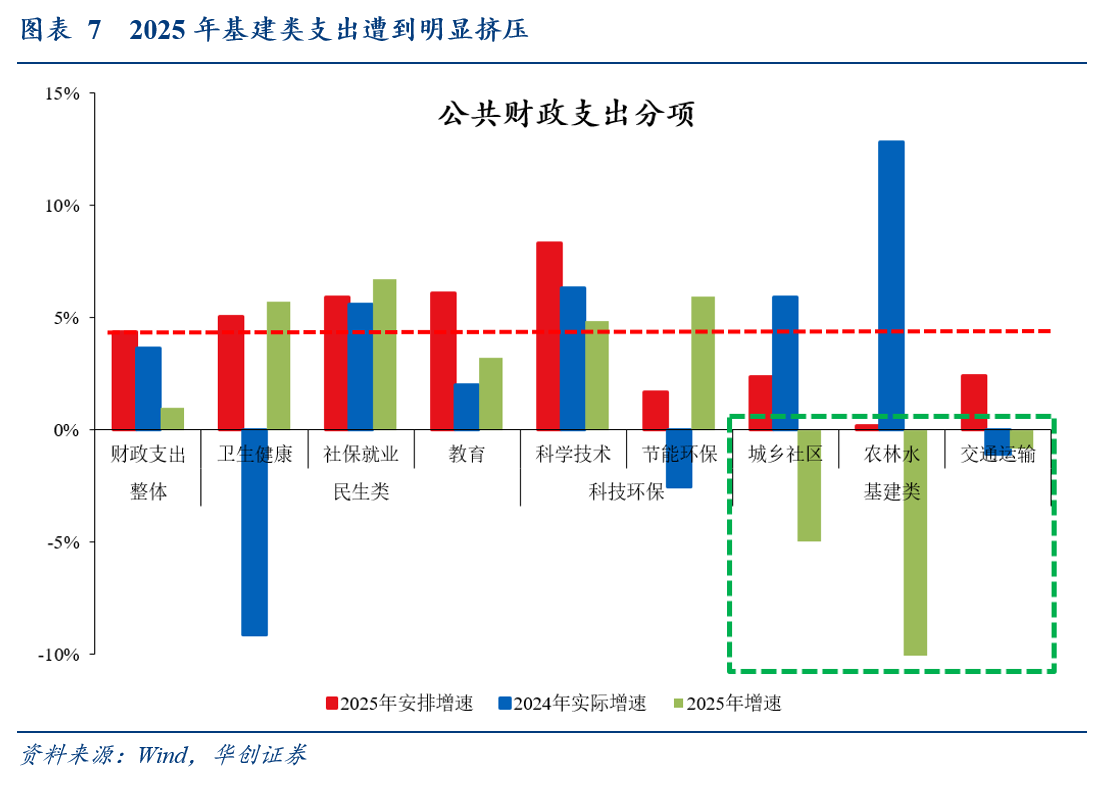
Core Insights - China's fiscal spending structure is shifting towards human investment, with a notable decline in infrastructure spending in 2024 [1] - The government is focusing on resolving existing hidden debts, leading to a reduction in new funds for infrastructure projects [5] - The decline in infrastructure investment marks the first annual negative growth since detailed statistics began in 2004 [5] Fiscal Spending Trends - In 2025, key infrastructure-related expenditures such as agricultural, urban community, and transportation spending are projected to decrease by 13.2%, 5%, and 0.7% respectively, resulting in an overall decline of approximately 7.8% compared to 2024 [1] - The total fixed asset investment in 2025 is estimated at 48.5 trillion yuan, a decrease of 3.8% year-on-year, with infrastructure investment (excluding certain utilities) down by 2.2% [5] Debt and Investment Dynamics - The new special bond limit for 2025 is set at 4.4 trillion yuan, with only 2.5 trillion yuan allocated for infrastructure, a reduction of over 400 billion yuan from 2024 [5] - The focus on debt resolution and the decline in land transfer income are contributing to a shortage of funds for infrastructure projects [6] Future Outlook - For 2026, infrastructure investment is expected to rebound, with a projected growth rate of 8% due to the initiation of major projects and increased central budget investments [9] - Analysts predict a "bottoming out and structural reshaping" of infrastructure investment, with growth rates potentially returning to a range of 3% to 4.5% [10] - Central government support for infrastructure investment is anticipated to play a crucial role in stabilizing the economy in 2026, with some institutions forecasting a growth rate of 4.5% [11]
施策重点明晰 促进有效投资将打出组合拳
Zhong Guo Zheng Quan Bao· 2026-02-08 20:22
Group 1 - The State Council meeting emphasized the need to enhance effective investment through various financial tools, including central budget investments, long-term special bonds, and local government bonds [1][2] - The introduction of new policy financial tools has significantly supported over 2,300 projects with a total investment of approximately 7 trillion yuan, indicating a strong investment drive [1][2] - The National Development and Reform Commission (NDRC) has outlined plans for 2026, including a list of major construction projects and a central budget investment plan totaling around 295 billion yuan [2] Group 2 - The meeting highlighted the importance of planning major projects in key sectors such as infrastructure, urban renewal, public services, and emerging industries to stimulate effective investment [2][3] - Local governments are actively responding to the call for stabilizing investment, with specific measures to enhance industrial and livelihood investments, as well as new infrastructure projects [3] - The focus for 2026 includes a rebound in infrastructure investment driven by government initiatives, which is expected to support the overall investment growth [4] Group 3 - Experts predict that the investment growth rate will recover in 2026, driven by comprehensive policy measures aimed at promoting effective investment [4] - The emphasis will be on government-led infrastructure investments, manufacturing upgrades, and stabilizing the real estate market to foster economic growth [4] - The coverage of new policy financial tools is expected to shift towards emerging industries, further stimulating technology innovation investments [4]
热卷日报:震荡偏弱-20260205
Guan Tong Qi Huo· 2026-02-05 11:09
Report Industry Investment Rating - The report gives a short - term cautious and bullish rating on hot - rolled coils [6] Core Viewpoints - The hot - rolled coil futures market is oscillating weakly, with supply relatively stable and demand showing strong resilience despite a decline due to the approaching Spring Festival. The total inventory is at a high level mainly because of high - level social inventory, and there is still inventory pressure. Attention should be paid to the resumption of manufacturing operations after the Spring Festival and the inventory depletion speed [6] Summary by Directory 1. Market Review - **Futures Price**: On Thursday, the open interest of the main hot - rolled coil futures contract increased by 11,934 lots, and the trading volume was 283,875 lots, a decrease compared to the previous trading day. The intraday low was 3255 yuan, the high was 3278 yuan, and the market was oscillating weakly. In the short - term, it fell below the 5 - day, 30 - day, and 60 - day moving average lines, closing at 3263 yuan/ton, a decrease of 13 yuan or 0.40% [1] - **Spot Price**: The price of hot - rolled coils in Shanghai, a mainstream area, was reported at 3260 yuan/ton, a decrease of 10 yuan compared to the previous trading day [2] - **Basis**: The basis between futures and spot was - 3 yuan [3] 2. Fundamental Data - **Supply**: As of February 5, the weekly output of hot - rolled coils decreased by 0.05 million tons to 3.0916 million tons week - on - week and decreased by 11.03 million tons year - on - year. The current output is at a moderately high level in recent years, indicating that steel mills maintain a high production pace before the Spring Festival and production enthusiasm has increased [4] - **Demand**: As of February 5, the weekly apparent consumption decreased by 5.87 million tons to 3.0554 million tons week - on - week and decreased by 8.11 million tons year - on - year. Affected by the Spring Festival shutdown, the demand of downstream manufacturing industries has declined, but it is still at a relatively high level in recent years and shows certain resilience [4] - **Inventory**: As of February 5, the total inventory increased by 3.62 million tons to 3.592 million tons week - on - week (social inventory increased by 2.12 million tons week - on - week, and steel mill inventory increased by 1.5 million tons). The pressure is concentrated in social inventory, and the steel mill inventory is controllable, indicating inventory backlog in the distribution link and insufficient willingness of downstream buyers to purchase [4] - **Policy**: The new regulations on the export license management of steel products will cause short - term export fluctuations, increase supply, and put pressure on prices. In the long term, it will promote industrial upgrading, structural optimization, and competitiveness improvement. The central economic meeting in December proposed a proactive fiscal policy and a moderately loose monetary policy, which is beneficial to prices and industry profits, and efforts will be made to stabilize the real estate market and expand domestic demand [4][5] 3. Market Driving Factor Analysis - **Bullish Factors**: Supply contraction, demand resilience, and policy support (the 14th Five - Year Plan, infrastructure investment) [6] - **Bearish Factors**: Unexpected resumption of production by steel mills, seasonal weakening of demand, insufficient manufacturing orders, and inventory accumulation suppressing prices [6] 4. Short - term View Summary - The hot - rolled coil futures decreased in volume today. Short - term pressure is near the 30 - day moving average, and the lower support is the previous low. Adopt a cautious and bullish approach. Currently, the supply is relatively stable, and although the demand has declined mainly due to the approaching Spring Festival, it still shows strong resilience. The total inventory is at a high level mainly due to high social inventory pressure, and inventory pressure still exists. Attention should be paid to the resumption of manufacturing operations after the Spring Festival and the inventory depletion speed [6]
基建产业链集体狂飙!工程机械ETF富国(516250)、机械ETF(159886)、建材ETF(516750)盘中集体涨超3%
Sou Hu Cai Jing· 2026-02-03 07:45
Group 1 - The core viewpoint is that the infrastructure industry chain is experiencing a significant increase in prosperity due to ongoing "stabilizing growth" policies, leading to a new round of large-scale equipment updates [1] - As of February 3, engineering machinery ETFs (516250), machinery ETFs (159886), and building materials ETFs (516750) have all seen notable gains, with increases of 6.02%, 3.76%, and 3.29% respectively, indicating a clear recovery trend [1] - Since 2026, the pace of major transportation, energy, water conservancy, and municipal engineering projects has accelerated, enhancing expectations for physical workload formation [1] Group 2 - Support policies for industrial equipment updates, renovation of old production lines, and domestic substitution of high-end equipment are continuously being implemented, creating new demand space for the machinery equipment industry [1] - The dual drive of "infrastructure investment support + manufacturing equipment upgrade and expansion" is becoming the core logic for improving expectations in the sector [1] - Research institutions believe that the engineering machinery industry is likely to experience a resonance of domestic demand recovery and renewal cycles, while the building materials sector is expected to benefit from improved demand due to the recovery of project commencement [1]
基建投资、设备更新联袂发力!双重利好催化工程机械ETF富国(516250)盘中涨近6%
Mei Ri Jing Ji Xin Wen· 2026-02-03 06:53
Core Viewpoint - The engineering machinery sector is expected to gradually recover due to the acceleration of major project implementations since 2026, with significant demand anticipated [1] Group 1: Market Performance - On February 3, the engineering machinery sector showed active performance, with the engineering machinery ETF (516250) rising nearly 6% during intraday trading, and the latest increase reported at 5.73% [1] - Key constituent stocks such as Yanmeng Technology, Weichai Power, HuoDuan Intelligent, Guangli Technology, and Liande Co. experienced substantial gains, reflecting a recovery supported by policies and market conditions [1] Group 2: Industry Outlook - Research institutions believe the engineering machinery industry is currently in an upward phase from the cycle bottom, driven by equipment replacement demand, policy support for infrastructure investment, and companies' cost reduction and efficiency improvement efforts [1] - Although short-term performance may still be influenced by seasonal factors, the medium-term outlook indicates a clearer trend of improvement in the industry's fundamentals, suggesting that the sector's valuations have room for recovery [1] Group 3: Investment Tools - The engineering machinery ETF (516250) closely tracks the engineering machinery thematic index, covering representative companies across the entire industry chain, including complete machine manufacturing and core components [1] - In the context of strengthened investment expectations and marginal recovery in industry prosperity, this ETF provides a convenient tool for investors to participate in cyclical opportunities within the engineering machinery sector [1]
热卷日报:震荡偏弱-20260127
Guan Tong Qi Huo· 2026-01-27 09:51
1. Report Industry Investment Rating - The short - term view maintains a bullish stance [6] 2. Core View of the Report - The current supply of hot - rolled coils is contracting, while the demand side shows resilience, with the overall supply - demand in a tight balance. Pre - holiday winter stockpiling is an important support for current demand. The social inventory of the total inventory is decreasing month - on - month, and the pressure on mill inventory is controllable. The overall inventory risk is marginally improving but still relatively high year - on - year. Attention should be paid to the impact of the post - holiday resumption of work and production on supply and demand. The supply - demand tight balance and inventory reduction support prices, and subsequent attention should be paid to raw material costs and the strength of post - holiday demand recovery. Currently, the macro - economic easing expectations and pre - holiday weak demand are in a tug - of - war, with cautious market sentiment and low volatility [6] 3. Summary by Relevant Catalogs Market行情回顾 - **Futures price**: On Tuesday, the open interest of the main hot - rolled coil futures contract decreased by 6,369 lots, with a trading volume of 288,700 lots, a decrease compared to the previous trading day. The intraday low was 3,283 yuan, and the high was 3,306 yuan. It showed a weak intraday oscillation. In terms of the daily moving average, it briefly fell below the 5 - day moving average in the short term, but found support near the 30 - day moving average, closing at 3,289 yuan/ton, a decrease of 2 yuan or 0.60% [1] - **Spot price**: The price of hot - rolled coils in the mainstream Shanghai area was reported at 3,290 yuan/ton, a decrease of 10 yuan compared to the previous trading day [2] - **Basis**: The spot - futures basis was 1 yuan, basically at par [3] Fundamental Data - **Supply side**: As of January 22, the weekly output of hot - rolled coils decreased by 29,500 tons month - on - month to 3.0541 million tons, and decreased by 172,300 tons year - on - year. The output decline may be affected by factors such as maintenance schedules and profit fluctuations, which supports prices [4] - **Demand side**: As of January 22, the weekly apparent consumption decreased by 42,000 tons month - on - month to 3.0996 million tons, and increased by 73,900 tons year - on - year. Although demand declined slightly month - on - month, it maintained year - on - year growth. Pre - holiday stockpiling supported demand, and overall demand showed strong resilience [4] - **Inventory side**: As of January 22, the total inventory decreased by 45,500 tons week - on - week to 3.5778 million tons (social inventory decreased by 46,600 tons week - on - week, and mill inventory increased by 1,100 tons), and increased by 212,700 tons year - on - year (social inventory increased by 241,800 tons year - on - year, and mill inventory decreased by 29,100 tons year - on - year). The total inventory decreased month - on - month, and the inventory pressure was marginally relieved. The year - on - year increase indicated that the inventory accumulation rate this year was slightly faster than last year, but the overall risk was controllable [4] - **Policy side**: The new regulations on the export license management of steel products will cause short - term fluctuations in exports, increase supply, and put pressure on prices. In the long term, it will promote industrial upgrading, structural optimization, and competitiveness improvement. The Central Economic Work Conference in December proposed a proactive fiscal policy and a moderately loose monetary policy, and listed the in - depth rectification of involution - style competition as a key task for 2026, which is beneficial to prices and industry profitability. Efforts are being made to stabilize the real estate market and expand domestic demand [5] Market Driving Factor Analysis - **Bullish factors**: Decrease in supply - side output, expectation of winter stockpiling demand, export rush market, policy support ("the 14th Five - Year Plan", infrastructure investment), and strong iron ore as furnace feed [6] - **Bearish factors**: Unexpected resumption of production by steel mills in January, seasonal weakening of demand, insufficient manufacturing orders, and inventory accumulation suppressing prices [6]
基建投资加速下滑,交通投资环比恶化
Changjiang Securities· 2026-01-27 06:22
Investment Rating - The industry investment rating is "Positive" and maintained [9] Core Insights - In December 2025, narrow infrastructure investment decreased by 11.4%, with a month-on-month decline of 1.7 percentage points. Broad infrastructure investment fell by 9.5%, with a month-on-month decline of 1.2 percentage points. For the entire year, narrow infrastructure investment declined by 2.2%, with a month-on-month decline of 1.1 percentage points, while broad infrastructure investment grew by 0.6%, with a month-on-month growth rate decrease of 1.2 percentage points [2][6][12] - Investment across various sectors showed a downward trend in December, particularly in transportation, where the investment growth rate significantly declined. Specifically, power sector investment fell by 3.7%, transportation sector investment dropped by 12.7%, railway investment decreased by 30.0%, and road transport investment declined by 18.4%. Water conservancy investment fell by 26.6%, with management investment down by 36.4%, and public facility management investment decreased by 25.3% [12] - Cement production data indicated a continued decline in physical workload, with December cement output down by 6.6% year-on-year and a total decline of 6.9% for the year. The national cement dispatch volume from January 7 to January 13 was 2.645 million tons, a month-on-month decrease of 2.7% and a year-on-year decrease of 1.6% [12] - Looking ahead to 2026, infrastructure investment may show resilience due to coordinated fiscal efforts. The National Development and Reform Commission has initiated a list of major construction projects and a central budget investment plan totaling approximately 295 billion yuan, aimed at accelerating fund allocation and usage [12] Summary by Sections - **Investment Performance**: December saw a significant drop in narrow and broad infrastructure investments, with respective declines of 11.4% and 9.5% [2][6] - **Sector Analysis**: All sectors experienced a decline in investment, with transportation and water conservancy sectors showing the most significant drops [12] - **Physical Workload Trends**: Cement production and dispatch volumes continued to decline, indicating a weak physical workload in the construction sector [12] - **Future Outlook**: Anticipated resilience in infrastructure investment for 2026, supported by government initiatives and major project approvals [12]