
恩格尔系数

Search documents
2025年全国居民人均可支配收入43377元
Ren Min Ri Bao· 2026-01-19 02:21
Core Viewpoint - The National Bureau of Statistics projects that the per capita disposable income of residents nationwide will reach 43,377 yuan in 2025, reflecting a nominal growth of 5.0% year-on-year, with a real growth of 5.0% after adjusting for price factors [1] Income Distribution - Urban residents' per capita disposable income is expected to be 56,502 yuan, with a nominal growth of 4.3% and a real growth of 4.2% year-on-year [1] - Rural residents' per capita disposable income is projected at 24,456 yuan, showing a nominal growth of 5.8% and a real growth of 6.0% year-on-year [1] - The median per capita disposable income for all residents is estimated at 36,231 yuan, with a nominal growth of 4.4% year-on-year [1] - Income distribution across five groups shows: low-income group at 10,150 yuan, lower-middle-income group at 22,702 yuan, middle-income group at 35,536 yuan, upper-middle-income group at 55,586 yuan, and high-income group at 103,778 yuan [1] Consumption Expenditure - The average per capita consumption expenditure for residents is projected to be 29,476 yuan, with a nominal growth of 4.4% and a real growth of 4.4% year-on-year [1] - The Engel coefficient, representing the proportion of food, tobacco, and alcohol expenditure in total consumption, is expected to be 29.3%, a decrease of 0.5 percentage points from the previous year [1] - Per capita expenditure on services is anticipated to grow by 4.5%, maintaining a share of 46.1% in total consumption expenditure compared to the previous year [1]
去年全年全国居民人均可支配收入43377元
Xin Jing Bao· 2026-01-19 02:13
Core Viewpoint - The report highlights the economic performance of China in 2025, focusing on the growth of disposable income and consumption among residents, indicating a stable economic environment with positive growth rates across different income groups [1] Income Distribution - The national per capita disposable income reached 43,377 yuan, reflecting a nominal growth of 5.0% and a real growth of 5.0% after adjusting for price factors [1] - Urban residents had a per capita disposable income of 56,502 yuan, with a nominal growth of 4.3% and a real growth of 4.2% [1] - Rural residents reported a per capita disposable income of 24,456 yuan, showing a nominal growth of 5.8% and a real growth of 6.0% [1] - The median per capita disposable income for all residents was 36,231 yuan, with a nominal increase of 4.4% [1] - Income distribution among five groups showed low-income households with 10,150 yuan, lower-middle-income with 22,702 yuan, middle-income with 35,536 yuan, upper-middle-income with 55,586 yuan, and high-income households with 103,778 yuan [1] Consumption Patterns - The average per capita consumption expenditure for residents was 29,476 yuan, with a nominal growth of 4.4% and a real growth of 4.4% after adjusting for price factors [1] - The Engel coefficient, which measures the proportion of food, tobacco, and alcohol in total consumption, was 29.3%, a decrease of 0.5 percentage points from the previous year [1] - Per capita expenditure on services grew by 4.5%, maintaining a share of 46.1% in total consumption expenditure compared to the previous year [1]
日本家庭恩格尔系数达29.4%
日经中文网· 2025-12-31 06:57
Core Viewpoint - Japan's Engel coefficient has reached a record high of 29.4% in Q3 2025, indicating a significant burden on food spending amidst persistent food inflation [2][5][7]. Group 1: Engel Coefficient and Food Inflation - The Engel coefficient for Japan in Q3 2025 is 29.4%, the highest since the current standard was adopted in 2000, with a moving average of 28.4% for the last four quarters [2][5]. - Japan's Engel coefficient was already the highest among G7 countries in 2024, with the lowest being around 16% in the United States, indicating a stark difference in food spending [7][9]. - Food prices in Japan have shown a year-on-year increase of around 6%, with specific items like chocolate and coffee beans experiencing significant price hikes due to high import costs [7][9]. Group 2: Household Financial Pressure - Real wages in Japan have seen negative growth for ten consecutive months as of October 2025, exacerbating financial pressure on households [9][10]. - The average proportion of disposable income spent on food for households of two or more was nearly 19% from January to October 2025, higher than previous years [9][10]. - Households are reaching their limits in cutting food spending, indicating a need for a shift in strategy to manage overall expenses [10][11]. Group 3: Strategies for Financial Management - Households are encouraged to reassess fixed expenditures such as housing, communication, and insurance to find areas for potential cuts [11]. - Despite ongoing wage increases, concerns about corporate salary adjustments have risen, potentially leading to stagnation in salary growth [11]. - Families are advised to explore various strategies, including job changes, to cope with inflationary pressures [11].


探访寒潮下的菜篮子:供应充足,价格不会暴涨
Qi Lu Wan Bao· 2025-12-12 10:42
Core Viewpoint - The article discusses the impact of a cold wave and rising CPI on vegetable prices in Jinan and North China, highlighting the current stability in vegetable prices despite potential future increases due to transportation costs and supply fluctuations [1][3]. Group 1: Current Market Conditions - The vegetable market in Jinan is currently characterized by stable prices and sufficient supply, with consumers purchasing more durable vegetables like cabbage, radishes, and potatoes [1]. - Local sources are supporting the market, with minimal reliance on external supplies, and merchants are following a "daily procurement, daily sales" model without stockpiling [1]. - Major supermarkets have not yet announced price adjustments and will respond dynamically to market conditions following the cold wave [1]. Group 2: Price Stability and Government Measures - Prices for perishable vegetables remain stable, with examples such as spinach at 3 yuan per jin, coriander at 5 yuan per jin, and celery at 2 yuan per jin, indicating limited expected price increases even with rising transportation costs [3]. - The Jinan Agricultural and Rural Bureau has proactively addressed potential challenges by implementing measures for agricultural facility safety and emergency heating to ensure vegetable supply stability [3]. Group 3: Economic Analysis - Professor Zhu Jin from Jinan University explains that vegetable price volatility significantly impacts the CPI due to the strong consumer demand and limited substitutes, despite vegetables only accounting for 2% of the CPI [4]. - The food category constitutes about 20% of the CPI, meaning significant increases in vegetable prices can elevate the overall food index and subsequently the CPI [4]. - Zhu notes that urban residents' increasing income levels have led to a decrease in the Engel coefficient, allowing for better resilience against seasonal vegetable price fluctuations through alternative product choices [6]. Group 4: Government Response and Future Outlook - The current situation is seen as a routine test of Jinan's emergency supply capabilities, with the government emphasizing the importance of the "vegetable basket" project and having mature emergency plans to mitigate short-term price volatility [6].

下降的恩格尔系数、上升的餐饮消费
Di Yi Cai Jing· 2025-10-29 12:32
Group 1 - The core viewpoint emphasizes the importance of boosting consumption, particularly service consumption, as a key strategy for promoting domestic and international dual circulation in China's economy post-COVID-19 [1][20] - The 2023 Central Economic Work Conference highlighted the need to cultivate and expand new types of consumption, with a focus on service consumption and cultural tourism development [1] - The 2025 government work report includes the implementation of special actions to boost consumption, indicating a long-term commitment to enhancing service consumption [1] Group 2 - The life service industry in China encompasses 13 sectors and 288 sub-sectors, with the catering industry being the most frequented by residents, indicating a significant area for service consumption growth [2] - The catering industry is expected to experience stable and rapid high-quality development, driven by increasing consumer demand as China transitions to a middle-income country [2] - The aging population in China is predicted to increase the likelihood of dining out, further expanding the market for the catering industry [2] Group 3 - Economic theory suggests that as residents' income rises, the Engel curve should decline, but recent data shows an increase in the Engel coefficient post-pandemic [3] - Analysis of 31 provinces indicates that food and beverage consumption as a share of total spending is decreasing in most regions, aligning with rising GDP [4] Group 4 - As income levels rise, the structure of consumer spending is shifting from goods to services, with service consumption as a percentage of disposable income showing an upward trend [6] - External dining is a reflection of economic development, indicating that residents are willing to spend on high-quality dining experiences [8][10] Group 5 - The rapid increase in dining expenses is evident, with significant fluctuations observed in the restaurant industry's revenue from 2008 to 2023, influenced by the elasticity of substitution with home dining [11] - The price of dining out has risen significantly compared to the overall Consumer Price Index (CPI), indicating a thriving restaurant industry [13] Group 6 - The ratio of per capita dining expenses to food and beverage spending has shown an upward trend, particularly in major cities like Beijing and Shanghai, highlighting the impact of income and urban factors on dining out [17] - The 20th Central Committee emphasized the need to expand domestic demand and boost consumption, particularly in service sectors like dining, which directly affects public satisfaction and quality of life [20]
“十四五”以来广东民生发展主要情况出炉 去年广东城镇居民人均可支配收入超6万元
Guang Zhou Ri Bao· 2025-10-15 08:01
Core Insights - The report highlights significant growth in disposable income and consumption expenditure for residents in Guangdong, indicating a positive trend in economic development and living standards [1][2][3] Income and Consumption - In 2024, the per capita disposable income for all residents in Guangdong is projected to exceed 50,000 yuan, with an annual growth rate of 5.8% [1] - Urban residents' per capita disposable income is expected to reach 61,629 yuan, growing at 5.2% annually, while rural residents' income is anticipated to be 26,729 yuan, with a higher growth rate of 7.3% [2] - The per capita living consumption expenditure for all residents is forecasted to be 35,818 yuan, with an annual increase of 5.9% [2] - Urban residents' consumption expenditure is projected at 41,055 yuan, growing at 5.2%, while rural residents' expenditure is expected to be 23,057 yuan, with a growth rate of 7.7% [2] - The income disparity between urban and rural residents has decreased, with the ratio of per capita disposable income dropping from 2.49 in 2020 to 2.31 in 2024 [2] Employment and Agricultural Production - The employment situation remains stable, with over 1.3 million new urban jobs created annually since the start of the 14th Five-Year Plan, and over 1.43 million expected in 2024 [3] - The urban unemployment rate is consistently maintained below 5.5%, which is lower than the national average [3] - Agricultural production has seen increases in sown area, yield, and total output, with grain sown area reaching 33.55 million acres, a 1.5% increase from 2020 [3] - The total grain output is projected at 13.134 million tons, reflecting a 3.6% increase from 2020 [3] - Key crops such as rice, sweet potatoes, and corn have shown significant production growth, with rice output at 11.236 million tons, a 2.2% increase from 2020 [3]
恩格尔系数稳定降至30%以下,第三产业就业人员占比近半专家解读:最新社会民生统计报告有何深意?
Mei Ri Jing Ji Xin Wen· 2025-09-28 15:07
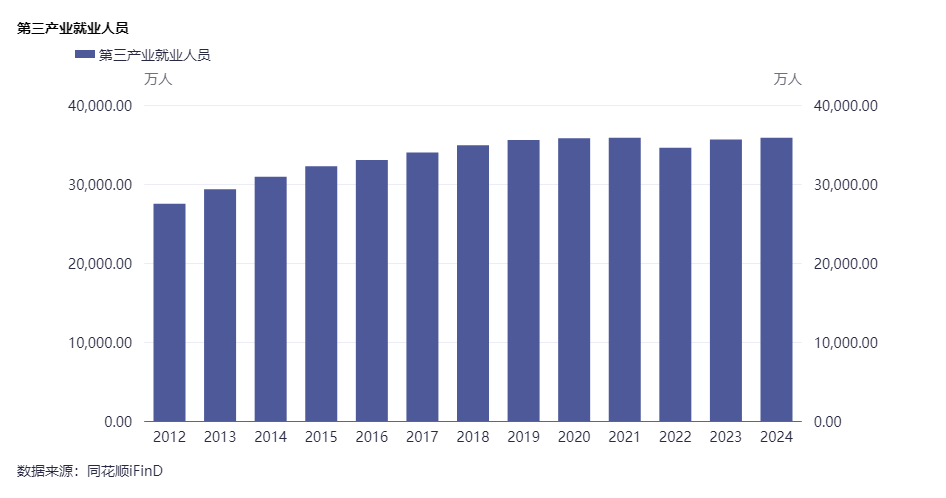
Core Insights - The report released by the National Bureau of Statistics indicates an optimization and upgrading of China's consumption structure, with the Engel coefficient decreasing from 30.2% in 2020 to 29.8% in 2024, reflecting a shift from survival-type to development-type consumption [1][2][6] - The average annual growth rate of development-type consumption expenditures, including education, culture, entertainment, transportation, communication, and healthcare, is projected to be 10.0% from 2021 to 2024, while service consumption expenditures are expected to grow at an average annual rate of 9.5%, outpacing goods consumption by 3.8 percentage points [1][6] Economic Growth Implications - The optimization of consumption structure is expected to enhance economic stability by smoothing economic fluctuations and expanding growth space, particularly in the service and development consumption sectors [6][8] - The proportion of employment in the tertiary industry is projected to increase, with 35.866 million people employed in this sector by the end of 2024, representing 48.8% of total employment, an increase of 1.1 percentage points from 2020 [3][6] Income Distribution and Growth - By the end of 2024, the national per capita disposable income is expected to reach 41,314 yuan, an increase of 9,125 yuan from 2020, with an average annual real growth rate of 5.5% from 2021 to 2024 [9][11] - Rural residents' per capita disposable income is projected to grow at a faster rate than urban residents, with a real growth rate of 6.9% compared to 4.5% for urban residents [9][11] Consumption Trends - The report highlights a significant increase in consumption expenditures among rural residents, particularly in poverty alleviation counties, where per capita disposable income is expected to rise from 12,588 yuan in 2020 to 17,522 yuan in 2024, with an average annual real growth rate of 7.8% [11][12] - The consumption structure in these areas is also evolving, with per capita consumption expenditures expected to increase from 10,758 yuan in 2020 to 15,138 yuan in 2024, reflecting a shift towards development-type consumption [12] Employee Benefits and Pension Growth - By the end of 2024, the number of employees participating in enterprise annuities is projected to reach 32.42 million, with the accumulated fund scale expected to grow to 36,422 billion yuan, marking increases of 19.3% and 61.9% respectively since 2020 [12][14]
滕泰:中国消费是不是全球第一,重要吗?
Di Yi Cai Jing· 2025-06-05 04:45
Core Viewpoint - The article argues that the notion of China being the world's largest consumer market based on selective product consumption data is misleading and does not reflect the true state of consumer capability and economic structure in China [1][6]. Consumption Data Analysis - Claims that China's consumption of pork, freshwater fish, cars, and air conditioners surpasses that of the U.S. are based on selective data, ignoring the overall consumption capacity and economic context [1][2]. - China's Engel's coefficient stands at 28.4%, indicating that a significant portion of household spending is still on basic needs, unlike the U.S. at 7.3%, which reflects a more developed consumption structure [2][6]. Economic Structure and Consumer Capability - The article emphasizes that comparing consumption based on specific products like pork and fish is flawed, as it does not account for income levels and overall spending power [1][4]. - The disparity in income levels between China and the U.S. suggests that China's lower wages directly impact its consumption capacity, making it inappropriate to use purchasing power parity without considering these factors [4][5]. Misleading Comparisons - The article critiques the use of purchasing power parity as a basis for comparison, highlighting its core flaw of not considering wage and income level differences [3][4]. - It questions the validity of claims that China's retail sales can be inflated to match or exceed those of the U.S. based on simplified currency comparisons [3][4]. Policy Implications - The article stresses the need for effective measures to increase residents' income and stimulate consumption rather than engaging in debates about being the largest consumer market [6]. - It highlights that addressing the challenges of low consumer capability and income disparity is crucial for China's economic transformation in the coming decade [6].
物价低得令人发指,人民币购买力超强
集思录· 2025-04-25 13:48
坐标上海: 蔬菜:生菜0.8元1斤,茼蒿菜2元一大把,香菜4元一斤,萝卜1元 水果:刚上市的西瓜3.5元一斤,鸡蛋芒果10元3斤,大水仙芒果才6.8元 对于发达国家,绿叶菜等那可是奢侈品,一般老百姓吃不起,在荷兰茼蒿卖8欧元1公斤,在 日本萝卜10元一斤,苹果15元1个,西瓜150~200元一个 对于中国人民,蔬菜和水果是完全自由的,想吃多少吃多少,如果把收入换算成蔬菜和水 果,上海等沿海地区人民的收入应该是全世界第一了吧。 这么低的物价,如此强的购买力,近一个月人民币相对于欧元/日元居然跌了10%,不可思 议! 说不出的YD 中国不只蔬菜便宜,还有肉蛋奶、汽车、汽油、教育、养老、医疗、房租,几乎所有的消费 都比世界平均价格低了很多很多,房子不便宜但房租便宜,可以看看蓝战非环游世界时各国 的消费。 但很多人偏偏要每一项都要和世界最低价格比,幸福指数是和想象里的发达国家比,其实人 家的苦自己知道。14亿人过成这样,安全、饿不死、都能用劳动换来生存,我不认为换任何 别的国家能做到。 chenyun1979 如果你月入3000元,还觉得3.5元1斤的西瓜便宜吗?如果你已失业,你还舍得吃6.8元1斤的 芒果吗?看社会 ...