战略安全

Search documents
一基揽尽有色金属行业龙头!有色龙头ETF规模突破5亿元!
Xin Lang Ji Jin· 2025-10-12 12:35
Core Insights - The article discusses the impact of macroeconomic factors on various commodities, highlighting the strategic importance of metals like gold, rare earths, tungsten, and tin in the context of global geopolitical tensions and monetary policy shifts [3]. Group 1: Macroeconomic Drivers - The article emphasizes that the Federal Reserve's interest rate cuts are leading to increased monetary competition among countries, which is expected to influence commodity prices [3]. - Geopolitical disturbances are driving demand for safe-haven assets, particularly gold, as countries navigate through global uncertainties [3]. Group 2: Supply and Demand Dynamics - The supply-demand landscape for industrial metals such as copper and aluminum is evolving, with emerging industries expected to release significant demand for lithium, diamonds, and nickel [3]. - There is a collective expectation among global nations for policy support to stabilize and enhance the supply-demand balance in the commodities market [3].

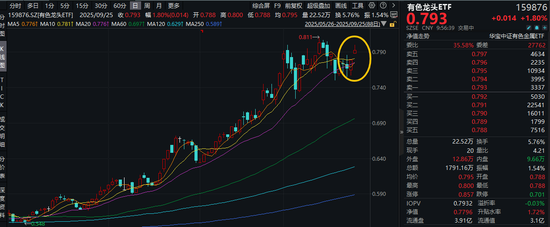
铜业重磅!全球第二大铜矿,因事故停产!洛阳钼业登顶A股吸金榜,有色龙头ETF(159876)跳空大涨2.7%
Xin Lang Ji Jin· 2025-09-25 02:13
Core Viewpoint - The non-ferrous metal sector is leading the market, with the non-ferrous metal ETF (159876) experiencing a significant jump, reflecting strong performance since its low point in April 2023, outperforming major indices like the Shanghai Composite and CSI 300 [1][3] Group 1: Market Performance - The non-ferrous metal ETF (159876) saw a peak intraday increase of 2.7% and is currently up 1.8% [1] - Since the low on April 8, 2023, the ETF has risen by 55.21%, significantly outperforming the Shanghai Composite (24.45%) and CSI 300 (27.21%) [1] - The top six constituents of the CSI Non-Ferrous Metal Index are all copper industry leaders, with notable gains from Northern Copper and Luoyang Molybdenum [1][3] Group 2: Supply and Demand Dynamics - A landslide at the Grasberg copper mine, the world's second-largest, has halted production, with Freeport estimating a 35% drop in copper and gold output for 2026 and a return to pre-accident production levels not expected until 2027 [3] - Short-term factors such as tariff suspensions and supply disruptions are expected to support copper prices, while long-term demand from home appliance subsidies and increased investment in power grids may further elevate price levels [3] Group 3: Investment Recommendations - Huabao Fund suggests increasing allocation to the non-ferrous sector, as the economic recovery's impact on cyclical goods has yet to be fully realized [3] - CITIC Construction anticipates that domestic policies aimed at optimizing production factors will enhance profitability across the supply chain, benefiting metal prices [3] Group 4: Sector Composition - The non-ferrous metal ETF (159876) and its linked funds provide diversified exposure to various metals, with copper, aluminum, rare earths, gold, and lithium comprising 25.3%, 14.2%, 13.8%, 13.6%, and 7.6% of the index, respectively [5]

新股王寒武纪:想象中的“大爆发” | 小白商业观
Jing Ji Guan Cha Wang· 2025-08-31 07:44
Core Viewpoint - The recent surge in Cambricon's stock price and market valuation reflects a broader market reassessment of domestic chip companies amid geopolitical tensions and national policies supporting AI and semiconductor industries [2][3]. Company Summary - Cambricon's stock price reached a peak of 1438 yuan per share, with a market capitalization exceeding 600 billion yuan, surpassing Kweichow Moutai to become the new "king of stocks" [2]. - The company reported a revenue of 2.881 billion yuan for the first half of 2025, a staggering increase of 4347.82% compared to 64.76 million yuan in the same period last year [3]. - Despite the impressive financial report, Cambricon has faced significant losses in previous years and relies heavily on a few large government and enterprise clients, raising concerns about its business model's resilience [5]. Industry Summary - The current valuation of domestic chip companies like Cambricon is influenced by national strategies aimed at reducing reliance on foreign technology and enhancing strategic security [3]. - The AI chip market is characterized by high capital requirements and significant challenges in commercializing technology, making it a "burning money" game [6]. - The industry faces a substantial gap in advanced manufacturing capabilities, particularly in critical equipment like photolithography machines, compounded by U.S. export controls that limit performance improvements [7]. - Building a robust software ecosystem is crucial for hardware success, as exemplified by NVIDIA's CUDA ecosystem, which presents a formidable barrier for new entrants [7]. - The Chinese AI chip industry, represented by companies like Cambricon, is at a critical juncture filled with uncertainties and challenges, necessitating a focus on sustainable growth rather than merely optimistic projections [6][7].


新股王寒武纪:想象中的“大爆发”
Jing Ji Guan Cha Wang· 2025-08-31 07:43
Core Viewpoint - The recent surge in Cambricon's stock price and market valuation reflects a broader market reassessment of domestic chip companies amid geopolitical tensions and national policies promoting AI and semiconductor industries [1][2]. Group 1: Company Performance - Cambricon reported a significant revenue increase of 4347.82%, reaching 2.881 billion yuan in the first half of 2025, compared to 64.76 million yuan in the same period last year [1]. - Despite the impressive financial report, Cambricon has faced substantial losses in previous years, indicating a volatile financial history [2][3]. - The company's business model heavily relies on a few major government and enterprise clients, raising concerns about its risk management capabilities [2]. Group 2: Industry Context - The global competition in the semiconductor industry has intensified, with the U.S. implementing the CHIPS and Science Act and China responding with various AI industry promotion policies [1]. - The domestic chip industry, including Cambricon, faces significant challenges in commercializing technology, particularly in achieving scale and building ecological barriers against established players like NVIDIA [3]. - The development of AI chips is characterized as a "money-burning" game, requiring continuous investment to catch up with international technology leaders, compounded by export controls from the U.S. that limit performance improvements [3][4]. Group 3: Future Outlook - The Chinese AI chip industry, represented by companies like Cambricon, is at a critical juncture filled with uncertainties and challenges, emphasizing the need for sustainable business models over grand narratives of explosive growth [4]. - Building a robust software ecosystem is essential for hardware success, as seen with NVIDIA's CUDA ecosystem, which presents a significant barrier for new entrants [3].
博弈145天后,李嘉诚态度转变,长和突发公告,与贝莱德谈判终止
Sou Hu Cai Jing· 2025-07-31 14:48
Group 1 - Li Ka-shing's company, CK Hutchison Holdings (长和), has decided to invite mainland Chinese strategic investors to join a consortium to take over its global port assets after a 145-day negotiation period with BlackRock-TiL ended [1][3] - The Chinese government had previously warned that the transaction parties must not evade antitrust reviews and must not implement concentration without approval, indicating a strong stance on maintaining national interests [3][5] - China COSCO Shipping Group (中远集团) is seeking to join the consortium, demanding equal shareholder status and a veto right in decisions related to Chinese shipping operations, which reflects a strategic move to protect national interests while ensuring commercial development [3][5] Group 2 - Li Ka-shing's shift is seen as a calculated risk hedge against geopolitical pressures, particularly concerning the Panama Canal, which handles 6% of global maritime trade and has faced U.S. security-related threats [5][7] - The introduction of Chinese capital is intended to demonstrate neutrality to both the U.S. and China, potentially providing operational flexibility for CK Hutchison while mitigating risks associated with U.S. sanctions [5][7] - The involvement of COSCO is strategically significant as it aims to safeguard shipping routes and counteract U.S. efforts to control port operations, thereby preserving China's energy and food supply chains [5][7] Group 3 - The deal's complexity is heightened by the need for approval across 12 global jurisdictions, with China's stance being a critical variable in the antitrust review process [7] - BlackRock's willingness to allow Chinese participation is a pragmatic approach to avoid the collapse of the transaction, as it still seeks to benefit from long-term operational gains through port management [7] - By integrating Chinese investment, CK Hutchison not only mitigates potential backlash regarding national interests but also retains commercial collaboration opportunities, while simultaneously reallocating funds towards technology and renewable energy sectors [7]


不给稀土就不访华?威胁中国的欧盟主席,转身“跪”在了美国面前
Sou Hu Cai Jing· 2025-07-21 04:10
Core Viewpoint - The strategic value of rare earth materials is increasingly highlighted amid the global reshaping of supply chains, with China transitioning from a resource supplier to a rule-maker and technology controller in the rare earth sector [3][6]. Group 1: China's Dominance in Rare Earths - China currently holds 92% of the global rare earth refining capacity and over 80% of deep processing technology patents, establishing a complete and efficient industrial chain with significant technical barriers [6][13]. - The implementation of the Rare Earth Management Regulations in April 2025 signifies a systematic upgrade in China's resource security strategy, altering Western perceptions of unlimited supply from China [5][6]. Group 2: Global Reactions and Challenges - In response to China's tightening export controls, the U.S. Department of Defense announced a $400 million investment in MP Materials, marking a strategic move to bolster domestic rare earth production [9]. - Despite U.S. efforts, MP Materials remains significantly behind China in terms of technology and production capabilities, with costs 30%-40% higher than Chinese products [9][10]. - The EU's reliance on Chinese rare earth magnets is critical, with a dependency rate of 98%, leading to heightened tensions and political maneuvers within Europe [7][10]. Group 3: China's Countermeasures - China has adopted a more sophisticated counter-strategy, including imposing anti-dumping duties on EU brandy imports, reflecting a targeted approach to trade relations [12]. - The establishment of a rare earth traceability system aims to ensure that exported products are not used for military or prohibited purposes, reinforcing China's control over the supply chain [12][15]. - China's flexible management of rare earth applications from European companies indicates a willingness to cooperate under legitimate circumstances, while maintaining a firm strategic stance [12][15]. Group 4: Future Implications - The ongoing competition over rare earth resources is not merely about supply but represents a deeper struggle for global industrial chain dominance and strategic security [15]. - The internal divisions within the EU and the long-term technological challenges faced by the U.S. highlight the complexities of breaking free from dependence on Chinese rare earths [10][15].

中国发布禁令,这2国钻空子!3834吨稀土转运美国,中方做了个29年来的重大决定
Sou Hu Cai Jing· 2025-07-19 03:37
Core Insights - China has initiated a special operation named "Shield" to combat the illegal outflow of strategic minerals, marking a significant enforcement action against smuggling activities [1] - The new Mineral Resources Law, effective from July 1, 2025, represents a comprehensive revision aimed at addressing key issues in mineral exploration and extraction, enhancing the legal framework for resource management [3][5] Group 1: Enforcement Actions - The operation "Shield" involved customs authorities intercepting a cargo ship carrying antimony ingots disguised as industrial raw materials, highlighting China's commitment to curbing illegal mineral exports [1] - Trade data revealed that Thailand and Mexico exported 3,834 tons of antimony oxide to the U.S. within a few months, surpassing the total from the previous three years, indicating a surge in smuggling activities [1] Group 2: Legislative Changes - The revised Mineral Resources Law introduces a direct acquisition system for mining rights, resolving the challenges faced by explorers in transitioning to mining operations [3] - The law mandates that all mining operations must adhere to an ecological restoration principle, linking mining permits to the responsibility of land rehabilitation [5] Group 3: Strategic Implications - The U.S. has been actively seeking to reduce its dependence on Chinese rare earths through initiatives like the "Critical Minerals Initiative," which aims to create alternative supply chains [3] - The legal reforms in China signal a shift in the perception of strategic minerals from ordinary commodities to critical assets in national security and international competition [7]