换手率

Search documents
柏诚股份换手率32.44%,上榜营业部合计净卖出3981.83万元
Zheng Quan Shi Bao· 2025-12-25 10:02
Core Viewpoint - The stock of 柏诚股份 (601133) experienced a 2.12% increase today, with a turnover rate of 32.44% and a trading volume of 844 million yuan, despite a net sell-off of 39.82 million yuan by brokerage seats [1][2]. Trading Activity - The stock was listed on the trading board due to its turnover rate reaching 32.44%, with a total net sell-off of 39.82 million yuan from brokerage seats [1]. - The top five brokerage seats accounted for a total transaction of 123 million yuan, with a buying amount of 41.55 million yuan and a selling amount of 81.37 million yuan, resulting in a net sell-off of 39.82 million yuan [1]. - The largest buying brokerage was 国泰海通证券股份有限公司总部, with a purchase amount of 12.33 million yuan, while the largest selling brokerage was 高盛(中国)证券, selling 29.29 million yuan [1][3]. Fund Flow - The stock saw a net outflow of 11.63 million yuan in principal funds today, with a net inflow of 5.96 million yuan from large orders and a net outflow of 17.58 million yuan from major orders [2]. - Over the past five days, the stock has seen a net inflow of 16.54 million yuan in principal funds [2]. Margin Trading - As of December 24, the stock's margin trading balance was 237 million yuan, with a financing balance of 237 million yuan and a securities lending balance of 386,300 yuan [2]. - The financing balance increased by 25.04 million yuan over the past five days, representing an increase of 11.81%, while the securities lending balance increased by 384,800 yuan, showing a significant increase of 25,298.29% [2]. Financial Performance - According to the third-quarter report released on October 29, the company achieved a total revenue of 3.276 billion yuan in the first three quarters, a year-on-year decrease of 14.63%, and a net profit of 133 million yuan, down 16.22% year-on-year [2].
信用分析周报(2025/12/15-2025/12/19):利差低位走扩,品种表现分化-20251221
Hua Yuan Zheng Quan· 2025-12-21 14:01
1. Report Industry Investment Rating No relevant content provided. 2. Core Viewpoints of the Report - This week, the credit spreads of the AAA electrical equipment industry compressed significantly compared to last week, while the credit spreads of other industries and ratings widened to varying degrees. For urban investment bonds, the credit spreads of those with a maturity over 10 years compressed slightly by 1BP, while the spreads of other maturities widened by 3BP. For industrial bonds, most of the industrial credit spreads continued to widen, with the short - end widening more significantly than the long - end. For bank capital bonds, the short - end spreads of bank Tier 2 and perpetual bonds within 1 year widened slightly, while the long - end spreads over 10 years compressed slightly [3][4][30]. - In 2026, for urban investment bonds, short - duration (within 2Y) sinking urban investment bonds can be used as a base position, and high - quality urban investment entities with a moderately extended duration (3 - 5Y) can be selected. For industrial bonds, high - quality central and state - owned enterprise industrial bonds can be used as a base position with an extended duration, and attention should be paid to industries with marginal improvements. For Tier 2 and perpetual bonds, trading opportunities of those with good liquidity (preferably 3 - 5Y AAA -) should be grasped, and attention should be paid to high - quality city commercial banks and rural commercial banks in economically developed areas and areas with advanced debt resolution progress [5][7][44]. 3. Summary by Related Catalogs 3.1 This Week's Credit Hot Events - On December 19th, the Shanghai Stock Exchange issued a notice allowing eligible overseas institutional investors to conduct bond repurchase business on the Shanghai Stock Exchange, providing them with standardized liquidity management tools [11]. - On December 15th, the National Association of Financial Market Institutional Investors launched a self - regulatory investigation into Postal Savings Bank of China for suspected violations in the underwriting and issuance of debt financing instruments [12]. - On December 15th, Guizhou Rural Commercial United Bank Co., Ltd. was approved to open. It acquired the shares of 16 rural commercial banks and 5 rural credit cooperatives, with an increased registered capital of 10.458 billion yuan and new shareholders including the Guizhou Provincial Department of Finance and China Kweichow Moutai Group Co., Ltd. [13]. 3.2 Primary Market 3.2.1 Net Financing Scale - This week, the net financing of credit bonds (excluding asset - backed securities) was 116.1 billion yuan, a decrease of 128.1 billion yuan compared to last week. The total issuance was 365.5 billion yuan, a decrease of 99.1 billion yuan, and the total repayment was 249.3 billion yuan, an increase of 29 billion yuan. The net financing of asset - backed securities was 20.9 billion yuan, a decrease of 27 billion yuan compared to last week [14]. - By product type, the net financing of urban investment bonds was 21.3 billion yuan, an increase of 500 million yuan; the net financing of industrial bonds was 70.9 billion yuan, a decrease of 44.7 billion yuan; and the net financing of financial bonds was 24 billion yuan, a decrease of 83.9 billion yuan [15]. 3.2.2 Issuance Cost - This week, the issuance rates of AA industrial bonds and urban investment bonds were adjusted to over 2.8%, while the average issuance rates of other bonds with different ratings and types were below 2.8%. Specifically, the issuance rates of AA industrial bonds and urban investment bonds increased by 45BP and 27BP respectively compared to last week, and the issuance rate of AA + financial bonds increased by 58BP [17]. 3.3 Secondary Market 3.3.1 Transaction Situation - In terms of trading volume, the trading volume of credit bonds (excluding asset - backed securities) decreased by 44.3 billion yuan compared to last week. By product type, the trading volume of urban investment bonds was 259.4 billion yuan, a decrease of 13.7 billion yuan; the trading volume of industrial bonds was 367.4 billion yuan, an increase of 13.2 billion yuan; the trading volume of financial bonds was 627.5 billion yuan, a decrease of 43.8 billion yuan. The trading volume of asset - backed securities was 25.5 billion yuan, an increase of 1 billion yuan [24]. - In terms of turnover rate, the turnover rate of credit bonds showed a mixed trend compared to last week. Specifically, the turnover rate of urban investment bonds was 1.66%, a decrease of 0.1 pct; the turnover rate of industrial bonds was 1.89%, an increase of 0.06 pct; the turnover rate of financial bonds was 4.05%, a decrease of 0.29 pct; the turnover rate of asset - backed securities was 0.67%, an increase of 0.03 pct [24]. 3.3.2 Yield - This week, the yields of credit bonds with different ratings and maturities fluctuated within 3BP compared to last week. For example, the yields of AA, AAA -, and AAA + credit bonds within 1 year decreased by 2BP, 2BP, and 1BP respectively; the yields of AA and AAA + credit bonds with a 5 - year maturity increased by 2BP and 1BP respectively, while the yield of AAA - credit bonds decreased by 1BP; the yields of AA, AAA -, and AAA + credit bonds with a maturity over 10 years decreased by 1BP, 1BP, and less than 1BP respectively [25]. 3.3.3 Credit Spreads - Overall, the credit spreads of the AAA electrical equipment industry compressed significantly by 14BP compared to last week, while the spreads of other industries and ratings widened to varying degrees. For example, the credit spreads of the AA + leisure service industry widened by 20BP, and the spreads of the AA + media and light manufacturing industries widened by 9BP [30]. - **Urban Investment Bonds**: By maturity, the credit spreads of urban investment bonds with a maturity over 10 years compressed slightly by 1BP, while the spreads of other maturities widened by 3BP. By region, the top five regions with the highest credit spreads of AA - rated urban investment bonds were Guizhou, Yunnan, Jilin, Shandong, and Sichuan; for AA + urban investment bonds, they were Guizhou, Inner Mongolia, Gansu, Shaanxi, and Yunnan; for AAA urban investment bonds, they were Liaoning, Yunnan, Shaanxi, Jilin, and Tianjin [32][34]. - **Industrial Bonds**: Most of the industrial credit spreads continued to widen, with the short - end widening more significantly than the long - end. For example, the credit spreads of 1 - year AAA -, AA +, and AA private industrial bonds widened by 4BP, 4BP, and 7BP respectively compared to last week; the spreads of 10 - year AAA -, AA +, and AA private industrial bonds widened by 2BP, 2BP, and 2BP respectively [36]. - **Bank Capital Bonds**: The short - end spreads of bank Tier 2 and perpetual bonds within 1 year widened slightly, while the long - end spreads over 10 years compressed slightly. For example, the credit spreads of 1 - year AAA -, AA +, and AA Tier 2 capital bonds widened by 4BP, 3BP, and 3BP respectively compared to last week, and the spreads of 10 - year AAA -, AA +, and AA Tier 2 capital bonds compressed by 3BP, 2BP, and 2BP respectively [39]. 3.4 This Week's Bond Market Negative News - This week, the implied ratings of bonds issued by five issuers, including Nanjing Zijin Financial Leasing Co., Ltd. and Beijing Tianheng Yuanxin Capital Investment Management Co., Ltd., were downgraded. The "H20 Tianying 3" issued by Wuhan Tianying Investment Group Co., Ltd. and the "Hongda Debenture" issued by Hongda Xingye Co., Ltd. defaulted in essence [4][40]. 3.5 Investment Recommendations - In 2026, for urban investment bonds, short - duration (within 2Y) sinking urban investment bonds can be used as a base position to obtain stable coupon income, and high - quality urban investment entities with a moderately extended duration (3 - 5Y) can be selected to increase portfolio returns. For industrial bonds, high - quality central and state - owned enterprise industrial bonds can be used as a base position with an extended duration to obtain stable coupon income, and attention should be paid to industries with marginal improvements. For Tier 2 and perpetual bonds, trading opportunities of those with good liquidity (preferably 3 - 5Y AAA -) should be grasped, and attention should be paid to high - quality city commercial banks and rural commercial banks in economically developed areas and areas with advanced debt resolution progress [44].



周度报告:换手率对当下成长行情节奏如何指示?-20251214
Huaan Securities· 2025-12-14 11:27
Key Insights - The report indicates that the central economic work conference and the Federal Reserve's interest rate meeting have concluded smoothly, with overall policy coherence and limited marginal changes, suggesting that the market will continue to experience high-level fluctuations [1] - The report emphasizes that industry rotation remains the main theme, but the difficulty of grasping this trend is increasing, recommending careful positioning for the next phase of the market, particularly focusing on the AI industry chain as a core direction [1][4] - Additionally, sectors experiencing supply-demand recovery and upward economic trends, such as storage and energy chains, are also highlighted as areas of importance [1] Market Data Analysis - The economic data released for November shows a continuation of the previous trend of marginal slowdown, with exports maintaining a high level of prosperity, while financial data indicates weak domestic demand [3][10] - The Consumer Price Index (CPI) shows a strong trend primarily driven by fresh vegetable prices, while the Producer Price Index (PPI) has not shown a significant narrowing of decline, indicating a stable low price level [14][16] - The report notes that the social financing increased by 24,885 billion yuan in November, with a year-on-year increase of 1,597 billion yuan, while the increase in RMB loans was 3,181 billion yuan, which is a year-on-year decrease of 917 billion yuan, mainly due to the weak performance in the household sector [11][14] Industry Configuration - The report suggests continuing to focus on the AI industry chain for investment opportunities, indicating that the current growth style and communication sector are at relatively low turnover rates, implying a significant potential for short-term price increases [24][35] - The analysis of turnover rates indicates that during the first phase of the growth industry cycle, turnover rates can serve as an effective auxiliary indicator for observing the growth style and strong main lines, with high turnover rates often preceding market corrections [24][35] - The report outlines a three-phase framework for the growth industry cycle, emphasizing that the current market is still in the early stages of this cycle, with significant room for growth remaining [25][35] Specific Sector Insights - The AI industry is identified as a core main line with a clear upward trend, and the report suggests that adjustments in this sector provide good opportunities for future positioning [37] - The report also highlights the importance of sectors experiencing supply-demand improvements, particularly in storage and energy chains, which are expected to benefit from AI-driven demand and other market dynamics [37][39]
A股唯一不骗人指标:换手率大于15%,代表主力已进场
Sou Hu Cai Jing· 2025-12-08 06:10
Core Viewpoint - The article emphasizes that a turnover rate exceeding 15% in the A-share market is a reliable indicator of institutional investors entering the market, serving as a signal for retail investors to take action [1][3]. Group 1: Understanding Turnover Rate - Turnover rate is defined as the proportion of shares traded in a day relative to the total circulating shares, indicating the "activity level" of a stock [3]. - In 2025, the average turnover rate for A-share main board stocks was reported at only 1.03%-1.37%, while the Sci-Tech Innovation Board had a slightly higher range of 1.85%-2.30% [3]. - A turnover rate of 15% signifies that nearly one-fifth of the circulating shares have changed hands, indicating a highly active trading environment [3]. Group 2: Low Turnover Rate as a Buying Signal - A high turnover rate at low price levels is a strong indicator that institutional investors are accumulating shares, as they have limited profit-taking opportunities [4]. - Data from 2025 shows that stocks with a turnover rate between 15%-20% and a price drop of over 40% in the past year had a 67% probability of rising in the following 10 days [4]. - Characteristics of genuine institutional buying include a volume increase of 50%-80% compared to the previous five trading days, without a sudden drop in turnover rate [4]. Group 3: High Turnover Rate as a Selling Trap - Retail investors often misinterpret a high turnover rate at elevated price levels as a buying signal, leading to potential losses [6]. - In 2025, stocks with a turnover rate exceeding 20% and a price increase of over 50% in the last three months had a 76% probability of declining in the following month [6]. - Indicators of a selling trap include high turnover with stagnant price movement or significant net selling by institutional investors [6]. Group 4: Practical Guidelines for Investors - Investors should first assess the stock's price position, looking for a drop of over 30% and a position below the 60-day moving average before considering a 15% turnover rate as reliable [7]. - The turnover rate must be accompanied by sustained volume increases; a sudden spike followed by a drop is likely a false signal [7]. - Basic fundamentals should also be considered, as stocks with strong performance forecasts and policy support have a higher probability of rising compared to those without [7]. Group 5: Conclusion on Turnover Rate - While there are no absolute indicators in the A-share market, turnover rate serves as a significant marker of institutional activity that cannot be easily manipulated [8]. - Retail investors are advised to focus on turnover rates in conjunction with price position, volume, and fundamentals to better understand institutional intentions [8].


股票盘面信息解读
Sou Hu Cai Jing· 2025-12-02 03:22
Group 1: Market Indicators - The concept of intraday charts is introduced, showing real-time price movements with two curves: the white line representing the current price and the yellow line representing the average price for the day, indicating strong or weak market trends based on their movements [1] - Volume is defined as the number of trades within a specific time period, reflecting the inflow and outflow of funds in the market, and is a crucial indicator for assessing market trends [2] - The委比 (Order Ratio) measures the relative strength of buy and sell orders, with positive values indicating strong buying pressure and negative values indicating strong selling pressure [3] - 内盘 (Internal Volume) and 外盘 (External Volume) are used to assess the strength of buying and selling forces, with internal volume reflecting buy orders and external volume reflecting sell orders [4] Group 2: Trading Metrics - The volume ratio is calculated as the current total volume divided by the average volume over the past five days, indicating market activity; a ratio greater than 1 suggests higher trading activity compared to the previous five days [5] - The turnover rate is defined as the volume over a specific period divided by the total number of shares issued, serving as an indicator of stock liquidity; a higher turnover rate indicates better liquidity [6] - The price-to-earnings (P/E) ratio is calculated by dividing the stock price by earnings per share, serving as a measure of stock price levels; a higher P/E ratio indicates higher risk, while a lower P/E ratio suggests lower risk and potentially higher investment value [7]
UP向上,投资有温度︱2025年投资者服务活动第四站:市场波动加剧,投资该如何“排兵布阵”?
Xin Lang Ji Jin· 2025-11-27 10:42
Core Insights - The initiative "UP向上,投资有温度" by 中信保诚基金 aims to provide comprehensive wealth management support for investors throughout their life cycle through systematic financial knowledge dissemination and professional investment decision-making [1] Group 1: Market Conditions and Investor Behavior - Investors are currently facing uncertainty in the market, leading to common questions about whether to sell funds after recovering losses or how to select funds amidst market fluctuations [3] - A prevalent issue among investors is the cycle of buying when prices rise and selling when they fall, often driven by emotional responses rather than the underlying investment products [5] Group 2: Investment Strategies and Tools - To build a more resilient investment portfolio, the event introduced practical tools and concepts to shift from "feeling-based investing" to "data-driven decision-making" [6] - The "correlation coefficient" is highlighted as a key indicator for measuring asset interdependence, emphasizing the importance of diversification to avoid concentrated risk [7] - The "KDJ indicator" is presented as a tool for gauging market sentiment, particularly noting that a negative J value may indicate a potential buying opportunity for long-term investors [10] Group 3: Core Asset Selection - The 中证A500 index is recommended as an ideal core asset for ordinary investors due to its risk diversification, transparency, and low cost, representing a broader view of the Chinese economy [8] - Since its inception, the 中证A500 index has shown a growth of 454.81% with an annualized volatility of 8.83%, covering 35 secondary and 91 tertiary industries, thus providing a comprehensive representation of China's economic transformation [9] Group 4: Investment Philosophy - The event concluded with the notion that investment success relies more on discipline and philosophy rather than luck, advocating for a diversified asset allocation that aligns with individual risk tolerance [11]

【干货】一图看懂2025年3季报,投顾组合基金背后的投资秘诀
银行螺丝钉· 2025-11-20 12:54
Core Viewpoint - The article provides an overview of the updated active fund manager pool information for the third quarter of 2025, highlighting various metrics such as investment style, stock allocation, industry preferences, turnover rates, and fund sizes. Group 1: Fund Manager Information - The article includes a detailed summary of fund managers categorized by their investment styles, such as value and growth, along with their respective fund names and codes [4][5][6]. - Key metrics for each fund manager include their experience, stock allocation percentages, and the concentration of holdings [11][12][21][22]. Group 2: Fund Characteristics - The article discusses the importance of analyzing fund characteristics such as investment style, industry preference, and stock concentration when evaluating fund performance [34][36][48][53]. - It emphasizes that different investment styles exhibit varying performance over time, with value and growth styles alternating in strength [36][48]. Group 3: Fund Performance Metrics - The article outlines critical performance metrics such as stock allocation, turnover rates, and fund sizes, which are essential for assessing fund managers' effectiveness [43][59][61]. - It notes that a higher stock allocation typically leads to greater volatility in fund performance [45]. Group 4: Fund Manager Insights - The article highlights the significance of fund managers' insights in their reports, which include reflections on past performance and future market outlooks [62][63]. - It points out that the depth and detail of these insights can vary significantly among fund managers, impacting investor understanding [63].

科创板活跃股榜单:75股换手率超5%
Zheng Quan Shi Bao Wang· 2025-11-11 09:30
Market Overview - The Sci-Tech Innovation Board (STAR Market) index fell by 1.42%, closing at 1387.53 points, with a total trading volume of 4.281 billion shares and a turnover of 193.197 billion yuan, resulting in an average turnover rate of 2.24% [1] - Among the tradable stocks on the STAR Market, 230 stocks closed higher, with 11 stocks rising over 10%, including ShenGong Co., Mag Valley Technology, and Shangwei New Materials, which hit the daily limit [1] Trading Activity - The highest turnover rates were observed in He Yuan Biological, which closed down 8.02% with a turnover rate of 26.26%, and Xi'an Yicai, which closed down 1.48% with a turnover rate of 25.49% [1] - A total of 41 stocks with a turnover rate exceeding 5% saw price increases, while the largest declines were in Pu Ran Co., He Yuan Biological, and Tengjing Technology, which fell by 9.33%, 8.02%, and 7.99% respectively [1][2] Sector Performance - The electronics sector had the highest number of stocks with a turnover rate exceeding 5%, totaling 23 stocks, followed by the power equipment and computer sectors with 18 and 10 stocks respectively [2] - In terms of capital flow, 41 stocks with high turnover rates experienced net inflows from main funds, with the highest net inflows recorded for Baiwei Storage, Atas, and Huicheng Co., amounting to 281 million yuan, 196 million yuan, and 128 million yuan respectively [2] Leverage Fund Movements - A total of 50 stocks with high turnover rates received net purchases from leveraged funds, with significant increases in financing balances for Atas, Jinpan Technology, and Tengjing Technology, which rose by 614 million yuan, 228 million yuan, and 215 million yuan respectively [2] Notable Stocks - Key stocks with high turnover rates included He Yuan Biological, Xi'an Yicai, and Mag Valley Technology, with respective turnover rates of 26.26%, 25.49%, and 25.07% [3][4] - Stocks such as ShenGong Co. and Mag Valley Technology achieved daily limit increases of 20% [3]


ETF谋势:科创债ETF收益扭负转正
SINOLINK SECURITIES· 2025-11-03 13:26
1. Report Industry Investment Rating No information provided in the content. 2. Core Viewpoints of the Report - Last week (October 27 - October 31), bond - type ETFs had a net capital inflow of 12.7 billion yuan. Credit - bond ETFs, interest - rate bond ETFs, and convertible - bond ETFs had net inflows of 9.9 billion yuan, 4.5 billion yuan, and a net outflow of 1.7 billion yuan respectively. Their cumulative unit net value weekly growth rates were +0.26%, +0.42%, and +0.69% respectively, with a slight recovery in net values [2][13]. - Recently, interest - rate bond ETFs and credit - bond ETFs continued the recovery trend, with cumulative unit net values closing at 1.19 and 1.04 respectively. As of October 31, the cumulative yield of benchmark market - making credit - bond ETFs increased to 0.95% (with February 7 as the base date), and the cumulative yield of science - innovation bond ETFs marginally recovered to 0.13% (with July 17 as the base date), entering the positive range [5][32]. 3. Summary by Relevant Catalogs 3.1 Issuance Progress Tracking - No new bond ETFs were issued last week [3][17]. 3.2 Stock Product Tracking - As of October 31, 2025, the circulating market values of interest - rate bond ETFs, credit - bond ETFs, and convertible - bond ETFs were 140.9 billion yuan, 375.5 billion yuan, and 67.8 billion yuan respectively. The scale of credit - bond ETFs accounted for 64.3%. Compared with last week, the circulating market values of interest - rate bond ETFs, credit - bond ETFs, and convertible - bond ETFs increased by 5.41 billion yuan, 4.93 billion yuan, and decreased by 1.18 billion yuan respectively. Products with significant scale growth last week included Tianhong CSI AAA Science and Technology Innovation Corporate Bond ETF and Penghua 0 - 4 Local Government Bonds, with a year - on - year scale growth of over 3 billion yuan [4][19][21]. - Among credit - bond ETFs, the circulating market values of benchmark market - making credit - bond ETFs and science - innovation bond ETFs were 122.2 billion yuan and 252.1 billion yuan respectively, increasing by 760 million yuan and 7.47 billion yuan compared with last week [24]. 3.3 ETF Performance Tracking - Based on the average trends of the cumulative unit net values of 16 interest - rate bond ETFs and 35 credit - bond ETFs, recently, interest - rate bond ETFs and credit - bond ETFs continued the recovery trend, with cumulative unit net values closing at 1.19 and 1.04 respectively [27]. - As of October 31, with February 7 as the base date, the average cumulative yield of benchmark market - making credit - bond ETFs increased to 0.95%; with July 17 as the base date, the cumulative yield of science - innovation bond ETFs marginally recovered to 0.13%, entering the positive range [5][32]. 3.4 Premium/Discount Rate Tracking - Last week, the average premium/discount rates of credit - bond ETFs, interest - rate bond ETFs, and convertible - bond ETFs were - 0.09%, - 0.02%, and - 0.03% respectively. The average trading price of ETFs was lower than the fund's unit net value, indicating low allocation sentiment. Specifically, the weekly average premium/discount rates of benchmark market - making credit - bond ETFs and science - innovation bond ETFs were - 0.13% and - 0.10% respectively [6][37]. 3.5 Turnover Rate Tracking - Last week, the turnover rate was interest - rate bond ETFs > credit - bond ETFs > convertible - bond ETFs. The weekly turnover rates of the three types of products all increased marginally, reaching 162%, 150%, and 107% respectively. Specifically, products such as Haifutong Shanghai Stock Exchange 5 - year Local Government Bond ETF, Huaxia Shanghai Stock Exchange Benchmark Market - making Treasury Bond ETF among interest - rate bond ETFs, and Huaan CSI AAA Science and Technology Innovation Corporate Bond ETF, Science - innovation Bond ETF Yongying among science - innovation bond ETFs had relatively high turnover rates [7][42].
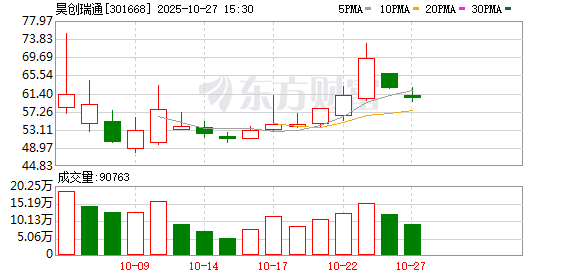
昊创瑞通换手率39.38%,龙虎榜上机构买入5747.35万元,卖出3559.50万元
Zheng Quan Shi Bao Wang· 2025-10-27 14:16
Group 1 - The stock of Haocreative Technology fell by 3.49% today, with a turnover rate of 39.38% and a trading volume of 548 million yuan, indicating significant market activity [2] - Institutional investors net bought 21.88 million yuan, while brokerage seats collectively net sold 9.97 million yuan, reflecting mixed investor sentiment [2] - The stock has appeared on the Dragon and Tiger list 9 times in the past six months, with an average price increase of 0.63% the day after being listed and a 0.17% increase over the following five days [3] Group 2 - Today's main capital outflow for the stock was 42.96 million yuan, with large orders contributing to a net outflow of 14.21 million yuan and 28.75 million yuan respectively [3] - The top five trading departments accounted for a total transaction amount of 127 million yuan, with a net buying amount of 11.91 million yuan [2] - Specific trading details show that institutional specialized seats were prominent in both buying and selling activities, with total buying amounting to 57.47 million yuan and selling amounting to 35.59 million yuan, resulting in a net buying of 21.88 million yuan [2][3]