政策驱动

Search documents
今日早评-20260116
Ning Zheng Qi Huo· 2026-01-16 01:10
1. Report's Industry Investment Ratings - No industry investment ratings are mentioned in the report. 2. Core Views of the Report - The report provides short - term evaluations of multiple commodities, including their supply - demand situations, price trends, and influencing factors. It offers trading suggestions for some commodities based on these analyses [1][3][5]. 3. Summaries by Commodity 3.1. Energy Crude Oil - OPEC's December commercial inventory in OECD increased by 4 million barrels to 2.84 billion barrels. The expected demand for OPEC crude in 2026 remains at 43 million barrels per day, an increase of 600,000 barrels per day compared to 2025. US refined oil demand in the four - week period ending January 9 was 1.1% lower than the same period last year. With the reduced expectation of US strikes on Iran, the oil price dropped significantly. The oil market still faces oversupply pressure, and the price is expected to be short - sold in the short term [5]. Natural Gas - Not covered in the report. Coal - For coking coal, the capacity utilization rate of 523 coking coal mines is 88.5%, a 3.1% increase from the previous week. The daily output of raw coal is 1.978 million tons, an increase of 79,000 tons. The raw coal inventory is 5.499 million tons, an increase of 765,000 tons. After last week's rebound, the coking coal futures have entered a volatile pattern this week. Without policy intervention, the coal price may remain low before the Spring Festival [1]. 3.2. Metals Iron Ore - From January 5 to January 11, the global iron ore shipment volume was 31.809 million tons, a decrease of 328,000 tons. The shipment volume from Australia and Brazil was 26.064 million tons, a decrease of 1.364 million tons. The overseas iron ore shipment volume has slightly declined after the year - end rush. The market expects limited growth in overseas shipments in the first quarter. The port inventory is under pressure to increase, but the short - term increase in iron water production and steel mills' restocking provide some support for the ore price [3]. Steel - As of the week of January 15, the weekly output of rebar was 1.903 million tons, a decrease of 7400 tons. The factory inventory decreased by 52,700 tons to 1.4266 million tons, and the social inventory increased by 52,300 tons to 2.9541 million tons. The apparent demand increased by 153,800 tons to 1.9034 million tons. With the approaching cold air, the demand is expected to weaken, but the steel price may continue to fluctuate in the short term due to macro - economic factors and high costs [4]. Aluminum - Starting from April 1, 2026, China will cancel the export tax rebate for photovoltaic products. In the short term, the policy has boosted the aluminum price, but in the long term, it may suppress aluminum demand. The aluminum price is expected to remain volatile at a high level [9]. Gold - Trump has no plan to fire Powell, and concerns about the Fed's independence may weaken. With strong US economic data, the short - term demand for interest rate cuts has decreased, and the upward momentum of precious metals has weakened [10]. Silver - The number of initial jobless claims in the US last week dropped to 198,000, the lowest since November last year. The short - term urgency for interest rate cuts has decreased. Industrial demand supports silver, but the price increase is limited in the short term [1]. 3.3. Chemicals PTA - The social inventory of PTA is 2.8674 million tons, a decrease of 10,800 tons. The PTA capacity utilization rate is 76.76%. The polyester load is slowly decreasing, and the sharp drop in oil prices has suppressed market sentiment. PTA is expected to fluctuate weakly in the short term [6]. Methanol - The market price of methanol in Jiangsu Taicang is 2240 yuan/ton, a decrease of 17 yuan/ton. The domestic methanol capacity utilization rate is 91.11%, a decrease of 0.31%. The port inventory decreased by 101,900 tons to 1.4353 million tons. The methanol market is expected to fluctuate in the short term [11]. Polypropylene - The mainstream price of East China drawn polypropylene is 6494 yuan/ton, an increase of 21 yuan/ton. The capacity utilization rate is 76.19%, a decrease of 0.42%. The commercial inventory decreased by 48,000 tons to 695,500 tons. Polypropylene is expected to be under pressure and fluctuate in the short term [13]. Natural Rubber - The price of Thai raw material glue is 58.2 Thai baht/kg, and the cup - lump price is 52.3 Thai baht/kg. The domestic rubber production area has stopped harvesting, and the raw material price in Southeast Asia is firm. The social inventory of natural rubber in China has seasonally increased to a neutral level. It is recommended to short - sell or wait and see in the short term [6][7]. Palm Oil - From January 1 to 15, Malaysia's palm oil exports increased by 18.64% compared to the same period last month. Malaysia has lowered the reference price and tariffs, but strong export data and Indonesia's signal of long - term supply tightening have led to a market expectation of tightening supply. It is recommended to trade in a range in the short term [8]. 3.4. Agriculture Soybean Meal - On January 15, the domestic soybean meal spot price was 3160 yuan/ton. The market has demand, but the willingness to chase high - priced soybeans is weak. The domestic soybean and soybean meal inventories are still high, and the supply is expected to be loose in the first quarter. The spot price is expected to stop falling and stabilize in the short term [7]. Corn - Not covered in the report. Wheat - Not covered in the report. Livestock - On January 15, the average pork price in the national agricultural product wholesale market was 18 yuan/kg, a decrease of 0.3%. The pig price is expected to fluctuate after a short - term increase. Attention should be paid to the slaughter volume of farmers and the reduction of breeding sows [8]. 3.5. Others Long - term Treasury Bonds - The central bank has implemented measures to support high - quality economic development, including lowering the rediscount and re - loan interest rates by 0.25 percentage points and increasing the re - loan quota for agriculture and small businesses by 50 billion yuan. The bond market is expected to be more volatile, and attention should be paid to the stock - bond seesaw effect [10]. Futures - Not covered comprehensively. Only short - term evaluations of various commodity futures are provided in the report.
山东药玻(600529):重组方案改为定增,仍然看好与国药协同发展:山东药玻(600529):
Shenwan Hongyuan Securities· 2026-01-14 10:50
Investment Rating - The report maintains an "Outperform" rating for the company [1]. Core Insights - The company has introduced a private placement involving Guoyao International and Shandong Yaoxin, with Guoyao International becoming the controlling shareholder. The placement involves the issuance of up to 199 million shares at a price of 16.25 yuan per share, raising a maximum of 3.235 billion yuan [5]. - The collaboration with Guoyao Group is expected to enhance the company's long-term development, leveraging Guoyao's comprehensive medical industry chain from research and development to manufacturing and distribution [5]. - The report highlights a long-term trend of upgrading from low borosilicate and soda-lime glass to medium borosilicate glass in the pharmaceutical packaging industry, driven by increasing safety and stability requirements for pharmaceuticals [5]. Financial Data and Earnings Forecast - Total revenue is projected to reach 5,125 million yuan in 2024, with a growth rate of 2.9%. By 2027, revenue is expected to grow to 6,119 million yuan, reflecting a compound annual growth rate of approximately 7.2% [4]. - The net profit attributable to the parent company is forecasted to be 943 million yuan in 2024, with a decline of 24.7% in 2025, followed by a recovery to 1,010 million yuan by 2027 [4]. - The earnings per share (EPS) is expected to be 1.42 yuan in 2024, decreasing to 1.20 yuan in 2025, and then recovering to 1.52 yuan by 2027 [4].

山东药玻(600529):重组方案改为定增,仍然看好与国药协同发展
Shenwan Hongyuan Securities· 2026-01-14 09:44
Investment Rating - The report maintains an "Outperform" rating for the company [2] Core Insights - The company has introduced a private placement involving Guoyao International and Shandong Yaoxin, with Guoyao International becoming the controlling shareholder. The placement involves the issuance of up to 199 million shares at a price of 16.25 yuan per share, raising up to 3.235 billion yuan [5][7] - The collaboration with Guoyao Group is expected to enhance the company's long-term development, leveraging Guoyao's comprehensive supply chain in the pharmaceutical industry [7] - The trend towards upgrading to borosilicate glass in pharmaceutical packaging is anticipated to continue, driven by increasing safety and stability requirements for drugs [7] Financial Data and Earnings Forecast - Total revenue is projected to reach 5,125 million yuan in 2024, with a growth rate of 2.9%. By 2026, revenue is expected to increase to 5,711 million yuan, reflecting a growth rate of 9.9% [6] - Net profit attributable to shareholders is forecasted to be 943 million yuan in 2024, with a projected increase to 1,010 million yuan by 2027 [6] - The company's earnings per share (EPS) is expected to be 1.42 yuan in 2024, increasing to 1.52 yuan in 2027 [6]
从“爆款”到“经典”,国产剧2025年做到了吗?
Xin Lang Cai Jing· 2026-01-10 17:26
Core Insights - The year 2025 marks a transformative period for domestic Chinese drama series, characterized by significant changes in narrative styles, aesthetics, and regulatory policies, leading to a richer creative ecosystem [1] Group 1: Creative Trends - Reality-based themes dominate the landscape, shifting from singular glorification to multi-dimensional and in-depth portrayals, reflecting societal intricacies and individual experiences [1][4] - The narrative focus has evolved to emphasize humanized perspectives and contemporary expressions, particularly in historical dramas commemorating significant anniversaries, such as the 80th anniversary of the victory in the War of Resistance against Japan [1][4] - A notable increase in the production of reality-themed dramas is evident, with over 66% of the 72 domestic dramas released from January to September 2025 falling into this category [4] Group 2: Genre Innovations - Legal dramas exhibit a strong social engagement, addressing pressing legal issues that resonate with the public, thus transcending mere entertainment [10][11] - Suspense and crime dramas have shifted from mere puzzle-solving to exploring social issues and human complexities, integrating philosophical reflections into their narratives [13][14] - Historical dramas are returning to their roots, enhancing cultural depth and interactive storytelling, with a focus on authentic historical contexts [14][16] Group 3: Technological Advancements - 2025 is recognized as a year of technological empowerment in drama production, with innovations such as 4K ultra-high-definition filming enhancing visual storytelling [19][20] - The integration of AI and virtual production techniques is reshaping creative processes, allowing for more immersive and visually cohesive narratives [20][21] - Regulatory changes, such as the "Broadcasting 21 Articles," have liberated creative constraints, enabling a diverse range of formats and accelerating approval processes [21][22] Group 4: Market Dynamics - The domestic drama market is experiencing a dual growth trend, with both short and medium-length series gaining traction alongside traditional long-form dramas [21][22] - Despite advancements, challenges remain, including issues of narrative homogeneity in urban dramas and the overemphasis on technical aspects at the expense of storytelling [22]


2025年苏州楼市:存量房时代政策驱动结构性回暖
Feng Huang Wang Cai Jing· 2026-01-06 14:25
2025年,苏州新房共成交21443套,成交量峰值也出现在3月,相城区的新房成交量领跑全市,占比超 23%。成交结构方面,90—120㎡的房源也是新房成交的主力,成交量占比超34%;价格方面,200— 300万元区间的新房成交占比最高,达到近30%。整体来看,2025年苏州楼市在存量房时代中呈现出政 策驱动的结构性回暖。 2025年,省内多个城市接连发布了楼市新政,在一定程度上刺激了新房和二手房市场,新房在以去库存 为主的背景下,成交量低于二手房。整体来看,2025年苏州楼市在存量房时代中呈现出政策驱动的结构 性回暖。 2025年二手房共成交57650套,根据苏州贝壳成交数据显示,全年成交量峰值出现在3月,昆山区域的二 手房成交量全市占比最高,达28%。成交结构方面,90—120㎡的房源最受市场欢迎,占比超32%。价 格方面,从2025年第四季度开始,苏州二手房成交均价持续3个月均有缓步回升。 2025年12月末,财政部、税务总局联合发文,个人销售购买不满2年的住宅,增值税征收率迎来下调。 贝壳研究院苏州分院院长周洁分析,新政落地将进一步激活改善型需求,促进市场联动二手房流通,为 2026年稳定市场预期、推动 ...
年底车市静悄悄 | 棱镜
Xin Lang Cai Jing· 2025-12-22 11:19
Group 1 - The Chinese automotive market is experiencing a significant decline in sales, with retail sales of passenger vehicles dropping by 32% year-on-year in early December 2025, totaling 297,000 units [2][28] - The new energy vehicle (NEV) market also saw a decline, with retail sales of 185,000 units, down 17% year-on-year [2][28] - This decline is attributed to the phasing out of the vehicle purchase tax exemption and uncertainty surrounding the "trade-in" subsidy policies [3][29] Group 2 - The current vehicle purchase tax is set at 10%, with a reduced rate of 5% for NEVs, and the exemption cap has been lowered from 30,000 yuan to 15,000 yuan [5][31] - There is a prevailing market sentiment of caution among consumers, with 58.2% of dealers reporting that November sales did not meet expectations due to this cautious attitude [6][33] - The "trade-in" subsidies have been paused in many regions, impacting consumer purchasing behavior [8][34] Group 3 - The anticipated "year-end surge" in sales, typically seen in the fourth quarter, has not materialized this year, leading to a "flat tail" effect instead of the expected "tail effect" [36][44] - The automotive market saw a rare decline in November, with retail sales down 8.1% year-on-year, attributed to high sales figures from the previous year and the suspension of trade-in subsidies [38][39] - The inventory warning index for dealers reached a high of 55.6%, indicating over 3.3 million vehicles in stock, with more than 30% of dealers facing inventory pressure [35][41] Group 4 - Over 20 automotive companies have introduced "purchase tax guarantee" policies, where manufacturers will cover the difference in tax if consumers order vehicles before the end of 2025 but do not receive them until after [41][44] - This policy is expected to affect purchasing behavior, leading consumers to delay purchases, which could suppress immediate demand in the fourth quarter [42][44] - The exit of subsidies is projected to significantly impact the market, with estimates suggesting a potential sales growth slowdown from 8% in 2025 to -2% in 2026 [45][46] Group 5 - The automotive industry is shifting from a "policy-driven" to a "market-driven" and "technology-driven" model, indicating a maturation of the market [46] - The average price of new energy vehicles is expected to decrease from 185,000 yuan in 2023 to 156,000 yuan in 2025, putting pressure on profit margins [52] - The penetration rate of new energy vehicles has surpassed 50%, indicating a significant shift in consumer adoption and market dynamics [52]



购置税政策切换在即 新能源汽车市场迈入“价值驱动”新阶段
Xi Niu Cai Jing· 2025-12-18 03:52
根据政策安排,自2026年1月1日起,新能源汽车购置税从全额免征调整为减半征收,从每辆最高免税额3万元,调整为每辆最高减税额1.5万元。 中国汽车工业协会数据显示,2025年11月,我国汽车市场在高基数上继续保持稳健增长,其中新能源汽车表现尤为亮眼,产销量分别达到188万辆和182.3万 辆,新能源汽车新车销量占汽车新车总销量的比例历史性突破53.2%。 行业专家指出,上述数据印证了新能源汽车已占据市场主导地位,反映出在购置税优惠"退坡"预期下,部分消费需求正集中提前释放,形成政策切换前 的"末班车效应"。国家信息中心经济师林超指出,从长期视角看,购置税优惠力度的逐步调整,标志着新能源汽车市场发展的核心动力,正从依赖财政补贴 的"政策驱动",加速转向依靠产品技术、成本与服务体验的"价值驱动"。市场竞争的焦点将更加聚焦于内生竞争力。 随着政策普惠性减弱,消费者购车行为将日趋理性。林超分析,未来消费者将逐渐从依赖政策优惠,转向更加关注产品本身的品质、技术性能、残值率,以 及购车、用车全生命周期的服务体验。 补能体验已成为影响消费决策的关键一环。国家能源局有关负责人表示,尽管我国充电基础设施快速发展,基本满足当前需 ...

华联期货股指年报:预计股指中期攀升格局未改
Hua Lian Qi Huo· 2025-12-15 11:05
Report Industry Investment Rating No relevant content provided. Core Viewpoints of the Report - The mid - term upward trend of stock index remains unchanged, but the growth rate may slow down. The core driving force for the mid - term rise of the stock index is the confirmation of the performance bottom and the profit repair. The significant entry of incremental funds and favorable policies also contribute to the market's upward movement. With the introduction of year - end favorable policies and the stimulation of the 14th Five - Year Plan, the stock index may enter a cross - year layout market from December to January, and the spring market is worth looking forward to. It is recommended to focus on the CSI 500, SSE 50, CSI 300, and CSI 1000 indices and buy call options [14]. Summary According to Relevant Catalogs 1. Annual Viewpoint and Strategy - **Market Review**: In 2025, the market first fluctuated and adjusted, then rose significantly and exceeded the previous year's high, showing an overall upward trend. All four major indices rose, with small and medium - cap stock indices leading the gains. In terms of style indices, growth and cyclical indices had the largest increases, with the former rising over 35%. The stable - style index hardly rose, and the financial and consumer - style indices had relatively low increases. In the Shenwan industry, most industries rose, but some declined. TMT and cyclical sectors such as communication, non - ferrous metals, electronics, and comprehensive led the gains, with the first two having annual increases of over or close to 80%. Industries with lower increases included real estate, commercial trade, public utilities, building decoration, and banking. Declining industries were food and beverage, coal, and transportation [9]. - **Economic Situation**: In November 2025, the manufacturing PMI was 49.2%, up 0.2 percentage points from the previous month; the non - manufacturing PMI was 49.5%, down 0.7 percentage points from the previous month. In terms of sub - items, both supply and demand in the manufacturing PMI rebounded slightly in November, with new export orders rebounding by 1.7%, which was related to the easing of Sino - US tariffs. Factory prices and raw material purchase prices rebounded after two months of decline [9]. - **Policy Situation**: The Political Bureau set the tone for the real estate market to stop falling and stabilize and boost the capital market. The State Council issued the new Nine - Article Guidelines to strengthen investor returns. The central bank created two new monetary policy tools. The implementation plan for promoting the entry of medium - and long - term funds into the market was officially released, which is expected to add 800 billion yuan of long - term funds to the A - share market annually [9]. - **Performance Situation**: A - share performance showed signs of stabilization in the first quarter. After the implementation of reciprocal relations with the US in April, which increased by 30%, performance declined in the second quarter and showed fluctuations. Performance continued to stabilize and rebound in the third quarter, and the performance of the four major indices rebounded again in Q3 2025 [9]. 2. Index and Industry Trend Review - The market in 2025 first fluctuated and adjusted, then rose significantly and exceeded the previous year's high, showing an overall upward trend. All four major indices rose, with small and medium - cap stock indices leading the gains. In terms of style indices, growth and cyclical indices had the largest increases, with the former rising over 35%. The stable - style index hardly rose, and the financial and consumer - style indices had relatively low increases. In the Shenwan industry, most industries rose, but some declined. TMT and cyclical sectors such as communication, non - ferrous metals, electronics, and comprehensive led the gains, with the first two having annual increases of over or close to 80%. Industries with lower increases included real estate, commercial trade, public utilities, building decoration, and banking. Declining industries were food and beverage, coal, and transportation [20][26]. 3. Main Contracts and Basis Trends - The four major indices fluctuated and rebounded, exceeding the previous year's high. Except during quarterly contract roll - overs, the basis was at a reasonable level. In terms of arbitrage among main contracts, IC/IF and IC/IH first adjusted and then rebounded, showing an overall upward trend; IH/IF first rose and then fell sharply, with significant fluctuations; IM/IF and IM/IH showed wide - range fluctuations; IM/IC first fluctuated repeatedly and then declined [32][36]. 4. Economic Policy - **Economic Situation** - In November 2025, the manufacturing PMI was 49.2%, up 0.2 percentage points from the previous month; the non - manufacturing PMI was 49.5%, down 0.7 percentage points from the previous month. In terms of sub - items, both supply and demand in the manufacturing PMI rebounded slightly in November, with new export orders rebounding by 1.7%, which was related to the easing of Sino - US tariffs. Factory prices and raw material purchase prices rebounded after two months of decline [42]. - Generally, PPI leads the inventory cycle (by 1 to 12 months, with an average of about half a year). PPI bottomed out and rebounded in June 2023, weakened after two months, and since March 2024, the decline has been continuously narrowing. From July 2024, the decline of PPI expanded again, and since November 2024, it has been narrowing until it expanded for five consecutive months until March 2025. Since August 2025, the decline has been narrowing, and currently it remains weak. In October 2025, industrial enterprise revenues fell to 1.8%, inventory continued to rise to 3.7%, demand declined, and there was passive inventory replenishment [45]. - China's social financing scale in November 2025 was 248.85 billion yuan, an increase of 15.28 billion yuan compared with 233.57 billion yuan in the same period last year. New RMB loans were 40.53 billion yuan, a decrease of 11.7 billion yuan compared with the same period last year, mainly due to a 20.63 - billion - yuan decrease in household loans, a decrease of 47.63 billion yuan compared with the same period last year. Short - term household loans decreased by 3.7 billion yuan, a decrease of 17.88 billion yuan compared with the same period last year, and medium - and long - term household loans increased by 1 billion yuan, a decrease of 29 billion yuan compared with the same period last year. Government bonds were 120.41 billion yuan, a decrease of 10.6 billion yuan compared with the same period last year [48]. - The growth rate of medium - and long - term credit has been falling since reaching a high of 12.94% in May 2023 after starting to stabilize and rebound from 10.21% in November 2022. As of November 2025, it has fallen for 30 consecutive months to 5.89% and continues to decline [7][53]. - **Policy Situation** - **New Nine - Article Guidelines**: In April 2024, the "Several Opinions on Strengthening Supervision, Preventing Risks, and Promoting the High - Quality Development of the Capital Market" (New Nine - Article Guidelines) were issued. It tightened the "entry threshold" and smoothed the "exit channel" by raising the listing standards for each sector and accelerating the clearance of inferior enterprises through stricter delisting indicators. It also strengthened investor returns by strengthening the supervision of cash dividends of listed companies and restricting major shareholders' share - reduction for companies that have not paid dividends for many years or have a low dividend ratio [55][58]. - **Implementation Plan for Promoting the Entry of Medium - and Long - Term Funds into the Market**: It aims to increase the actual investment ratio. For public funds, it is required that the market value of A - shares held by public funds should increase by at least 10% annually in the next three years. For commercial insurance funds, large - state - owned insurance companies are expected to invest 30% of their newly - added premiums in A - shares annually starting from 2025, which means adding at least several hundred billion yuan of long - term funds to the A - share market each year. The second - batch pilot project of long - term stock investment by insurance funds will be implemented in the first half of 2025, with a scale of no less than 10 billion yuan, and the scale will be gradually expanded. It also extends the assessment period. By implementing a long - cycle assessment, it can effectively smooth the impact of short - term market fluctuations on performance and improve the stability of medium - and long - term funds' investment behavior [61]. - **Political Bureau's Policy Orientation**: The Political Bureau meeting pointed out that efforts should be made to boost the capital market, guide medium - and long - term funds to enter the market, and remove obstacles for funds such as social security, insurance, and wealth management to enter the market. It also emphasized increasing the counter - cyclical adjustment of fiscal and monetary policies, ensuring necessary fiscal expenditures, and doing a good job in the "three guarantees" at the grass - roots level. It proposed to issue and use ultra - long - term special treasury bonds and local government special bonds, reduce the deposit reserve ratio, and implement significant interest rate cuts. It also aimed to promote the real estate market to stop falling and stabilize, control the increment of commercial housing construction, optimize the stock, and improve the quality [62]. - **Central Bank's New Monetary Policy Tools**: The central bank created a structural monetary policy tool to support the capital market for the first time. One is the swap facility for securities, funds, and insurance companies, which allows eligible institutions to use their bonds, stock ETFs, and SSE 300 constituent stocks as collateral to exchange for high - liquidity assets such as treasury bonds and central bank bills from the central bank. The initial scale of the swap facility operation is 500 billion yuan. The central bank also created a re - loan for stock repurchase and increase, guiding commercial banks to provide loans to listed companies and major shareholders for stock repurchase and increase. The initial scale is 300 billion yuan [63]. - **Debt Resolution Measures**: In November 2024, the National People's Congress Standing Committee announced a large - scale debt resolution measure. The total debt resolution scale mainly includes three parts: 6 trillion yuan of local debt limits, all arranged as special debt limits, approved at once and implemented over three years; starting from 2024, 800 billion yuan will be allocated from new local special bonds for five consecutive years to replenish government fund financial resources, with a cumulative replacement of 4 trillion yuan of implicit debt; and 2 trillion yuan of implicit debt from shantytown reconstruction due after 2029 will be repaid according to the original contract. The first two parts will directly increase 10 trillion yuan of local debt resolution funds [64]. - **Accelerating the Building of First - Class Investment Banks and Investment Institutions**: At the Eighth Member Congress of the Securities Association of China, it was proposed that securities companies should shift from price competition to value competition. Appropriate "relaxation" measures will be taken for high - quality institutions to optimize risk - control indicators, expand capital space and leverage limits, and improve capital utilization efficiency. Differentiated supervision will be explored for small - and medium - sized securities companies and foreign - funded securities companies in terms of classification evaluation and business access to promote their characteristic development. Strict supervision will be carried out for a small number of problematic securities companies [65]. - **14th Five - Year Plan**: The 14th Five - Year Plan is a crucial period that connects the past and the future, with multiple strategic goals (such as carbon peaking and reform) to be achieved. A multi - polar trade system is gradually taking shape, and China's voice in global economic and trade fields is expected to further increase. Sino - US competition remains the core variable affecting the global political and economic landscape, and it is becoming "normalized" and "complicated". The reconstruction of the global supply chain has entered the second half, with geopolitics and strategic security as the main lines. China will focus on developing new - quality productive forces and upgrading industries, promoting anti - involution and building a unified national market, and expanding domestic demand and boosting consumption [68]. - **US Mid - term Elections**: In 2026, the US mid - term elections will be held. The schedule includes the primary elections in August 2026 and the main election period from September to November, with November 3rd as the final voting date. The fiscal bill requires that the Trump administration is prohibited from laying off federal government employees before January 30th, which is expected to ease the situation of significant employment reduction. It is expected that fiscal support will continue during the mid - term elections [71]. 5. Revenue and Net Profit of Each Index - The core factor affecting the long - term trend of the stock index is the performance of listed companies. Since the coordinated efforts of monetary and fiscal policies in the third quarter of last year, the policy effects have gradually been transmitted to the real economy. The first - quarter report of 2025 showed that the performance of A - share listed companies had initially shown signs of stabilization, and the profit bottom was likely to have been confirmed. Although affected by external factors such as "reciprocal tariffs" in the second quarter, performance fluctuated, the third - quarter report data confirmed that corporate profits had returned to an upward channel. The continuous rebound of performance in Q3 2025 strengthened the market's confidence in the start of the profit cycle, providing strong internal impetus for the mid - term rise of the stock index [77][82]. 6. Valuation - The valuation of the Shanghai Composite Index is 16.2398, with an upper - limit value of 15.64, and it is at the 83.45th percentile since 2010, indicating a relatively high valuation level since 2010. However, as performance rises, the valuation will decline. The valuation of the ChiNext Index is relatively low [100][102]. 7. Interest Rates - Interest rates are in a downward channel. According to the Fed's December interest - rate meeting forecast, from 2025 to 2028, variables such as real GDP growth, unemployment rate, PCE inflation, and core PCE inflation are expected to show certain trends, and the federal funds rate is also expected to decline [88]. 8. Capital Flows - **Overall Capital Inflow**: In 2025, the A - share market is expected to have a capital inflow (including scale growth) of 4.3505 trillion yuan, which is not much different from the increase in non - bank deposits and bank wealth - management scale. Excluding the scale - growth factor, the A - share market is expected to have a net capital inflow of 1.8311 trillion yuan in 2025 (with an expected net inflow of 300 billion yuan from retail investors in the third quarter) [105]. - **Margin Trading and Short Selling**: In 2024, the net inflow of margin trading and short - selling funds was 27.48 billion yuan. As of December 14, 2025, the net inflow in 2025 was 62.96 billion yuan, indicating active leverage funds [12][109]. - **Private Securities Investment Funds**: The scale of private securities investment funds increased by 1.7946 trillion yuan this year, with a significant increase of 1.040028 trillion yuan in October. The current total scale is 7.0076 trillion yuan. The newly - registered scale this year is 38.6 billion yuan, with registration scales of 7.92 billion yuan in July, 4.28 billion yuan in August, 3.68 billion yuan in September, and 4.29 billion yuan in October [12][113]. - **Insurance Funds**: In the third quarter of 2025, the market value of A - shares held by insurance funds increased by 55.24 billion yuan, a month - on - month increase of 18.00%, while the SSE 300 Index rose by 17.90% during the same period. In the first three quarters of 2025, the market value of A - shares held by insurance funds increased by 119.3 billion yuan, and after excluding the scale - growth factor, it increased by 75.84 billion yuan. The proportion of stock and fund investment by insurance funds in the total insurance fund balance continued to rise to 14.93% [115][116]. - **Newly - Established Funds**: As of September 30, 2025, the newly - established share of stock - type funds was 323.3 billion yuan, with 137 billion yuan in the third quarter; the newly - established share of hybrid funds was 103.6 billion yuan, with 53 billion yuan in the third quarter. In 2025, index funds had a net inflow of 104.9 billion yuan, while active equity funds had a net outflow of 444.9 billion yuan, and equity funds had a net outflow of 340 billion yuan [126][130]. - **Other Capital Flows**: In October 2025, the deposits of non - bank financial institutions increased by 1.8574 trillion yuan again, and the total increase in deposits of non - bank financial institutions this year was 6.6688 trillion yuan. Overall, funds are flowing from the banking system to non - bank channels such as the capital market and wealth - management products. In terms of secondary - market shareholder share - reduction, important shareholders in the A - share market had a net share - reduction of 307.3 billion yuan in 2025. The IPO financing in 2023 was 356.5 billion
和讯投顾孔晓云:消费能启动一波吗?
Sou Hu Cai Jing· 2025-12-15 09:41
今天小云给大家聊一点不一样的,最近消费提及的次数特别多,会给我们市场带来什么影响?明年的行 情能否期待,我们该关注什么方向? 当然股市的任务也不小,毕竟要承担起未来资产池的重任。所以长期看短线可能会很难,时间大概在12 月到1月份,但长期看政策才是股市的核心,政策不会断,明年也不会差,大家一定要有信心。06年到 07年,14年到15年的牛市结束的太快了,但今年的A股涨幅控制的非常好,只有15.6%,我个人认为明 年A股大概率还会有10%~15%的空间保持稳定,资本市场不动摇,指数可能会来到4300~4500附近,蓝 筹的估值还是会进一步提升,科技成长加出海依旧会有较高的弹性,所以即便12月到1月份不加,也不 必对明年整体失望,反而回撤下来之后会有更好的买点。 和讯投顾孔晓云分析称,消费的低迷,投资的低迷反映在A股上,周末三部门发文更大力度提振消费, 但消费真正想要走好需要的不是刺激,而是口袋鼓起来。 ...
11月车市现“产销温差”:350万产量创新高,零售下滑8%
3 6 Ke· 2025-12-12 01:47
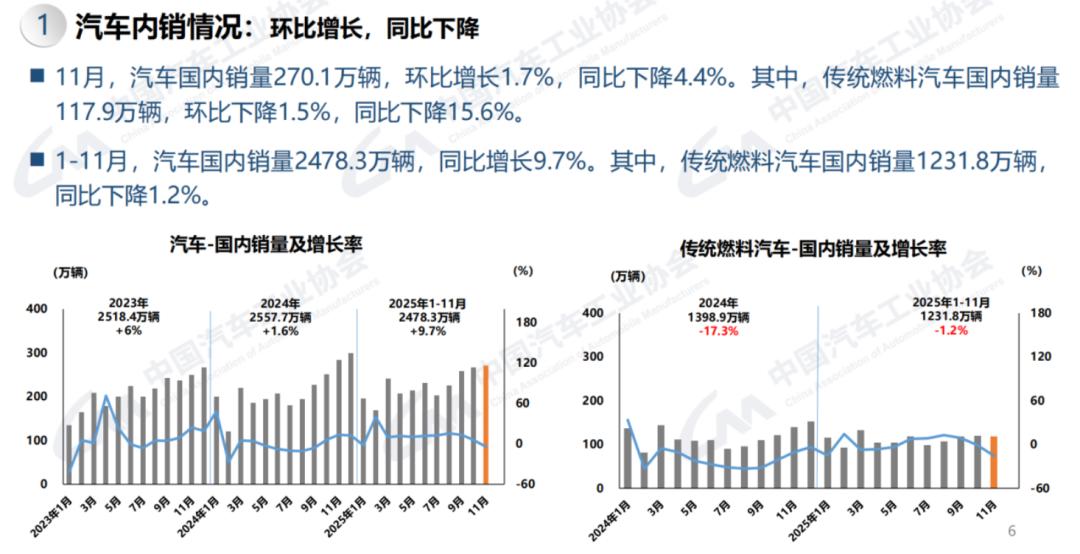
Core Insights - The Chinese automotive market in November 2025 shows a complex scenario with high production but declining retail demand, indicating a disconnect between production enthusiasm and consumer spending [1][2][5] Production and Sales - In November, China's automotive production reached a historic high of 3.53 million units, with a month-on-month increase of 5.1% and a year-on-year increase of 2.8% [1][2] - Cumulative production and sales from January to November reached 31.23 million and 31.13 million units, respectively, reflecting year-on-year growth of 11.9% and 11.4% [1] - Retail sales of passenger vehicles in November fell by 8.1% year-on-year and 1.1% month-on-month, indicating a significant decline in consumer demand [1][5] Inventory and Market Dynamics - The disparity between production and retail sales has led to increased inventory pressure, with manufacturer inventory rising by 60,000 units compared to a decrease of 220,000 units in the same month last year [5] - Factors contributing to this divergence include the withdrawal of previous policy stimuli and a cautious consumer outlook regarding future economic conditions [5] New Energy Vehicles (NEVs) - NEVs continue to be a key growth driver, with production and sales in November reaching 1.88 million and 1.82 million units, respectively, marking a year-on-year increase of over 20% and achieving a penetration rate of 53.2% [7][8] - From January to November, NEV production and sales totaled 14.91 million and 14.78 million units, with year-on-year growth of 31.4% and 31.2% [8] - The retail penetration rate for NEVs reached 59.3%, indicating a shift from a policy-driven growth phase to a market-driven stabilization phase [8] Export Performance - November saw a record export of 728,000 vehicles, a month-on-month increase of 9.3% and a year-on-year increase of 48.5%, with total exports from January to November reaching 6.34 million units, up 18.7% year-on-year [10][13] - NEVs accounted for 47.3% of total passenger vehicle exports, reflecting a growing trend in international markets [10] - The export market is diversifying, with significant demand for plug-in hybrid models in developing countries, indicating a shift in market strategy [13] Future Outlook - The end of 2025 is marked by a critical policy transition, with the expiration of the NEV purchase tax exemption expected to create a surge in consumer demand in December [14][15] - Despite structural challenges, the overall outlook for the automotive market in 2025 remains optimistic, with expectations for record production and sales driven by policy support and resilient foreign trade [14][15]