
物理 AI

Search documents
当黄仁勋在CES重申物理 AI 路径,它石已提前走通具身智能 Scaling Law
具身智能之心· 2026-01-13 04:47
Core Viewpoint - The article emphasizes that autonomous driving is a key pathway to physical AI, a perspective reinforced by industry leaders like NVIDIA's CEO Jensen Huang and Dr. Chen Yilun, CEO of Itstone Intelligent Navigation [2][3]. Group 1: Technological Insights - Autonomous driving is identified as a critical sub-task of embodied intelligence, showcasing the ability of intelligent agents to navigate complex physical environments [3]. - The end-to-end systems in autonomous driving unify perception, decision-making, and planning, providing a foundational framework for robots to understand and act in the physical world [3]. - High-quality, large-scale data is essential for driving advancements in intelligence, with the demand for such data in embodied intelligence being ten times greater than that in autonomous driving [3]. Group 2: Data Innovation - Itstone has introduced a "Human-centric" data collection paradigm, launching the world's first open-source multimodal dataset, World In Your Hands (WIYH), in December 2025, aimed at enhancing model learning of human interactions in the physical world [5]. - The integration of Human-centric data has significantly improved robotic operation success rates in chaotic environments, increasing from 8% to 60% [5]. - The data collection suite developed by Itstone achieves centimeter-level motion capture precision and generates high-density data streams, enabling a single data collector to produce 1.8TB of data in just 5 hours [6]. Group 3: Strategic Development - Itstone's comprehensive understanding of technology and engineering systems is facilitating the transition of embodied intelligence from laboratory settings to real-world applications, marking a significant step towards general physical AI [8].

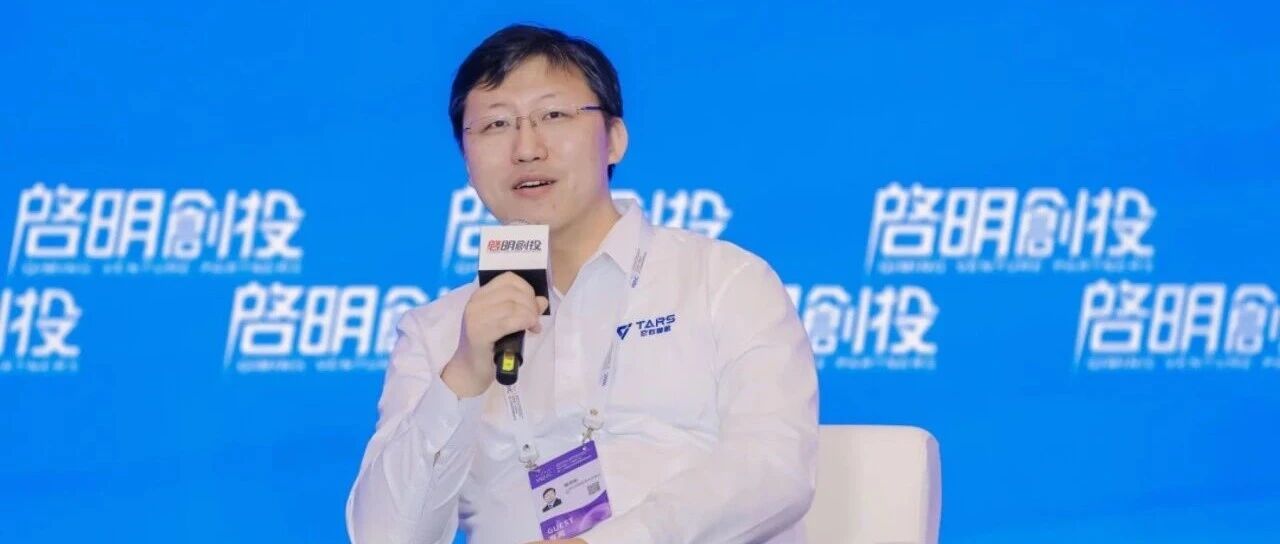
具身智能行业研究:上纬启元Q1正式亮相,宇树腾讯战略合作落地
SINOLINK SECURITIES· 2026-01-11 12:50
Investment Rating - The report indicates a positive investment outlook for the humanoid robotics sector, highlighting 2026 as a pivotal year for the realization of humanoid robots from concept to mass production [3][19]. Core Insights - The robotics industry is experiencing accelerated growth, with significant advancements in humanoid robot designs, including the announcement of Tesla's third-generation robot and the unveiling of the world's first fully controllable small humanoid robot, "Shangwei Q1" [1][24]. - Strategic collaborations are forming, such as the partnership between Tencent's Robotics X Lab and Yushun Technology, aimed at enhancing humanoid robot applications in various sectors [1][21]. - The report emphasizes the importance of technological convergence in the development of humanoid robots, with companies like Xiaopeng leveraging their expertise in smart vehicles to enhance robot capabilities [19]. Summary by Sections 1. Robotics - The robotics sector is witnessing a surge in activity, with a focus on commercial applications and ecosystem development. Companies are making strides in integrating AI services into robotics, enhancing their capabilities [8][9]. - The unveiling of the "Shangwei Q1" humanoid robot marks a significant step towards personal and family-oriented robotics, emphasizing portability and user-friendliness [24][26]. - Major industry players are collaborating to create robust ecosystems, as seen in the partnership between Tencent and Yushun Technology, which aims to deploy humanoid robots in cultural and commercial settings [21][22]. 2. Investment Recommendations - 2026 is projected to be a critical year for humanoid robots, with expectations for mass production and significant market penetration. The report identifies key areas for investment, including supply chain consolidation and technological advancements in electric drive systems and smart hands [3][19]. - The report suggests focusing on leading companies in the supply chain and technology sectors, as well as exploring opportunities in both domestic and international markets [3][19]. 3. Key Components - The report highlights the launch of the "CHOHO Hand" by Zhenghe Industrial, showcasing its capabilities and strategic partnerships aimed at enhancing the robotics ecosystem [2][28]. - The emphasis on core component innovation is critical, with companies like Zhishen Technology achieving significant funding to accelerate product development and market entry [28].




无需人工标注,轻量级模型运动理解媲美72B模型,英伟达、MIT等联合推出FoundationMotion
机器之心· 2026-01-11 02:17
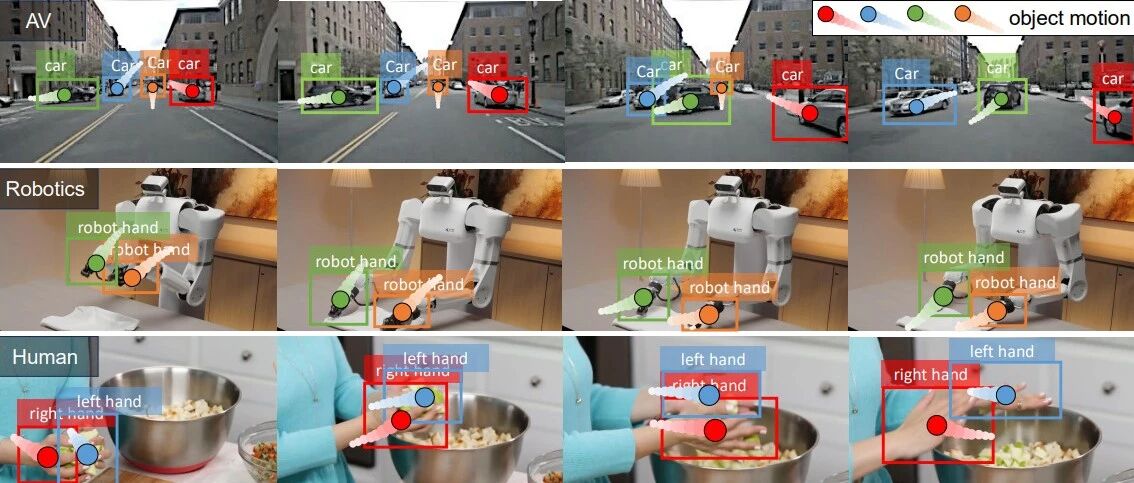
Core Insights - The rapid development of video models faces challenges in understanding complex physical movements and spatial dynamics, leading to inaccuracies in interpreting object motion [2][6] - A significant issue is the lack of high-quality motion data, as existing datasets are either too small or heavily reliant on expensive manual annotations [3][12] - FoundationMotion, developed by researchers from MIT, NVIDIA, and UC Berkeley, offers an automated data pipeline that does not require manual labeling, significantly improving motion understanding in video models [4][13] Data Generation Process - FoundationMotion operates through a four-step automated data generation process, starting with precise extraction of motion from videos using advanced detection and tracking models [16] - The system then translates these trajectories into a format understandable by language models, enhancing the model's ability to comprehend object movements [17] - Finally, it utilizes GPT-4o-mini to automatically generate high-quality annotations and questions, resulting in a dataset of approximately 500,000 entries for motion understanding [18] Model Performance - The data generated by FoundationMotion was used to fine-tune various open-source video models, including NVILA-Video-15B and Qwen2.5-7B, leading to significant performance improvements [21] - The fine-tuned models surpassed larger models like Gemini-2.5 Flash and Qwen2.5-VL-72B on multiple motion understanding benchmarks, demonstrating the impact of high-quality data [26] Broader Implications - FoundationMotion's contributions extend beyond performance metrics, as understanding object motion is crucial for safety and decision-making in autonomous driving and robotics [24] - The system provides a cost-effective and scalable solution for AI to develop an intuitive understanding of the physical world through extensive video analysis [25] - This advancement is seen as foundational for building true embodied intelligence, enhancing both physical perception and general video understanding capabilities [26][27]
黄仁勋的“物理 AI 革命”:Alpamayo 让自动驾驶学会 “思考”
3 6 Ke· 2026-01-07 03:48
Core Insights - Nvidia's CEO Jensen Huang announced the arrival of "physical AI" at CES 2026, highlighting the transformative potential of the Alpamayo autonomous driving AI system, which signifies a shift from "data-driven" to "reasoning-driven" autonomous driving [1][10] Group 1: Alpamayo's Technological Breakthrough - Alpamayo addresses the "long tail problem" in autonomous driving, where 99% of scenarios can be covered by data, but the remaining 1% poses significant safety risks. Traditional solutions focused on accumulating vast amounts of data, which are costly and insufficient for unprecedented scenarios [2] - Alpamayo is the first visual-language-action (VLA) model that enables autonomous systems to possess "human-like reasoning capabilities." It breaks down problems similarly to human drivers, enhancing decision-making safety and providing clear directions for system optimization [2][3] Group 2: Development Ecosystem and Partnerships - Alpamayo employs a 10 billion parameter architecture and supports trajectory generation and reasoning logic from video inputs. Nvidia has created a comprehensive development ecosystem, including the open-source AlpaSim simulation framework and a dataset of over 1,700 hours of physical AI data [3][5] - The first vehicle equipped with Alpamayo will be launched in the first quarter of 2026 in partnership with luxury car manufacturer Mercedes-Benz, marking a significant step in Nvidia's dominance in the autonomous driving sector [5][7] Group 3: Market Position and Competitive Landscape - Nvidia's strategy combines "hardware dominance" with "algorithmic ecosystem dominance," allowing automakers to quickly access advanced autonomous driving capabilities without starting from scratch [7][10] - The introduction of Alpamayo shifts the competitive focus in the autonomous driving industry from "computational power" and "data volume" to "reasoning capabilities," potentially redefining the competitive landscape [10][11] Group 4: Implications for the Industry - For traditional automakers, Alpamayo presents both opportunities and challenges. The open-source ecosystem lowers the barrier for high-level autonomous driving development, enabling smaller companies to compete without massive R&D investments [11] - Tech companies like Google Waymo and Baidu Apollo must accelerate their reasoning model development to remain competitive, while chip manufacturers need to adapt to the new demands of integrating reasoning models with computational power [11][9]

英伟达开源智驾模型,想定义 “物理 AI 的 ChatGPT 时刻”
晚点Auto· 2026-01-06 02:59
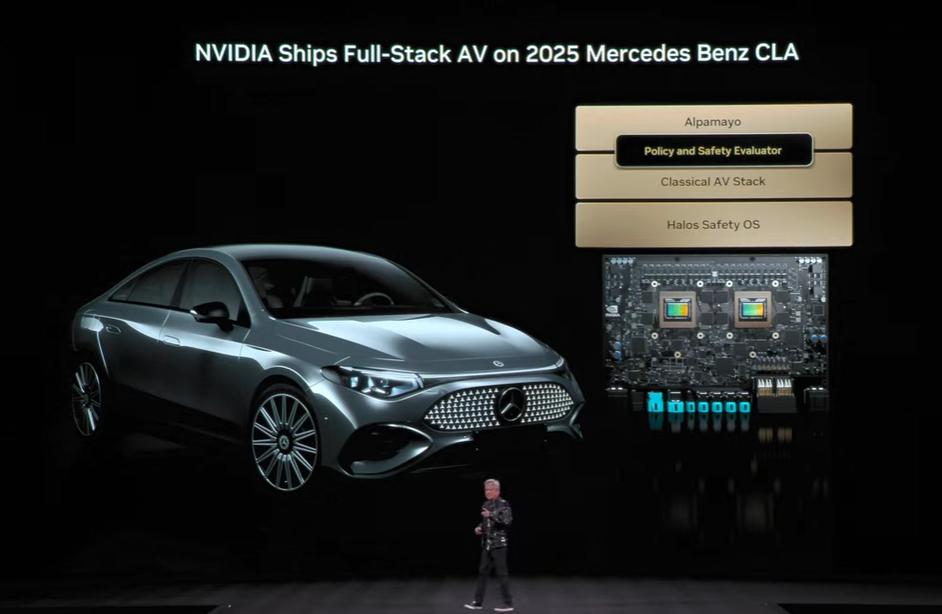
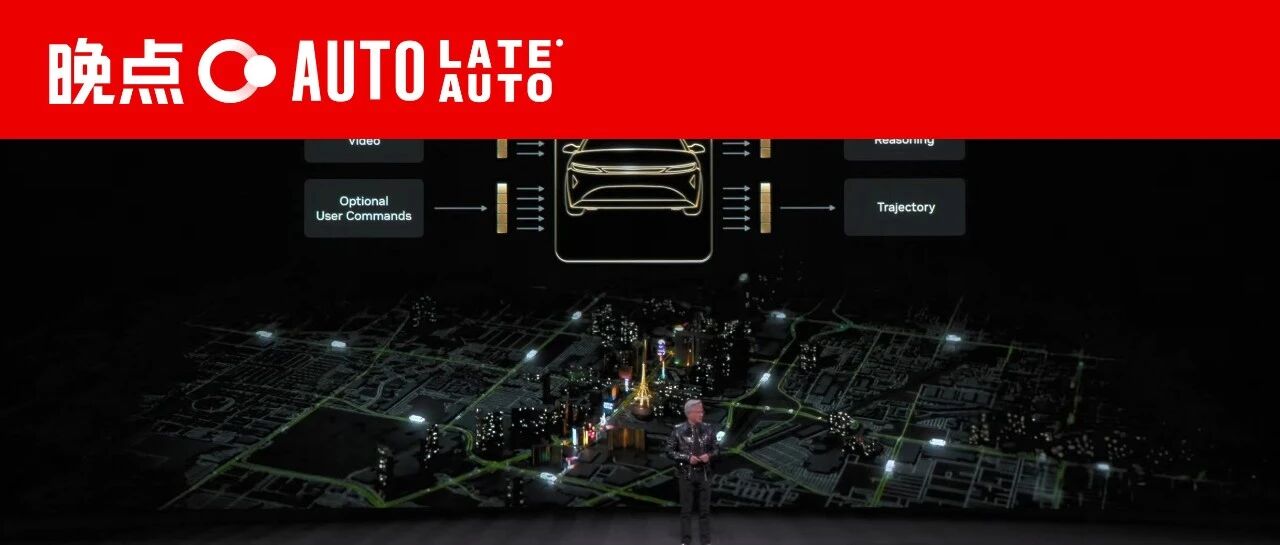
Core Viewpoint - The article discusses NVIDIA's advancements in the autonomous driving sector, particularly the launch of the open-source VLA model Alpamayo, which aims to enhance the capabilities of self-driving vehicles and compete in the market against local Chinese manufacturers [3][4][9]. Group 1: NVIDIA's Innovations - NVIDIA's CEO Jensen Huang announced at CES 2026 that the future will see 1 billion vehicles achieving high or full automation, with autonomous taxis being one of the first beneficiaries [3]. - The Alpamayo model, featuring a 10 billion parameter architecture, is designed to support Level 4 autonomous driving and is the first open-source AI system capable of reasoning and decision-making for self-driving vehicles [4][5]. - The Alpamayo series includes simulation tools and an open dataset with over 1,700 hours of driving data, providing a comprehensive foundation for developers [4]. Group 2: Competitive Landscape - Despite NVIDIA's advancements, local Chinese companies like Li Auto, Xpeng, NIO, and Huawei have already developed similar models, indicating a competitive landscape where NVIDIA is not the frontrunner [4][5]. - NVIDIA faces immediate challenges in the Level 2 assisted driving market, where it has announced a partnership with Mercedes-Benz to deploy its full-stack assisted driving solution in the 2025 model of the CLA [5][7]. - The collaboration with Mercedes-Benz involves a dual-system approach, combining an end-to-end AI system with a traditional safety-certified system to ensure reliability in complex driving scenarios [7]. Group 3: Market Opportunities and Challenges - NVIDIA's strategy includes targeting overseas markets, where the penetration of assisted driving solutions is still low compared to China, presenting significant opportunities for growth [9]. - The company is working to improve its autonomous driving solutions, with plans for quarterly software updates to enhance user experience following previous setbacks in the Chinese market [8][9]. - Despite being behind local competitors in China, NVIDIA aims to regain its influence in the autonomous driving sector through strategic partnerships and technological advancements [9].
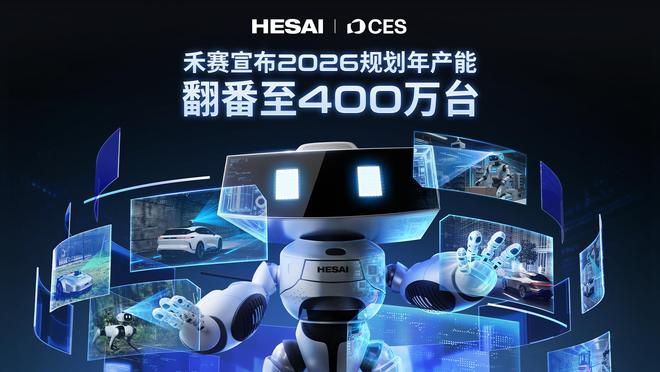
CES 2026|禾赛规划年产能翻番至 400 万,泰国海外工厂 2027 年初投产
Jin Rong Jie· 2026-01-05 14:38
Core Viewpoint - Hesai Technology, a global leader in lidar technology, announced plans to double its annual production capacity from 2 million units in 2025 to 4 million units in 2026 to meet the growing demand in the ADAS and robotics sectors [1][3]. Group 1: Production Capacity and Milestones - Hesai is the first company to achieve an annual production volume exceeding 1 million units and has cumulatively delivered over 2 million lidar units [3]. - In 2025, Hesai's total delivery volume surpassed 1.6 million units, with a peak monthly delivery exceeding 200,000 units [3]. - The company has achieved a consistent doubling of annual delivery volume for five consecutive years, with 1.4 million units delivered for ADAS products and over 200,000 units for robotics in 2025 [3]. Group 2: Manufacturing Capabilities - The company's strong self-research and manufacturing capabilities underpin its plan to double production capacity [5]. - Hesai has established a comprehensive center integrating R&D and manufacturing, ensuring high-quality lidar production with consistency and stability [5]. - The fully automated production line can produce one lidar unit every 10 seconds [5]. Group 3: New Factory and Global Expansion - The construction of Hesai's new factory, "Galileo," in Bangkok, Thailand, is progressing steadily and is expected to commence production in early 2027 [7]. - This new facility will enhance Hesai's global production capacity and support future business growth [7][9]. Group 4: Product Innovations and Market Demand - At CES 2026, Hesai showcased its new generation of L3 automotive lidar solutions, which include the ETX and FTX models designed for enhanced vehicle safety [9][11]. - The new lidar solutions are expected to significantly reduce the risk of fatal accidents by 90% and conventional traffic accidents by 30% compared to pure vision systems [11]. - The penetration rate of lidar in China's new energy vehicle market has reached 28%, indicating strong market recognition of lidar's safety value [11]. Group 5: Client Base and Orders - Hesai has secured production contracts with 24 major automakers for over 120 vehicle models, including top-tier companies in Europe and China [12]. - The company has achieved 100% standardization for its first two major ADAS clients for all models in 2026 [12]. - The recently updated ATX model has received orders exceeding 4 million units from several leading automakers, with production set to begin in April 2026 [12]. Group 6: Robotics and AI Integration - Beyond the ADAS market, the robotics industry is experiencing rapid growth driven by AI, with lidar being essential for stable and precise environmental perception [13]. - Hesai's lidar products are widely used in autonomous vehicles from various innovative companies, with some models planning to use up to 8 lidar units [13][14]. - The JT series of mini 3D lidar has seen over 200,000 units shipped, demonstrating its versatility in various applications [14].

小鹏拆掉过去的自己,再战 “物理 AI”
晚点LatePost· 2025-11-26 08:46
Core Insights - The article discusses how Xiaopeng Motors is shifting its focus towards advanced technologies, particularly in the realm of "physical AI," which encompasses autonomous driving, robotics, and flying cars [2][20]. Group 1: Technological Innovations - Xiaopeng Motors has introduced a new autonomous driving model called VLA (Vision-Language-Action), which aims to deploy AI reliably in real-world scenarios [3][20]. - The second generation of the VLA product has been designed to be more "human-like," capable of interpreting gestures and navigating complex traffic situations [3][4]. - The company is also focusing on humanoid robots, with the latest iteration showcasing advanced design features that enhance its mobility and human-like characteristics [4][7]. Group 2: Strategic Shifts - Xiaopeng's leadership emphasizes the need to dismantle past successful experiences to foster innovation and adaptability in a rapidly changing technological landscape [4][10]. - The company is moving away from traditional modular approaches to a more streamlined, end-to-end architecture for its autonomous driving technology [10][12]. - The strategy includes a dual approach where one team iterates on existing products while another focuses on new technologies, ensuring continuous improvement and innovation [13][20]. Group 3: Future Goals and Market Position - Xiaopeng aims to become a global leader in embodied intelligence, with plans to scale production of humanoid robots and advanced autonomous vehicles by 2026 [20][24]. - The company has set ambitious targets, including the production of 1 million robots by 2030, aligning its goals with industry leaders like Elon Musk [23][24]. - Recent financial performance indicates a positive trend, with a cumulative delivery of 350,000 vehicles and a gross margin exceeding 20% in Q3 [19][20].

贝索斯砸 447 亿复出搞 AI,马斯克吐槽“跟屁虫”
程序员的那些事· 2025-11-19 01:55
Core Viewpoint - Jeff Bezos, after four years of retirement, is launching an AI company named "Prometheus Project" with a significant investment of $6.2 billion (approximately 44.7 billion RMB), focusing on "physical AI" that operates in the real world rather than just theoretical applications [4]. Group 1: Bezos's New Venture - Bezos aims to develop AI that can conduct real-world experiments, such as testing wing designs in wind tunnels and optimizing robotic collaboration in automotive production lines [5]. - The project has already attracted nearly 100 top researchers from leading AI teams, including OpenAI and Google DeepMind, indicating a strong talent acquisition strategy [5]. - Bezos is partnering with Vik Bajaj, a key member from Google's X Lab, to oversee operations in aerospace and automotive engineering [5]. Group 2: Musk's Reaction - Elon Musk quickly criticized Bezos's initiative, labeling it as a "copycat" move, reflecting a long-standing rivalry between the two tech giants [6][8]. - Musk's companies, including Tesla and XAI, have been focusing on AI and robotics in manufacturing, which overlaps with Bezos's new project [8]. Group 3: Industry Implications - The simultaneous focus of both Bezos and Musk on "physical AI" suggests a potential surge in this sector, moving beyond theoretical AI applications to practical implementations [10]. - The competition between these two billionaires could accelerate the development of physical AI technologies, benefiting the entire industry, similar to the smartphone wars that led to more advanced products [10]. - Concerns have been raised about the influx of capital into the AI sector, with some investors fearing a potential market correction akin to the 2008 financial crisis [10].

华为投资物理 AI:首家国产世界模型公司“极佳视界”新一轮融资
Sou Hu Cai Jing· 2025-11-12 04:35
Core Insights - The company Jiga Vision announced the completion of a new round of financing amounting to hundreds of millions in the A1 round, led by a well-known industry player and Huakong Fund [1] - The well-known industry player is identified as Huawei Hubble [1] - Jiga Vision is a physical AI company founded in 2023, focusing on "world model-driven general intelligence in the physical world" [3] Company Overview - Jiga Vision specializes in products such as the GigaWorld world model platform, GigaBrain embodied foundational model, and Maker general embodied ontology, representing a full stack of physical AI software and hardware products [3] - The company claims to be the first in China to focus on "world models," which are core technological frameworks in AI for simulating environmental dynamics and predicting future states [3] Industry Context - Huawei's Smart Automotive Solutions BU CEO, Jin Yuzhi, emphasized that Huawei will not pursue the VLA (Vision-Language-Action) path, but rather focus on WA (World Action) for achieving true autonomous driving [3] - The WA approach eliminates the language processing step, directly using visual and other information inputs to control vehicles, which is seen as a more effective route towards genuine autonomous driving [3]

小鹏汽车-W(09868):迈向物理AI新世界,开辟增程新时代
Ping An Securities· 2025-11-09 12:23
Investment Rating - The report maintains a "Recommended" investment rating for the company [1] Core Insights - The company recently held the 2025 Xiaopeng Technology Day, unveiling its second-generation VLA large model, Xiaopeng Robotaxi, a new humanoid robot IRON, and a flying car. Additionally, the X9 Super Range Extender has begun pre-sales, starting at 350,000 yuan [4][7] - The company forecasts significant revenue growth, with projected revenues increasing from 30.68 billion yuan in 2023 to 159.05 billion yuan by 2027, representing a compound annual growth rate (CAGR) of approximately 59.7% from 2025 to 2027 [6][10] - The company aims to leverage its AI capabilities and mass production capacity to explore new business models and expand into embodied intelligence [8] Financial Projections - Revenue projections for 2024, 2025, 2026, and 2027 are 40.87 billion yuan, 81.97 billion yuan, 130.88 billion yuan, and 159.05 billion yuan, respectively, with year-over-year growth rates of 33.2%, 100.6%, 59.7%, and 21.5% [6][10] - Net profit is expected to improve from a loss of 5.79 billion yuan in 2024 to a profit of 4.68 billion yuan by 2027, indicating a significant turnaround [6][10] - The gross margin is projected to increase from 14.3% in 2024 to 18.9% in 2027, reflecting improved operational efficiency [12] Product Development and Innovation - The second-generation VLA model enables direct output from visual signals to action commands, enhancing the AI capabilities of vehicles, humanoid robots, and flying cars [7] - The company plans to launch three Robotaxi models by 2026, utilizing a pure visual technology approach without relying on high-precision maps [7] - The humanoid robot IRON is expected to enter mass production by the end of 2026, featuring advanced AI capabilities and a humanoid design [8] Market Positioning - The company is positioned to capitalize on the growing demand for AI-driven automotive solutions and innovative transportation methods, including flying cars and humanoid robots [8] - The introduction of the X9 Super Range Extender aims to address common issues faced by traditional range extender users, enhancing the company's competitive edge in the market [8]