纯电动汽车

Search documents
消息称比亚迪 2025 年首超特斯拉,成全球最大纯电动汽车厂商
Xin Lang Cai Jing· 2026-01-02 20:26
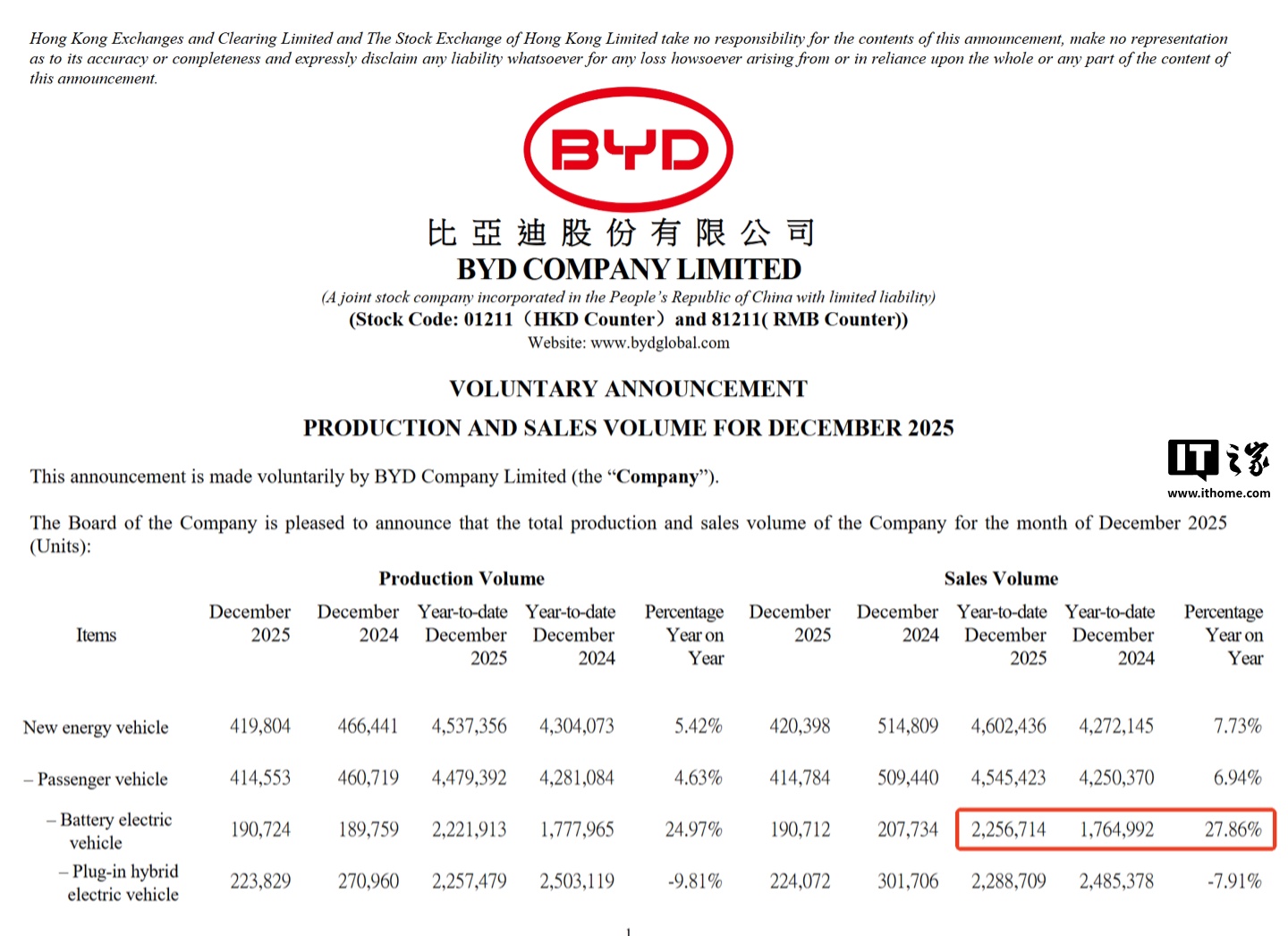
IT之家 1 月 2 日消息,英国 BBC 今天(1 月 2 日)发布博文,报道称比亚迪在 2025 年将首次超越特斯拉,登顶全球纯电动汽车(EV)年度销量冠军。 基于比亚迪官方公布的数据,2025 年共计交付 2256714 辆纯电汽车,相比较 2024 年(1764992 辆)同比增长 27.86%。IT之家附上相关截图如下: | | | | Production Volume | | | | | Sale | | --- | --- | --- | --- | --- | --- | --- | --- | --- | | | December | December | Year-to-date | Year-to-date | Percentage | December | December | Ye | | Items | 2025 | 2024 | December | December | Year on | 2025 | 2024 | D | | | | | 2025 | 2024 | Year | | | | | New energy vehicle | 419,804 | 466,441 ...



泰国汽车出口量下降了12%
Shang Wu Bu Wang Zhan· 2025-12-26 17:13
Group 1 - The core viewpoint of the articles highlights a significant decline in Thailand's automotive exports, with a 12% year-on-year decrease from January to November, totaling 78,692 vehicles, primarily due to the global shift from internal combustion engine vehicles to electric vehicles [1] - The Thai automotive industry is facing increased competition, with major manufacturers halting production of internal combustion engine models and countries imposing new carbon emission taxes on fuel vehicles, contributing to the decline in sales [1] - Exports to Asia decreased by 5.64%, to Australia by 16%, and to the European Union by 33%, while the Middle East showed a slight growth of 0.45% [1] Group 2 - Domestic automotive sales in Thailand increased by 5.2% year-on-year, reaching 546,045 vehicles, with November sales alone growing by 20.6% to 51,044 vehicles [1] - The growth in domestic sales is attributed to more affordable electric vehicle prices, lower loan costs due to reduced interest rates, and promotional activities during the Thailand International Motor Expo [2] - The automotive industry aims to produce 1.45 million vehicles by 2025, with 950,000 for export and 500,000 for the domestic market, although export volumes may not meet expectations [2] Group 3 - The Thai automotive production in November increased by 11% year-on-year to 130,222 vehicles, despite a total production decline of 1.6% from January to November, amounting to 1,341,714 vehicles [2] - Following the upcoming elections, the Thai Industrial Federation anticipates that the new government will introduce more economic stimulus measures to boost economic growth and investor confidence, positively impacting the automotive industry [3]
第五代宝马 X5 谍照曝光:配备四出排气和充电接口
Xin Lang Cai Jing· 2025-12-24 15:24
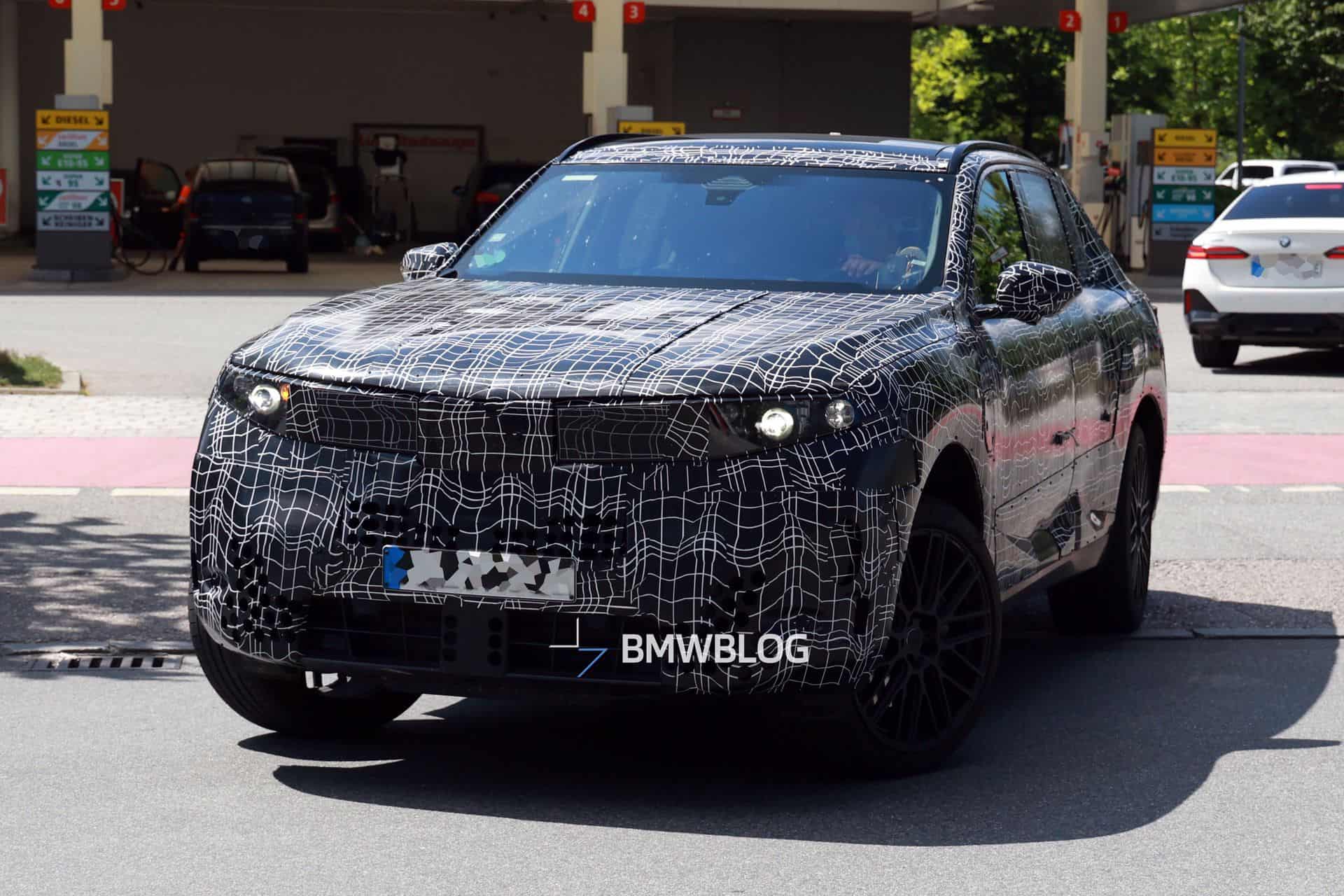
Group 1 - The fifth-generation BMW X5 (code G65) is set to launch next year with a diverse lineup, including traditional gasoline, diesel, plug-in hybrid versions, and two new electric variants, including the iX5, with a hydrogen version planned for 2028 [1] - The M Performance series for the new X5 will expand, adding a plug-in hybrid model alongside the current fuel version X5 M60i, with a prototype spotted featuring a distinctive dual exhaust system and charging interface [1][3] - The new X5 will feature a simplified and streamlined design, with traditional door handles replaced by integrated hidden pull handles, marking it as BMW's first production model to adopt this design [4] Group 2 - Speculation suggests the new hybrid performance version may be named "X5 M60e xDrive," likely equipped with a straight-six engine, providing power comparable to V8 fuel versions [3] - The new X5 is expected to include a third M Performance model, the iX5 M70 xDrive, which will be fully electric and surpass the other M Performance models in power output [4] - The G65 X5 is scheduled for production in August, with a global debut anticipated between late spring and mid-summer next year [4]
FT中文网精选:在欧盟推翻燃油车禁令之前,众车企早已不再押注纯电
日经中文网· 2025-12-18 03:01
Group 1 - The German government opposes the 2035 ban on combustion vehicles while planning to boost electric vehicle (EV) demand, indicating a focus on supporting the domestic automotive industry rather than choosing a specific technology route [5][6]. - Apostolos Tzitzikostas, a member of the European Commission, stated that the EU will remain open to all technologies, including zero-emission and low-emission fuels, suggesting that reliance solely on battery electric vehicles is not necessary [6]. - The potential delay in announcing a comprehensive plan until January indicates ongoing discussions and considerations regarding the future of vehicle technologies in Europe [6].

丰田发布3款超高端跑车,含雷克萨斯LFA后继车
日经中文网· 2025-12-05 08:00
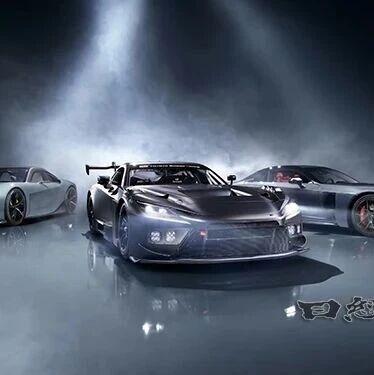
Core Viewpoint - Toyota has unveiled three flagship models, including the successor to the high-end sports car "LFA," aimed at enhancing brand appeal and adding value in the context of increasing vehicle commoditization and a shift towards electric vehicles [2][4]. Group 1: Model Details - The three models introduced are the flagship "GR GT," the race-performance "GR GT3," and the pure electric "Lexus LFA Concept," with the latter's release date yet to be determined [4]. - All three models feature an aluminum body structure and incorporate Toyota's latest technologies, representing the pinnacle of the company's engineering capabilities [2][5]. Group 2: Historical Context - The introduction of these models continues the legacy of Toyota's high-performance vehicles, tracing back to the "2000GT" launched in 1967, which achieved world-leading speed and acceleration at the time [5]. - The previous "LFA," released in 2010, was notable for its carbon fiber reinforced plastic (CFRP) body and a 4.8-liter V10 engine, showcasing Toyota's commitment to high-performance engineering [5]. Group 3: Development Philosophy - Toyota's president, Akio Toyoda, emphasized the motivation behind the development of these vehicles, stating that the company aims to transform past disappointments in racing into a driving force for creating better cars [4].

造车新势力Q3财报
2 1 Shi Ji Jing Ji Bao Dao· 2025-12-01 23:13
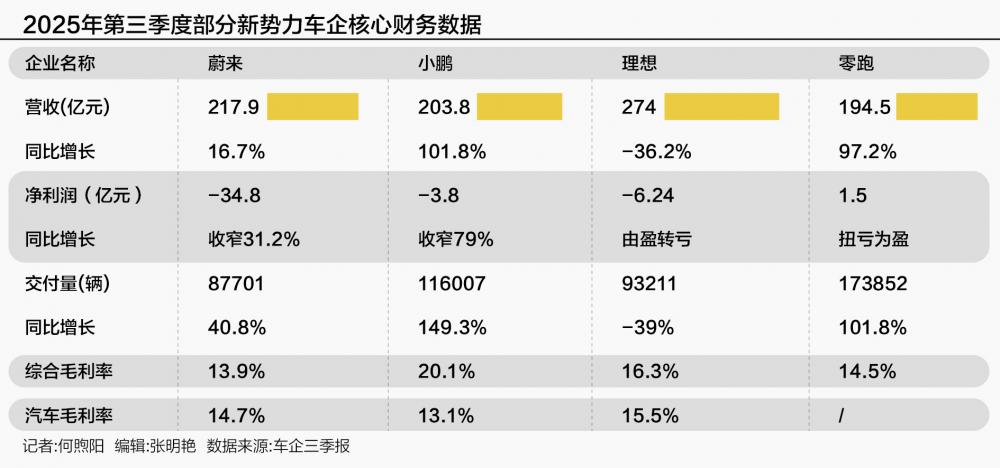
Core Insights - The competitive landscape of new energy vehicle manufacturers in China is undergoing significant changes as Q3 2025 financial reports are released, with Xpeng Motors showing remarkable growth while NIO and Li Auto face challenges [1][2][3] Company Performance - **Xpeng Motors**: Achieved a revenue of 203.8 billion yuan, with a year-on-year growth of 101.8%. Despite a net loss of 3.8 billion yuan, this represents a 79% reduction in losses compared to the previous year. The company delivered 116,007 vehicles, marking a 149.3% increase year-on-year [4][6][8] - **NIO**: Reported a revenue of 217.9 billion yuan, with a year-on-year growth of 16.7%. The net loss was 34.8 billion yuan, a 31.2% reduction from the previous year. NIO delivered 87,701 vehicles, a 40.8% increase year-on-year [4][12][14] - **Li Auto**: Generated a revenue of 274 billion yuan, but experienced a 36.2% year-on-year decline. The company reported a net loss of 6.24 billion yuan, ending an 11-quarter streak of profitability. Vehicle deliveries fell by 39% to over 93,000 units [4][9][11] - **Leap Motor**: Achieved a revenue of 194.5 billion yuan, with a year-on-year growth of 97.2%. The company reported a net profit of 1.5 billion yuan, marking its second consecutive profitable quarter. Leap Motor delivered nearly 174,000 vehicles, a 101.8% increase year-on-year [4][15][16] Strategic Adjustments - The new energy vehicle market is shifting from growth to competition based on product, technology, and brand strength, as companies adapt their strategies to survive in a more competitive environment [3][16] - **Xpeng Motors**: Focused on improving operational efficiency and profitability, launching new models like the X9 Super Range Extender, which aims to address consumer pain points regarding range and charging speed [7][8] - **Li Auto**: Shifted focus towards AI integration in vehicles, moving away from traditional family-oriented branding to emphasize technological advancements [10][11] - **NIO**: Reduced operational costs and refocused on core automotive sales, moving away from previous explorations in other business areas [12][13] - **Leap Motor**: Adjusted its strategy to enter the range extender market and target the high-end SUV segment, while also attempting to elevate its brand image [15][16]



港股异动 | 广汽集团(02238)再涨超8% 埃安UT super开启全面交付 全固态电池产线建成
Zhi Tong Cai Jing· 2025-11-28 02:05
Group 1 - GAC Group's stock has increased over 8% and has risen more than 20% this week, currently trading at 3.82 HKD with a transaction volume of 226 million HKD [1] - The Aion UT super, a pure electric vehicle developed in collaboration with JD.com and CATL, has completed its first batch of deliveries during the 2025 Guangzhou International Auto Show [1] - GAC Group's chairman announced the completion and production of a solid-state battery pilot production line in Panyu, Guangzhou, which is the first in China to meet automotive-grade mass production conditions with over 60Ah capacity [1] Group 2 - The new battery production line has achieved key breakthroughs in energy density and safety performance, with plans for vehicle testing in 2026, laying the foundation for the next generation of power battery industrialization [1]

理想拒绝进入ICU
3 6 Ke· 2025-11-26 12:15
Core Viewpoint - Li Auto's third-quarter financial results showed significant declines in delivery volume, revenue, and profit, indicating challenges in maintaining growth and profitability in a competitive market [1][3][4]. Financial Performance - Revenue for the third quarter was 27.4 billion yuan, a year-on-year decrease of 36.2% [1]. - The company reported a net loss of 624 million yuan, compared to a net profit of 2.8 billion yuan in the same period last year [1]. - Delivery volume was 93,211 units, down nearly 39% year-on-year and over 16% quarter-on-quarter [1]. Market Position and Competition - Li Auto's sales have lagged behind competitors like Xpeng and NIO, with a notable decline in monthly sales since early this year [7][8]. - The company's market capitalization was recently surpassed by Xpeng, reflecting a decline in investor confidence [8]. - The competitive landscape is intensifying, with new entrants and established players increasing pressure on Li Auto's market share [4][9]. Strategic Shift to AI - Li Auto is pivoting towards AI technology as a strategic focus, moving away from its initial emphasis on range-extended vehicles [3][9]. - The company has made significant organizational changes to support its AI strategy, including restructuring teams and leadership roles [11][12]. - Investment in AI is projected to reach 50% of the total R&D budget, amounting to 12 billion yuan for the year, indicating a strong commitment to this area [17]. Product Development and Innovation - The recent updates to the L series have not been sufficient to reverse the downward trend in sales [5]. - Li Auto's AI initiatives include the development of the VLA system, which aims to enhance driving assistance capabilities [13][16]. - The company is also exploring new product offerings, such as AI glasses and smart speakers, to expand its technology ecosystem [12].

中韩等车企为何挤入日本EV市场?
3 6 Ke· 2025-11-26 04:32
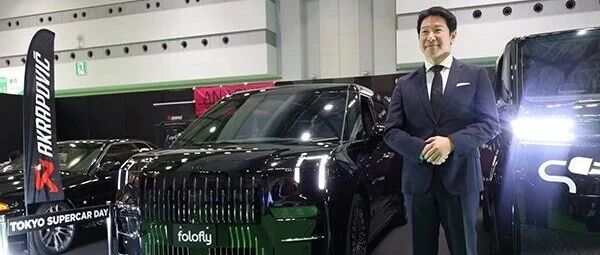
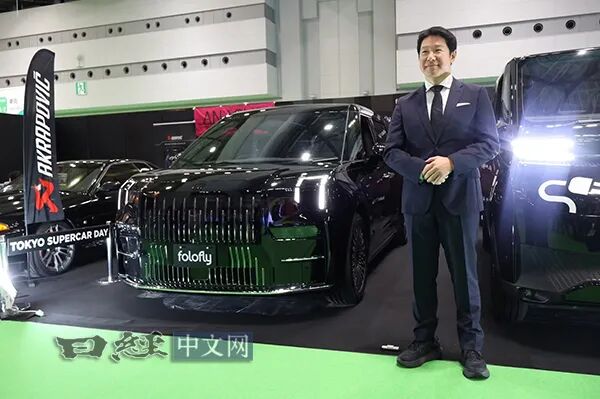
Group 1 - The Japanese market is unique for luxury 7-seater electric vehicles (EVs), with Zhejiang Geely's flagship MPV "Zeekr 009" set to enter in 2026, highlighting a gap in the market [2][3] - Folofly, a Japanese company, will begin accepting pre-orders for the "Zeekr 009" within the year, with deliveries starting in 2026, emphasizing the importance of establishing a local after-sales service network [3] - Kia plans to launch its mid-size EV "PV5" in Japan in spring 2026, collaborating with local companies to establish a sales and service network [5] Group 2 - BYD showcased its light electric vehicle "RACCO" at the Japan Mobility Show, aiming for a comprehensive strategy to penetrate the Japanese market [8] - Taiwanese company Hon Hai Precision Industry is also attempting to enter the Japanese market, with plans to release an EV based on its own developed chassis by 2027 [8] - The competition for EV market dominance in Japan is intensifying, with Chinese and Korean companies positioning themselves favorably against traditional Japanese automakers [10]

中韩等车企为何挤入日本EV市场?
日经中文网· 2025-11-26 02:47
Core Viewpoint - The Japanese market is unique for luxury 7-seater electric vehicles (EVs), with companies like Zhejiang Geely's Zeekr 009 and Kia's PV5 planning to enter this space by 2026, highlighting the competitive landscape for EVs in Japan [2][4][11]. Group 1: Market Entry and Strategy - Folofly, a Japanese company, will start selling Geely's Zeekr brand vehicles in Japan from 2026, focusing on the 6-7 seat flagship MPV Zeekr 009 [4]. - Geely, the second-largest car manufacturer in China, aims to leverage its high-performance and safety-focused EV brand, Zeekr, to capture market share in Japan [4][5]. - Kia plans to launch its mid-sized EV, the PV5, in Japan in spring 2026, collaborating with local firms to establish a sales and service network [7]. Group 2: Market Characteristics and Consumer Behavior - The Japanese EV market has a low penetration rate, with consumers being particularly discerning, which presents both challenges and opportunities for foreign brands [2][11]. - The pricing for the Zeekr 009 starts at 13 million yen (approximately 600,000 RMB), indicating a premium positioning aimed at environmentally conscious corporate clients [5]. - Kia's PV5 will have a starting price of 5.89 million yen (approximately 270,000 RMB) for the cargo version and 6.79 million yen (approximately 310,000 RMB) for the passenger version, catering to diverse consumer needs [7]. Group 3: Competitive Landscape - The global new car sales rankings show that South Korean and Chinese companies are gaining significant market share, with BYD and Geely among the top ten manufacturers [10]. - The competition in Japan is intensifying, with local automakers like Suzuki and Honda also launching new EV models, indicating a robust EV market landscape [11].