
经济萎缩

Search documents
新西兰第二季度经济萎缩幅度超过预期
Xin Hua Cai Jing· 2025-09-18 00:03
Core Viewpoint - New Zealand's economy contracted more than expected in the second quarter due to rising unemployment and global uncertainties affecting demand [1] Economic Performance - The revised GDP for the first quarter showed a growth of 0.9%, while the GDP for the three months ending in June decreased by 0.9%, contrasting with economists' expectations of a 0.3% contraction [1] Monetary Policy Implications - The sluggish response of the economy to significant interest rate cuts by the central bank suggests that cooling demand may alleviate inflationary pressures, potentially allowing the Reserve Bank of New Zealand to further lower interest rates by the end of the year [1]
美国9月纽约联储制造业指数骤降 拉响经济萎缩警报
智通财经网· 2025-09-15 13:37
Core Viewpoint - The manufacturing activity in New York sharply declined in September due to a significant drop in demand, with the New York Fed manufacturing index falling nearly 21 points to -8.7, below the market expectation of 5, indicating economic contraction [1] Group 1: Manufacturing Activity - The New York Fed manufacturing index dropped to -8.7, signaling a contraction in the manufacturing sector [1] - New orders and shipments fell to their lowest levels since April 2024 [1] - The ISM manufacturing index has contracted for six consecutive months as of August [1] Group 2: Employment and Future Outlook - The manufacturing employment index shrank for the first time since May, and the work hours index also declined [1] - The future expectations index for manufacturing appears more optimistic than the current situation, although the official statement notes that "optimism remains relatively low" [1]
经济数据接连疲软 加拿大央行或很快重启降息周期
Jin Tou Wang· 2025-09-11 04:13
Group 1 - The Canadian economy faced a GDP decline of 1.6% in the second quarter, indicating ongoing challenges ahead [1] - The economic contraction was primarily driven by severe net trade impacts, although the likelihood of a similar situation recurring is low [1] - Revised GDP data for June and preliminary estimates for July suggest insufficient economic growth momentum, indicating that third-quarter performance may fall short of the Bank of Canada's previous expectations [1] Group 2 - Capital Economics posits that the Bank of Canada may soon resume interest rate cuts in response to weakened economic growth and heightened downside risks [1] - The USD/CAD exchange rate is testing the 9-day Exponential Moving Average (EMA) at 1.3801, with a potential breakthrough improving short-term price momentum [1] - If the USD/CAD surpasses the 1.3801 level, it may target the four-month high of 1.3924 established on August 22, with further resistance at the five-month high of 1.4016 reached on May 13 [1]
加拿大第二季度GDP按年率计算萎缩1.6%
Sou Hu Cai Jing· 2025-08-30 10:12
Core Viewpoint - Canada's GDP contracted by 1.6% in the second quarter, marking the first decline in seven quarters, slightly exceeding the Bank of Canada's July forecast of a 1.5% decrease [1] Economic Performance - The contraction in GDP was primarily due to a significant drop in goods exports and reduced business investment in machinery and equipment [1] - Exports fell by 7.5% in the second quarter, heavily impacted by U.S. tariffs, with passenger car and light truck exports plummeting by 24.7%, industrial machinery and equipment exports declining by 18.5%, and tourism service exports decreasing by 11.1% [1] Domestic Demand - Despite the export decline, domestic demand grew by 3.5%, indicating a relatively healthy domestic economic condition [1] - Increases in business inventories, growth in household spending, and a reduction in goods imports helped mitigate the negative impacts of the export downturn [1] Future Implications - Analysts suggest that the unexpected extent of the economic slowdown may increase the likelihood of the Bank of Canada lowering interest rates in September to stimulate economic recovery [1]
关税冲击显现 德国Q2经济萎缩幅度超预期
智通财经网· 2025-08-22 09:03
Economic Performance - Germany's GDP contracted by 0.3% in Q2, worse than the initial estimate of a 0.1% decline, primarily due to a significant drop in manufacturing performance following the end of inventory buildup by U.S. companies [1][3] - Investment in Germany decreased by 1.4%, and private consumption did not provide the expected support to the economy [1][3] Economic Outlook - The economic contraction represents a major setback for Germany, undermining expectations of recovery from the economic downturn caused by the Russia-Ukraine conflict [3] - The German economy is experiencing a reversal of the inventory buildup effect and is facing the initial comprehensive impact of U.S. tariffs, with a potential stagnation expected until next year [3] - The German central bank warned that GDP may not grow in Q3, with stagnation being the most likely outcome [3] External Factors - Germany's economy is affected by global economic sluggishness, geopolitical uncertainties, and long-standing issues such as an aging workforce and bureaucratic inefficiencies [3] - A recent agreement between the EU and the U.S. to impose a 15% tariff on most EU goods has faced strong criticism from the German industrial sector [3] Recent Developments - Despite the economic challenges, there is some optimism due to the new government's plans for significant increases in defense and infrastructure spending, which are expected to show effects by 2026 [3] - The S&P Global's German Composite Purchasing Managers' Index indicated an unexpected acceleration in private sector activity in August, suggesting that the manufacturing sector may be nearing the end of a three-year slump [4]

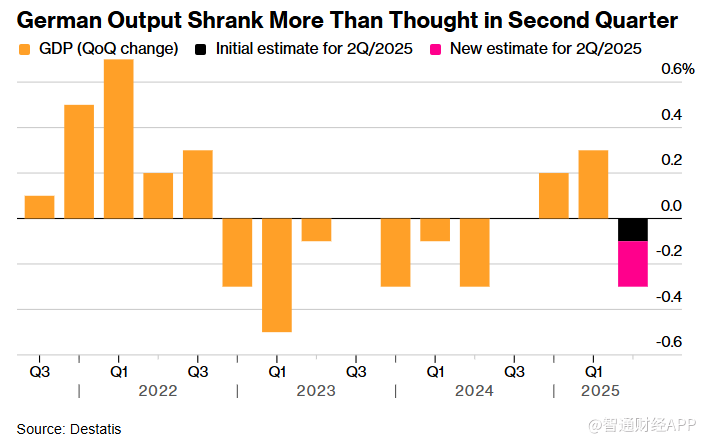
因美国需求疲软,德国第二季经济萎缩0.1%
news flash· 2025-07-30 08:47
Core Viewpoint - The German economy contracted by 0.1% in the second quarter, contrasting with a 0.4% growth in the first quarter, primarily due to weakened demand from the United States [1] Economic Performance - The contraction in the second quarter is attributed to a slowdown in U.S. demand, which previously led to increased imports of German goods as importers anticipated higher tariffs [1] - Investment in Germany saw a decline in the second quarter, while consumption and government spending increased compared to the previous three months [1]
英国经济连续两月萎缩!美国关税与多成本压力致二季度或面临停滞风险
智通财经网· 2025-07-11 07:01
Economic Performance - The UK economy has entered a recession for the second consecutive month, with May GDP declining by 0.1%, slightly better than April's 0.3% drop but still below economists' expectations of a 0.1% growth [1] - If June's output falls by 0.4% or more, the second quarter will show a significant deterioration compared to the 0.7% growth in the first quarter [1] Currency and Fiscal Pressure - Following the data release, the British pound fell by 0.3% to 1.3545 USD, reflecting ongoing economic concerns [1] - The Labour government faces dual pressures to support fiscal spending goals through economic growth while managing recent policy reversals that have exacerbated fiscal challenges [1] Sector Performance - Manufacturing and construction sectors were the main contributors to the economic decline, with May output experiencing the largest drop in nearly 18 months [3] - The decline is attributed to ongoing economic weakness from April, U.S. tariff pressures, and rising household energy bills and property taxes [3] - The services sector also showed weak performance, with only a 0.1% growth in May, and retail sales significantly decreased [3] Employment and Taxation - Employers are facing an additional £26 billion in new payroll taxes, alongside rising regulated prices for services like rail fares and water, which are contributing to the economic downturn [5] - Since the budget announcement last October, over 250,000 jobs have been cut as businesses respond to significant increases in minimum wage [5] Monetary Policy Outlook - With inflation pressures easing, the market anticipates that the Bank of England will initiate interest rate cuts in August, with another expected by the end of the year [5] - Analysts suggest that the growth seen in the first quarter was a one-off event, primarily driven by preemptive production increases before the implementation of U.S. tariffs [5]
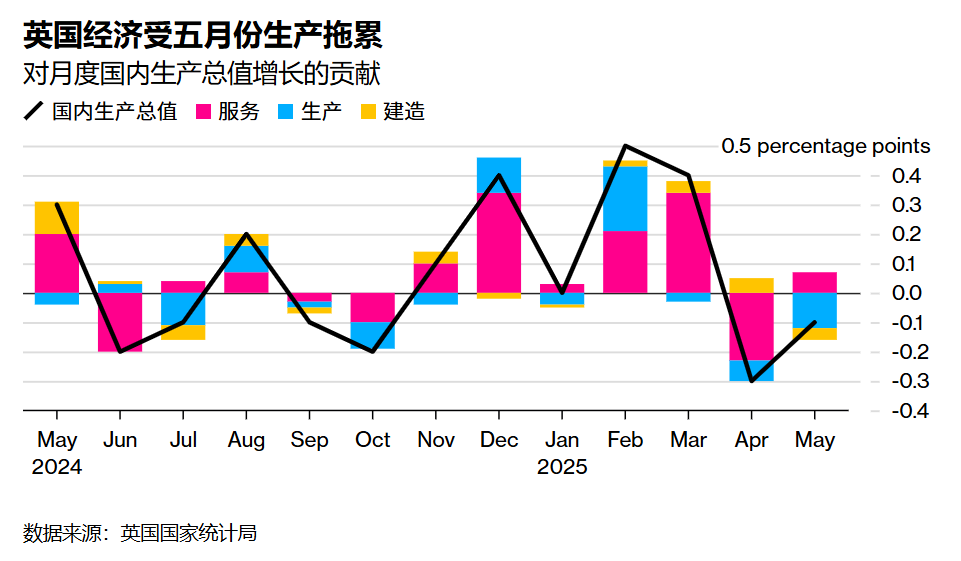
英国经济连续第二个月录得萎缩,对斯塔默造成新打击
news flash· 2025-07-11 06:29
Core Viewpoint - The UK economy has contracted for the second consecutive month, indicating challenges for businesses and consumers in recovering from tariffs and tax increases [1] Economic Performance - In May, the GDP decreased by 0.1% following a 0.3% contraction in the previous month, suggesting a potential economic shrinkage in the second quarter [1] - The ongoing economic difficulties are compounded by recent political setbacks faced by the government [1] Government Response - The Labour government is relying on stronger economic growth to fund its spending goals, which have been complicated by a significant policy shift regarding welfare cuts and winter fuel payments for pensioners [1]
机构:预计加拿大Q2经济将萎缩,加央行下月将降息
news flash· 2025-06-27 13:24
Core Viewpoint - Canada is expected to experience an economic contraction in Q2, with consecutive declines in April and May, marking the first such occurrence since 2017 before the pandemic [1] Economic Outlook - Desjardins economists predict a slight contraction in Canada's GDP for the second quarter, indicating a downturn in economic activity [1] - The tracking of Q2 GDP by Desjardins shows clearer signs of this mild contraction [1] Monetary Policy Implications - The expectation is that the Bank of Canada will lower interest rates in the upcoming month in response to the economic conditions [1]
美国第一季度经济折合年率萎缩0.5%
news flash· 2025-06-26 12:39
Group 1 - The core point of the article is that the U.S. Department of Commerce reported a contraction in the economy, with a 0.5% annualized decline in the first quarter [1]