获利了结

Search documents
金属普跌 期铝自一周低位回升关税下调前景加剧定价不确定性【2月13日LME收盘】
Wen Hua Cai Jing· 2026-02-14 00:20
Core Viewpoint - Aluminum prices on the London Metal Exchange (LME) fell to a one-week low but recovered some losses, with tariff reduction prospects increasing pricing uncertainty [1][3]. Group 1: Aluminum Market - On February 13, LME three-month aluminum dropped by $22.5, or 0.73%, closing at $3,077.5 per ton, reaching its lowest level since February 6 [1][2]. - The prospect of the U.S. reducing aluminum tariffs has added uncertainty to trade flows and pricing, with U.S. buyers' prices dropping 6.8% to 93 cents per pound [3]. - Analysts indicate that the main market impact comes from primary aluminum tariffs, and any tariff reductions on derivative products will not affect LME aluminum prices unless they extend to primary metals [3]. Group 2: Other Base Metals - Other industrial metals experienced declines due to profit-taking and risk aversion, with LME three-month copper rising slightly by $5.5, or 0.04%, to $12,881.0 per ton, moving away from its record high of $14,527.50 set on January 29 [4]. - LME three-month zinc fell by $36.5, or 1.08%, closing at $3,337.5 per ton [5]. - LME three-month lead decreased by $17.5, or 0.88%, to $1,960.0 per ton, while nickel dropped by $444, or 2.55%, to $16,984.0 per ton [6]. - LME three-month tin saw a significant drop of $2,961, or 5.96%, closing at $46,702.0 per ton [7]. Group 3: Supply and Export Regulations - Indonesia is considering a plan to ban the export of various raw materials, including tin, in the coming years [8]. - The country has already banned the export of several raw ores, including nickel ore, bauxite, and copper concentrate, to attract domestic processing industry investment and promote high-value product exports [9].

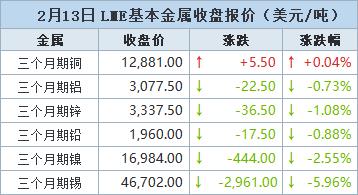
现货黄金跌破4900美元!白银暴跌10%+,普通人抄底必亏
Sou Hu Cai Jing· 2026-02-14 00:17
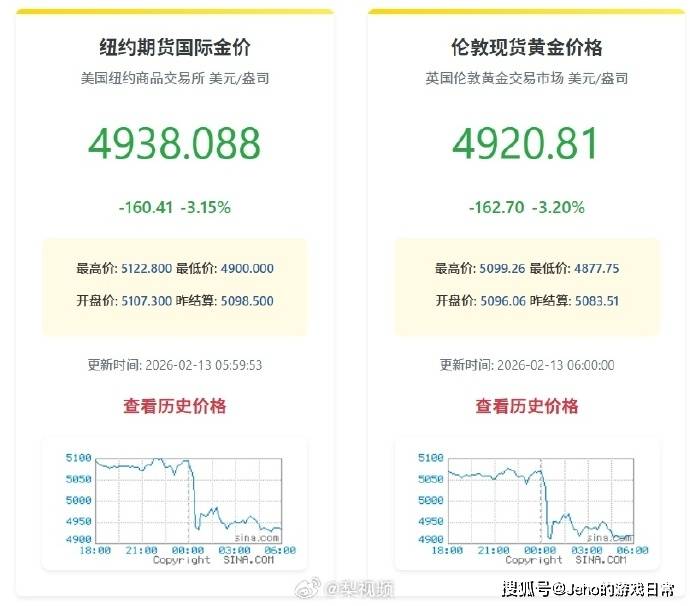
Core Viewpoint - The recent sharp decline in precious metals, particularly gold and silver, has surprised many investors, with gold dropping below $4900 and silver experiencing a single-day drop of over 10% [1][3]. Market Performance - As of the latest update, spot gold has decreased by 3.27% to $4917.09 per ounce, with a minimum price of around $4878 during trading. COMEX gold futures fell by 3.19% to $4936 per ounce [3]. - Silver has seen a more severe decline, with spot silver dropping 10.84% to $75.07 per ounce, and COMEX silver futures down 10.93% to $74.75 per ounce, marking one of the largest single-day declines since 2026 [3]. Economic Factors - The primary reason for the sharp decline in precious metals is the cooling expectations for interest rate cuts by the Federal Reserve, driven by stronger-than-expected U.S. employment data, which showed an addition of 130,000 jobs and a drop in the unemployment rate to 4.3% [5]. - A stronger U.S. dollar has also negatively impacted precious metals, making them more expensive for global buyers and reducing demand [5]. Trading Dynamics - Algorithmic trading has exacerbated the price drop, particularly through momentum-based risk-off strategies that trigger automatic sell orders when key price levels are breached [7]. - Profit-taking by investors who had previously benefited from rising prices has further contributed to the downward pressure on gold and silver prices [7]. Investment Guidance - Investors are advised against attempting to "buy the dip" due to the high volatility and potential for further declines in precious metals [9]. - For those already holding gold or silver investments, a long-term perspective is recommended, while short-term traders should consider cutting losses [9][10]. Future Outlook - Analysts suggest that precious metals may continue to experience volatility, with upcoming U.S. CPI data being a critical factor influencing future price movements [10]. - Long-term forecasts remain bullish for gold, with institutions like JPMorgan and Goldman Sachs predicting prices could exceed $6000 per ounce by year-end, while silver is expected to face short-term fluctuations but has a tight supply outlook [10].
艾马克技术股价回调7.97%,财报后获利了结与板块调整是主因
Jing Ji Guan Cha Wang· 2026-02-13 21:10
Company Overview - AMKR's stock price experienced a significant decline of 7.97% to $47.48 on February 13, 2026, following a rapid increase after the release of its Q4 2025 earnings report on February 9, which exceeded expectations [1] - The stock had risen a cumulative 13.98% over three consecutive trading days, closing at $56.26 on February 11, prompting some investors to take profits, leading to increased selling pressure [1] Industry Context - On February 13, the semiconductor sector in the U.S. saw a decline of 0.33%, with the Nasdaq index down 0.22%, indicating a weak industry sentiment that negatively impacted individual stocks [2] - As an outsourced semiconductor packaging and testing service provider, AMKR's stock price fluctuations are closely tied to the overall market conditions of the sector [2] Financial Performance - The Q4 earnings report indicated a year-over-year net profit increase of 62.58% and a gross margin improvement to 16.66% [3] - Despite the positive earnings results, the stock's rapid ascent led to a trailing twelve months (TTM) price-to-earnings ratio of 31.65, causing some investors to adopt a cautious stance regarding short-term valuations [3] - Needham raised the target price for AMKR to $65 on February 10, but the market may need time to digest the recent price increases [3]

CPI前夜惊魂!AI恐慌拖累金属,黄金、白银盘中闪崩
Jin Shi Shu Ju· 2026-02-12 22:31
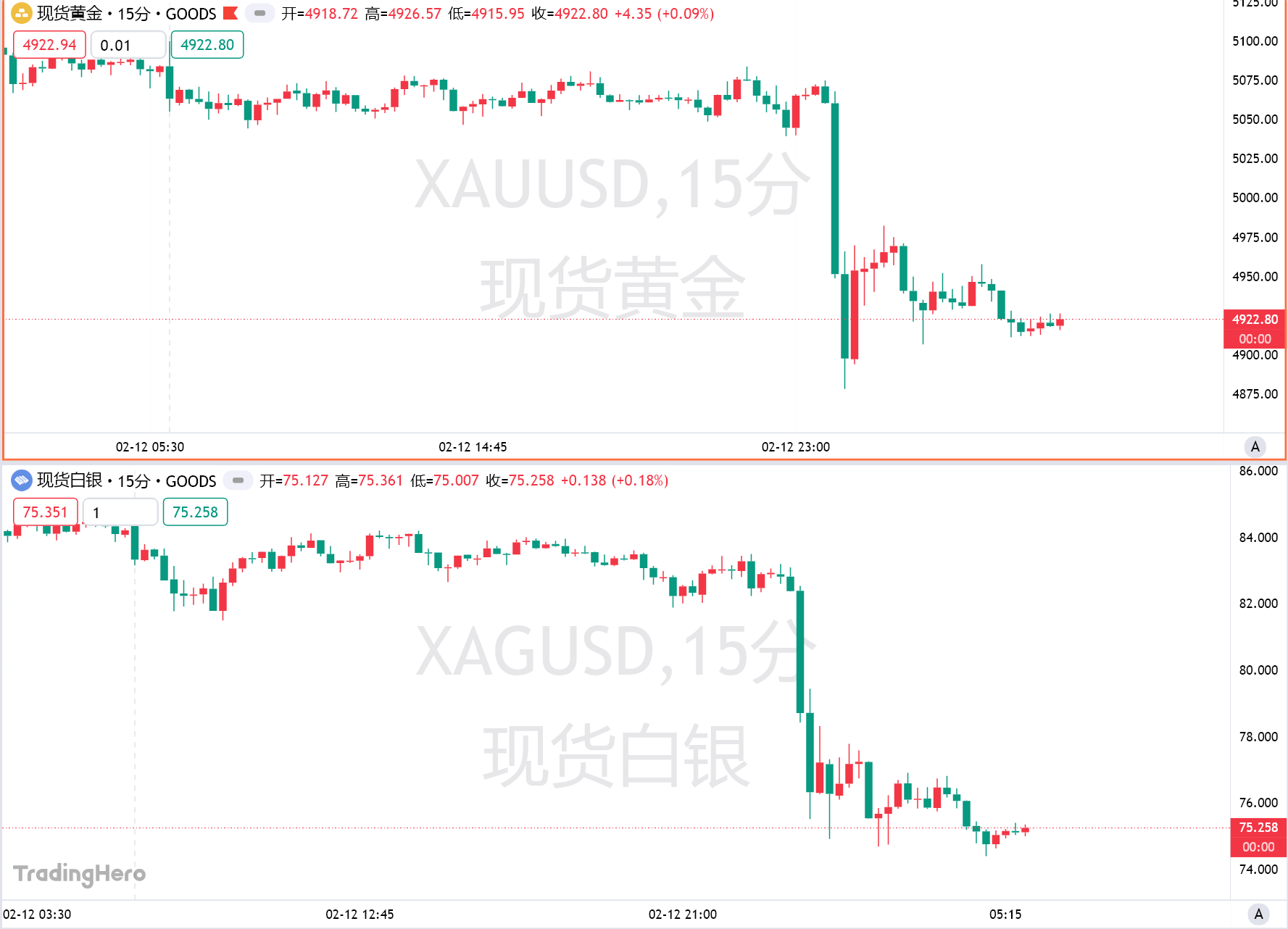
Core Viewpoint - The financial markets experienced a significant sell-off, leading to a sharp decline in gold and silver prices as investors liquidated positions to cover losses in the stock market [1][2]. Group 1: Market Reactions - Gold prices plummeted nearly $200 within 30 minutes, closing down over 3% at $4878.37 per ounce, while silver fell nearly $9, closing at $75.26 per ounce, a drop of 10.64% [1]. - The sell-off in precious metals was partly driven by profit-taking after a recent surge in prices, which had been fueled by speculative buying [3][4]. - The sudden drop in metal prices was characterized as a "risk-off" market sentiment, where even safe-haven assets like gold were sold off by investors in need of liquidity [2][4]. Group 2: Technical Analysis and Market Sentiment - The recent volatility in gold and silver prices was attributed to a lack of new catalysts, leading to sharp fluctuations within a narrow range [4]. - Analysts noted that stop-loss orders triggered below $5000 contributed to the rapid decline in prices, indicating a chain reaction in the market [4]. - The overall sell-off appeared to be driven by algorithmic trading and systematic strategies, particularly from Commodity Trading Advisors (CTAs) reacting to key price levels being breached [4]. Group 3: Future Outlook - Despite the recent downturn, several banks maintain a bullish outlook on gold, citing ongoing factors such as geopolitical tensions and a shift in global capital from traditional assets [5]. - Major financial institutions like JPMorgan and Deutsche Bank project gold prices to reach between $6000 and $6300 per ounce by year-end [5]. - Market participants are closely monitoring upcoming economic data, such as the U.S. core CPI, which is expected to influence Federal Reserve interest rate expectations and potentially support gold prices [5].
利西亚车行股价下跌6.79%,受市场环境及获利了结压力影响
Jing Ji Guan Cha Wang· 2026-02-12 19:00
Group 1 - The core point of the article is that LMC Automotive (LAD.N) experienced a significant stock price decline of 6.79% on February 12, 2026, closing at $298.66, primarily influenced by broader market trends and sector performance [1][3] Group 2 - On the day of the decline, major U.S. stock indices showed notable adjustments, with the Nasdaq down 1.50% and the Dow Jones down 0.99%, contributing to a weak market sentiment that pressured individual stocks [1] - The automotive retail sector, to which the company belongs, also saw a decline of 2.88%, further impacting the stock's performance [1] Group 3 - The company's Q3 2025 financial report, which ended on September 30, 2025, indicated year-over-year growth in both revenue and net profit; however, the stock had already accumulated gains post-announcement [2] - On February 12, the trading volume reached $74.22 million with a turnover rate of 1%, suggesting that some investors opted to take profits after the positive earnings report [2] - The stock experienced a trading range of 7.29% on that day, hitting a low of $298.24, with a volume ratio of 0.78 indicating lower trading activity compared to recent averages [2] Group 4 - The decline on February 12 is attributed to a combination of overall market weakness, sector fatigue, and technical adjustments in the stock [3]
火神材料成交激增股价下跌,财报前获利了结与行业情绪成主因
Jing Ji Guan Cha Wang· 2026-02-11 21:54
Core Viewpoint - The stock of Vulcan Materials Company (VMC.N) experienced a surge in trading volume but a decline in price on February 11, 2026, indicating a divergence in market sentiment ahead of its upcoming earnings report [1]. Group 1: Stock Price Movement - On February 11, 2026, the trading volume reached $507 million (1.5767 million shares), a 62.5% increase from the previous day, while the stock price fell by 3.21% to close at $319.78 [1]. - The stock price movement was influenced by the anticipation of earnings expectations being already priced in, as the Q3 2025 earnings report showed revenue of $6.029 billion (up 8.35% year-over-year) and net profit of $825 million (up 33.20% year-over-year) [1]. - The price-to-earnings ratio (TTM) on that day was 38.02, significantly above the industry average, indicating pressure from high valuations and intensified selling activity [1]. Group 2: Industry Policy and Environment - The construction materials sector overall weakened, with a decline of 3.09%, underperforming the broader market (Dow Jones down 0.13%) [2]. - Concerns about the Federal Reserve maintaining high interest rates may suppress demand in real estate and infrastructure, negatively impacting the core business of construction aggregates [2]. - Economic data, such as January's new housing starts falling short of expectations, raised worries about a slowdown in the construction industry's short-term growth, directly affecting Vulcan Materials' performance outlook [2]. Group 3: Market Dynamics and Technical Analysis - The stock price reached a high of $329.01 before retreating, hitting a low of $319.28, breaking below the psychological support level of $330 [3]. - The volume ratio was 1.30, indicating that bearish sentiment dominated during active trading [3]. - Despite the company's solid fundamentals, with a net profit growth of 33.20% in Q3 2025, some funds shifted away from high-valuation cyclical stocks towards defensive assets due to sector rotation [3]. Group 4: Recent Events of Interest - There is a cautious sentiment in the market ahead of Vulcan Materials' upcoming Q4 2025 and full-year earnings report, with particular concerns about potential changes in infrastructure policy affecting future order growth [4]. - The combination of profit-taking pressure before the earnings report and pessimistic sentiment in the construction materials sector contributed to the unusual trading activity of increased volume but decreased price [4]. - Future attention should focus on the actual performance of the company's earnings report and developments in U.S. infrastructure policy [4].
惊魂一周!金价、银价反弹:现货黄金日内涨超1%,现货白银日内涨幅扩大至3%
Sou Hu Cai Jing· 2026-02-10 16:57
Core Viewpoint - The precious metals market experienced extreme volatility in early February 2026, with gold and silver prices plummeting and then rebounding sharply, leading to significant market divergence regarding future trends [1][3]. Group 1: Market Dynamics - Gold reached a historical high of $5598.75 per ounce on January 29, 2026, before crashing to $4403.64 within three trading days, marking a single-day drop of over 10% [1]. - Silver saw an even more dramatic decline, falling from $120 to $71.31, with a maximum single-day drop of 35% [1]. - Following the crash, gold rebounded to over $5000, while silver experienced a daily increase of 3% [1]. Group 2: Triggers of Volatility - The volatility was triggered by the nomination of Kevin Walsh, known for his hawkish stance, as the next Federal Reserve Chair, leading to expectations of tighter monetary policy [3]. - The Chicago Mercantile Exchange raised margin requirements, forcing leveraged long positions to liquidate, which exacerbated the market downturn [3][4]. - A significant technical factor was the extreme concentration of long positions, with gold and silver having risen 67% and 120% respectively from December 2025 to January 2026 [3]. Group 3: Institutional Behavior - Institutional investors rapidly exited the market during the downturn, with many international banks significantly reducing their net long positions [6]. - Retail investors, lacking risk management tools, became passive victims of the liquidity crisis [6]. - The divergence in supply and demand fundamentals amplified the volatility, with silver's industrial demand increasing significantly, while gold remained more reliant on monetary attributes [6]. Group 4: Market Outlook - Analysts are divided on the future of gold prices, with some predicting a long-term decline to $4000 or even $3000 by 2027, while others maintain bullish forecasts, raising year-end price targets to $6300 [7]. - The market is experiencing a structural shift, with concerns about the independence of the Federal Reserve easing due to the nomination of a qualified candidate [11][14]. - The extreme volatility has led to a re-evaluation of asset pricing logic, with warnings about the fragility of the silver market compared to gold [16].

震荡下跌,港股三大指数全绿,科网巨头齐跌!汽车股爆发,蔚来涨近7%,理想、小米、比亚迪等齐涨
Mei Ri Jing Ji Xin Wen· 2026-02-06 11:33
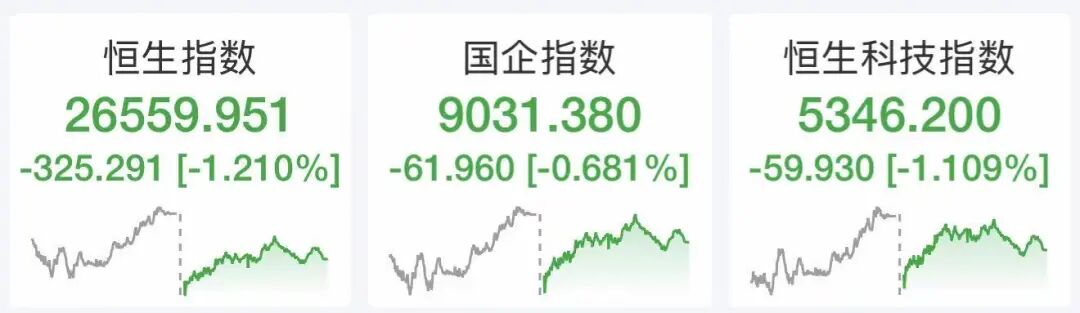
Market Overview - The Hong Kong stock market experienced a decline across all major indices, with the Hang Seng Index falling by 1.21%, the Hang Seng China Enterprises Index down by 0.681%, and the Hang Seng Tech Index decreasing by 1.109% [1] - Technology stocks saw a significant drop, with Alibaba falling nearly 3%, Meituan, Kingsoft, JD Health, Baidu, and NetEase all declining over 2%, while Tencent dropped nearly 2% [2][3] Automotive Sector - The automotive sector showed positive performance, with NIO rising nearly 7%, Li Auto increasing over 3%, and Leap Motor gaining more than 5% [4] - NIO announced an earnings forecast indicating that it expects to achieve an adjusted operating profit of approximately 700 million to 1.2 billion yuan for Q4 2025, marking the company's first quarterly adjusted operating profit in its 11-year history [4] Market Outlook - Analysts suggest that the recent adjustments in the Hong Kong stock market are primarily technical corrections rather than a trend reversal, attributing the decline to overly optimistic market sentiment and external factors such as liquidity concerns stemming from the nomination of the Federal Reserve Chairman [5] - Despite the recent downturn, the low valuation of Hong Kong stocks and the continued inflow of southbound capital provide support for the market [5] - A notable shift in capital is observed, moving from recently high-performing tech stocks to more defensive sectors, such as consumer and dividend stocks, which are favored for their lower valuations and stable performance [5] - Resource stocks, particularly coal, have shown strong performance due to events like Indonesia's suspension of coal spot exports, indicating a market focus on physical assets and short-term catalysts [5]



老溉邓白银,史诗级暴跌!黄金,40年最大跌幅!-美股-特朗普-美元指数-沃什-收盘_新闻
Sou Hu Cai Jing· 2026-02-05 09:41
Group 1 - The core point of the news is the significant drop in precious metal prices, with gold experiencing its largest single-day decline in 40 years and silver hitting a historic intraday drop of 36% [1][2][4] - On January 31, spot gold prices fell over 12%, reaching a low of $4682 per ounce, while closing down 9.25% at $4880 per ounce [2][4] - Spot silver prices dropped to a low of $74.28 per ounce, closing down 26.42% at $85.259 per ounce [4][8] Group 2 - The sell-off in precious metals was triggered by the strengthening of the US dollar, following the announcement of Kevin Walsh as the new Federal Reserve Chairman, which raised concerns about the Fed's independence [4][6][7] - The dollar index saw a significant increase, marking its largest single-day rise since July of the previous year, which negatively impacted investor confidence in gold and silver [4][5] - The market was already experiencing a demand for a correction, and the combination of factors, including the Fed chair nomination and broader capital flow dynamics, acted as a catalyst for profit-taking [4][6] Group 3 - The broader US stock market also faced declines, with major indices closing lower due to uncertainties surrounding Federal Reserve policies, inflation pressures, and geopolitical risks [5] - The gold sector saw substantial losses, with major companies like Barrick Gold and AngloGold experiencing declines of over 10% [5] - The sell-off in precious metals was characterized by panic selling and profit-taking, particularly among leveraged positions, which exacerbated market volatility [8][12]


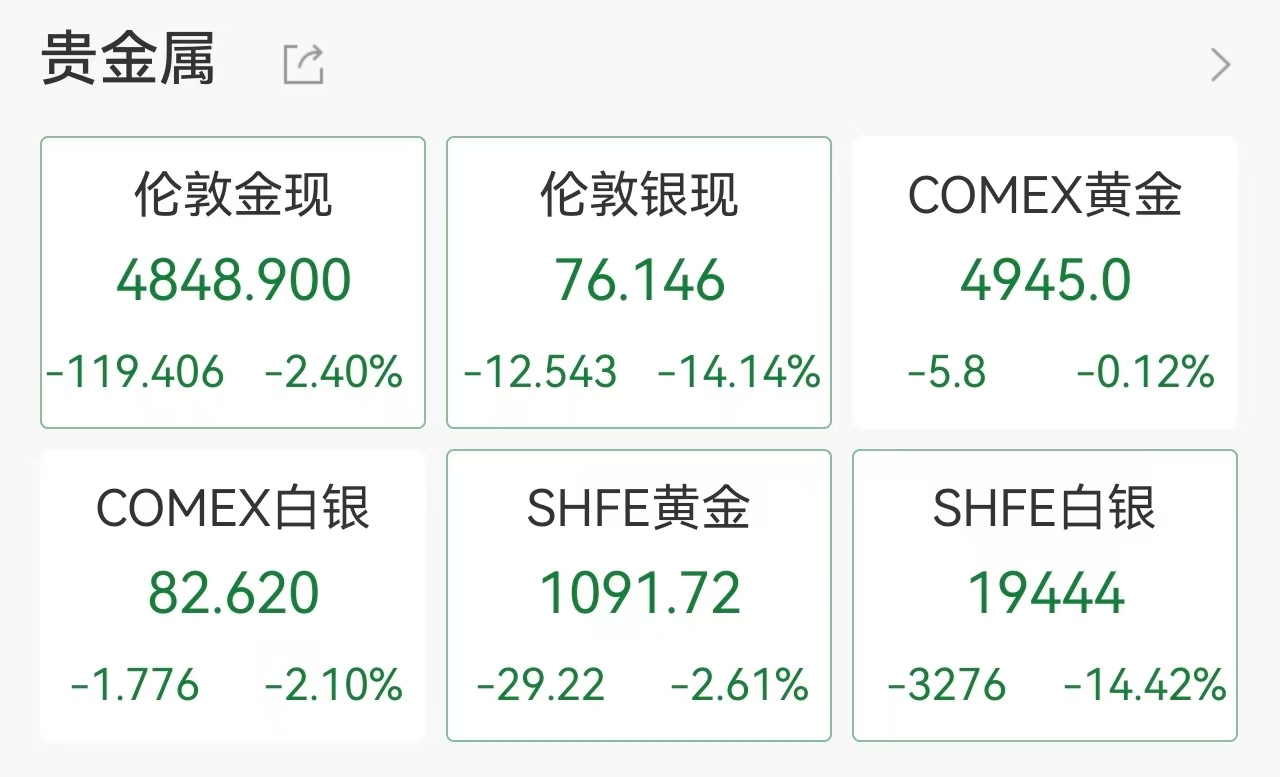
金银惊魂跳水!现货黄金跌超2%、现货白银一度跌超17%,中东局势降温+美数据强劲,历史级回调还是趋势反转?
Jin Rong Jie· 2026-02-05 04:05
Core Viewpoint - The recent sharp decline in gold and silver prices is attributed to a combination of reduced geopolitical tensions and resilient U.S. economic data, which has diminished safe-haven demand [1] Group 1: Market Performance - As of the latest report, spot gold has dropped by 2.4% to $4848.9 per ounce, previously falling over 3.6% below $4800 per ounce; spot silver has decreased by 14.14% to $76.146 per ounce, having plummeted over 17% below $74 per ounce [1] - Last Friday marked the beginning of a significant downturn, with silver prices crashing by 26%, the largest drop in history, while gold fell by 9%, representing the worst single-day performance in nearly a decade [1] Group 2: Economic Indicators - Upcoming U.S. economic data to watch includes JOLTS job openings and initial jobless claims for the week ending January 31 [1] - The strengthening U.S. dollar and stable U.S. Treasury yields have also contributed to the downward pressure on gold prices [1] Group 3: Influential Factors - The nomination of Kevin Warsh as the next Federal Reserve Chairman by Trump has been identified as a catalyst for market panic, as Warsh is known for his hawkish stance on inflation and support for quicker interest rate cuts [1] - Warsh's views on excessive quantitative easing and support for balance sheet reduction may influence the narrative around de-dollarization and fiat currency proliferation [1] Group 4: Historical Context - Historical analysis indicates that significant price increases in gold typically require around six months to digest, with the current rapid price increases leading to a necessary correction to alleviate overbought conditions [2] - The report highlights that gold experienced 55 record highs in the previous year and surged over 20% in less than a month at the start of this year, indicating an unsustainable rate of increase [2]