
逢低买入

Search documents
一天砸入40亿美元!散户硬赌特朗普TACO再次完胜
Jin Shi Shu Ju· 2026-01-23 12:47
Core Insights - The article discusses the resilience of retail investors in the face of market volatility, particularly during a significant drop in the S&P 500 index, where retail investors injected $4 billion into U.S. stocks on Tuesday and an additional $2.3 billion on Wednesday, coinciding with a market rebound [2][3]. Group 1: Market Reactions - Retail investors have adopted a "buy the dip" strategy, which gained traction during the COVID-19 pandemic and matured during the meme stock frenzy in 2021, now seeing renewed application during Trump's second term [2]. - The trading logic dubbed "TACO" (Trump Always Comes Out) suggests that any market drop due to tariff threats is viewed as a "golden buying opportunity," a strategy that has proven effective in previous instances [2][3]. - The influx of retail investment has been significant, with exchange-traded funds (ETFs) capturing a large portion of this demand, particularly broad stock ETFs, which saw record inflows during the week ending January 21 [2]. Group 2: Retail Investor Behavior - Retail trading activity has reached historical highs, with retail investors accounting for nearly a quarter of U.S. exchange activity, demonstrating their strong presence in the market [3]. - Technology stocks continue to dominate retail investor demand, followed by consumer discretionary and communication services, with Tesla and Amazon being top picks, alongside other tech stocks like Netflix and Micron Technology [4]. - Retail investors are also actively engaging in the derivatives market, with daily trading volumes of stocks and options contracts exceeding average levels from January 2020 to 2025 by over 40% [4].
鲍威尔多年隐忍后与特朗普硬刚!“卖出美国”重返,美股为何收于历史新高?
Sou Hu Cai Jing· 2026-01-13 06:59
Group 1 - The U.S. stock market reached a new historical high on January 13, driven by investor "buying the dip" despite concerns regarding the independence of the Federal Reserve [1] - The S&P 500 index rose by 0.2% to close at 6,977.32 points, while the Dow Jones Industrial Average also increased by 0.2% to 49,590.20 points, both marking record closing highs [1] - The Nasdaq Composite index saw a 0.3% increase, coming within 0.9% of its historical closing high from late October of the previous year [1] Group 2 - Concerns about the Federal Reserve's independence were reignited, with Fed Chair Jerome Powell stating that threats of criminal charges against him were "unprecedented" [1] - Powell indicated that public service sometimes requires standing firm in the face of threats, suggesting political pressure aimed at influencing monetary policy [1] - Morgan Stanley's Andrew Slimmon noted that the rise in U.S. stocks is fundamentally driven and is expected to continue until 2026, indicating a healthy part of a sustained bull market [3] Group 3 - The tension in the market led to a temporary resurgence of the "sell America" trade theme, particularly affecting the dollar and long-term U.S. Treasury yields [2] - Strong demand was observed in the 3-year and 10-year U.S. Treasury auctions, alleviating upward pressure on bond yields, with the 3-year yield at 3.604% and the 10-year yield at 4.184% [2] - Despite concerns, foreign investors bought more U.S. Treasuries than they sold last year, indicating a "hedge against America" strategy rather than a core concern for the year [2]
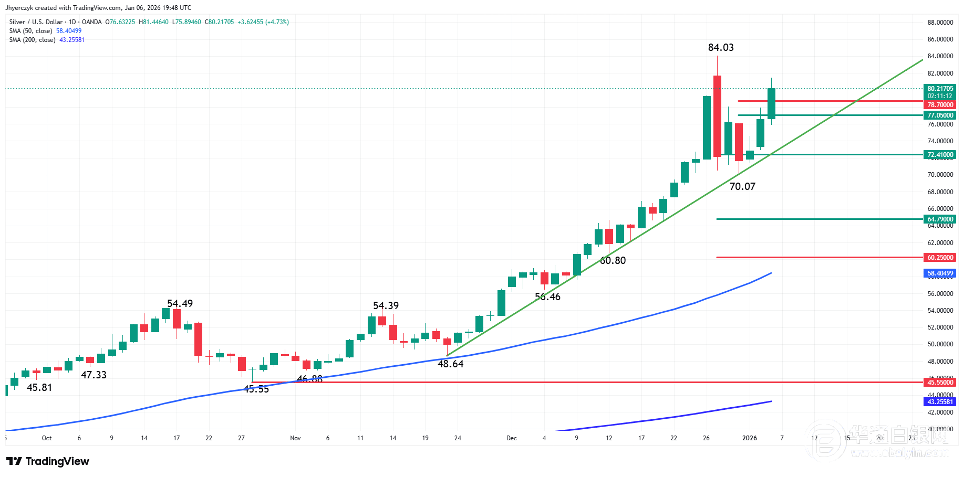
白银预测:市场转向“追涨”模式,84.03美元目标在望
Sou Hu Cai Jing· 2026-01-07 06:14
Core Viewpoint - Silver prices have broken through the resistance level of $78.70, reaching $81.45, and are nearing the record high of $84.03 [1][4][6] Group 1: Market Dynamics - Investors have shifted from a "buying the dip" strategy to an aggressive "buying the rally" approach, anticipating silver prices to reach three-digit levels [2][7] - The recent surge in silver prices is supported by strong demand from solar panels, electric vehicles, and AI infrastructure, despite supply shortages [8] - The current bullish market is driven by a combination of supply-demand dynamics, ETF demand, dovish Federal Reserve stance, and geopolitical tensions [9] Group 2: Economic Indicators - The upcoming non-farm payroll report is expected to influence silver prices significantly, with a strong labor market potentially leading to a pause in the upward trend [3][10] - Recent economic data, including a decline in U.S. manufacturing activity, has increased the likelihood of the Federal Reserve considering rate cuts earlier than previously anticipated [10]

1 No-Brainer Stock Down 55% to Buy on the Dip Right Now
The Motley Fool· 2025-12-29 10:10
Core Viewpoint - Sprouts Farmers Market has experienced significant stock price fluctuations, rising fivefold in two years before a 55% drop from its peak, highlighting the volatility of growth stocks [1][2] Group 1: Company Growth and Strategy - Sprouts Farmers Market focuses on health-oriented grocery items that are more affordable than premium chains, aiming to provide a "farmers market" experience at scale [3][4] - The company operates 464 stores across 24 states and plans to achieve 10% annualized growth in store count, with 140 new locations already approved [6][9] - Sprouts has maintained strong profitability with rising margins, achieving 10% annualized sales growth over the last decade [7] Group 2: E-commerce and Product Development - E-commerce sales have grown from 1% of revenue in 2018 to 16% in 2025, reflecting a 21% increase compared to 2024, enhancing customer experience and order frequency [10] - Private-label goods now account for 25% of sales, up from 16% in 2021, contributing to higher margins and allowing for product innovations based on customer feedback [11][12] Group 3: Valuation and Share Buybacks - The company's stock is currently trading at a discounted valuation of 17 times free cash flow and 15 times earnings, despite a 13% sales growth this year [13][15] - Sprouts has been actively repurchasing shares, reducing the number of outstanding shares at an annualized rate of 4.5%, with nearly $1 billion remaining on its buyback authorization [15]


美股异动丨耐克盘前涨2.4%,近日获苹果CEO库克“逢低买入”5万股
Ge Long Hui· 2025-12-24 09:18
Core Viewpoint - Nike's stock price increased by 2.4% to $58.71 in pre-market trading following a significant drop of over 10% due to disappointing earnings report last Friday [1] Group 1: Stock Activity - Cook purchased 50,000 shares of Nike at an average price of $58.97, totaling nearly $3 million [1] - The stock rebound indicates potential investor confidence despite recent volatility [1] Group 2: Analyst Ratings - Bank of America reiterated a "Buy" rating for Nike, highlighting positive performance in the North American market and running category [1] - The report acknowledged disappointment regarding the lengthy transition of Nike's business in China but noted signs of improvement in other markets [1]

日债触及历史高位引发逢低买入情绪
Sou Hu Cai Jing· 2025-12-23 01:20
Group 1 - Japanese government bond prices saw a significant drop on Monday, but experienced a slight increase during early Asian trading on Tuesday due to potential buy-on-dip demand [1] - The yield on 10-year Japanese government bonds closed at 2.080%, marking the highest level since February 1999 [1] - Analyst Ataru Okumura from SMBC highlighted that the focus will be on whether demand will emerge at the critical 2% yield level for 10-year bonds [1] Group 2 - Okumura noted that if the yield increase over the next 12 months can be limited to 2.2%, the returns from buying at current levels may exceed the interest from the Bank of Japan's current account deposits [1] - The yield on 40-year Japanese government bonds decreased by 1 basis point to 3.705% [1]
三大指数下跌 比特币跌破9.2万美元关口 谷歌(GOOG.US)逆市涨超3%
Zhi Tong Cai Jing· 2025-11-17 23:22
Market Overview - Major U.S. indices declined, with the Dow Jones down 557.24 points (1.18%) to 46,590.24, the Nasdaq down 192.51 points (0.84%) to 22,708.07, and the S&P 500 down 61.7 points (0.92%) to 6,672.41 [1] - European indices also fell, with Germany's DAX30 down 283.38 points (1.19%) to 23,603.69, the UK's FTSE 100 down 22.72 points (0.23%) to 9,675.65, and France's CAC40 down 51.07 points (0.63%) to 8,119.02 [1] Cryptocurrency - Bitcoin dropped over 2.5%, falling below $92,000, while Ethereum fell over 3%, dropping below $3,000 [3] Commodities - Crude oil prices decreased slightly, with NYMEX light crude for December delivery down $0.18 to $59.91 per barrel (0.3%) and Brent crude for January down $0.19 to $64.20 per barrel (0.3%) [2] - Gold prices fell by 0.97% to $4,045.87, with Goldman Sachs projecting gold prices could reach $4,900 by the end of 2026 due to increased central bank purchases and ongoing economic concerns [4] Federal Reserve Insights - Federal Reserve Governor Waller supports another rate cut in December, citing concerns over a weakening labor market and the impact of monetary policy on low-income consumers [5] - Fed Vice Chair Jefferson noted rising downside risks to employment but emphasized a cautious approach to policy adjustments, indicating a potential for further rate cuts or holding rates steady [9] Corporate News - Amazon is set to issue approximately $12 billion in high-rated corporate bonds, marking its first such issuance in three years, with proceeds potentially used for debt repayment, acquisitions, and investments [10] - The EU is considering regulatory measures for major cloud service providers like Amazon, Microsoft, and Google, following significant service disruptions that highlighted market dependency on a few providers [11] Analyst Ratings - Jefferies raised the target price for Sohu (SOHU.US) from $18 to $20 [12] - Stifel analyst Stephen Gengaro increased Tesla's (TSLA.US) target price from $483 to $508, citing advancements in the company's autonomous driving and ride-hailing products [13]



分析师:美股逢低买入动能消退 市场在英伟达财报前感到焦虑
Ge Long Hui A P P· 2025-11-17 22:33
Core Insights - Analyst Adam Button indicates that since the "tariff day" low, the market has shown a pattern of stabilizing and then buying on dips whenever there is a downturn [1] - Recent market behavior has been inconsistent since late October, with momentum appearing and disappearing intermittently [1] - Concerns are raised regarding anxiety triggered by large-scale cloud computing companies ahead of Nvidia's earnings report, as well as expectations of tighter monetary policy from the Federal Reserve [1] - Despite Powell's statement on October 30 suggesting that a rate cut in December is unlikely, the market did not react with selling, which was expected [1] - The market took two weeks to price in the likelihood of a December rate cut, which has now decreased to 36% [1] - The recent market decline appears to lack any specific news event as a catalyst [1]
美股牛市“重要支柱”出现裂痕!泡沫担忧浮现,散户“逢低买入”意愿下降
智通财经网· 2025-11-17 13:44
Group 1 - Retail investors' confidence in the U.S. stock market's rebound is gradually weakening, with a noticeable decline in their enthusiasm for buying low-priced stocks [1][2] - Retail investors have been a significant driving force behind the market rebound this year, helping the market recover from sell-offs and reach new highs [1] - Vanda Research reported that retail investors are no longer exhibiting the strong confidence seen earlier this year, which previously fueled significant stock market increases [1][2] Group 2 - Vanda Research noted that retail investors' purchasing volume was the weakest since May and among the lowest for 2025, indicating a shift in market behavior [2] - There has been a trend where retail investors are increasingly directing their funds towards more speculative stocks, such as uranium mining companies and meme stocks [2] - Since September, retail investors have shown a decline in purchasing individual stocks and have shifted towards broader market ETFs, although recent data indicates a reduction in ETF purchases as well [2][3] Group 3 - Other firms, including Bank of America Securities, have also observed signs of diminishing interest from retail investors, noting that they have become net sellers for the first time since late September [3] - Despite the cautious sentiment among retail investors, some analysts believe it is premature to issue alarms regarding their behavior, as their sentiment remains in a positive zone [4] - Analysts emphasize that without the support of retail investors, any market rebound would become increasingly challenging [4]
机构抄底散户观望!美股反弹能走多远?
Di Yi Cai Jing· 2025-11-13 00:07
Group 1 - The core viewpoint of the articles highlights a significant market correction in U.S. stocks, particularly in the tech sector, with institutional investors adopting a "buy the dip" strategy while retail investors remain hesitant [1][2]. - Institutional investors have shown a strong interest in buying Exchange-Traded Funds (ETFs), with net purchases reaching $4.3 billion, the highest weekly total since December 2022 [2]. - Concerns about valuation risks in the tech sector have been exacerbated by news of SoftBank reducing its stake in Nvidia and CoreWeave lowering its earnings forecast, leading to increased short positions in semiconductor stocks [3][4]. Group 2 - The technology sector is experiencing heightened scrutiny regarding its valuation, with the short interest in North American semiconductor companies reaching 0.285%, the highest level this year [3]. - Analysts from Wells Fargo have downgraded the rating of the S&P 500 Information Technology sector from "bullish" to "neutral," citing overly optimistic market expectations for AI-related stocks [4]. - Despite the potential for revenue growth driven by AI, there are concerns about high valuations and the risk of disappointing earnings reports, prompting recommendations to reduce exposure to the technology sector [4][5]. Group 3 - Wells Fargo suggests reallocating investments into sectors such as industrials and utilities, which are seen as undervalued compared to the technology sector, while also benefiting from trends in AI [5]. - Goldman Sachs projects that the S&P 500 index could reach 7,600 points by the end of 2026, representing an 11% increase from current levels, but advises investors to temper their expectations [5]. - The concentration of stocks in the market, particularly among tech giants, poses a risk to overall market returns if these companies' profitability or valuations decline [5].

