高股息红利资产

Search documents
恒指一个月跌近700点,港股科技股多数回调,华虹半导体、蔚来跌超15%
2 1 Shi Ji Jing Ji Bao Dao· 2025-12-20 15:17
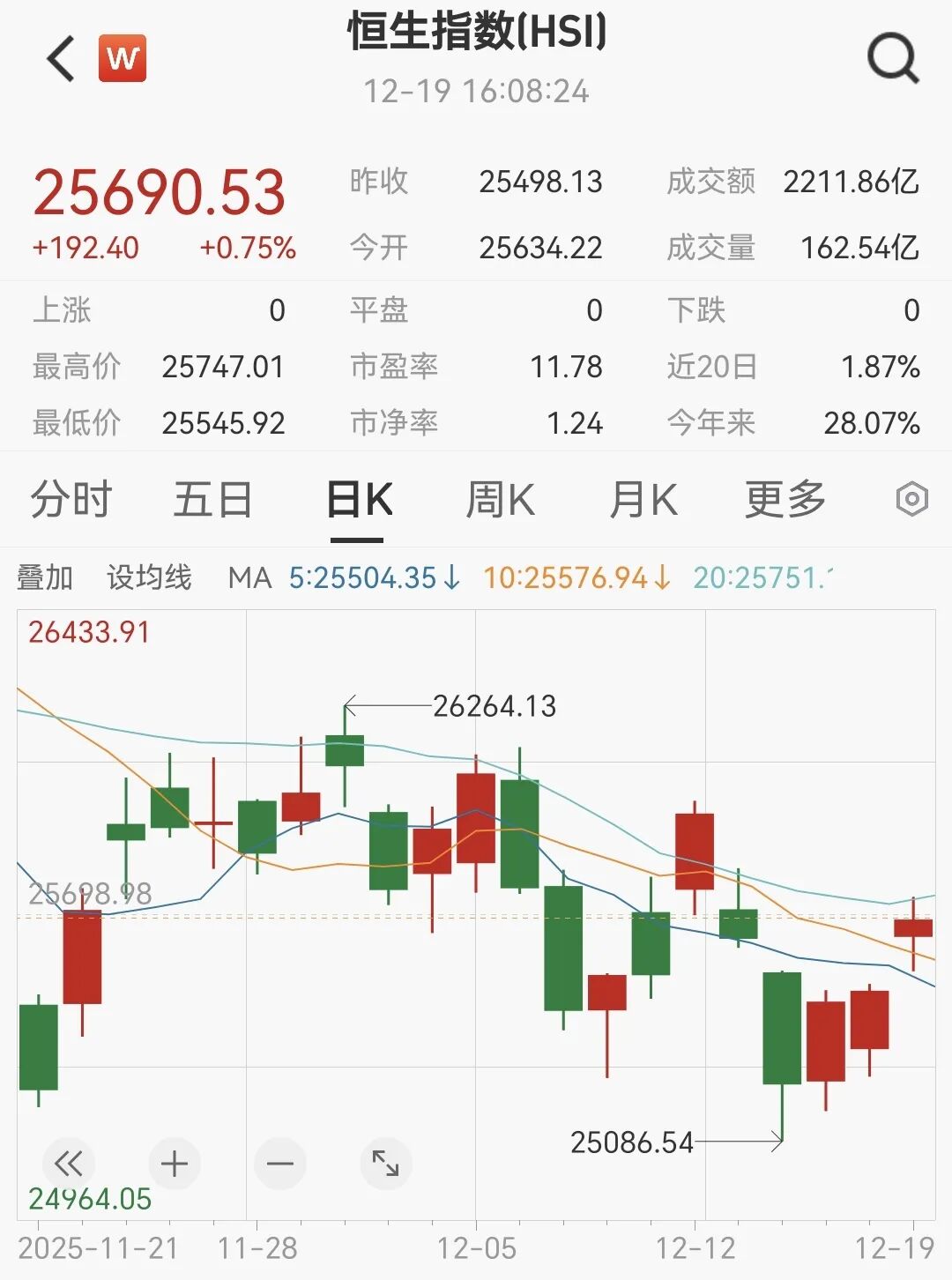
Market Performance - The Hong Kong stock market has experienced continuous fluctuations and adjustments over the past month, with the Hang Seng Index declining by 2.63%, approximately 700 points [1] - The Hang Seng China Enterprises Index fell by 4.58%, over 400 points, while the Hang Seng Technology Index dropped by 4.83%, nearly 300 points [1] - Notable declines in technology stocks include NIO down 17%, Hua Hong Semiconductor down 15%, SMIC down 12%, and Li Auto down 10% [1] Fundraising and Investment Trends - Since early October, 15 Hong Kong-themed new funds have chosen to end their fundraising early, particularly technology-themed ETFs that rapidly increased stock positions after establishment [3] - Institutional investors share a consensus on the undervaluation of Hong Kong stocks and are actively seizing the opportunity presented by market corrections [4] Market Adjustment Factors - The adjustment in the Hong Kong stock market is attributed to a combination of internal and external factors, with the Hang Seng Index down 5.85% and the Hang Seng Technology Index down 18.01% from October 3 to December 19 [5] - Key factors include fluctuations in liquidity expectations due to hawkish statements from Federal Reserve officials, which have weakened interest rate cut expectations and affected global capital flows [6] - Concerns over the "AI bubble" in the U.S. have also impacted the Hong Kong technology sector [7] - Increased IPO activity has created significant pressure on the capital market, with over HKD 100 billion raised since the new IPO regulations were implemented [7] - A notable slowdown in southbound capital inflows has been observed, with the 10-day moving average dropping from an average of HKD 7 billion to below HKD 1 billion [7] Long-term Outlook - Despite short-term pressures, institutions maintain an optimistic long-term outlook for the Hong Kong stock market, identifying structural investment opportunities [8] - Predictions indicate a "slow bull" market for Hong Kong stocks in 2026, with attractive valuation ratios and improving liquidity conditions as southbound and overseas capital returns [9] - Key investment themes for 2026 include technology and high-end manufacturing, with a focus on sectors such as computing power, semiconductors, and consumer electronics [10] - High dividend yield assets are also favored in a low-interest-rate environment, with institutions highlighting the value of dividend-paying stocks [10] - Opportunities in innovative pharmaceuticals and biotechnology are anticipated, driven by industry acceleration and favorable policy adjustments [10] - Traditional consumer and pharmaceutical sectors may see valuation recovery, as they are currently undervalued and could benefit from policies aimed at boosting domestic demand [11]

恒指一个月跌近700点,港股科技股多数回调,华虹半导体、蔚来跌超15%
21世纪经济报道· 2025-12-20 15:16
Market Overview - The Hong Kong stock market has experienced continuous fluctuations and adjustments over the past month, with the Hang Seng Index declining by 2.63%, approximately 700 points, and the Hang Seng China Enterprises Index falling by 4.58%, over 400 points [1] - The Hang Seng Technology Index has also decreased by 4.83%, nearly 300 points, with notable declines in tech stocks such as NIO (-17%), Hua Hong Semiconductor (-15%), SMIC (-12%), and Li Auto (-10%) [1] Fundraising and Investment Trends - Since early October, 15 new thematic funds in Hong Kong have chosen to end their fundraising early, particularly technology-themed ETFs, which have rapidly increased their stock positions after establishment, indicating a "fast launch, fast build" characteristic [3] - This trend reflects institutional investors' consensus on the undervaluation of Hong Kong stocks and their proactive approach to seizing the market correction as a buying opportunity [3] Reasons for Market Adjustment - The market adjustment since early October is attributed to a combination of internal and external factors, with the Hang Seng Index dropping 5.85% and the Hang Seng Technology Index experiencing a deeper decline of 18.01% from October 3 to December 19 [5] - Key factors include: 1. Volatility in liquidity expectations due to hawkish statements from Federal Reserve officials, which have weakened interest rate cut expectations and affected global capital flows and valuations in the Hong Kong tech sector [5] 2. Concerns over the "AI bubble" in the U.S. impacting sentiment in the Hong Kong tech sector [5] 3. Increased pressure on the funding environment, with over HKD 1 billion raised from IPOs since new regulations were introduced, significantly impacting market liquidity [5] 4. Profit-taking from previously high-performing tech and consumer stocks, combined with external chip supply news affecting market sentiment [6] Long-term Outlook - Despite short-term pressures, institutions maintain an optimistic long-term outlook for the Hong Kong stock market, predicting a "slow bull" market in 2026 with attractive valuation ratios and improved liquidity as southbound and overseas capital returns [7] - Key investment themes for 2026 include technology and high-end manufacturing, with a focus on areas such as computing power, semiconductors, consumer electronics, and humanoid robots [7] - High dividend yield assets are also favored in a low-interest-rate environment, with institutions highlighting the stability of dividend-paying stocks [7] - Additionally, the innovative drug and biotechnology sectors are seen as having significant investment opportunities, driven by industry acceleration and favorable policy adjustments [8]

港股新基金上演资金突围 提前结募火速建仓,抢筹估值洼地
Xin Lang Cai Jing· 2025-12-19 23:35
Core Viewpoint - A trend of "counter-market buying" is emerging in the Hong Kong stock market amidst ongoing fluctuations, with institutional investors recognizing the valuation opportunities and actively seizing the market pullback as a layout window [1][4]. Group 1: Fundraising and Investment Trends - Since October 10, at least 15 new Hong Kong-themed funds have announced early fundraising closures, covering various types including passive index funds, equity mixed funds, and QDII funds [2][3]. - The early closure of fundraising is characterized by significantly shortened timelines, with some funds reducing their fundraising periods by over a month [3]. - Newly launched ETFs have shown rapid establishment of high stock positions, indicating a strong bullish signal, with some ETFs achieving stock positions of 69.53% and 63.32% before listing [3]. Group 2: Market Conditions and Institutional Sentiment - The recent market adjustment is viewed as a good opportunity for building positions, with many funds seeing significant declines in their core stocks, yet maintaining strong fundamentals [4][5]. - The Hang Seng Index's price-to-earnings ratio is approximately 12 times, and the Hang Seng Tech Index is around 23 times, both at about 30% lower than historical averages, reflecting institutional recognition of valuation opportunities [5]. Group 3: Market Challenges and External Factors - The Hong Kong stock market has experienced a decline of 5.85% in the Hang Seng Index and 18.01% in the Hang Seng Tech Index from October 3 to December 19 [7]. - Factors contributing to the market adjustment include fluctuations in liquidity expectations, concerns over the "AI bubble" in the U.S., increased IPO activity causing funding pressure, and profit-taking in previously high-performing stocks [8]. Group 4: Long-term Outlook and Investment Opportunities - Despite short-term pressures, institutions maintain an optimistic long-term outlook for the Hong Kong stock market, predicting a "slow bull" market in 2026 with improved liquidity conditions [9]. - Key investment themes for 2026 include technology and high-end manufacturing, with a focus on sectors such as computing power, semiconductors, and consumer electronics [9][10]. - High dividend yield assets are also favored in a low-interest-rate environment, with institutions highlighting the value of resource companies and industrial metals [9][10].
港股新基金上演资金突围 提前结募火速建仓
2 1 Shi Ji Jing Ji Bao Dao· 2025-12-19 23:25
Core Insights - A trend of "counter-market buying" is emerging in the Hong Kong stock market amidst ongoing fluctuations, with institutional investors recognizing the valuation opportunities presented by the market correction [1][4]. Group 1: Fundraising and Investment Trends - Since October 10, at least 15 new Hong Kong-themed funds have announced early fundraising closures, covering various types including passive index funds and equity mixed funds [2][3]. - The early closure of fundraising is characterized by significant time reductions, with some funds shortening their fundraising periods by over a month [3]. - Newly launched ETFs have established high stock positions quickly, indicating a strong bullish sentiment, with some ETFs reaching stock positions of 69.53% and 63.32% before listing [3]. Group 2: Institutional Perspectives - Institutions view the current market adjustment as a prime opportunity for building positions, with many believing that the fundamental performance of key stocks remains strong despite recent price declines [4][5]. - The consensus among institutions is that the current valuation levels, with the Hang Seng Index trading at approximately 12 times earnings, represent a significant undervaluation [5]. Group 3: Market Dynamics and Challenges - The Hang Seng Index has seen a cumulative decline of 5.85% and the Hang Seng Tech Index has dropped 18.01% since early October, attributed to various internal and external factors [7]. - Key challenges include fluctuations in liquidity expectations, concerns over the U.S. "AI bubble," and increased pressure from IPO activities, which have raised over 100 billion HKD since new regulations were introduced [7][8]. Group 4: Long-term Outlook and Investment Opportunities - Despite short-term pressures, institutions maintain an optimistic long-term outlook for the Hong Kong market, predicting a "slow bull" market in 2026 driven by improved liquidity and returning capital [9]. - Key investment themes for 2026 include technology and high-end manufacturing, with a focus on sectors such as computing power, semiconductors, and consumer electronics [9][10]. - High dividend yield assets are also favored, with institutions highlighting the stability of dividend-paying stocks in a low-interest-rate environment [9][10].
刚刚!重要数据公布,利好这类资产!
摩尔投研精选· 2025-09-10 10:06
Market Overview - The A-share market is showing a "strong Shanghai, weak Shenzhen, and index differentiation" pattern, with total trading volume in the Shanghai and Shenzhen markets at 1.98 trillion, a decrease of 140.4 billion compared to the previous trading day, indicating a lack of trading activity and insufficient capital inflow [1] - The market is experiencing rapid rotation of hotspots, with the number of rising and falling stocks being roughly equal [2] Economic Data - The National Bureau of Statistics released the August CPI data, which presents a mixed picture [3] - In August, the consumer price index (CPI) decreased by 0.4% year-on-year and remained flat month-on-month. Specifically, urban prices fell by 0.3% and rural prices by 0.6%. Food prices dropped by 4.3%, while non-food prices increased by 0.5%. The average CPI from January to August decreased by 0.1% compared to the same period last year [4] - The decline in food prices, particularly for pork and fresh vegetables, is the main reason for the negative year-on-year CPI, reflecting ample agricultural supply but also indicating weak basic consumer demand [4] Sector Insights - Certain sectors such as seasoning, beer, dairy, and meat products, as well as agriculture and livestock farming, may face negative impacts due to the current economic environment [5] - There is a growing preference for stable, high-dividend assets, akin to "bond-like" investments, as evidenced by the performance of sectors like banking, insurance, coal, electricity, public utilities, and highways, which have risen against the trend [6] - The continuous improvement in core CPI, particularly the rise in service prices, indicates resilient demand in service consumption sectors such as tourism, hospitality, dining, and entertainment, which are closely correlated with core CPI trends [6] Stock Performance - Industrial giant "Industrial Fulian" hit the daily limit, with a collective rebound in computing hardware stocks, including Industrial Fulian, Dongshan Precision, and Jingwang Electronics [7] - Positive news from the AI sector has significantly stimulated related concept stocks, including a 27% post-market surge for Oracle, which anticipates a 77% growth in cloud infrastructure revenue for fiscal year 2026, and OpenAI's projected revenue doubling this year [8] - Nvidia's announcement of a new GPU designed for AI workloads further supports the bullish sentiment in the AI sector, with expectations of policy catalysts enhancing market emotions in the short term, despite potential differentiation in previously high-performing segments [8]




中信建投:高股息“红利资产”备受市场青睐 机械板块现金充裕、具分红潜力公司值得关注
智通财经网· 2025-09-04 01:49
Group 1 - The core viewpoint is that high dividend "redemption assets" remain favored in the market for 2025, following the trends of "special valuation" and "central enterprise market value assessment" in 2023 and 2024 [1] - The mechanical sector has 24 companies that meet the criteria of having an average cash content of net profit exceeding 50% from 2022 to 2024 and a current market value cash content exceeding 30% [1][4] - The overall fixed asset investment growth rate is low, with a cumulative growth rate of 1.60% from January to July 2025, indicating a challenging investment environment [1] Group 2 - Among the 742 listed companies in the mechanical sector, 49 companies have a projected dividend yield exceeding 3% and a dividend payout ratio of no less than 30% from 2022 to 2024, representing 6.60% of the sample [2] - The distribution of high dividend companies includes segments such as engineering machinery, mining machinery, elevators, and rail transit, with a significant number of companies offering competitive dividend yields [2] - There are still over 15 quality companies with a projected dividend yield above 5% for 2025, all maintaining a dividend payout ratio of at least 30% from 2022 to 2024 [3] Group 3 - Companies in the mechanical sector with a market value cash content exceeding 30% total 24, with 4 companies exceeding 50%, indicating a solid foundation for increasing cash dividend ratios [4]

市场增量流动性持续注入 A股新稳态有望进一步确立
Shang Hai Zheng Quan Bao· 2025-08-17 23:56
Market Overview - The A-share market has seen increased activity, with the ChiNext Index rising by 8.58% in a week and the Shanghai Composite Index up by 1.7%, surpassing 3700 points for the first time in nearly four years [1][2] - Since April, the A-share market has entered a four-month trend, with institutions predicting that the short-term sentiment will remain strong due to the accumulation of profit-making effects [1][2] Liquidity Trends - Recent data indicates a positive trend in A-share market liquidity, with daily trading volumes exceeding 2 trillion yuan for three consecutive days [2] - The margin trading balance has also returned to the 2 trillion yuan mark, reflecting increased investor participation [2] - In July, new A-share accounts opened on the Shanghai Stock Exchange reached 1.9636 million, a 19% month-on-month increase and a 71% year-on-year increase, indicating a shift of household wealth towards financial assets [2] External Influences - A-shares are seen as attractive to foreign investors, especially in the context of non-USD assets outperforming USD assets [3] - The narrowing of the China-US interest rate differential is expected to facilitate capital inflows into the Chinese market, providing further monetary policy space [3] Market Characteristics - The current market is characterized by a steady upward trend, supported by capital market reforms aimed at increasing investor returns [4] - The market is experiencing a "healthy" upward trend, with volatility decreasing and many sectors remaining at moderate levels of crowding [4] Investment Focus - Short-term investment recommendations include focusing on sectors with strong industrial trends such as innovative pharmaceuticals, resources, communications, and gaming [5] - Long-term investment should consider industries with sustainable pricing power, including rare earths, cobalt, phosphorous chemicals, pesticides, fluorochemicals, and photovoltaic inverters [5] Foreign Investment Preferences - If the Federal Reserve lowers interest rates in the second half of the year, foreign investment is expected to flow into the Chinese market, with a focus on industries with stable performance and sustainability [6] - Key sectors for foreign investment include innovative pharmaceuticals, leading internet companies in Hong Kong, the Nvidia supply chain, and new energy sectors [6]
超720亿!46家A股公司官宣中期分红
第一财经· 2025-08-10 12:05
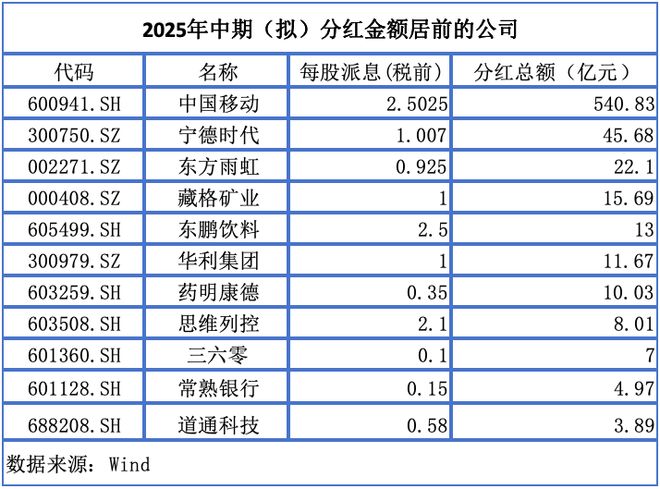
Core Viewpoint - The article highlights the increasing trend of interim dividends among A-share companies, with many firms announcing substantial profit distributions, indicating a robust performance in the first half of the year despite some experiencing revenue declines [3][4][8]. Summary by Sections Interim Dividend Announcements - As of August 8, companies like Guanggang Gas (688548.SH) and Shuoshi Bio (688399.SH) have announced interim profit distributions, with Shuoshi Bio proposing a distribution of 3.4 yuan per share, totaling 285 million yuan [3][4]. - Nearly 50 A-share companies have disclosed interim dividend proposals, with a total distribution amount exceeding 720 billion yuan [4][6]. Major Dividend Payers - China Mobile (600941.SH) leads with a proposed dividend of 2.75 HKD per share, amounting to approximately 594.32 billion HKD (over 540 billion yuan) [4][6]. - Other significant companies include Ningde Times (300750.SZ) and Oriental Yuhong, with proposed distributions of 10.07 yuan and 9.25 yuan per share, respectively [5][6]. Performance of Dividend Companies - Many companies proposing high dividends have reported revenue and profit growth in the first half of the year, such as Dongpeng Beverage, which achieved a revenue of 10.737 billion yuan and a net profit of 2.375 billion yuan, both up over 30% year-on-year [8]. - However, some companies like China Mobile and Cangge Mining (000408.SZ) experienced slight revenue declines, with China Mobile's revenue at 543.769 billion yuan, down 0.54% year-on-year [8][9]. Upcoming Dividend Distributions - Three A-share companies, including Sujiao Science and Technology (300284.SZ), are set to implement interim dividends next week, with Sujiao proposing a distribution of 0.2 yuan per share [10][11]. Trends in Dividend Distribution - The trend of increased dividend distributions is supported by regulatory encouragement, with the total cash dividends for A-share companies in 2024 projected to reach 2.4 trillion yuan, a 9% increase from 2023 [12]. - The frequency of dividend payments is also rising, with many companies adopting policies for multiple distributions within a year [12]. Investment Considerations - Investors are advised to analyze dividend yield, coverage ratio, and sustainability when selecting stocks, considering industry differences and company fundamentals [12][13]. - In mature industries, high dividends are attractive, while in growth sectors, increased dividends may indicate a shift towards maturity or a change in profit models [13][14].





46家A股公司抛出中期分红预案,合计金额超720亿
Di Yi Cai Jing Zi Xun· 2025-08-10 10:24
Core Viewpoint - The mid-year dividend distribution among A-share companies is gaining momentum, with many companies announcing substantial dividend payouts, reflecting their financial performance and shareholder return strategies [1][2]. Group 1: Dividend Announcements - Nearly 50 A-share companies have disclosed mid-year dividend proposals or shareholder suggestions, with a total proposed dividend amount exceeding 720 billion yuan [2][4]. - Major companies like China Mobile and Ningde Times are leading with significant dividend distributions, with China Mobile proposing a dividend of 594.32 billion Hong Kong dollars (approximately 540 billion yuan) [2][3]. - Companies such as Shuoshi Biology and Dongpeng Beverage are also participating in the trend, with Shuoshi Biology proposing a dividend of 3.4 yuan per share and Dongpeng Beverage exceeding 1 yuan per share [4][5]. Group 2: Financial Performance - Many companies proposing high dividends have reported revenue and profit growth in the first half of the year, indicating strong financial support for their dividend policies [5][6]. - For instance, Dongpeng Beverage achieved a revenue of 10.737 billion yuan and a net profit of 2.375 billion yuan, both showing over 30% year-on-year growth [5]. - However, some companies like China Mobile and Oriental Yuhong experienced slight revenue declines, raising questions about the sustainability of their high dividend payouts [5][6]. Group 3: Upcoming Dividend Distributions - Three A-share companies are set to implement mid-year dividends next week, including Sujiao Technology and Zhongchong Co., with specific dividend amounts announced [6][7]. - Sujiao Technology plans to distribute 0.2 yuan per share, while Zhongchong Co. intends to distribute 2 yuan per share [6][7]. Group 4: Trends in Dividend Distribution - The trend of increased dividend distributions is supported by regulatory encouragement, with a projected total cash dividend of 2.4 trillion yuan for 2024, marking a 9% increase from 2023 [7][8]. - The frequency of dividend distributions is also rising, with many companies adopting policies for multiple distributions within a year, contributing to a growing culture of continuous dividends [7][8].


年内二度出手,新华保险举牌北京控股,高股息红利资产仍是“心头好”
Zhong Guo Jing Ji Wang· 2025-08-08 07:26
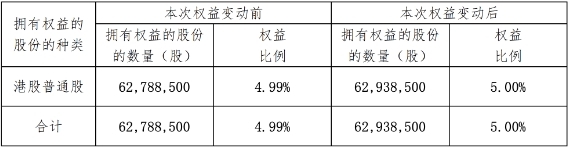
Core Viewpoint - Insurance companies are actively increasing their stakes in high-dividend stocks, with New China Life Insurance's recent acquisition of Beijing Enterprises Holdings being a notable example of this trend [1][5][6]. Group 1: New China Life Insurance's Actions - On March 26, New China Life Insurance increased its holdings in Beijing Enterprises Holdings by 150,000 shares, raising its stake from approximately 4.99% to 5% of the total shares [2][4]. - This marks the second time in 2023 that New China Life Insurance has made a significant acquisition, having previously acquired over 329 million shares of Hangzhou Bank, representing 5.87% of its total shares [4]. Group 2: Industry Trends - A total of six insurance companies have increased their stakes in 13 listed companies this year, surpassing the total number of acquisitions made in 2021, 2022, and 2023 combined [6]. - High-dividend assets, particularly in the banking and public utility sectors, are favored by insurance companies due to their stable cash flow and attractive returns [5][8]. Group 3: Financial Metrics - As of March 26, New China Life Insurance's equity assets amounted to 317.47 billion yuan, representing 21.13% of its total assets [4]. - The book value of New China Life Insurance's holdings in Beijing Enterprises is approximately 1.6 billion yuan, accounting for 0.11% of its total assets as of the end of 2024 [4]. - Beijing Enterprises Holdings has a total market capitalization of 38.81 billion yuan, with a dividend yield of 5.25% based on its recent stock price of 30.85 yuan per share [8].