港股估值洼地

Search documents
中国银河证券: 可选消费是当前港股所有板块中业绩增速与盈利能力最强的方向
Jin Rong Jie· 2026-03-19 00:05
Group 1 - The core viewpoint of the article is that the resilience of the Hong Kong stock market is attributed to its valuation being at a low point, which attracts risk-averse funds seeking certainty [1] - Foreign investment in the Hong Kong stock market is largely driven by the valuation gap between Hong Kong and other major global markets [1] - The low valuation of Hong Kong stocks is typically accompanied by high dividend yields, making it highly attractive for risk-averse funds seeking stable cash flow [1] Group 2 - Looking ahead over the next six months, the consumer discretionary sector is identified as the strongest direction in terms of performance growth and profitability among all sectors in the Hong Kong stock market [1] - The financial sector is noted to have a sufficient margin of safety [1] - The technology sector has demonstrated dual attributes during the recent market turmoil [1]

港股新基金上演资金突围:提前结募火速建仓 抢筹估值洼地
2 1 Shi Ji Jing Ji Bao Dao· 2025-12-21 00:11
Core Viewpoint - A trend of "counter-market buying" is emerging in the Hong Kong stock market amidst ongoing fluctuations, with institutional investors recognizing the valuation opportunities and actively seizing the market pullback as a layout window [1][4]. Group 1: Fundraising and Investment Trends - Since October 10, at least 15 new Hong Kong-themed funds have announced early fundraising closures, covering various types including passive index funds, equity mixed funds, and QDII funds [2]. - The early fundraising trend is characterized by significantly shortened timelines, with some funds reducing their fundraising periods by over a month [2]. - Newly launched ETFs have established high stock positions quickly, indicating strong bullish signals, with some ETFs reaching stock positions of 69.53% and 63.32% before listing [3]. Group 2: Market Conditions and Valuation - The recent market adjustment has provided a favorable entry point for new funds, as many heavy-weight stocks have seen significant weekly declines while maintaining stable fundamentals [4]. - The Hang Seng Index's price-to-earnings ratio (TTM) is approximately 12 times, and the Hang Seng Tech Index's is about 23 times, both at historical low levels, reflecting institutional recognition of undervalued Hong Kong stocks [5]. Group 3: Market Challenges - The Hang Seng Index has dropped 5.85% and the Hang Seng Tech Index has fallen 18.01% since October 3, indicating a clear market correction [6]. - Factors contributing to the market adjustment include fluctuating liquidity expectations, concerns over the "AI bubble" in the U.S., increased IPO activity, and reduced southbound capital inflows [7][8]. Group 4: Long-term Outlook and Investment Opportunities - Despite short-term pressures, institutions maintain an optimistic long-term outlook for the Hong Kong stock market, predicting a "slow bull" market in 2026 with improved liquidity conditions [9]. - Key investment themes for 2026 include technology and high-end manufacturing, with a focus on sectors such as computing power, semiconductors, and consumer electronics [9]. - High dividend yield assets are also favored in a low-interest-rate environment, with institutions highlighting the value of leading copper and aluminum mining companies [9]. - The innovative drug and biotechnology sectors are seen as having significant investment opportunities due to industry acceleration and favorable policy adjustments [10].
港股新基金上演资金突围 提前结募火速建仓,抢筹估值洼地
Xin Lang Cai Jing· 2025-12-19 23:35
Core Viewpoint - A trend of "counter-market buying" is emerging in the Hong Kong stock market amidst ongoing fluctuations, with institutional investors recognizing the valuation opportunities and actively seizing the market pullback as a layout window [1][4]. Group 1: Fundraising and Investment Trends - Since October 10, at least 15 new Hong Kong-themed funds have announced early fundraising closures, covering various types including passive index funds, equity mixed funds, and QDII funds [2][3]. - The early closure of fundraising is characterized by significantly shortened timelines, with some funds reducing their fundraising periods by over a month [3]. - Newly launched ETFs have shown rapid establishment of high stock positions, indicating a strong bullish signal, with some ETFs achieving stock positions of 69.53% and 63.32% before listing [3]. Group 2: Market Conditions and Institutional Sentiment - The recent market adjustment is viewed as a good opportunity for building positions, with many funds seeing significant declines in their core stocks, yet maintaining strong fundamentals [4][5]. - The Hang Seng Index's price-to-earnings ratio is approximately 12 times, and the Hang Seng Tech Index is around 23 times, both at about 30% lower than historical averages, reflecting institutional recognition of valuation opportunities [5]. Group 3: Market Challenges and External Factors - The Hong Kong stock market has experienced a decline of 5.85% in the Hang Seng Index and 18.01% in the Hang Seng Tech Index from October 3 to December 19 [7]. - Factors contributing to the market adjustment include fluctuations in liquidity expectations, concerns over the "AI bubble" in the U.S., increased IPO activity causing funding pressure, and profit-taking in previously high-performing stocks [8]. Group 4: Long-term Outlook and Investment Opportunities - Despite short-term pressures, institutions maintain an optimistic long-term outlook for the Hong Kong stock market, predicting a "slow bull" market in 2026 with improved liquidity conditions [9]. - Key investment themes for 2026 include technology and high-end manufacturing, with a focus on sectors such as computing power, semiconductors, and consumer electronics [9][10]. - High dividend yield assets are also favored in a low-interest-rate environment, with institutions highlighting the value of resource companies and industrial metals [9][10].
港股新基金上演资金突围 提前结募火速建仓
2 1 Shi Ji Jing Ji Bao Dao· 2025-12-19 23:25
Core Insights - A trend of "counter-market buying" is emerging in the Hong Kong stock market amidst ongoing fluctuations, with institutional investors recognizing the valuation opportunities presented by the market correction [1][4]. Group 1: Fundraising and Investment Trends - Since October 10, at least 15 new Hong Kong-themed funds have announced early fundraising closures, covering various types including passive index funds and equity mixed funds [2][3]. - The early closure of fundraising is characterized by significant time reductions, with some funds shortening their fundraising periods by over a month [3]. - Newly launched ETFs have established high stock positions quickly, indicating a strong bullish sentiment, with some ETFs reaching stock positions of 69.53% and 63.32% before listing [3]. Group 2: Institutional Perspectives - Institutions view the current market adjustment as a prime opportunity for building positions, with many believing that the fundamental performance of key stocks remains strong despite recent price declines [4][5]. - The consensus among institutions is that the current valuation levels, with the Hang Seng Index trading at approximately 12 times earnings, represent a significant undervaluation [5]. Group 3: Market Dynamics and Challenges - The Hang Seng Index has seen a cumulative decline of 5.85% and the Hang Seng Tech Index has dropped 18.01% since early October, attributed to various internal and external factors [7]. - Key challenges include fluctuations in liquidity expectations, concerns over the U.S. "AI bubble," and increased pressure from IPO activities, which have raised over 100 billion HKD since new regulations were introduced [7][8]. Group 4: Long-term Outlook and Investment Opportunities - Despite short-term pressures, institutions maintain an optimistic long-term outlook for the Hong Kong market, predicting a "slow bull" market in 2026 driven by improved liquidity and returning capital [9]. - Key investment themes for 2026 include technology and high-end manufacturing, with a focus on sectors such as computing power, semiconductors, and consumer electronics [9][10]. - High dividend yield assets are also favored, with institutions highlighting the stability of dividend-paying stocks in a low-interest-rate environment [9][10].
港股新基金上演资金突围:提前结募火速建仓,抢筹估值洼地
2 1 Shi Ji Jing Ji Bao Dao· 2025-12-19 13:10
Core Viewpoint - A trend of "counter-market buying" is emerging in the Hong Kong stock market amidst ongoing fluctuations, with institutional investors recognizing the valuation opportunities and actively positioning themselves during the market pullback [1][3]. Fundraising and Investment Trends - Since early October, at least 15 new Hong Kong-themed funds have announced early closures of their fundraising periods, particularly in the technology sector, indicating a "fast launch and build" characteristic [1][2]. - Fundraising deadlines have been significantly advanced, with some funds shortening their periods by over a month, reflecting a concentrated early closure trend primarily occurring from late November to mid-December [2]. - Newly launched ETFs have established high stock positions quickly, with notable examples including the Huatai-PineBridge Hang Seng Index ETF and the GF CSI Hong Kong Internet ETF, which reached stock positions of 69.53% and 63.32% respectively before listing [2]. Market Analysis and Institutional Sentiment - Institutions view the current market adjustment as a favorable opportunity for building positions, with many believing that the recent declines provide lower entry points for fundamentally strong companies [3]. - The Hang Seng Index's price-to-earnings ratio (TTM) is approximately 12 times, and the Hang Seng Technology Index's is about 23 times, both at historically low levels, indicating a consensus among institutions regarding the undervaluation of Hong Kong stocks [3]. Market Conditions and External Influences - The Hong Kong stock market has experienced a decline of 5.85% in the Hang Seng Index and 18.01% in the Hang Seng Technology Index from October 3 to December 19 [5]. - The market adjustment is attributed to a combination of internal and external factors, including fluctuating liquidity expectations, concerns over the U.S. "AI bubble," increased IPO activity, and reduced southbound capital inflows [6]. Long-term Outlook and Investment Opportunities - Despite short-term pressures, institutions maintain an optimistic long-term outlook for the Hong Kong stock market, predicting a "slow bull" market in 2026 with improved liquidity conditions [7]. - Key investment themes for 2026 include technology and high-end manufacturing, with a focus on sectors such as computing power, semiconductors, and consumer electronics [7][8]. - High dividend yield assets are also favored in the current low-interest-rate environment, with institutions highlighting the value of dividend-paying stocks [7]. - The innovative drug and biotechnology sectors are seen as having significant investment opportunities, driven by industry acceleration and favorable policy adjustments [8].
外资机构集体看多做多港股 看好腾讯控股、比亚迪股份等公司
Xin Lang Cai Jing· 2025-09-25 01:08
Group 1 - International capital is reassessing and positioning in the Hong Kong stock market, indicated by Alibaba's stock surge and the presence of prestigious cornerstone investors in IPOs [1][4] - The Federal Reserve's interest rate cuts have led to a weaker dollar and declining U.S. Treasury yields, making Hong Kong an attractive destination for global capital inflows [1][2] - The total market capitalization of the Hong Kong securities market reached HKD 46.6 trillion by the end of August 2025, a 47% increase from HKD 31.8 trillion in the same period last year [2] Group 2 - The Hong Kong stock market is experiencing significant liquidity improvements, attracting international capital due to its appealing valuation "discount" [2] - Foreign long-term funds are actively subscribing to cornerstone investments in Hong Kong IPOs, with notable companies like CATL and Hengrui Medicine receiving strong interest [4] - As of September 17, foreign net inflows into offshore Chinese stocks reached USD 1.86 billion, marking the highest weekly inflow since November of the previous year [4] Group 3 - The Hang Seng Tech Index has risen over 41.5% year-to-date as of September 24, with Alibaba's market capitalization returning to HKD 3 trillion [3] - Major foreign investment banks have recently issued bullish reports on well-known Hong Kong-listed companies, indicating a positive outlook for Chinese assets [5] - Analysts expect continued foreign inflows into Hong Kong stocks as companies in sectors like AI, internet, and innovative pharmaceuticals show strong growth momentum [5]

外资机构集体看多做多港股
Sou Hu Cai Jing· 2025-09-24 16:36
Group 1 - International capital is reassessing and positioning in the Hong Kong stock market, indicated by Alibaba's stock surge and the presence of prestigious cornerstone investors in IPOs [1][4] - The Federal Reserve's interest rate cuts have led to a weaker dollar and declining U.S. Treasury yields, making Hong Kong an attractive destination for global capital inflows [1][2] - The total market capitalization of the Hong Kong securities market reached HKD 46.6 trillion by the end of August 2025, a 47% increase from HKD 31.8 trillion in the same period last year [2] Group 2 - The technology sector in Hong Kong has led the market this year, with the Hang Seng Tech Index rising over 41.5% as of September 24 [3] - International long-term funds are actively subscribing to cornerstone investments in Hong Kong IPOs, with notable companies like CATL and Hengrui Medicine attracting significant interest [4] - Foreign institutional investors are increasingly purchasing quality Hong Kong stocks, with net inflows into offshore Chinese stocks reaching USD 1.86 billion, the highest weekly figure since November of the previous year [4] Group 3 - Major foreign investment banks have recently expressed bullish views on well-known Hong Kong-listed companies, reaffirming buy or outperform ratings for firms like Tencent and BYD [5] - The performance of sectors such as AI, internet, and innovative pharmaceuticals shows strong growth momentum, contributing to the positive outlook for foreign investment in Chinese assets [5]
进击的港股:恒指何以领跑全球?
2 1 Shi Ji Jing Ji Bao Dao· 2025-08-29 10:37
Group 1 - The Hong Kong stock market has shown significant growth this year, with the Hang Seng Index rising over 20% since the beginning of the year, and the Hang Seng Tech Index performing even better [1] - Current valuations of the Hong Kong stock market are still considered low compared to historical highs in 2021, indicating potential for further growth, especially in sectors like technology, internet, innovative pharmaceuticals, and new consumption [1][2] - The recent trend of foreign capital inflow into the Hong Kong market is expected to continue, driven by the Federal Reserve's shift towards a more accommodative monetary policy, which could act as an accelerator for the market [2] Group 2 - Hong Kong's tech companies are becoming increasingly competitive in the AI sector, supported by recent upgrades to the listing system that facilitate the entry of biotech and hard tech companies [2] - Major tech firms in Hong Kong, such as Alibaba and Tencent, are leading in the development of multimodal AI models and are increasing their capital expenditures in AI, which could enhance their market position [2] - There is still room for growth in southbound capital flows, with over 900 billion RMB having flowed into Hong Kong stocks this year, particularly benefiting large tech stocks like Tencent, Meituan, Xiaomi, and Kuaishou [3]

南下资金爆买港股创历史新高
Shen Zhen Shang Bao· 2025-08-17 22:42
Group 1 - The core viewpoint is that southbound capital has accelerated its net buying of Hong Kong stocks, reaching a historical high of 938.92 billion HKD from January 1 to August 15, 2025, surpassing the total for the entire year of 2024 [1][2] - On August 15, despite a 0.98% drop in the Hang Seng Index, southbound capital recorded a net purchase of 35.88 billion HKD, setting a new single-day record [1] - The net buying pace of southbound capital increased significantly, with a total net inflow of 36.20 billion HKD from August 1 to August 14, and a record high of 35.88 billion HKD on August 15 alone [1] Group 2 - The top three net bought stocks by southbound capital in the past month were the Tracker Fund of Hong Kong, Alibaba, and Xiaomi, with net purchases ranging from 11.25 billion HKD to 2.96 billion HKD [2] - As of August 15, Tencent Holdings had the highest holding value among southbound capital at 582.50 billion HKD, followed by China Mobile and China Construction Bank with holdings of 268.36 billion HKD and 267.79 billion HKD, respectively [2] - The main reason for the accelerated inflow of southbound capital is the undervaluation of Hong Kong stocks, with many companies maintaining good growth despite significant price declines over the past six years [2]

见证历史!南向资金,疯狂买入
Zheng Quan Shi Bao· 2025-07-25 12:19
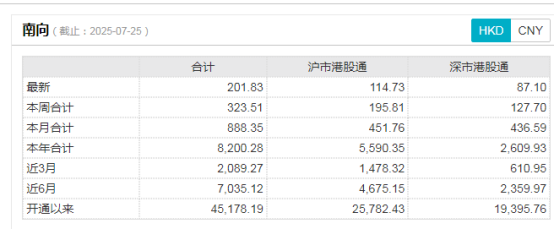
Group 1 - The Hong Kong stock market is experiencing a significant capital influx led by southbound funds, with a net buying amount exceeding 200 billion HKD on July 25, 2025, and a total net buying amount of over 820 billion HKD for the year, surpassing the previous record of 807.87 billion HKD for the entire year of 2024 [1][2] - The Hang Seng Index, Hang Seng Tech Index, and Hang Seng China Enterprises Index have shown year-to-date increases of 26.56%, 27.08%, and 25.52% respectively, ranking among the top global markets [2] - Southbound funds have frequently recorded daily net inflows exceeding 10 billion HKD, with 32 days in 133 trading days this year exceeding 10 billion HKD, and 9 days exceeding 20 billion HKD, including a record high of 35.586 billion HKD on April 9 [2][3] Group 2 - The continuous influx of southbound funds is attributed to the undervaluation of Hong Kong stocks, as the Hang Seng Index has undergone a six-year adjustment since 2018, with many companies maintaining good growth despite significant declines [5] - The Hong Kong market offers unique assets such as Tencent, Meituan, and Alibaba, along with new consumer companies like Pop Mart and Mixue Ice City, providing more investment options for southbound funds [5] - The influx of southbound funds reflects a "scarcity of assets," as domestic funds seek effective allocation opportunities amid a backdrop of abundant liquidity but limited high-quality assets [6] Group 3 - The sustained inflow of southbound funds has improved liquidity in the Hong Kong market and enhanced the pricing power of domestic funds, which accounted for 34.64% of the market's trading volume in 2024 [7] - The share of foreign capital in the Hong Kong stock market has decreased from 75% in October 2020 to 61% in June 2025, indicating a shift towards greater influence from domestic funds [7][8] - Southbound funds are gaining marginal pricing power in sectors such as consumer goods and telecommunications, with holdings exceeding 50% in these areas [8][9] Group 4 - The Hong Kong stock market has shown strong performance globally, driven by AI breakthroughs and the appeal of being a "value trap," with the Hang Seng Index reaching new highs [10] - Future market performance may depend more on corporate earnings growth rather than further valuation expansion, as the expected earnings growth for the Hang Seng Index is relatively low [10][11] - A balanced investment strategy focusing on stable returns and growth returns is recommended, particularly in sectors less affected by tariff impacts and those benefiting from AI advancements [11]