
AI供应链

Search documents
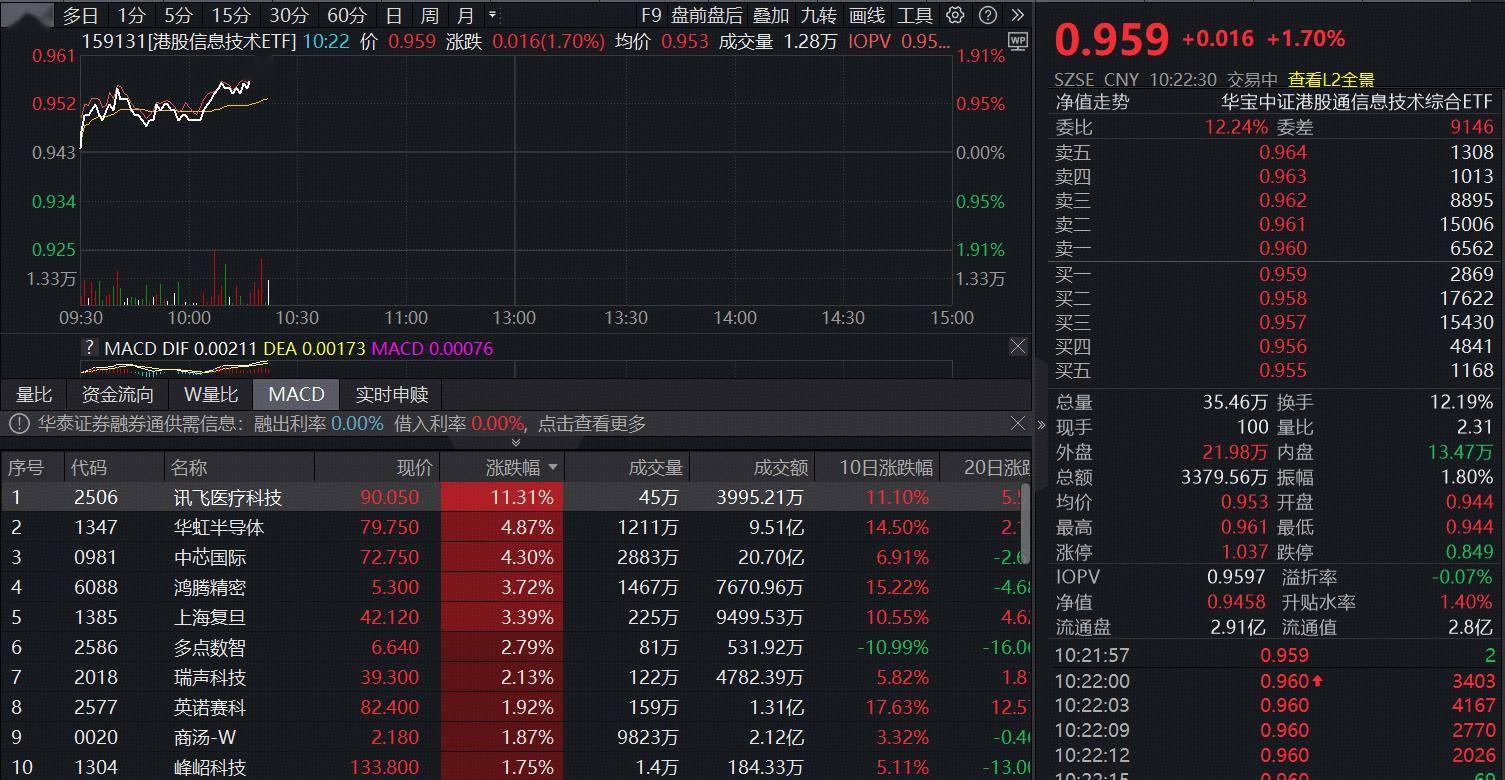
ETF盘中资讯 | 连涨3天!首只聚焦“港股芯片”产业链的港股信息技术ETF(159131)涨1.7%,机构:2026中国AI供应链迈入爆发新阶段!
Sou Hu Cai Jing· 2025-12-08 02:46
Group 1 - The Hong Kong stock market's chip industry chain is experiencing a strong rally, with notable increases in stocks such as Hua Hong Semiconductor rising by 4% and others like SMIC and Shanghai Fudan gaining over 3% [1] - The first Hong Kong ETF focused on the chip industry, the Information Technology ETF (159131), has seen a price increase of 1.70% with a trading volume exceeding 330 million yuan [1] Group 2 - Bernstein's recent report highlights that China's AI industry is transitioning from early development to a new phase of supply chain explosion, predicting 2026 as a critical turning point for growth [3] - The report emphasizes that the current state of China's AI is not a bubble but a key moment for supply chain emergence, with AI chips expected to lead growth due to direct demand and clear growth trajectories [3] - The ETF tracks an index composed of 70% hardware and 30% software, heavily investing in semiconductor, electronics, and computer software sectors, with significant weights in companies like SMIC (20.27%) and Xiaomi (9.11%) [3]

靠钻孔半年入账17亿,58岁深圳装备大佬再冲刺港股IPO
21世纪经济报道· 2025-12-07 23:12
Core Viewpoint - Gao Yunfeng's company, Dazhu CNC, is making a second attempt to list on the Hong Kong Stock Exchange, aiming to raise funds for R&D, capacity enhancement, and financial support amid a tight production environment for high-end PCB manufacturing equipment [1][3][4]. Group 1: Company Overview - Dazhu CNC, a subsidiary of Dazhu Laser, specializes in manufacturing PCB (Printed Circuit Board) production equipment, holding a market share of 10.1% in China [8]. - The company reported a revenue of 3.9 billion yuan for the first nine months of the year, reflecting a year-on-year increase of 66.5% [8]. - Gao Yunfeng, the controlling shareholder, has a net worth estimated at 13.5 billion yuan, and the company's current market capitalization is around 44 billion yuan, surpassing that of its parent company [4][5]. Group 2: Management and Corporate Governance - Gao Yunfeng holds approximately 21.7% of Dazhu CNC's shares and has delegated daily operations to professional managers, emphasizing internal promotion and stability within the management team [6][8]. - The average salary of the nine senior executives is around 1.5 million yuan, with the highest-paid executive, Yang Chaohui, earning 2.314 million yuan [7][8]. Group 3: Market Position and Product Offering - Dazhu CNC is recognized as the largest manufacturer of PCB production equipment in China, with a strong focus on drilling equipment, which is critical for PCB production [10][13]. - The company sold 2,637 drilling machines in the first half of 2025, generating revenue of 1.69 billion yuan, accounting for nearly 80% of its total income [10][12]. Group 4: Expansion and Future Prospects - Dazhu CNC is expanding its international presence, having established four overseas subsidiaries and three distributors, particularly targeting the Southeast Asian market, where demand for PCB manufacturing equipment is increasing [15][16]. - The company's overseas sales revenue reached 500 million yuan in the first nine months of 2025, representing 12.8% of total revenue, with expectations for continued growth in the Southeast Asian PCB market [15][16].

速递|从芯片到机架:OpenAI与富士康合作,深入掌控AI硬件供应链
Z Potentials· 2025-11-21 03:15
Core Viewpoint - OpenAI is collaborating with Foxconn to design and produce data center hardware to meet the increasing infrastructure demands of AI systems [2][3][4]. Group 1: Collaboration Details - Foxconn will work with OpenAI to develop data center server racks and aims to ensure large-scale production in the United States [3]. - The agreement does not include specific procurement commitments [4]. - Foxconn plans to produce cables, power systems, and other critical equipment for data center facilities in the U.S. [4]. Group 2: Strategic Implications - OpenAI has recently signed multiple agreements worth billions with cloud service providers and chip manufacturers, significantly expanding its data center capacity [6]. - The collaboration with Foxconn highlights Foxconn's long-term intention to enhance its role in the AI ecosystem, reducing reliance on assembling iPhones for Apple [6]. - OpenAI's CEO, Sam Altman, stated that this partnership is a crucial step in building core AI technologies domestically in the U.S. [6]. Group 3: Financial Commitments - OpenAI has committed to investing $500 billion in U.S. data centers and AI infrastructure over the coming years [6]. - Altman previously mentioned a total commitment of $1.4 trillion for AI infrastructure, a significant amount for a startup that has yet to become profitable [8]. Group 4: Additional Ventures - Foxconn announced a joint venture with Intrinsic to explore AI data center business opportunities [9].

“最火AI板块”交成绩单:涨飞了的“易中天”,只有中际旭创撑住了“高预期”
Hua Er Jie Jian Wen· 2025-10-31 06:48
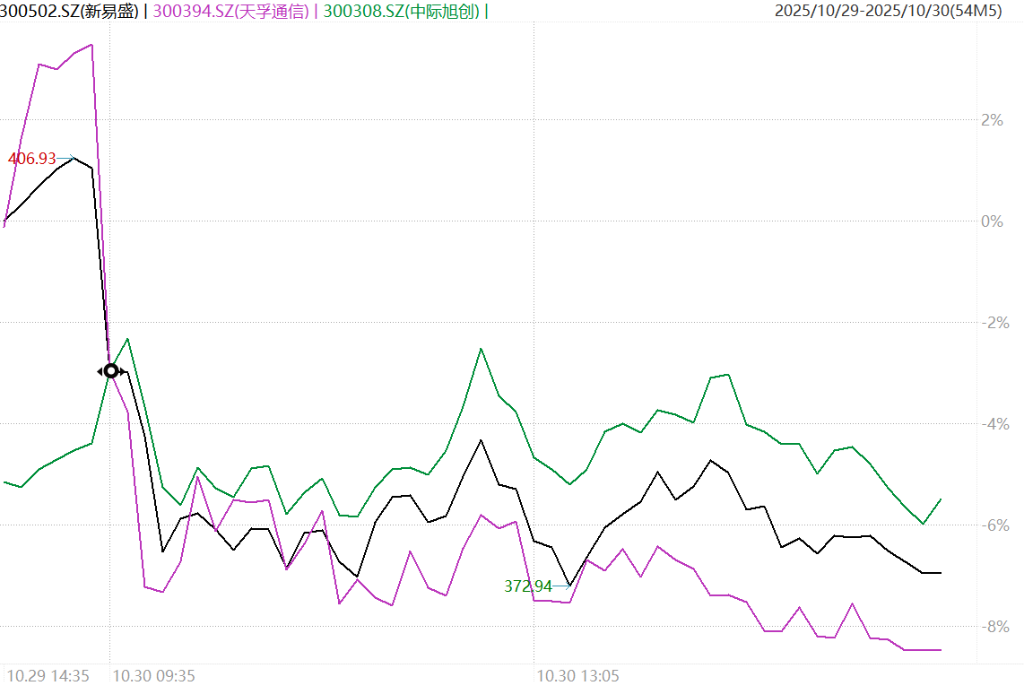
Core Insights - The latest performance report from the AI infrastructure sector shows mixed results, particularly in the optical module segment, with only the industry leader, Zhongji Xuchuang, achieving consistent revenue and profit growth [1][5] Company Performance - Zhongji Xuchuang reported both year-on-year and quarter-on-quarter growth in revenue and profit, maintaining high expectations from the market [1] - In contrast, both Xinyi and Tianfu Communication experienced declines in revenue, with Xinyi's revenue decreasing by 3.17 billion and Tianfu's by 0.48 billion quarter-on-quarter [7] - The stock prices of Xinyi and Tianfu fell sharply by 7.9% and 11.56% respectively after their earnings reports, while Zhongji Xuchuang's decline was more modest [1][3] Market Outlook - Zhongji Xuchuang's optimistic outlook was reinforced during an institutional conference call, where management indicated that overseas clients are increasing capital expenditures and providing clear demand guidance extending to 2025-2026 [3] - The company is preparing for large-scale deliveries in 2026-2027 by focusing on core material reserves and capacity expansion [3] - Zhongji Xuchuang is capitalizing on the growing demand for 800G and 1.6T products, with key clients starting to deploy 1.6T optical modules [3][4] Financial Metrics - Zhongji Xuchuang's gross margin has steadily improved to 40.74%, while Xinyi and Tianfu Communication have faced fluctuations in their gross margins due to cost pressures [8] - All three companies reported significant increases in inventory impairment losses, indicating operational risks associated with rapid expansion [10] Investment Sentiment - Citigroup's recent report highlights the strategic importance of optical modules within China's AI supply chain, ranking them as the top investment priority due to their potential for scale-up opportunities [11][12] - The report aligns with Zhongji Xuchuang's insights on the rapid growth of bandwidth demand, which could outpace other segments in the supply chain [12] - As the AI industry matures, companies with core technologies and stable supply chains are expected to outperform in the long run [13]

16000人,一家超级巨头宣布裁员
36氪· 2025-10-30 00:11
Core Viewpoint - Nestlé plans to lay off approximately 16,000 employees globally over the next two years, primarily targeting white-collar professionals, as part of a strategy to reduce costs and adapt to changing market conditions [5][6][7]. Group 1: Layoff Strategy - The layoffs will save the company 1 billion Swiss francs annually, doubling the previous target of 500 million Swiss francs, with a one-time restructuring cost expected to be twice the annual savings [6]. - The CEO emphasized the need for faster adaptation to market changes, indicating that the company must take difficult but necessary steps to reduce workforce [6][7]. - The majority of the layoffs (75%) will affect cross-functional and cross-regional white-collar workers rather than frontline employees [6]. Group 2: Digital Transformation - Nestlé is implementing a "digital twin" strategy to centralize demand forecasting, promotional scheduling, and SKU profitability calculations into a unified cloud-based data model, allowing AI to provide replenishment and pricing suggestions [6][8]. - This digital transformation aims to streamline operations, reducing the time required for promotional planning from two weeks to 30 minutes, with a low error rate [6][8]. Group 3: Industry Challenges - The traditional food industry faces significant challenges, including SKU proliferation, regulatory compliance delays, and competition from agile new brands leveraging social media [7][16]. - The impact of GLP-1 drugs and extreme weather events is expected to shrink the global candy market by 15% over the next five years, adding to the uncertainty in the food sector [7][16]. Group 4: Historical Context - Nestlé's peak performance was around 2005, with revenues of approximately $74 billion, but has since faced declining growth rates and increased competition [10][14]. - The company's historical success was built on technological advancements, aggressive acquisitions, and a strong global presence, but it has struggled to adapt to the fragmented consumer landscape [15][17]. Group 5: Future Outlook - The company must transition from a traditional food model to a nutrition technology model, leveraging synthetic biology and real-time data to create personalized nutrition solutions [19][21]. - The ability to innovate and retain a connection to consumer preferences will be crucial for Nestlé to regain its competitive edge in a rapidly evolving market [8][21].

中国AI供应链迎来重估?花旗看好:光模块>PCB> AI服务器
美股IPO· 2025-10-27 12:18
Group 1 - The core viewpoint of the article highlights the potential upward space for high-speed optical modules by 2027, driven mainly by untapped expansion opportunities [1][5] - The report indicates that the supply tightness of PCBs may persist into 2026, with aggressive manufacturers like Shenghong Technology potentially benefiting from additional demand from ASICs while maintaining a solid position in the NVIDIA supply chain [1][5] - Long-term investors show a significant increase in interest in Chinese tech stocks, with a focus on the AI supply chain [3][4] Group 2 - Citi has outlined the investment priority in the AI supply chain as follows: optical modules (with scale-up opportunities) > PCB sector > ODM manufacturers benefiting from AI server demand growth [4] - Investors are particularly interested in Alibaba's data center expansion, which requires a tenfold increase in investment, AI chip supply capabilities, and the monetization pathways for AI investments [5] - The report suggests that the 7nm equivalent wafer capacity should support domestic AI chip demand in 2026, even if the demand doubles compared to 2025 [5]
中国AI供应链迎来重估?花旗看好:光模块>PCB> AI服务器
Hua Er Jie Jian Wen· 2025-10-27 07:51
Group 1 - The core viewpoint of the report indicates a significant increase in long-term investors' interest in Chinese tech stocks, particularly focusing on the AI supply chain [1] Group 2 - Citi prioritizes investment in the AI supply chain as follows: optical modules (with scale-up opportunities) > PCB sector > ODM manufacturers benefiting from AI server demand growth [2] - The report highlights potential upside for high-speed optical modules by 2027, driven by untapped expansion opportunities [2] - PCB supply tightness is expected to persist into 2026, with aggressive players like Shenghong Technology potentially gaining additional demand from ASICs while maintaining a solid position in the NVIDIA supply chain [2] Group 3 - Investors are particularly interested in Alibaba's data center expansion, which requires a tenfold increase in investment, AI chip supply capabilities, and monetization pathways for AI investments [2] - The report suggests that 7nm equivalent wafer capacity should support domestic AI chip demand in 2026, even if demand doubles compared to 2025 [2] - There is a general consensus among investors that monetization in the ToC sector is challenging, while ToB primarily targets software products for small and medium enterprises [2] - Interest in smart glasses as an investment in AI edge devices is also on the rise [2]
苹果与AI供应链:贸易紧张下或迎布局良机
Sou Hu Cai Jing· 2025-10-13 07:26
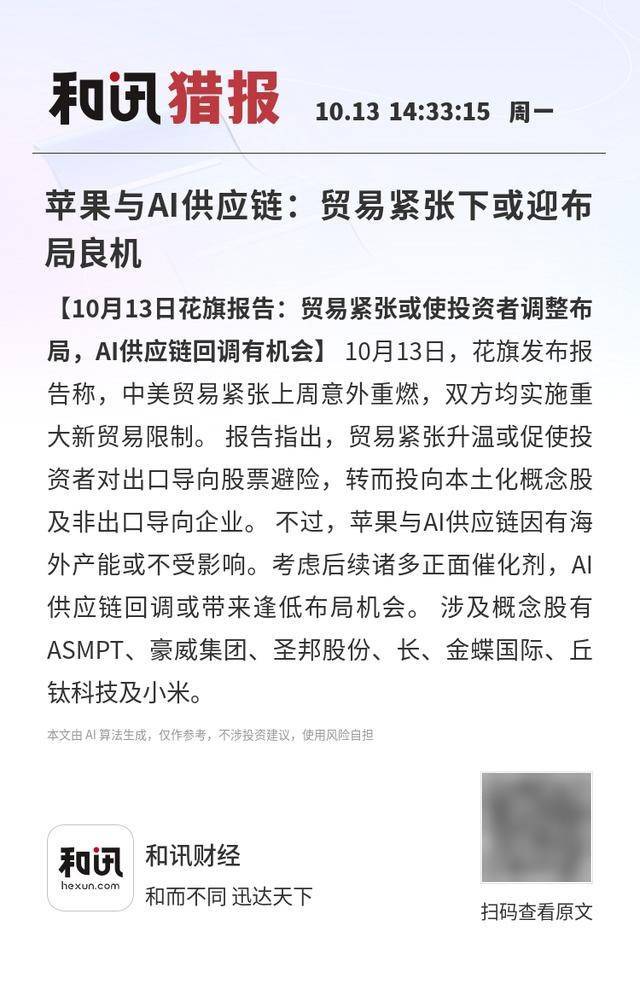
Core Insights - The report from Citigroup highlights that renewed trade tensions between China and the U.S. may lead investors to shift their focus from export-oriented stocks to domestic concept stocks and non-export-oriented companies [1][3] - Despite the trade tensions, companies like Apple and those in the AI supply chain may remain unaffected due to their overseas production capabilities [1][3] - The report suggests that the pullback in the AI supply chain could present buying opportunities, supported by several positive catalysts in the future [1][3] Industry Impact - The renewed trade restrictions are likely to prompt a reevaluation of investment strategies, with a potential increase in interest towards localized businesses [1][3] - Companies mentioned as part of the AI supply chain that could benefit from this situation include ASMPT, Omnivision, Sanan Optoelectronics, Chang, Kingdee International, Q Tech, and Xiaomi [1][3]

摩根资管:海外投资者对港股前景乐观 外资或会逐步吸纳港股
Zhi Tong Cai Jing· 2025-10-06 07:41
Core Viewpoint - The Hang Seng Index rose by 1,012 points last week, indicating optimism among overseas investors regarding market prospects. The Hong Kong stock market has outperformed the US market this year, leading foreign capital to gradually absorb Hong Kong stocks to avoid further losses [1] Group 1: Market Outlook - The market is expected to remain positive until the end of next year, but with the index having risen for five consecutive months, there may be opportunities for profit-taking as investors reassess their portfolios, making the current risk-reward ratio less attractive [1] - The recent increase in investment recommendations for technology stocks by sell-side analysts suggests promising industry developments, particularly with major US tech companies investing in data centers and power plants, which raises expectations for similar growth opportunities in China, benefiting the entire AI supply chain [1] Group 2: Sector Analysis - New consumer stocks in the Hong Kong and A-share markets have accumulated significant gains, leading to a lack of short-term investment appeal [1] - Investors are encouraged to consider other Asian markets, such as Taiwan, for potential opportunities [1] - The selection of a new Prime Minister in Japan may provide important insights for the Japanese stock market [1] Group 3: Economic Indicators - The anticipated government shutdown in the US is expected to have a limited direct impact on the US stock market, while other data indicates a weakening labor market, suggesting a high likelihood of interest rate cuts by the Federal Reserve in October [1]
AI基础设施投资持续增长,英伟达展望显示需求依然强劲
Zhao Yin Guo Ji· 2025-08-29 08:48
Investment Rating - The report maintains a "Buy" rating for companies benefiting from the AI supply chain, specifically for 中际旭创 (300308 CH) and 生益科技 (600183 CH) [2][4]. Core Insights - AI infrastructure investment continues to grow, with NVIDIA's strong performance indicating sustained demand. NVIDIA's revenue for Q2 FY26 reached $46.7 billion, a 56% year-over-year increase and a 6% quarter-over-quarter increase, exceeding Bloomberg consensus estimates [2][4]. - The management expects Q3 revenue to be $54 billion, indicating a 16% quarter-over-quarter growth, which is significantly higher than previous quarters [2][4]. - The report highlights the robust growth in NVIDIA's data center revenue, which increased by 17% quarter-over-quarter, driven by high sales of Blackwell chips and strong network business growth [4]. Summary by Sections NVIDIA Performance - NVIDIA's Q2 FY26 revenue was $46.7 billion, with a Non-GAAP gross margin of 72.7%, expected to rise to around 75% by year-end [2][4]. - The net profit for Q2 was $25.8 billion, reflecting a 52% year-over-year increase and a 30% quarter-over-quarter increase [2][4]. Market Outlook - Management anticipates that the capital expenditure of the four major cloud providers will reach $600 billion by 2025, with market opportunities potentially expanding to $3-4 trillion by 2030 [4]. - The report emphasizes the improving return on investment for AI infrastructure, with GB200's ROI projected to be 10 times [4]. Geopolitical Considerations - NVIDIA's sales outlook in China remains uncertain due to geopolitical tensions, with potential revenue from H20 products estimated between $2 billion to $5 billion if conditions improve [4].
