AI基础设施投资

Search documents
索尔黄金同意江西铜业收购要约
Zhong Guo Neng Yuan Wang· 2025-12-25 08:34
Core Viewpoint - SolGold has agreed to a £867 million ($1.17 billion) acquisition offer from its largest shareholder, Jiangxi Copper, which represents a 43% premium over the closing price prior to the acquisition proposal [1] Group 1: Acquisition Details - The acquisition price is set at 28 pence per share, which is significantly higher than SolGold's closing price of 19.6 pence on November 19, the day before Jiangxi Copper's initial approach [1] - Following the announcement, SolGold's share price slightly increased to 25.65 pence [1] Group 2: Strategic Importance - This agreement will enable Jiangxi Copper to control SolGold's Cascabel project in Ecuador, which is significant due to the increasing demand for copper driven by electric vehicle consumption and AI infrastructure investments [1] - Ecuador has recently been identified as a location with multiple world-class copper deposits, enhancing its attractiveness for mining companies [1] Group 3: Investor Landscape - Other notable investors in SolGold include BHP and Newmont, indicating a competitive investment environment around the company [1]

中芯国际:确认涨价
Xin Lang Cai Jing· 2025-12-24 06:58
Core Viewpoint - The semiconductor wafer foundry industry is set to initiate a new round of price increases, primarily focused on the 8-inch BCD process platform, with price hikes around 10% reported by multiple sources [1][5]. Group 1: Price Increases - SMIC has issued price increase notifications to downstream customers, with variations in price adjustments for each client [1][5]. - Other suppliers, including World Advanced (VIS), are also raising prices by approximately 10% on the BCD platform, indicating a broader trend in the industry [1][5]. - Industry insiders predict that other major foundries will follow suit in raising prices due to underlying industry factors [1][5]. Group 2: Reasons for Price Increases - The surge in AI infrastructure investment is driving demand for power chips, which is consuming much of the BCD capacity [6]. - TSMC's reduction of 8-inch capacity in favor of high-end processes has created supply shortages [6]. - High prices of metals like gold and copper are also contributing to the increase in foundry prices [6]. Group 3: Market Dynamics - The price increase in wafer foundry services is expected to create dual pricing pressures for domestic chip design companies in the coming year [6]. - The storage price surge has led end customers to shift cost pressures to other chip manufacturers, affecting pricing strategies across the board [6]. - Companies are experiencing forced price increases for automotive products, with many selling at negative margins to capture market share [6]. Group 4: Company Strategies - Domestic foundries involved in the BCD platform include SMIC, Huahong Semiconductor, Chipone, and Huarun Microelectronics [7]. - Huahong Semiconductor plans to improve average selling prices and expand BCD capacity, as it is one of their most profitable technology platforms [7][8]. - Chipone has reported a supply-demand imbalance in high-end applications, allowing for stable pricing and potential price increases [8]. - Huarun Microelectronics focuses on high-efficiency products for various applications, including AI server power supply [8].

中芯国际:确认涨价
财联社· 2025-12-24 06:56
Group 1 - The core viewpoint of the article is that the semiconductor wafer foundry industry is about to enter a new round of price increases, primarily driven by demand for BCD process technology [1][2] - SMIC has notified downstream customers of a price increase of approximately 10%, particularly affecting the 8-inch BCD process platform [1] - Other foundries, such as World Advanced (VIS), are also expected to follow suit with similar price increases, indicating a broader trend in the industry [1][2] Group 2 - The price increase is attributed to several industry factors, including a surge in AI infrastructure investment, which requires a significant number of power chips, thus consuming much of the BCD capacity [3] - TSMC's reduction of 8-inch capacity in favor of high-end processes has created a supply gap, further contributing to the price hikes [3] - The high prices of metals like gold and copper are also impacting foundry pricing [3] Group 3 - The article mentions that high-voltage CMOS (HV-CMOS) is expected to be the next target for price increases as demand for BCD is currently high [3] - Domestic foundries such as SMIC, Huahong Semiconductor, and others are focusing on improving average selling prices and expanding BCD capacity, which is one of their more profitable technology platforms [4] - Companies like Chipone Integrated Circuits are experiencing supply shortages in high-end applications, while also maintaining stable prices and potential for price increases in their products [4]

台湾五年来首见税收短征 媒体忧军购挤压民生
Zhong Guo Xin Wen Wang· 2025-12-18 09:08
Group 1 - Taiwan's tax revenue is projected to fall short by NT$30 billion to NT$50 billion in 2025, raising concerns about the impact on social welfare and tax reduction space due to increasing military expenditures [1][2] - The recent military procurement from the U.S. includes over US$11.1 billion for eight arms sales, which is part of Taiwan's NT$1.25 trillion defense special budget awaiting legislative approval [1] - The slowdown in tax revenue growth amidst rising economic growth rates highlights structural imbalances in Taiwan's industry and tax base distribution, with reliance on exports and high-tech industries while consumer markets remain sluggish [1] Group 2 - The scale of special budgets in Taiwan has been expanding, with the upcoming fiscal year including budgets for "enhancing defense resilience" and "social resilience," totaling NT$2.2 trillion, nearing the total of NT$2.57 trillion during the previous administration [2] - The normalization of special budgets is weakening existing budget review mechanisms, posing challenges to fiscal discipline [2] - Taiwan's credit outlook for 2026 indicates potential economic growth slowdown to 2.4% due to reduced investment momentum in AI infrastructure and increased global trade uncertainties, which may exacerbate fiscal pressures [2]
OpenAI十周年记:从非营利实验室到5000亿美元帝国,马斯克与奥特曼的决裂之路
Hua Er Jie Jian Wen· 2025-12-12 08:10
Core Insights - OpenAI has transformed from a non-profit research lab into a commercial giant valued at $500 billion, with co-founders Elon Musk and Sam Altman now fierce competitors [1] - The shift from non-profit to profit-driven entity has altered the AI competition landscape, with OpenAI's ChatGPT reaching over 800 million users weekly since its launch [1] - Musk has accused OpenAI of betraying its founding mission and has initiated legal actions against the company and Altman [3][4] Group 1: Founding and Ideals - OpenAI was founded on a $1 billion commitment from Musk and other tech leaders to create an AI lab free from commercial pressures [2] - The initial non-profit vision faced challenges as early as 2017, with Musk expressing frustration over the potential shift towards a tech startup model [2] Group 2: Competition and Legal Battles - Musk left OpenAI's board in 2018, citing potential conflicts of interest with Tesla's AI initiatives, but deeper issues were at play [2] - Musk's xAI is now a direct competitor to OpenAI, with a projected valuation of $230 billion and plans for a $15 billion funding round [4][5] Group 3: Investment and Growth Strategies - OpenAI plans to invest over $1 trillion in AI infrastructure, significantly outpacing competitors like Anthropic, which has a $100 billion commitment [6] - Analysts express skepticism about OpenAI's aggressive spending strategy, questioning its sustainability and potential returns [6] Group 4: Revenue Projections and Partnerships - OpenAI anticipates annual revenue to reach $20 billion by year-end and potentially thousands of billions by 2030 [7] - Major tech companies, including Oracle, AMD, and Broadcom, are benefiting from OpenAI's growth, with Oracle signing a $500 billion infrastructure deal [7] Group 5: Strategic Adjustments - In response to competitive pressures, OpenAI has initiated a "red code" strategy to enhance ChatGPT's performance while delaying other projects [8] - OpenAI recently launched ChatGPT-5.2, claiming it to be the best system for everyday professional use [8]
大模型正沦为“免费基建”,真正Alpha机会在应用层?
美股IPO· 2025-11-24 07:45
Core Viewpoint - The investment focus in the AI sector should shift from infrastructure to application layers, as large language models (LLMs) are rapidly commoditizing and are not the ultimate value creators [1][3][4]. Group 1: Current Market Dynamics - LLMs are being compared to the early stages of broadband network construction, where the models are essentially being "given away for free" [4]. - Major LLM developers, such as OpenAI, are in fierce competition to surpass each other on similar functionalities, akin to "creating 10 Googles" simultaneously [5]. - The real profits in the value chain will flow to application developers who can effectively utilize these tools to create actual business value [5]. Group 2: Investment Strategy - The company prefers to invest in those who leverage AI capabilities to create significant efficiency improvements and business model transformations within specific industries, rather than in the developers of the search engines themselves [6]. - There is a cautious stance towards the current market's enthusiasm for AI infrastructure, with comparisons made between Nvidia's $5 trillion valuation and Cisco's valuation during the 1999 tech boom, suggesting it reflects past achievements rather than future potential [6]. Group 3: Future Predictions - The company predicts that the U.S. will invest $500 billion in data centers over the next few years to meet "crazy" demand, but views this investment as a "small boom" with capital and attention having already "overstepped" [7].

【广发宏观团队】全球资产主流叙事:一致预期松动但尚未逆转
郭磊宏观茶座· 2025-11-02 09:17
Global Asset Narrative - The core narrative of global assets is showing signs of loosening expectations but has not yet reversed. Key narratives include the weakening of dollar credit, gold transitioning from a safe-haven asset to a new monetary anchor, the reshaping of global supply chains, AI as the foundation of a new technological revolution, and non-ferrous metals being likened to the oil of this new revolution [1][2]. Recent Market Developments - Since October, the pricing environment for assets has shown signs of loosening consensus expectations, particularly with a rebound in the dollar, which rose from a low of 96.6 on September 16 to 99.7 by October 31. This shift has led to discussions around new economic logics such as increased labor productivity and rising real interest rates [2]. - Gold prices have experienced significant adjustments, peaking at $4,357 per ounce on October 20 before falling to $3,997 by October 31, influenced by geopolitical factors and easing global trade tensions [2]. - Recent economic discussions between China and the U.S. have yielded new outcomes, with tariffs being canceled or suspended, indicating a reduction in the risks of further disruptions in global supply chains [2]. Sector-Specific Insights - Meta's increased capital expenditures have led to a significant stock price adjustment, indicating a potential break in the positive cycle of AI infrastructure investment and market valuation [3]. - There is a general consensus on the increased demand for non-ferrous metals due to new industries, but there are differing views on the magnitude of this demand [3]. - The loosening of narratives is expected to impact asset prices, leading to increased volatility in financial market expectations, although the foundational narratives remain intact [3]. Global Market Performance - Global stock markets have shown divergence, with U.S. stocks beginning to exhibit signs of concern. The MSCI developed and emerging markets saw narrower gains of 0.61% and 0.92%, respectively [4][5]. - The S&P 500 and Nasdaq indices rose by 0.71% and 2.24%, respectively, despite concerns over Meta's aggressive capital spending plans leading to an 11% drop in its stock price on October 30 [5]. - In the commodities market, precious metals have moved away from a one-sided trend, with gold prices continuing to decline while silver prices increased by 2.0% [6]. Economic Indicators - The eurozone's economic performance in Q3 exceeded market expectations, with GDP growth of 0.2%, driven by stable investment and public spending despite weak private consumption [18][19]. - The ECB maintained interest rates at 2% during its October meeting, indicating a cautious approach to future monetary policy adjustments [19]. - In China, the stock and bond markets have shown signs of a "see-saw" effect, with the A-share market experiencing a slight increase of 0.41% [11]. Policy and Regulatory Developments - The Chinese government has announced plans to enhance digital transformation in urban areas, aiming to establish over 50 fully digitalized cities by 2027 [27][28]. - Recent policy measures aim to improve the financing environment for enterprises, with the BCI index rising from 47.6 to 52.4, indicating a more favorable outlook for corporate financing [24].

利空突袭!刚刚,直线大跳水!
券商中国· 2025-10-30 12:30
Core Viewpoint - The article highlights the significant decline in Meta's stock price due to disappointing earnings, raising concerns about the return on massive investments in AI infrastructure by major tech companies [1][2]. Financial Performance - Meta reported Q3 revenue of $51.24 billion, a 26% year-over-year increase, but net profit plummeted 83% to $2.71 billion, with earnings per share at $1.05, far below the market expectation of $6.68 [7]. - The drastic drop in net profit was primarily attributed to a one-time non-cash tax expense of $15.93 billion resulting from the U.S. tax reform [3][7]. - After adjusting for tax impacts, Meta's adjusted earnings per share were $7.25, exceeding analyst expectations of $6.69 [7]. Capital Expenditure and Future Outlook - Meta plans to increase its capital expenditures for the year to between $116 billion and $118 billion, up from a previous estimate of $114 billion to $118 billion [7]. - The company’s CEO, Mark Zuckerberg, indicated that the implementation of the tax reform would significantly reduce federal cash tax payments in the coming years [7]. - Meta's CFO, Susan Li, stated that capital expenditure growth in 2026 would significantly exceed that of 2025, indicating ongoing investment needs [8]. AI Infrastructure Investment - Major tech companies, including Meta, Alphabet, and Microsoft, collectively spent approximately $78 billion on capital expenditures in the last quarter, marking an 89% year-over-year increase, primarily for data center construction and GPU investments [12]. - Alphabet has raised its capital expenditure forecast for 2025 to between $91 billion and $93 billion, reflecting strong demand for its cloud services [13]. - Microsoft reported a record capital expenditure of $34.9 billion in its most recent quarter, driven by accelerating demand across multiple sectors [13][14]. Market Concerns - Investors are increasingly worried about whether the substantial investments in AI infrastructure will yield adequate returns, with analysts questioning if the industry is entering a bubble [14]. - Meta's total costs surged to $30.7 billion in Q3, a 32% increase, outpacing revenue growth and leading to a contraction in operating profit margin from 43% to 40% [11]. - The company’s guidance for Q4 revenue is between $56 billion and $59 billion, which aligns with market expectations, but concerns remain about ongoing cost pressures and declining profit margins [11].

10月22日美股成交额前20:迷因股Beyond Meat三日上涨约600%
Xin Lang Cai Jing· 2025-10-21 21:08
Group 1: Tesla - Tesla's stock fell by 1.08% with a trading volume of $23.925 billion, as CEO Elon Musk threatened to leave the company if he does not receive a high salary [1] - Notable investor Cathie Wood stated that Tesla could grow 30 times in the next decade, to which Musk agreed [2] Group 2: Nvidia - Nvidia's stock decreased by 0.83% with a trading volume of $21.519 billion; a competitor, Axelira, launched a new AI chip [2] - Nvidia is reportedly discussing providing loan guarantees for OpenAI, with a significant $100 billion investment agreement reached after tense negotiations [2] Group 3: Apple - Apple's stock rose by 0.20% with a trading volume of $12.225 billion, reaching a new all-time high [2] - Initial sales of the iPhone 17 exceeded those of the iPhone 16, with a 14% year-over-year increase in sales within the first 10 days in the US and China [2] Group 4: Amazon - Amazon's stock increased by 2.56% with a trading volume of $10.683 billion, recovering from a significant outage that affected global services [3][4] - Analysts noted that this outage could damage Amazon's reputation as a reliable cloud service provider, although it may not lead to severe long-term consequences [3] Group 5: Beyond Meat - Beyond Meat's stock surged by 146.26% with a trading volume of $4.952 billion, driven by a new agreement to expand product supply in over 2,000 Walmart stores [5] - The stock has seen a nearly 600% increase over the past three trading days, attributed to retail investor enthusiasm and high short interest [5] Group 6: Philip Morris - Philip Morris reported stronger-than-expected Q3 earnings, with adjusted EPS of $2.24, exceeding analyst expectations of $2.09, and a revenue of $10.85 billion, surpassing estimates [6] - The company's revenue grew by 9.42% year-over-year, driven by robust sales and demand for smoke-free products [6] Group 7: Market Overview - The trading volume for major stocks included Tesla at $23.925 billion, Nvidia at $21.519 billion, and Apple at $12.225 billion, indicating significant market activity [7][8]




揭秘黄仁勋与奥特曼千亿投资内幕!
国芯网· 2025-10-21 13:06
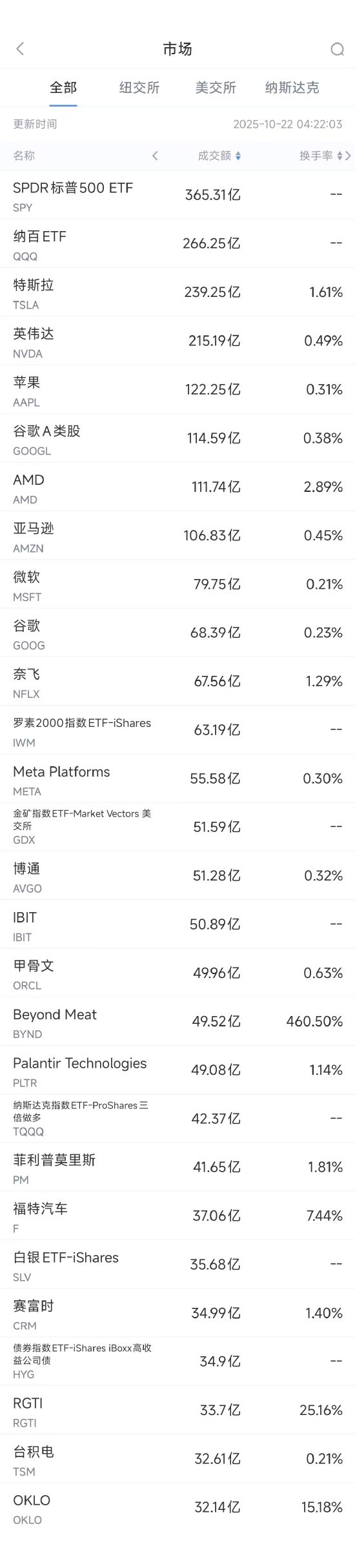
Core Viewpoint - The article discusses a significant investment agreement between OpenAI and Nvidia, highlighting the competitive dynamics in the AI infrastructure sector and the strategic maneuvers of key players like OpenAI CEO Sam Altman and Nvidia CEO Jensen Huang [1][3][5]. Group 1: Investment Agreements - Nvidia and OpenAI reached a monumental investment agreement worth $100 billion, marking it as one of the largest in the AI infrastructure space [1][3]. - The deal includes Nvidia renting up to 5 million chips to OpenAI, valued at $350 billion, along with an investment option of up to $100 billion to support OpenAI's operations [7]. Group 2: Competitive Dynamics - Altman has been leveraging the competitive nature of Silicon Valley tech giants to secure investments for OpenAI, creating a sense of urgency among them to participate in its growth [5]. - Following reports of OpenAI renting Google’s TPU chips, Nvidia's Huang quickly sought to re-engage in negotiations, indicating the high stakes involved [6]. Group 3: Strategic Partnerships - OpenAI has also entered into partnerships with AMD and Broadcom, with AMD's stock surging 24% after announcing a deal that grants OpenAI a 10% equity stake [7]. - Broadcom is collaborating with OpenAI to develop a new chip and computing system, with both companies accelerating negotiations after Nvidia's agreement [7][8].