ROE

Search documents
险资举牌热潮或将延续,银行股为何受青睐?
Guo Ji Jin Rong Bao· 2026-01-07 23:23
Core Viewpoint - Ping An Life has disclosed that it will increase its stake in Agricultural Bank of China H-shares to 20% by December 30, 2025, triggering a mandatory disclosure under Hong Kong market rules [1] Group 1: Investment Activities - This marks the fourth time Ping An Life has increased its stake in Agricultural Bank H-shares, having previously surpassed 5%, 10%, and 15% in February, May, and August 2025 respectively [4] - In 2025, Ping An Life also acquired 7.169 million shares of Postal Savings Bank H-shares, raising its stake to 5.01%, and subsequently increased its holdings to 10% and 15% in May and August [6] - Additionally, Ping An Life made multiple acquisitions of China Merchants Bank H-shares throughout 2025, surpassing 5%, 10%, 15%, and 20% in January, March, June, and December respectively [6] Group 2: Industry Trends - The enthusiasm for insurance capital to acquire shares has surged, with a total of 35 instances of share acquisitions in 2025, the highest since 2016 [5] - The preference for bank stocks among insurance companies is attributed to their average dividend yield exceeding 5%, which is significantly higher than the cost of liabilities (approximately 2% to 2.5%) [7] - The new financial instrument standards allow high-dividend bank stocks to be classified as FVOCI assets, reducing profit statement volatility [7] Group 3: Future Outlook - The trend of insurance capital actively acquiring shares is expected to continue into 2026, driven by low interest rates and the need for stable returns [8][10] - Analysts suggest that the motivations behind these acquisitions can be categorized into two types: one focused on stable dividend cash flows and the other on investing in mature, monopolistic enterprises with solid ROE [9][10] - The stock prices of major insurance companies have seen significant increases in 2025, with gains of 46.02% for New China Life, 35.87% for Ping An, and others [10]



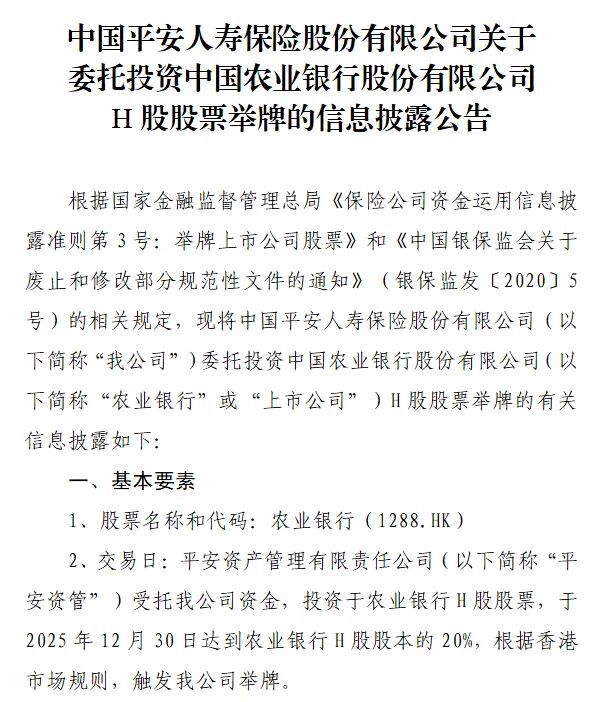
从5%到20%!平安人寿四度举牌农行H股,银行股为何受青睐?
Guo Ji Jin Rong Bao· 2026-01-07 15:40
Core Viewpoint - Ping An Life has disclosed that it will increase its stake in Agricultural Bank of China H-shares to 20% by December 30, 2025, triggering a mandatory disclosure under Hong Kong market rules [1]. Group 1: Investment Activities - This marks the fourth time Ping An Life has increased its stake in Agricultural Bank H-shares, having previously surpassed 5%, 10%, and 15% in February, May, and August 2025 respectively [4]. - In addition to Agricultural Bank, Ping An Life has also acquired shares in Postal Savings Bank and China Merchants Bank, with holdings reaching 5.01%, 10%, 15%, and 20% at various points in 2025 [6]. - Overall, in 2025, insurance capital made a total of 35 stake increases, the highest since 2016, indicating a growing trend in insurance investments [5][8]. Group 2: Reasons for Preference in Bank Stocks - Insurance companies are favoring bank stocks due to their average dividend yield exceeding 5%, which is significantly higher than the cost of liabilities (approximately 2% to 2.5%), making them attractive as "quasi-fixed income" assets [7]. - The new financial instrument standards allow high-dividend bank stocks to be classified in a way that stabilizes profit and loss statements, further encouraging investment [7]. - The stable performance and dividend consistency of bank stocks align with the long-term investment strategies of insurance companies, which seek value and stability [7]. Group 3: Future Outlook - The trend of insurance capital actively participating in equity markets is expected to continue, driven by low interest rates and regulatory support for long-term investments [8][10]. - Analysts suggest that the demand for bank stocks will persist, with insurance companies likely to focus on stable dividend-paying stocks and those with strong return on equity (ROE) [9][10]. - The stock prices of major insurance companies have shown significant increases in 2025, reflecting market confidence in the insurance sector's fundamentals [10].
EQB (OTCPK:EQGP.F) Conference Transcript
2026-01-06 20:02
Summary of EQB Conference Call - January 06, 2026 Company Overview - **Company**: EQB Inc. (OTCPK: EQGP.F) - **Industry**: Banking, specifically a challenger bank in Canada Key Points and Arguments Growth Expectations - **Loans Under Management**: Expected to grow in high single digits, with a previous growth of 10% in 2025 [3][6] - **Revenue Growth**: Anticipated mid-single-digit revenue growth for 2026, with flat to slightly positive operating leverage and low single-digit expense growth [3][6] - **Operating Efficiency**: Aiming to return to a competitive advantage in efficiency, targeting a return on equity (ROE) of 15%+ [5][6] Strategic Initiatives - **PC Financial Acquisition**: The acquisition is seen as a transformative opportunity, expected to increase customer base from 800,000 to 3.5 million, enhancing distribution capabilities and brand recognition [4][29] - **Focus on Core Franchise**: Emphasis on reigniting the core business and optimizing capabilities to drive revenue growth [4][5] Financial Performance - **Earnings Growth**: Projected EPS growth of 12%-15% for 2026, with a focus on improving operating leverage [6][11] - **Expense Management**: A significant improvement in expenses is expected, with a CAD 45 million reduction anticipated in 2026 [15][27] - **Credit Quality**: The company is well-positioned for a potentially recessionary environment, with an expected improvement in the provision for credit losses (PCL) ratio in 2026 [17][25] Equipment Financing - **Risk Posture Improvement**: The risk profile of the equipment financing business has improved, with a shift from lower quality long-haul trucking to more prime customers [19][20] Cross-Selling Opportunities - **PC Optimum Integration**: Plans to leverage the PC Optimum loyalty program to enhance customer engagement and cross-sell financial products [30][35] - **Product Offerings**: Potential to offer mortgages and insurance products to new customers from the PC Financial acquisition [36][44] Capital Management - **Capital Utilization**: The company is focused on organic growth and share buybacks, with a current CET1 ratio of 13.3% [48][51] - **Share Buyback Program**: An NCIB (Normal Course Issuer Bid) has been announced to repurchase shares, indicating confidence in the company's valuation [51][52] Cultural Alignment - **Partnership with Loblaw**: The shared culture and focus on building a distinct challenger bank were key factors in the partnership with Loblaw for the PC Financial acquisition [53][54] Future Outlook - **New Era for EQB**: The leadership team expresses excitement about the future, emphasizing a commitment to being a leading challenger bank in Canada and enhancing customer offerings [58][59] Additional Important Content - **Efficiency Ratio Goals**: The company aims to improve its efficiency ratio to the high 40s or around 50% by late next year [28] - **Physical Presence Strategy**: Plans to operate device pavilions in stores to enhance customer interaction without incurring high operating costs [39][40] This summary encapsulates the key insights and strategic directions discussed during the EQB conference call, highlighting the company's growth expectations, strategic initiatives, financial performance, and future outlook.
Bank of Montreal (NYSE:BMO) Conference Transcript
2026-01-06 16:12
Summary of Bank of Montreal Conference Call Company Overview - **Company**: Bank of Montreal (NYSE: BMO) - **Date**: January 06, 2026 Key Points ROE Target and Performance - Bank of Montreal aims to achieve a **15% Return on Equity (ROE)** by the end of **2027**, with a commitment to sustainable performance beyond that [6][8][59] - The bank increased its ROE by **150 basis points** year-over-year, the fastest among peers, and achieved **26% EPS growth** in the previous year [4][5] - The bank's operating leverage was **4.3%** with an **18% growth** in Pre-Provision Profitability (PPPT) in 2025 [5] U.S. Banking Segment - The objective is to exit 2027 with a **12% ROE** in the U.S. banking segment, which has been restructured to optimize synergies between personal, commercial, and wealth management services [9][10] - The restructuring began in July 2025, and the bank expects to see full benefits from this optimization by the second quarter of 2026 [11] - Loan growth in the U.S. is anticipated to be in the **mid-single digits** starting in the second quarter of 2026, contingent on macroeconomic conditions [16] Credit and Impairments - The bank expects a **flattish** credit experience in 2026, with improvements anticipated in the U.S. but some deterioration in Canadian retail [13][14] - The bank aims to normalize impaired Provision for Credit Losses (PCL) to the mid-30s, but does not expect significant credit normalization to impact ROE significantly [14][34] Deposit Growth and Strategy - Deposit growth has been strong, particularly following the instability in early 2023, and is expected to align with loan growth moving forward [18] - The bank is focusing on improving the mix of deposits, targeting low-cost retail deposits and operational deposits in the commercial sector [19][21] Canadian Market Outlook - Loan growth in Canada is projected to be low single digits, influenced by economic uncertainty and client confidence [22][24] - The bank is optimistic about the Canadian economy's resilience and expects to see increased loan demand as clients regain confidence [24] Efficiency and Cost Control - The bank's efficiency ratio gap to peers has narrowed from **400 basis points** to **160 basis points** over the past five years [27] - A restructuring expense of approximately **CAD 200 million** is expected, with an annual run rate benefit of **CAD 250 million** [28] Capital Deployment and M&A Strategy - The bank generated **90 basis points** of capital last year and maintains a **13.3% Common Equity Tier 1 (CET1)** ratio, indicating strong capital generation capacity [35] - While the bank is open to M&A opportunities, it prioritizes organic growth and optimizing existing operations over pursuing acquisitions [39][40] Capital Markets Outlook - The capital markets business is performing well, with expectations to exceed previous targets of **$625 million** in PPPT per quarter [48] - The U.S. capital markets are seen as a significant growth area, with high market shares in investment banking and a focus on integrating services across business lines [51][52] Macro Economic Outlook - The bank anticipates **2.3%-2.4% GDP growth** in the U.S. and **1.7%** in Canada, with a positive outlook for operational improvements continuing into 2026 [58] - The bank remains optimistic about its ability to achieve its ROE target and sustain it beyond 2027 [59] Additional Insights - The bank's strong position in the mining sector and its global reach in capital markets are expected to provide significant benefits as the market improves [55] - The bank is cautious about the timing of capital flows despite positive policy shifts, indicating a measured approach to growth [56]

Royal Bank of Canada (NYSE:RY) Conference Transcript
2026-01-06 14:42
Summary of Royal Bank of Canada Conference Call Company Overview - **Company**: Royal Bank of Canada (NYSE:RY) - **Event**: 2026 RBC Canadian Bank CEO Conference - **Date**: January 06, 2026 Key Industry Insights - **Canadian Economy**: The Canadian economy showed resilience in 2025, avoiding recession despite challenges such as USMCA negotiations and tariffs. The economy is slowly adjusting to these tariffs and other economic challenges [2][3] - **Credit Losses**: Credit losses have stabilized, with expectations for stable provisions for credit losses (PCLs) in 2026 and potential declines into 2027 [3] - **Interest Rates**: Current interest rates are favorable for lending and bank products, contributing to a constructive environment for banks [3] - **Valuation Metrics**: The median forward P/E ratio for the big six Canadian banks is currently 14, compared to 11.9 in the previous year. Canadian banks trade at 83% of the TSX P/E, which is higher than the 10-year average of 70% [4][5] Company-Specific Insights - **ROE Targets**: RBC aims for a return on equity (ROE) target of 17% or higher, with discussions around optimizing capital deployment to achieve this [20][24] - **Capital Management**: RBC plans to operate within a common equity tier one (CET1) ratio of 12.5% to 13.5%, with excess capital potentially used for stock buybacks [22][27] - **Growth Opportunities**: The bank sees significant growth opportunities in infrastructure investments, particularly in energy, mining, and transportation, with CAD 60 billion in defense spending and CAD 150 billion in infrastructure planned [10][11] - **Consumer Behavior**: Canadian consumers are redirecting disposable income from mortgage servicing to consumption, which is stabilizing the economy and creating jobs [12][13] Risks and Challenges - **Credit Risk**: There are concerns about sectoral credit risks, particularly related to unresolved issues in CUSMA and the impact on specific industries like steel and softwood lumber [44][45] - **Geopolitical and Cyber Risks**: Geopolitical tensions and cyber risks are significant concerns, with RBC investing heavily in cybersecurity to protect its infrastructure and customer trust [48][49] - **Tax Implications**: The implementation of global tax regulations (Pillar Two) is expected to increase RBC's overall tax burden, presenting a headwind for growth [56][57] Strategic Focus - **Investment in AI**: RBC is focusing on leveraging AI to enhance profitability and operational efficiency, with a strong emphasis on data-driven decision-making [35][36] - **Market Positioning**: RBC is well-positioned to capitalize on growth opportunities in both Canada and the U.S., with a strong deposit franchise and a focus on organic growth rather than acquisitions [70][73] - **Future Outlook**: The bank is optimistic about the macroeconomic environment and sees unprecedented growth opportunities in Canada, emphasizing the importance of infrastructure projects for long-term prosperity [70][71] Conclusion - RBC is navigating a constructive environment with a focus on optimizing returns while managing risks. The bank is well-positioned to leverage growth opportunities in both domestic and international markets, with a strong emphasis on capital efficiency and technological advancements.

聚焦格局更优的细分领域-证券行业2026年度投资策略
2025-12-29 01:04
Summary of the Securities Industry Conference Call Industry Overview - The securities industry is expected to continue a slow bull market in 2026, supported by proprietary and brokerage businesses, despite a decline in commission rates from 0.195% at the end of last year to approximately 0.17% by the end of this year [1][5] - The overall valuation of the securities sector has decreased to around 1.4 times, which is at the 30th percentile of the past decade [3][4] Key Points Performance in 2025 - The securities sector underperformed compared to other financial sub-sectors like insurance and banking, despite a significant profit growth of over 60% in the first three quarters, driven mainly by brokerage and proprietary trading [1][4] - Major brokerages such as Dongfang Caifu, CITIC Securities, Guosen Securities, and Galaxy Securities achieved a return on equity (ROE) of approximately 9%-10% [1][4] Focus Areas for 2026 - Investment strategies should focus on the following areas: - **Asset Management (AM)**: Expected to see a positive growth rate in 2025, but the net income growth was only 4% in the first three quarters. The introduction of new public fund commission regulations is anticipated to boost revenue growth in 2026 [2][11] - **Investment Banking (IB)**: Currently at the bottom of the cycle, with a potential recovery as the market improves [9][13] - **International Business**: High concentration among leading firms like CITIC, CICC, and Huatai, with expected growth in 2026 as these firms leverage their competitive advantages in Hong Kong [2][12] Market Conditions - The A-share IPO market remains tight, with a focus on balancing investment and financing, leading to a smaller number and scale of IPOs. The suspension of IPOs since the end of 2023 continues [1][8] - The Hong Kong IPO and refinancing market has recovered quickly, but the profitability of these activities is not as robust as that of A-share IPOs [10] Future Projections - The overall ROE for the securities industry is projected to be around 7.5% in 2025, with leading firms achieving approximately 10%. The growth in profitability is expected to be modest, reaching around 8% [2][13] - The proprietary trading business is shifting towards OCI accounts, which may enhance the stability of the profit statement but reduce its elasticity [6] Additional Insights - The focus on investment banking, asset management, and international business is crucial due to their potential for growth and improvement in market conditions [7][9] - The concentration of international business among a few leading firms indicates a strong competitive barrier, which may benefit these firms in the long run [12][14]



南京证券(601990):深度研究报告:业务矩阵齐发力,区域国资强赋能
Huachuang Securities· 2025-12-25 11:47
Investment Rating - The report gives a "Buy" rating for Nanjing Securities with a target price of 9.45 RMB [1][6]. Core Views - Nanjing Securities, as a state-owned broker in Nanjing, leverages its local government background to enhance resource collaboration and has a stable shareholding structure [6][7]. - The company's return on equity (ROE) is currently below the industry average but shows potential for improvement due to increasing leverage and a favorable debt structure [8][29]. - The business layout is dominated by capital-intensive operations, with a significant portion of revenue coming from proprietary trading, which aligns well with industry trends [6][10]. Financial Summary - Total revenue is projected to grow from 3,147 million RMB in 2024 to 3,894 million RMB in 2027, with a compound annual growth rate (CAGR) of approximately 7% [2]. - Net profit attributable to shareholders is expected to increase from 1,002 million RMB in 2024 to 1,462 million RMB in 2027, reflecting a CAGR of about 7% [2]. - Earnings per share (EPS) is forecasted to rise from 0.27 RMB in 2024 to 0.40 RMB in 2027 [2]. Business Performance - The company has a high reliance on capital-intensive business, with an average revenue contribution of 69.1% from such operations from 2022 to 2024, significantly above the industry average of 49% [6][21]. - The brokerage business is transitioning towards wealth management, with expected net income from this segment to reach 7.78 million RMB in 2025 [9]. - Investment banking revenue is projected to decline slightly, with net income expected to be 1.67 million RMB in 2025 [9]. Leverage and Profitability - The financial leverage of Nanjing Securities has increased from 2.51X in 2022 to 3.76X in 2025, narrowing the gap with industry averages [8][38]. - The company's annualized ROE for the first three quarters of 2025 is reported at 6.8%, which is 1.8 percentage points lower than the industry average, indicating room for improvement [29][38]. Valuation and Investment Recommendation - The report suggests a price-to-book (PB) ratio of 1.8 for the year 2026, leading to a target price of 9.45 RMB based on the expected performance and capital strength post-equity financing [10][8]. - The anticipated capital increase of 5 billion RMB is expected to significantly enhance the company's capital strength and support business development [8][10].

A股盈利的四个宏观线索
Huachuang Securities· 2025-12-18 07:31
Group 1: Profitability Insights - The ROE of the entire A-share market (excluding finance and oil) increased from 6.32% in mid-2025 to 6.37% by Q3 2025, primarily driven by improved sales net profit margins due to effective cost control[3] - Sales net profit margin rose from 4.65% to 4.69%, indicating effective cost management despite a decline in gross profit margin from 17.73% to 17.48%[13] - Asset turnover improved slightly from 56.21% to 56.37%, reflecting enhanced operational efficiency[28] Group 2: Supply and Demand Dynamics - Among 17 industries, 10 are experiencing low capacity utilization and low capital expenditure/depreciation, indicating a poor current supply-demand balance but potential for future improvement[4] - Over two-thirds of industries have capacity utilization below historical medians, highlighting persistent demand weakness in the economy[41] Group 3: Valuation and Dividend Trends - In the past year, 24 out of 33 industries exhibited a trend of rising valuations and declining dividends, suggesting a marginal increase in market risk appetite[5] - The report identifies industries with high valuations and low dividends as needing caution, while those with low valuations and high dividends are seen as having better risk-reward profiles[53] Group 4: Dynamic Transmission of Profitability - Historical data shows that improvements in ROE and asset turnover typically lead capital expenditure by six months to a year, indicating a lag in investment response to profitability improvements[6] - Midstream manufacturing and upstream construction materials show a one-year lead of ROE over capital expenditure, while downstream goods show a six-month lead[64]
11月经济数据点评:中游供需矛盾进一步改善
Huachuang Securities· 2025-12-16 10:10
Group 1: Supply and Demand Analysis - The supply-demand gap for the midstream sector improved, with the demand-investment growth rate difference rising to 7.6% in November from 6.4% in October[1] - Midstream demand growth was 8.9% in November, down from 9.3% in October, while midstream investment growth fell to 1.3%[3] - The demand-investment growth rate difference for midstream has been increasing since May 2024 and turned positive in March 2025[3] Group 2: Future Projections - Historical data suggests that the midstream demand-investment growth rate difference is likely to remain positive, indicating potential price stabilization in the next two years[2] - The midstream PPI (Producer Price Index) is expected to stop declining and start rising, with a notable month-on-month increase of 0.04% in November, the first positive change since June 2024[4] - If the midstream PPI stabilizes, the year-on-year PPI is likely to continue rising, positively impacting midstream ROE (Return on Equity)[4] Group 3: Economic Data Overview - November's industrial value-added growth rate was 4.8%, with a slight month-on-month increase of 0.44%[20] - Retail sales growth in November was 1.3%, down from 2.9% in October, indicating weak consumer demand[22] - Real estate sales area decreased by 17.3% year-on-year in November, showing ongoing challenges in the property market[27]
中游供需矛盾进一步改善——11月经济数据点评
一瑜中的· 2025-12-16 06:56
Core Viewpoint - The article emphasizes the improvement of supply-demand contradictions in the midstream sector, indicating a potential shift from "strong supply and weak demand" to "weak supply and strong demand" in the coming years [2][3]. Group 1: Midstream Supply-Demand Analysis - The analysis method involves measuring the difference between demand growth and investment growth, where a positive difference indicates alleviation of supply-demand contradictions [2][5]. - Key indicators include upstream demand from material exports and construction investment, midstream demand from machinery exports and equipment investment, and downstream demand from labor-intensive product exports [5][12]. - In November, the midstream demand growth was 8.9%, slightly down from 10.3% in September, while midstream investment growth was 1.3%, down from 4.2% in September, leading to a demand-investment growth difference of 7.6% [6][13]. Group 2: Future Projections - Historical data suggests that the midstream demand-investment growth difference is likely to remain positive, with expectations for the midstream PPI (Producer Price Index) to stop declining and potentially rise by 2026 [3][14]. - The midstream PPI showed a month-on-month increase of 0.04% in November, marking the first positive change since June 2024, indicating a potential upward trend in midstream ROE (Return on Equity) [7][14]. Group 3: November Economic Data Overview - In November, industrial production growth was 4.8%, while service sector production index growth was 4.2%, indicating a slight weakening in supply-side performance [19]. - Consumer retail sales growth was 1.3%, down from 2.9% in October, while exports rebounded to a growth of 5.9% from a decline of 1.1% [19][21]. - Real estate sales area decreased by 17.3% year-on-year, and fixed asset investment saw a decline of 12.0% in November [19][22]. Group 4: Employment and Price Trends - The urban unemployment rate remained stable at 5.1%, with a slight decrease in the unemployment rate for migrant agricultural workers to 4.4% [23]. - The CPI (Consumer Price Index) rose to 0.7% year-on-year, while the PPI fell by 2.2%, indicating ongoing deflationary pressures in the economy [21][22].