
劳动力市场

Search documents
今年韩国失业救济金发放额或创历史纪录,超过新冠疫情期间
Xin Lang Cai Jing· 2025-12-08 06:17
Core Insights - The total unemployment benefits paid in South Korea for the first 11 months of this year have exceeded the record set in the same period of 2021, with expectations for the annual total to reach a historical high [1][4] - In November, the government paid 792 billion KRW (approximately 539 million USD) in unemployment benefits, marking a 6% decrease compared to the same month last year, and the first time since January that the monthly payment fell below 1 trillion KRW [1][4] Payment Trends - From February to October, the monthly unemployment benefit payments consistently exceeded 1 trillion KRW, establishing the longest streak of such payments [2][4] - Cumulative unemployment benefits paid in the first 11 months reached 11.47 trillion KRW, surpassing the previous record of 11.25 trillion KRW during the same period in 2021, when unemployment rates were high due to the COVID-19 pandemic [2][4] Employment Insurance Participation - As of the end of November, the number of individuals continuously participating in the national employment insurance program was 15.65 million, reflecting a 1.1% increase compared to the same period last year [2][4] Labor Market Conditions - The ratio of job vacancies to job seekers stands at 0.43, the lowest since November 1998, indicating a significant decrease in labor demand in manufacturing, construction, and wholesale retail sectors [3][5] - Despite improvements in the overall job market, there are notable weaknesses in employment opportunities within the manufacturing and construction industries, as well as among younger job seekers [3][5]
国投期货贵金属日报-20251205
Guo Tou Qi Huo· 2025-12-05 11:10
Report Summary 1. Report Industry Investment Rating - Gold and silver: ☆☆☆, representing a clearer long/short trend, with a relatively appropriate investment opportunity currently [1] 2. Core View - Overnight, the US weekly initial jobless claims dropped to 191,000, far below expectations and hitting a new low since September 2022, alleviating concerns about a sharp deterioration in the labor market. A December interest rate cut is largely priced in, and precious metals are mainly in a volatile state. Precious metals as a whole should not be chased higher before gold breaks through the previous high resistance. There is a supply gap for platinum this year, and the supply and demand are expected to be in a tight balance, with platinum outperforming palladium in terms of trend. Tonight, attention should be paid to the US September PCE data [1] - The White House National Economic Council Director Kevin Hassett said the Fed should cut interest rates at next week's meeting, predicting a 25 - basis - point cut, and hopes to "bring interest rates much lower" in the long run [2] - The World Gold Council stated that gold prices may fluctuate within a range next year, and a continued strong performance is not ruled out [2] - US Trade Representative Greer said Trump is considering withdrawing from the US - Mexico - Canada Agreement next year, and the possibility of breaking the tripartite tie is not excluded [2] 3. Other Key Information - Red stars represent a predicted trending up, green stars represent a predicted trending down. One star means being bullish/bearish, indicating a driving force for rising/falling but poor operability on the market. Two stars mean holding long/short positions, with a clearer rising/falling trend and the market situation fermenting. Three stars represent an even clearer long/short trend and a relatively appropriate investment opportunity currently. White stars mean the short - term long/short trend is in a relatively balanced state, with poor operability on the market and it is advisable to wait and see [3]
美初请数据创三年新低 获利了结施压白银
Jin Tou Wang· 2025-12-05 02:38
Group 1 - The core viewpoint of the articles indicates that silver prices are experiencing fluctuations, with a recent slight increase observed, while market sentiment remains sensitive to strong U.S. economic data and Federal Reserve officials' comments [1][2] - Silver prices reached a peak of $57.27 per ounce and a low of $56.85 per ounce, with a current price of $57.22 per ounce, reflecting a 0.22% increase [1] - The recent sell-off in silver was attributed to profit-taking after a significant price surge to record highs, leading to a 2.32% drop to $57.09 per ounce [1] Group 2 - The U.S. Labor Department reported that initial jobless claims unexpectedly fell to 191,000, the lowest level in over three years, significantly below the economists' expectation of 220,000, indicating a decrease of 27,000 claims [2] - The unadjusted claims dropped nearly 50,000 to 197,221, exceeding model expectations, particularly in states like California, Texas, and New York [2] - Continuing claims also decreased by 4,000 to 1.939 million, suggesting that the labor market is maintaining stability and not facing stagnation risks [2]
美国上周初请失业金人数创三年新低,裁员潮未成真?
Jin Shi Shu Ju· 2025-12-04 14:06
上周美国初请失业金人数降至三年多来的最低水平,这表明尽管近期出现了一波裁员公告,但雇主们在 很大程度上仍在留住员工。 在截至11月29日的一周(包括感恩节)内,初请失业金人数减少了2.7万人,降至19.1万人。值得注意的 是,每周的失业金数据在假期前后可能会出现特别大的波动。该数字低于市场预期的22万人。 根据劳工部周四发布的数据,有助于平滑波动的新申请人数四周移动平均值上周降至21.475万人。这是 自1月份以来的最低水平。 近几个月来,许多雇主大幅缩减了招聘,包括惠普和联邦快递在内的一些大公司已经宣布了裁员。即便 如此,周四的数据表明实际裁员仍然有限,有助于缓解对劳动力市场迅速恶化的担忧。 虽然在截至11月22日的一周内,续请失业金人数(衡量领取福利人数的指标)回落至194万人,但仍接 近自2021年以来的最高水平。这种"低招聘、低解雇"的就业市场虽然抑制了初次申请失业救济的人数, 但也限制了失业的美国人找到新工作的能力。 根据ADP研究所周三发布的数据,11月美国公司削减的就业岗位数量是两年多来最多的,主要受小企业 驱动。该报告连同每周的申请失业金数据,将为美联储官员在下周决定是否连续第三次降息提供参考 ...
美企11月裁员人数自高位回落 仍处三年同期高位
Sou Hu Cai Jing· 2025-12-04 13:26
美国就业咨询公司挑战者数据显示,美国企业上月宣布的裁员人数在10月激增后有所下降,但仍创下三 年来任何11月份的最高水平。报告还指出,除了不断增加的裁员公告外,今年的招聘意向较2024年同期 下降35%。年初至今的招聘计划为2010年以来最低水平,其中包括季节性招聘。该公司称上月没有宣布 新的假期招聘计划。这是美联储在下周举行年度收官会议前将看到的最后一份劳动力市场报告之一,投 资者普遍押注政策制定者将再次降息。然而,官员们在政策路径上分歧罕见,许多人仍倾向于维持高利 率以控制通胀。 来源:滚动播报 ...
中资离岸债每日总结(12.3) | 中国五矿召开投资者电话会议
Sou Hu Cai Jing· 2025-12-04 03:11
久期财经讯,12月3日,据悉,在关键经济数据因政府停摆而延迟发布之际,市场正紧盯将于周三公布的ADP 11月私营部门就业报告,这份本不算核心的月 度数据如今在美联储下周议息会议前承担了异常重要的角色。经济学家对11月新增就业的预测分歧明显:FactSet调查预计私营部门新增4万人,但媒体共识 仅预期增加5,000人,反映出劳动力市场信号持续混杂。 由于政府停摆导致美国劳工统计局(BLS)10月与11月的官方就业报告延至12月16日才公布,迟于美联储12月9-10日会议,本周的ADP数据将被迫成为政策前 的重要参考。然而摩根士丹利也提醒,过去一年ADP的预测能力偏弱,其每周数据往往无法准确预估月度就业结果。 如果11月就业增长表现接近市场较乐观的预期,显示劳动力市场韧性仍在,这可能使美联储内部对是否在12月降息的意见进一步分化。最近已有多位官员表 态支持降息,包括纽约联储主席威廉姆斯,他在11月21日表示"短期内"存在降息空间;美联储理事沃勒及旧金山联储主席戴利更是明确倾向于在12月会议上 降息,理由是劳动力市场显露脆弱迹象。但若ADP数据未显示显著降温,政策制定者中担忧通胀仍高于2%目标的鹰派阵营将获得更多坚 ...


美联储闲谈:12 月版-Fed Chatterbox_ December Edition
2025-12-04 02:22
Summary of Key Points from the Conference Call Industry Overview - The conference call primarily discusses the Federal Reserve's monetary policy outlook and its implications for the labor market and inflation. Core Insights and Arguments 1. **Monetary Policy Adjustments**: - New York Fed President Williams advocates for a "further adjustment [to the funds rate] in the near term" due to increased downside risks to employment and reduced upside risks to inflation [2][5] - A consensus among several FOMC members suggests a potential 25 basis point cut at the December meeting, with some members expressing caution about further cuts [2][5] 2. **Labor Market Conditions**: - The labor market is described as "weak and near stall speed," with several officials acknowledging downside risks to employment [2][7] - President Williams notes a gradual softening in labor demand and supply indicators, indicating a balanced but cooling labor market [7] 3. **Inflation Dynamics**: - Officials, including Williams and Jefferson, assert that tariffs are not contributing to ongoing inflationary pressures, viewing their impact as a one-time price level shift rather than a persistent issue [9] - Despite a decrease from post-pandemic peaks, inflation remains a concern, with some officials worried about its trajectory and the risk of it becoming entrenched above the 2% target [9] 4. **Policy Restrictiveness**: - Most participants view the current monetary policy as "somewhat restrictive," with varying opinions on its appropriateness given the economic context [10] - Some officials, like Miran, argue that the policy is "too restrictive," while others, like Collins, see it as mildly restrictive and appropriate for the current economic environment [10] Additional Important Insights 1. **Economic Risks**: - Several officials express concerns about the balance of risks, with a shift towards increased downside risks to employment compared to inflation [5][10] - The potential for a "nonlinear change" in the labor market is highlighted, indicating that conditions could deteriorate rapidly if not monitored closely [7] 2. **Future Outlook**: - The consensus suggests that inflation is expected to return to the 2% target by 2027, contingent on maintaining appropriate monetary policy [9] - The labor market's gradual cooling is viewed as orderly, but officials remain vigilant for signs of more significant deterioration [7] 3. **Caution in Policy Decisions**: - Officials emphasize the need for caution in monetary policy adjustments, balancing the risks of inflation against employment concerns [5][10] - The importance of clear evidence before making further cuts is stressed, particularly in light of the uncertain economic environment [5][10] This summary encapsulates the key themes and insights from the conference call, focusing on the Federal Reserve's monetary policy, labor market conditions, and inflation dynamics.
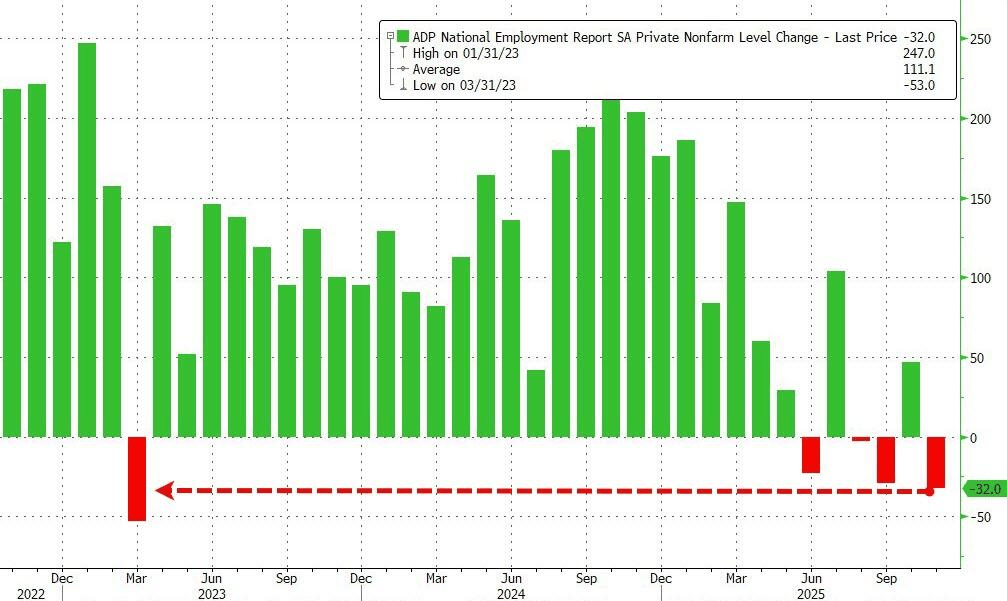
意外下滑!美国11月ADP就业人数减少3.2万人,创2023年3月以来最大降幅,小企业失业人数激增
Sou Hu Cai Jing· 2025-12-03 13:45
Core Insights - The U.S. labor market is experiencing a significant cooling, with private sector jobs decreasing by 32,000 in November, marking the largest decline since March 2023, and falling short of the expected increase of 40,000 jobs [1][4]. Employment Trends - Small businesses, defined as those with fewer than 50 employees, are particularly affected, losing a total of 120,000 jobs in November, with firms employing 20 to 49 people accounting for 74,000 of these job losses [5][9]. - In contrast, large enterprises with 50 or more employees added 90,000 jobs, indicating a stark difference in resilience between small and large businesses in the current economic climate [12]. Wage Growth - Wage growth for retained employees has slowed, with a year-over-year increase of 4.4%, down by 0.1 percentage points from October [2]. Industry Performance - The employment data reveals a broad decline across various sectors, with professional and business services losing 26,000 jobs, the information sector shedding 20,000 jobs, and manufacturing reducing its workforce by 18,000 [12]. - Only a few sectors saw job growth, notably education and healthcare services, which added 33,000 jobs, and leisure and hospitality, which increased by 13,000 jobs; however, these gains were insufficient to offset the widespread declines in other industries [12]. Federal Reserve Implications - This employment report is critical ahead of the Federal Reserve's policy meeting on December 9-10, with futures traders estimating a nearly 90% probability of a 25 basis point rate cut, despite some officials expressing concerns about further easing [4][16]. - Divergent views among Federal Reserve policymakers have emerged, with some advocating for rate cuts to prevent further deterioration in the labor market, while others worry that additional cuts could exacerbate inflation, which remains above the Fed's 2% target [16].
美关税政策反噬风险显现 沪金区间波动何时破局?
Jin Tou Wang· 2025-12-03 06:02
Group 1 - The core viewpoint of the article highlights concerns regarding the impact of the Trump administration's tariff policies on the U.S. labor market, suggesting that these policies may lead to job losses rather than job creation [3] - The U.S. labor market is showing signs of fatigue, characterized by a "no layoffs, no hiring" stalemate, raising concerns that tariffs on imported goods will increase operational costs for businesses, potentially leading to layoffs [3] - A report from the OECD indicates that while tariffs have not yet caused severe disruptions to the global economy, the full impact may not be fully realized until 2026, suggesting a more challenging labor market ahead [3] Group 2 - The latest gold futures trading indicates a range-bound movement between 950 and 955, with the market awaiting a new directional breakout [4] - The Bollinger Bands are narrowing, indicating a decrease in volatility, while the gold price has faced resistance around 953-954, suggesting persistent selling pressure above this level [4] - The MACD indicator shows limited bullish momentum, reinforcing the expectation of a range-bound market rather than a trend-driven increase in gold prices [4]
澳大利亚经济增长令人失望 加息预期降温
Xin Lang Cai Jing· 2025-12-03 00:40
Group 1 - Australia's GDP growth unexpectedly slowed to 0.4% for the quarter ending in September, below the expected 0.7% and the revised previous quarter's growth of 0.7% [1][3] - The annual growth rate was recorded at 2.1%, also lower than the anticipated 2.2% [1][3] Group 2 - Following the GDP data release, the Australian dollar depreciated, and the yield on three-year Australian government bonds declined [2][4] - The market now sees over a 50% probability that the Reserve Bank of Australia (RBA) will keep interest rates unchanged until the end of 2026, contrasting with previous expectations of a rate hike by the end of next year [2][4] - The RBA anticipates that economic growth will approach a "potential" rate of nearly 2% by 2026, supported by lower borrowing costs, stable household incomes, and strong population growth, despite ongoing high inflation and a tight labor market [2][4]