
消费金融

Search documents
建行福建省分行:践行中国特色金融文化,服务福建经济高质量发展
Zhong Guo Jin Rong Xin Xi Wang· 2025-06-27 12:39
Core Viewpoint - The Construction Bank's Fujian Branch is committed to integrating a distinctive financial development culture into its operations, focusing on serving the real economy and contributing to the high-quality development of Fujian's economy through innovative financial products and services [1] Group 1: Financial Services Innovation - The Fujian Branch has established a "Rural Comprehensive Property Trading and Management Service Platform," facilitating a recent forest rights auction that achieved a 112% premium rate [2] - The bank has supported over 160,000 private enterprises, providing comprehensive services including international settlement and cash management, and has assisted in the registration of the first private enterprise "Panda Bond" in the country [2] - The bank has developed specialized services for technology enterprises, with a loan balance exceeding 900 billion yuan for technology-related industries as of May [3] Group 2: Agricultural and Rural Financing - The bank has created a comprehensive financial service plan for the edible mushroom industry in Gutian County, providing over 5 billion yuan in loans to more than 3,200 mushroom farmers [4] - The bank has conducted outreach activities, providing over 530 billion yuan in credit to 66,000 small and micro enterprises, with online inclusive finance accounting for over 94% of its business [4] Group 3: Consumer Finance and Housing Support - The Fujian Branch has implemented a consumer finance initiative, disbursing over 49 billion yuan in personal consumer loans since 2024, focusing on sectors like new energy vehicles and tourism [5] - The bank has also provided 39 billion yuan in personal housing loans, serving 80,000 families, and has introduced the first allocation-type housing loan in Fujian [5] Group 4: Risk Management and Security - The bank has adopted AI-driven financial analysis tools to enhance credit approval processes, generating over 460,000 financial analysis reports since the project's launch in July 2024 [6][7] - The bank has established a comprehensive risk management framework, integrating technology for real-time monitoring and fraud prevention, while actively promoting financial literacy among vulnerable groups [7]

浦发银行上海分行行庆32周年:以金融之力赴民生之约促城市之兴
Xin Lang Cai Jing· 2025-06-27 03:01
Core Viewpoint - Shanghai Pudong Development Bank (SPDB) Shanghai Branch has achieved significant milestones over its 32 years, focusing on serving the local economy and enhancing consumer experiences through various financial services and initiatives [1][11]. Group 1: Service to Livelihood and Activation of Domestic Demand - SPDB Shanghai Branch actively participates in government consumption voucher programs, facilitating over 150,000 redemptions worth more than 300 million yuan, thereby stimulating local consumption [2]. - The bank has engaged in promotional activities linked to major city events, covering over 2,000 merchant stores and providing 114,000 discount opportunities to enhance consumer spending [2]. Group 2: Credit Empowerment and Consumer Vitality - The "Pudong Flash Loan" program has issued a total credit of 17 billion yuan in Shanghai, serving nearly 90,000 customers, with a loan balance of 7.7 billion yuan [3]. - The bank has focused on new residents, providing 600 million yuan in loans to nearly 2,000 individuals, addressing their housing and consumption needs [3]. Group 3: Innovative Branches and Community Engagement - SPDB Shanghai Branch has established unique service points, including "Citywalk" activities and pet-friendly branches, to integrate financial services with local culture and community events [4]. - The bank has transformed its branches into community hubs, offering services that cater to various lifestyle needs, thus enhancing customer engagement [4]. Group 4: Wealth Management and Financial Services - The bank's wealth management services have seen steady growth, with personal financial assets approaching one trillion yuan and private banking clients exceeding 15,000 [5]. - SPDB has launched innovative financial products, including commercial pension insurance, and has been recognized for its excellence in pension financial services [5]. Group 5: Airport Services and Internationalization - Leveraging its airport branches, SPDB Shanghai Branch provides comprehensive services, including foreign currency exchange and payment solutions, enhancing the experience for international travelers [7]. - The establishment of a 30-member youth team at the airport aims to improve payment services for foreign visitors, showcasing Shanghai's financial service capabilities [7]. Group 6: Elderly Financial Services and Social Responsibility - The bank has developed a "12345" elderly service system, offering tailored financial solutions and community activities to support the aging population [9]. - SPDB actively participates in events like the Shanghai Elderly Expo to promote its financial services aimed at enhancing the quality of life for senior citizens [9].



交通银行广东省分行:助力消费提振,守护“金”彩生活
Nan Fang Du Shi Bao· 2025-06-26 13:38
Core Viewpoint - Consumption acts as a "stabilizer" for economic operations and a "barometer" for market prosperity, while finance invigorates market vitality and supports consumption upgrades [2] Group 1: Financial Products and Services - The Bank of Communications Guangdong Branch has launched a series of consumer loan products, including "惠民消费贷" (惠民 Loan), "汽车贷" (Auto Loan), "装修贷" (Renovation Loan), and others, aimed at enhancing consumer flexibility in financial arrangements [5][6] - The "商圈惠贷" (Business Circle Loan) product is designed specifically for wholesale market merchants, allowing for a credit limit of up to 5 million yuan based on daily business transactions [8] - The bank emphasizes digital transformation, offering online applications and instant approvals for loans, thereby improving service efficiency and customer experience [9] Group 2: Consumer Empowerment and Market Activation - The bank's initiatives align with national policies aimed at boosting consumption, including measures to support personal consumption loans and enhance the financial capabilities of small and micro enterprises [7][10] - The bank integrates local cultural elements into its financial offerings, creating unique cultural tourism experiences and food discount activities to stimulate local consumption [6] - The bank's approach includes a focus on the needs of the working class, providing targeted loan products to facilitate consumption upgrades [10] Group 3: Future Outlook - The Bank of Communications Guangdong Branch plans to continue leveraging government policies to enhance consumer finance offerings, aiming to provide more flexible and affordable financial products for the public [10]


浦发银行广州分行:多元场景开心消费,特色权益便民惠民
Nan Fang Du Shi Bao· 2025-06-26 13:24
Core Viewpoint - The Shanghai Pudong Development Bank (SPDB) Guangzhou Branch is actively supporting the construction of Guangzhou as an international consumption center by transforming its financial services to enhance consumer spending and meet diverse customer needs [2][10]. Group 1: Wealth Management and Consumer Support - SPDB Guangzhou Branch is building a comprehensive wealth management service system that caters to various customer groups and scenarios, providing essential support for consumption growth [4]. - In response to declining deposit rates, the bank focuses on safeguarding customers' financial interests by innovating wealth management products and launching specialized services for the elderly [5]. Group 2: Elderly Financial Services - The bank has established a unique elderly financial service system featuring specialized branches and exclusive benefits, enhancing service quality for senior customers [5][6]. - SPDB Guangzhou Branch has received the "Elderly Financial Service Home+" certification from the Guangzhou Financial Bureau, promoting personal pension accounts and products [5]. Group 3: Consumer Loan Innovations - SPDB is innovating its consumer loan products to stimulate spending, including increasing credit limits and extending loan terms [7]. - The "Pu Flash Loan" product has expanded its eligibility and offers competitive pricing to reduce financing costs for customers [7]. Group 4: Payment Services and Promotions - The bank collaborates with local merchants and platforms to create a localized payment benefits system, enhancing customer engagement through various promotional activities [8][9]. - SPDB Guangzhou Branch has implemented a series of consumer incentives, including discounts for elderly customers and exclusive offers for new residents in Guangdong [6][9]. Group 5: Future Directions - The bank plans to continue its financial innovations and initiatives aimed at boosting consumption and improving the quality of life for residents, contributing to the high-quality development of Guangdong's economy [10].
农业银行广州分行:金融活水润民生,创新服务促消费
Nan Fang Du Shi Bao· 2025-06-26 13:17
Core Viewpoint - Agricultural Bank of China Guangzhou Branch is actively supporting consumer spending and economic growth in Guangzhou through innovative financial products and services, aligning with national strategies to boost domestic demand [5][6][7]. Group 1: Consumer Financial Products - The bank has introduced various consumer financial products, such as home decoration installment plans and low-interest auto financing, to meet the diverse needs of citizens [6][7]. - The home decoration installment product has provided significant support, with a customer receiving a 150,000 yuan (approximately 21,000 USD) five-year installment approval within two days [6]. - The auto financing program, in collaboration with government subsidies and enterprise discounts, has enabled customers to save over 20,000 yuan (approximately 2,800 USD) on new energy vehicles [6][7]. Group 2: Support for Small and Micro Enterprises - The bank is focusing on small and micro enterprises in popular commercial areas, offering tailored credit products and financial digital platforms to empower business growth [8]. - A restaurant founded by six chefs received 1 million yuan (approximately 140,000 USD) in support through the bank's "Merchant e-loan" program, showcasing the bank's role in enhancing the food economy [8]. - The bank has simplified loan processes for small businesses, providing comprehensive financial services to help entrepreneurs overcome funding challenges [8]. Group 3: Community and Consumer Engagement - The bank has established a smart canteen in Huadu District, providing affordable meal options and promoting community engagement among delivery workers [9]. - A partnership with a technology company has led to customized charging discounts for electric vehicle users, aiming to increase the usage rate of new energy vehicles by 15% [10]. - The bank is committed to consumer rights protection, conducting financial education campaigns to enhance public awareness of financial risks and promote safe financial practices [11][13]. Group 4: Service Optimization - The bank is continuously improving service experiences by launching new healthcare service functions and enhancing accessibility for special groups [14][15]. - It has established payment service demonstration areas in tourist spots to cater to foreign visitors, ensuring a diverse and convenient payment environment [15]. - The bank aims to further innovate consumer financial products and deepen collaborations with government and businesses to support high-quality economic development [15].


消费金融公司提升专业服务能力 扩大消费领域金融供给
Jin Rong Shi Bao· 2025-06-26 01:39
Core Viewpoint - Consumer finance companies play a crucial role in connecting financial resources with consumer demand, actively exploring practices to enhance specialized service capabilities and expand financial supply in the consumption sector [1]. Group 1: Policy Support and Market Dynamics - The "Guiding Opinions on Financial Support to Boost and Expand Consumption" has established a systematic policy framework for financial support in consumption [2]. - Consumer finance institutions are focusing on upgrading traditional businesses and innovating through technology to create a financial service network that covers the entire lifecycle of urban and rural residents' consumption needs [2]. - Companies like Ant Financial are increasing financial supply by targeting underserved populations, aligning with online consumption trends, and providing interest-free options to reduce consumer costs [2]. Group 2: Self-Acquisition and Risk Management - The Opinions encourage consumer finance companies to enhance their self-acquisition and risk control capabilities while reasonably determining comprehensive loan interest rates [3]. - With third-party channel traffic becoming saturated and customer acquisition costs rising, consumer finance companies are accelerating the development and optimization of self-operated channels [3]. - Digital transformation is emphasized, with a focus on using digital models to replace some manual judgment, adapting to the characteristics of consumer finance business [3]. Group 3: Innovations in Customer Engagement - Companies like Zhaolian and Mashang are prioritizing self-operated capability development, with Zhaolian's app now in its 7.0 version, offering tailored loan proposals based on user profiles [4]. - Nanyin Fabao Consumer Finance is enhancing customer research to provide customized incentives, while Zhongyuan Consumer Finance is combining innovative consumption scenarios with inclusive finance to improve customer acquisition precision [4]. - Haier Consumer Finance leverages its industrial background to expand scenario-based financial services, covering over 11,000 merchants in various sectors and providing installment services to 3 million users [4]. Group 4: Future Directions and Social Impact - The future of consumer finance lies in accurately allocating financial resources to areas that create genuine consumer demand, utilizing technology to lower service costs and enhance user experience [5]. - The industry aims to achieve a balance between commercial value and social value through inclusive innovation and efficient resource utilization [5].
瑞达期货集运指数(欧线)期货日报-20250625
Rui Da Qi Huo· 2025-06-25 09:57
明出处为瑞达期货股份有限公司研究院,且不得对本报告进行有悖原意的引用、删节和修改。 免责声明 本报告中的信息均来源于公开可获得资料,瑞达期货股份有限公司力求准确可靠,但对这些信息的准确性及完整性不 做任何保证,据此投资,责任自负。本报告不构成个人投资建议,客户应考虑本报告中的任何意见或建议是否符合其特定状 | | 集运指数(欧线)期货日报 | | 2025/6/25 | | --- | --- | --- | --- | | 项目类别 | 数据指标 最新 环比 数据指标 最新 | | 环比 | | EC主力收盘价 | 1740.200 -55.1↓ EC次主力收盘价 | 1292.8 | -30.60↓ | | 期货盘面 | 447.40 -20.00↓ EC2508-EC2512价差 EC2508-EC2510价差 | 304.50 | -10.00↓ | | EC合约基差 | 196.94 +31.80↑ | | | | 期货持仓头寸(手) EC主力持仓量 | 43528 -1263↓ | | | | SCFIS(欧线)(周) | 1937.14 239.51↑ SCFIS(美西线)(周) | 2,083 ...

六部门联合,金融支持消费政策再加码!5000亿元消费再贷款工具来了
Bei Jing Shang Bao· 2025-06-24 13:35
Core Viewpoint - The People's Bank of China and five other departments have jointly issued guidelines to boost consumption through financial support, outlining 19 key measures across six areas to enhance consumer capacity and optimize the consumption environment [1][5]. Group 1: Key Measures - The guidelines emphasize enhancing the professional service capabilities of financial institutions and expanding financial supply in the consumption sector, focusing on credit support and structural monetary policy tools [5]. - A new re-lending tool for service consumption and elderly care has been established with a quota of 500 billion yuan, allowing 21 national financial institutions and five systemically important urban commercial banks to apply for re-lending based on 100% of the loan principal [5]. - The re-lending tool is set to be effective until the end of 2027, following earlier announcements of a comprehensive financial policy package including interest rate cuts [5][6]. Group 2: Economic Context - The current economic environment is undergoing structural upgrades, with a shift from investment-driven growth to consumption-driven growth, which is expected to better meet the needs of the population and drive economic development [6]. - The guidelines aim to promote a transformation in consumption from goods to services, enhancing the experience and satisfaction of consumers [6]. Group 3: Financial Institution Support - Financial institutions are encouraged to diversify consumer financing, improve customer acquisition and risk control capabilities, and develop financial products tailored to various consumption scenarios [6][7]. - There is a call for optimizing risk grading models and enhancing consumer financial literacy, alongside efforts to combat illegal financial activities [7]. Group 4: Future Outlook - The People's Bank of China plans to accelerate the implementation of the guidelines and monitor their effectiveness, aiming to strengthen financial support for consumption and enhance its foundational role in economic development [7]. - With improving macroeconomic conditions and increased consumer willingness, consumption is expected to rise, further contributing to economic and social development [7].
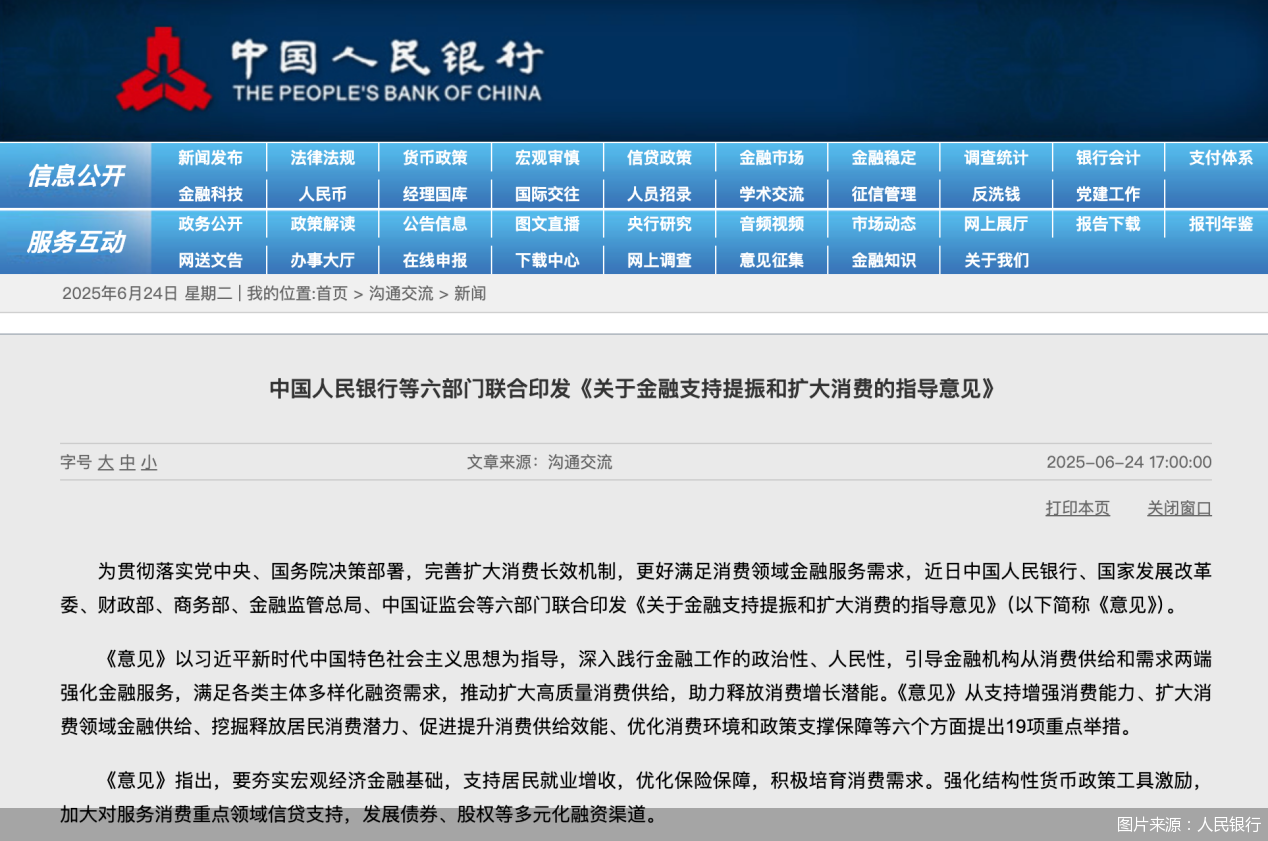
【立方债市通】河南年内已发债782亿置换存量隐性债务/河南省城乡综合投资公司拟首次发债/郑州经开投资无偿划转两子公司股权
Sou Hu Cai Jing· 2025-06-24 13:13
Focus on Financing - Henan Province has issued 78.2 billion yuan in refinancing special bonds this year to replace existing hidden debts [1] - On June 24, Henan issued government bonds totaling 16.57348 billion yuan, including 1.8 billion yuan for general projects and 6.7466 billion yuan for special projects [1] - The refinancing special bonds amounting to 8.02688 billion yuan are aimed at optimizing debt structure and alleviating financial pressure [1] Macro Dynamics - Six departments, including the People's Bank of China, issued guidelines to enhance bond market financing support for cultural, tourism, and education sectors [3] - The guidelines encourage qualified companies in these sectors to issue bonds and promote fundraising for smart healthcare and elderly care products [3] - The initiative aims to expand consumer credit and enhance the supply capacity of consumer finance [3] Regional Highlights - Hunan Province plans to issue 17.054 billion yuan in local bonds, including 9.856 billion yuan for land reserve projects [5] - The bond issuance will be conducted through a bidding process on June 30 [5] Issuance Dynamics - Henan Zhongyuan Expressway Co., Ltd. plans to issue 2 billion yuan in public bonds, with the registration submitted on June 24 [6] - The bond will have a term of up to 15 years, with 1.8 billion yuan allocated for debt repayment and 1 billion yuan for project construction [6] - Henan Urban Comprehensive Investment Company is set to issue 2 billion yuan in bonds, marking its debut in the bond market [7] Market Insights - CITIC Securities forecasts that the issuance of new special bonds in Q3 2025 could approach 200 billion yuan [13] - The report indicates that the overall issuance of local bonds in the first half of the year reached a historical high, but new bond issuance has been relatively slow due to project commencement restrictions [13] - The necessity for accelerated new local bond issuance is increasing, with a focus on debt resolution and land acquisition [13]
央行等六部门发布金融支持扩消费“19条” 鼓励消费产业链优质企业上市融资
Zheng Quan Shi Bao Wang· 2025-06-24 13:13
Core Viewpoint - The People's Bank of China and several government agencies issued guidelines to enhance financial support for consumption, emphasizing the importance of consumption in economic development and proposing 19 specific measures to boost consumer spending [1][2]. Financial Support for Consumption - The guidelines focus on enhancing the specialized service capabilities of financial institutions and expanding financial supply in the consumption sector, with credit support playing a crucial role [1][2]. - As of the end of Q1 this year, the balance of consumer loans (excluding personal housing loans) reached 21.02 trillion yuan, showing a year-on-year growth of 6.1%, which is 3.1 percentage points faster than the overall growth of household loans [2]. Structural Monetary Policy Tools - The guidelines include the establishment of a 500 billion yuan service consumption and pension relending program, aimed at incentivizing financial institutions to increase support for service consumption sectors such as hospitality, entertainment, and education [2][3]. - This relending tool is part of a broader financial policy announced in May, which will be in effect until the end of 2027 [2]. Expansion of Goods Consumption - The guidelines propose innovations in consumer credit products to meet diverse consumer needs and emphasize the importance of trade-in financing for consumer goods, particularly in the automotive sector [3]. - Support for quality enterprises in the consumption industry to raise funds through public offerings and bond issuance is also highlighted [3]. Enhancing Financial Services - The guidelines stress three main directions for financial efforts in the consumption sector: enhancing residents' consumption capacity, improving consumption supply efficiency, and strengthening basic financial services [3][4]. - The need for improved consumption infrastructure, particularly in logistics and supply chain efficiency, is acknowledged, with plans to explore innovative financial products to support infrastructure development [4]. Optimizing Consumer Environment - The guidelines emphasize optimizing payment services, building a credit system in the consumption sector, and protecting consumer financial rights to enhance consumer willingness and enthusiasm for spending [5].