
货币政策正常化

Search documents
【财经分析】超长端日债收益率刷新数十年高位 货币政策转折点衍生债市突变
Xin Hua Cai Jing· 2025-08-22 22:03
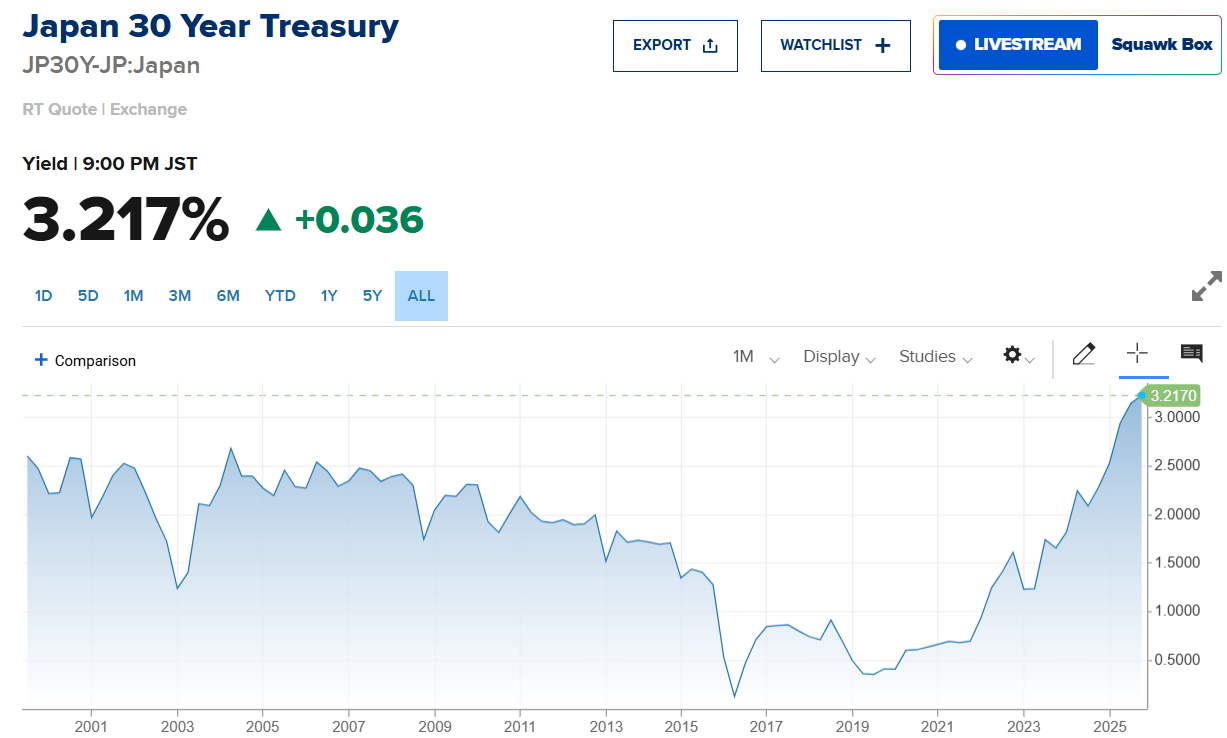
Core Viewpoint - The recent surge in Japan's ultra-long government bond yields signals a potential turning point in Japan's monetary policy and a revaluation of the global capital landscape [1][8]. Group 1: Bond Yield Trends - As of August 22, the 20-year government bond yield rose by 3 basis points to 2.671%, the highest level since 1999, while the 30-year yield increased by 3.6 basis points to 3.217%, slightly down from an intraday high of 3.236% [1]. - The steepening of the yield curve is driven by rising inflation expectations and concerns over a shift in monetary policy [4][5]. Group 2: Inflation and Economic Factors - Japan's core CPI rose by 3.1% year-on-year in July, remaining above the Bank of Japan's 2% target for the third consecutive month, indicating persistent inflationary pressure [4]. - The core CPI, excluding fresh food and energy, remains high at 3.4%, suggesting strong domestic demand-driven inflation [4]. Group 3: Market Reactions and Investor Behavior - Market expectations are pricing in further interest rate hikes by the Bank of Japan, with ultra-long bonds being particularly sensitive to interest rate changes [5]. - Foreign investment in long-term Japanese government bonds has decreased significantly, with net purchases in July dropping to 480 billion yen, only one-third of June's level [5]. Group 4: Policy Challenges for the Bank of Japan - The Bank of Japan faces a significant policy dilemma, needing to balance inflation control with fiscal sustainability, as rapid rate hikes could exacerbate fiscal pressures [6][7]. - A recent survey indicated that 63% of economists expect the Bank of Japan to raise rates from 0.5% to 0.75% by the end of the year [6]. Group 5: Global Economic Context - The global bond market's interconnectedness means that fluctuations in Japanese government bonds are influenced by movements in U.S. and European bond markets [5][7]. - The International Monetary Fund has downgraded its global economic growth forecast for 2025 from 3.3% to 2.8%, citing uncertainties from U.S. tariff policies [7].

“买方真空”风险显现日债收益率迭创新高
Shang Hai Zheng Quan Bao· 2025-08-22 21:10

Core Viewpoint - The Japanese government bond (JGB) market is facing significant pressure due to rising yields, driven by fiscal concerns and policy uncertainties, leading to a "buyer vacuum" risk in the market [1][3][4]. Group 1: Rising Yields - Recent data shows that the yield on Japan's 20-year government bonds reached over 2.67%, the highest level since 1999, while the 10-year yield closed at 1.615%, the highest since October 2008 [2]. - Year-to-date, the yield on 20-year JGBs has increased by nearly 45% [2]. - The Japanese Ministry of Finance plans to raise the provisional interest rate for government bonds to 2.6%, the highest level in 17 years, reflecting recent market yield averages plus a historical volatility adjustment [2]. Group 2: Fiscal Concerns - The loss of a majority in the House of Councillors by the ruling coalition has heightened concerns about Japan's fiscal policy, leading to expectations of increased fiscal expansion [3]. - Analysts suggest that the combination of fiscal deficit risks and policy uncertainties is contributing to the rising yields in the JGB market [3]. Group 3: Demand-Supply Imbalance - The demand side of the JGB market is changing, with traditional buyers like life insurance companies reducing their bond purchases [4]. - The Bank of Japan's move towards normalizing monetary policy has led to a significant reduction in its bond purchasing scale, creating a supply-demand mismatch in the market [4]. Group 4: Monetary Policy Caution - The Bank of Japan is maintaining a cautious approach to monetary policy normalization, avoiding rapid changes that could lead to market volatility [5]. - Despite pressure from U.S. officials for the Bank of Japan to raise interest rates, the central bank has kept its policy rate at around 0.5% since its last increase in January [5][6]. - Inflation levels in Japan have remained above target, with the core consumer price index rising 3.1% year-on-year in July, complicating the Bank of Japan's policy decisions [6].

日本央行货币正常化推动日债收益率上行
Xin Hua Cai Jing· 2025-08-22 16:29
Core Viewpoint - The Japanese bond market is undergoing significant changes as the Bank of Japan normalizes its monetary policy after decades of near-zero interest rates and aggressive quantitative easing, leading to a substantial rise in government bond yields [1][10][13] Group 1: Bond Yield Changes - The 10-year Japanese government bond yield reached 1.62%, an increase of 72 basis points year-on-year, while the 30-year yield surged to 3.236%, effectively doubling within a year [3][10] - The yield curve has steepened, indicating rising term premiums as investors seek compensation for duration risk [10][11] Group 2: Central Bank Actions - The Bank of Japan announced a slower pace of bond purchases, with a plan to reduce monthly purchases to approximately 3 trillion yen between January and March 2026, reflecting a cautious approach to tightening monetary policy [5][7] - As of August 8, the Bank of Japan held 561.73 trillion yen in Japanese government bonds, with over 78% in long-term and super-long-term bonds [5][6] Group 3: Debt Levels and Economic Impact - Japan's government debt is projected to reach 1,129 trillion yen by the end of the fiscal year 2025, with total central and local government long-term debt expected to hit 1,330 trillion yen, representing 211% of GDP [7][10] - The actual interest rates on government debt have been rising slowly but remain below inflation levels, supporting a decline in the debt-to-GDP ratio [1][10] Group 4: Market Reactions and Investor Behavior - Japanese investors are reallocating funds from foreign assets back to domestic bonds due to rising interest rates and changing global monetary policies, with a net reduction in overseas long-term bonds [10][11] - The bond market is no longer seen as a safe haven for global investors, with increased volatility prompting a preference for short-term bonds or high-quality corporate bonds [11][12] Group 5: Future Outlook - Market expectations indicate a 64% probability of a 25 basis point rate hike by the end of the year, with potential further hikes in 2026 [9][12] - The normalization of the Bank of Japan's monetary policy is viewed as a pivotal moment for global fixed income and foreign exchange markets, reshaping capital flows and investment strategies [12][13]
日债又陷抛售潮
21世纪经济报道· 2025-08-21 13:47
Core Viewpoint - Japan's bond market is experiencing a sell-off due to concerns over fiscal conditions and persistent inflation, leading to a surge in long-term government bond yields to their highest levels in a decade [1][3]. Group 1: Bond Yield Trends - On August 21, Japan's 10-year government bond yield rose to 1.61%, the highest since October 2008, while the 20-year yield reached 2.655%, a record since 1999, and the 30-year yield climbed to 3.18%, nearing the historical high of 3.2% set in July [1][2]. - As of 8 PM Beijing time, the 10-year yield was reported at 1.611%, the 20-year yield at 2.645%, and the 30-year yield at 3.191% [1]. Group 2: Factors Influencing Yield Increases - The primary driver for the rise in long-term bond yields is investor expectations of new fiscal stimulus measures following the ruling coalition's losses in the July Senate elections, which will increase Japan's already high debt levels [2][5]. - Persistent inflation in Japan has raised the likelihood of interest rate hikes by the Bank of Japan, further pushing up bond yields [3][5]. Group 3: Foreign Investment Trends - In July, net purchases of Japanese government bonds by foreign investors dropped to 480 billion yen (approximately 3.3 billion USD), only one-third of June's total, indicating a significant decline in demand [3][6]. - Despite earlier strong demand, the trend has shifted due to concerns over inflation exceeding targets and potential fiscal imbalances, compounded by the Bank of Japan's gradual exit from the bond market [6][8]. Group 4: Market Dynamics and Future Outlook - The bond market has faced a significant drop in demand, described as "disastrous," with both yield levels and bidding multiples reflecting this trend [5]. - Analysts suggest that the long-term outlook for Japanese government bond yields remains upward, influenced by the Bank of Japan's reduced bond purchases and the normalization of monetary policy [9][10]. - If the decline in bond prices continues, intervention from the Bank of Japan is likely, potentially through liquidity injections or adjustments to monetary policy [9][10].

日本10年期国债收益率创2008年来新高,日央行或出手干预
2 1 Shi Ji Jing Ji Bao Dao· 2025-08-21 11:42
Core Viewpoint - Japan's bond market is experiencing a significant sell-off due to concerns over fiscal conditions and persistent inflation, leading to a surge in long-term government bond yields to their highest levels in a decade [1][2]. Group 1: Bond Yield Trends - On August 21, Japan's long-term government bond yields rose sharply, with the 10-year yield reaching 1.61%, the highest since October 2008 [1]. - The 20-year bond yield hit 2.655%, the highest since 1999, while the 30-year yield approached its historical high of 3.2% [1]. - As of 6 PM Beijing time, the 10-year yield was at 1.616%, the 20-year yield at 2.649%, and the 30-year yield at 3.197% [1]. Group 2: Factors Influencing Bond Yields - The primary driver behind the rising yields is investor expectations of new fiscal stimulus measures following the ruling coalition's loss in the July Senate elections, which will increase Japan's already high debt levels [1][2]. - Persistent inflation in Japan has raised the likelihood of interest rate hikes by the Bank of Japan, further pushing up bond yields [2]. - A significant drop in demand for Japanese bonds has been noted, with net purchases of 10-year and longer bonds by overseas investors falling to 480 billion yen (approximately 3.3 billion USD) in July, just one-third of June's purchases [2][3]. Group 3: Market Sentiment and Future Outlook - The bond market is facing a "disastrous" situation due to a substantial decline in demand, as indicated by both yield levels and bid-to-cover ratios [2]. - Analysts suggest that the combination of rising inflation and potential fiscal stimulus will increase the burden on Japan's already high leverage, contributing to the upward pressure on long-term bond yields [2]. - The current market sentiment reflects a preference for Japanese equities over bonds, indicating a shift in investor confidence amid concerns about fiscal risks [3]. Group 4: Central Bank's Role and Potential Interventions - The Bank of Japan's gradual exit from bond purchases has created a demand gap in the bond market, exacerbating the pressure on yields [2][5]. - Experts believe that if the sell-off continues, the Bank of Japan may intervene to stabilize the market, potentially through liquidity injections or adjustments to its monetary policy stance [6]. - Future movements in long-term bond yields will depend on the Bank of Japan's monetary policy direction, fiscal expansion pace, and global interest rate environment [6].
经济学家:日本央行将在第四季度再次加息,可能是十月
Hua Er Jie Jian Wen· 2025-08-21 07:47
Group 1 - The Bank of Japan is widely expected to raise interest rates in the fourth quarter of this year, indicating a clearer path towards monetary policy normalization [1][2] - Among economists surveyed, nearly two-thirds predict the Bank of Japan will increase the benchmark rate from the current 0.50% by at least 25 basis points, with October being the most likely month for this action [1][2] - Despite recent weak employment data in the U.S. raising bets on a Federal Reserve rate cut, 70% of analysts believe this will not delay the Bank of Japan's tightening of monetary policy [1] Group 2 - October is emerging as a prime window for a rate hike, with 38% of economists favoring it, followed by January (30%) and December (18%) [2] - T&D Asset Management's chief strategist suggests that by October, the Bank of Japan will be able to respond to clearer U.S. monetary policy and domestic political dynamics [2] - A significant majority (92%) of economists expect the Bank of Japan to maintain current rates in the upcoming mid-September policy meeting [2] Group 3 - Persistent inflation is the core driver pushing the Bank of Japan towards a rate hike, with consumer inflation exceeding the 2% target for over three years [3] - There are concerns regarding fiscal policy, with over two-thirds of respondents worried about the pressure for increased fiscal spending [3] - Some economists warn of the risk of short-sighted policy choices due to recent political developments, while others believe extreme fiscal expansion is unlikely due to the ruling party's cautious stance on increasing the deficit amid rising interest rates [3]
日本资深议员喊话:日央行必须逐步加息,最好尽早开始
Hua Er Jie Jian Wen· 2025-08-19 07:39
Group 1 - Senior Japanese politician Taro Kono calls for the Bank of Japan to accelerate interest rate hikes to improve fiscal conditions and address the challenges posed by a weak yen and rising inflation [1][2] - Kono emphasizes the need to signal a departure from negative real interest rates and suggests that the best strategy to combat rising living costs is to reverse the yen's weakness and seek moderate strengthening [1][2] - The Bank of Japan ended a decade-long large-scale stimulus program last year and raised short-term interest rates to 0.5% in January, but Kono believes that maintaining negative real borrowing costs for an extended period is undesirable [2][3] Group 2 - Kono advocates for a new economic framework to replace "Abenomics," which was introduced by former Prime Minister Shinzo Abe in 2013, aimed at ending deflation through monetary and fiscal stimulus [3] - He suggests that the central bank should gradually raise interest rates while the government works towards restoring fiscal health under a new agreement framework [3] - Kono's statements reflect skepticism about the effectiveness of the current economic policy framework, especially following the ruling party's poor performance in recent elections [3]
日本政要警告央行加息需谨慎 警惕经济降温风险
Jin Tou Wang· 2025-08-19 03:43
Group 1 - The USD/JPY exchange rate is currently trading around 147, showing a slight decline of 0.07% from the previous close of 147.86 [1] - Japanese political figure Saito Ken emphasized the need for caution in the Bank of Japan's interest rate hikes due to potential economic cooling from increased US tariffs [1] - Saito Ken's comments indicate that the Bank of Japan may face political pressure if it resumes interest rate hikes, as rising US tariffs could weaken corporate profits and wage growth in Japan [1] Group 2 - The USD/JPY is in a corrective channel since the low of 147.05 on August 5, with a potential bearish flag pattern forming [2] - A break below the August 7 and 8 lows of 146.75 would confirm the bearish pattern, with the next target being the July 25 low of 145.85 [2] - Immediate resistance is noted at the intraday high of 148.10, with further resistance at 148.50 and the upper boundary of the bullish channel currently at 148.60 [2]
日美货币政策博弈加剧日元走强
Jin Tou Wang· 2025-08-18 05:43
Core Viewpoint - The USD/JPY exchange rate is influenced by the Bank of Japan's hawkish signals and the high probability of a Federal Reserve rate cut, leading to a strengthening of the Japanese yen [1] Group 1: Currency Movements - As of August 18, the USD/JPY is trading around 147, with a current quote of 147.50, reflecting a 0.22% increase from the previous close of 147.18 [1] - The USD/JPY is at a critical technical level, with support seen at 147.10 (38.2% Fibonacci retracement) and 145.80-146.00 (50-day and 100-day moving averages) [1] - Resistance levels are identified at 147.90 (21-day moving average) and the 149.40-149.50 range (200-day moving average and 50% Fibonacci retracement of 2025 high/low) [1] Group 2: Monetary Policy Insights - The Bank of Japan's July policy meeting indicated a hawkish stance, raising inflation expectations and keeping the option for rate hikes within the year [1] - U.S. Treasury Secretary criticized the Bank of Japan for its "policy lag," urging for rate hikes to combat inflation pressures [1] - Market analysis suggests that Japan's weak consumer recovery and potential U.S. tariffs on Japanese automobiles may lead the Bank of Japan to maintain a cautious approach [1] Group 3: Market Dynamics - The CME FedWatch tool indicates a 93.8% probability of a Federal Reserve rate cut in September, impacting the USD/JPY dynamics [1] - The market is currently assessing the interplay between the normalization of Japanese monetary policy and the Federal Reserve's policy shift [1]
政治变局增添不确定性 日元走势陷政策迷雾
Jin Tou Wang· 2025-08-12 04:08
周二(8月12日)亚盘早盘,美元兑日元上涨,目前交投于148附近,截止北京时间11:01分,美元兑日 元报价148.31,上涨0.11%,上一交易日美元兑日元收盘为148.14。日本政治局势变化正加剧市场对货 币政策前景的担忧。 美元兑日元现阶段围绕147.5—148.50窄幅震荡,布林带带宽较峰值明显收窄,呈"布林带挤压"特征,指 向方向选择临近。 MACD方面,DIFF为-0.154,DEA为-0.232,柱状图为0.158,显示零轴下方的金叉后 动能缓慢修复但仍属弱势回升,趋势性尚未确认。 自由民主党在7月20日地方选举中的失利,使得在野党主张的扩张性财政政策获得更多关注,这为日本 央行的政策路径增添了新的不确定性。尽管日本央行在7月政策会议上调了通胀预期,并保留了年内再 次加息的可能性,但行长植田和男近期的鸽派言论仍给市场传递出谨慎信号。植田和男多次强调需要保 持政策耐心,这种政策指引上的矛盾使得日元走势缺乏明确方向。当前市场陷入两难:一方面,政治压 力可能促使更宽松的财政政策;另一方面,央行又面临货币政策正常化的需求。这种政策组合的不确定 性导致投资者对日元持观望态度,汇价陷入区间震荡。未来走势将取 ...