
稳定币

Search documents
粤开市场日报-20260107
Yuekai Securities· 2026-01-07 07:55
Market Overview - The A-share market showed a mixed performance today, with major indices mostly closing higher. The Shanghai Composite Index rose by 0.05% to close at 4085.77 points, while the Shenzhen Component increased by 0.06% to 14030.56 points. The ChiNext Index saw a gain of 0.31%, closing at 3329.69 points. Overall, there were 2164 stocks that rose, 3188 that fell, and 107 that remained unchanged. The total trading volume in the Shanghai and Shenzhen markets reached 285.41 billion yuan, an increase of 47.6 billion yuan compared to the previous trading day [1][10]. Industry Performance - Among the Shenwan first-level industries, the sectors that performed well included Comprehensive, Coal, Electronics, and Communications, with increases of 3.86%, 2.47%, 1.25%, and 1.24% respectively. Conversely, the sectors that experienced declines were Oil & Petrochemicals, Non-bank Financials, Beauty Care, Computers, and Banks, with decreases of 1.73%, 1.13%, 1.03%, 0.81%, and 0.72% respectively [1][10]. Concept Sector Performance - The concept sectors that saw the most significant gains today included Semiconductor Equipment, Lithography Machines, the SMIC International Supply Chain, Semiconductor Materials, Industrial Gases, Rare Earths, Semiconductor Wafers, CRO, Wafer Industry, Nuclear Fusion, Selected Coal Mining, Cobalt Mining, Optical Modules (CPO), National Big Fund, and Aquaculture [2].
支付公链 Tempo 宣布推出原生代币标准 TIP-20,专为稳定币和支付用例而设计
Xin Lang Cai Jing· 2026-01-07 04:53
(来源:吴说) 吴说获悉,Stripe 与 Paradigm 联合推出的支付公链 Tempo 宣布推出原生代币标准 TIP-20,该标准专为 稳定币和支付用例而设计。它基于以太坊和 EVM 兼容链上现有的 ERC-20 标准,并且完全向下兼容。 在 ERC-20 的基础上增加了转账备注、合规性控制和奖励分配功能。TIP-20 标准允许发行针对特定支付 用例量身定制的稳定币, 同时满足运营和合规要求。任何以美元计价的 TIP-20 稳定币均可用于在 Tempo 上支付交易手续费 。未来,Tempo 计划支持使用非美元稳定币支付手续费。 ...
Stablecoin Titan Tether Wants Gold to Be Used for Everyday Payments—Here's How
Yahoo Finance· 2026-01-06 22:27
Core Viewpoint - Tether has introduced a new unit of account for gold called "Scudo," aiming to simplify gold transactions in everyday payments, with one Scudo equating to one-thousandth of a troy ounce of gold [1] Group 1: Market Context - Global demand for gold has increased due to persistent inflation concerns, interest-rate uncertainty, record central bank purchases, and a growing interest in safe-haven assets [2] - Tether sees this demand as an opportunity to restore gold's status as a universally accepted medium of exchange, which is not subject to devaluation by government actions [2] Group 2: Product Details - The Scudo is designed to function similarly to "satoshi," the smallest unit of Bitcoin, with one Scudo valued at approximately $4.48 [3] - Tether's XAUT token, which is valued at $2.3 billion, is backed by 1,329 gold bars equivalent to 16.2 metric tons, held in secure vaults [6] Group 3: Historical Context - The term "Scudo" has historical significance, dating back to the 16th century in Italy, where it described various coins and was derived from the Latin word for shield [4] Group 4: Company Background - Tether's CEO and CFO have Italian roots, and the company has previously acquired a minority stake in the Italian football club Juventus [5]
委内瑞拉的稳定币初创公司将对遭黑客攻击的用户进行全额赔付
Xin Lang Cai Jing· 2026-01-06 10:23
Core Viewpoint - Kontigo, a startup focused on the Venezuelan stablecoin market, announced it will fully reimburse over 1,000 users for $340,000 in funds stolen due to a hacking incident [1][2]. Group 1: Incident Details - The company detected unauthorized access, affecting some users' funds, and has committed to refunding the stolen amount [1][2]. - As of now, the estimated amount stolen is at least $340,000, and Kontigo plans to provide updates on the situation [1][2]. - Users reported unauthorized access attempts on their accounts, prompting the company to isolate affected systems and initiate security protocols [1][2]. Group 2: Company Background and Context - Last November, JPMorgan froze Kontigo's accounts due to the detection of numerous disputed transactions on the platform [1][2]. - Kontigo is backed by the well-known venture capital firm Y Combinator, and users previously opened virtual accounts at JPMorgan through the fintech intermediary Checkbook [1][2].
期指:大涨后的偏强震荡
Guo Tai Jun An Qi Huo· 2026-01-06 01:32
Report Summary 1. Report Industry Investment Rating No information provided. 2. Core Viewpoints - On January 5, 2026, all four major stock index futures contracts for the current month rose, with IF up 2.07%, IH up 2.42%, IC up 2.81%, and IM up 2.37% [1]. - On the trading day, the total trading volume of stock index futures rebounded, indicating increased trading enthusiasm among investors. The total trading volume of IF, IH, IC, and IM increased by 20,649 lots, 6,347 lots, 29,217 lots, and 24,485 lots respectively. In terms of positions, the total positions of IF, IH, IC, and IM increased by 8,201 lots, 3,543 lots, 22,660 lots, and 13,346 lots respectively [2]. - The trend strength of IF and IH is 1, and that of IC and IM is also 1. The A - share market had a good start in 2026, with the Shanghai Composite Index rising by more than 1% and returning to 4,000 points, and the ChiNext Index surging nearly 3%. The Hong Kong stock market fluctuated slightly up, with the biotechnology and semiconductor industries strengthening [6][7]. 3. Summary by Relevant Catalogs 3.1. Stock Index Futures Data Tracking - **CSI 300 and Related Futures**: The CSI 300 closed at 4,717.8, up 1.90%. Among its futures, IF2601 closed at 4,714, up 2.07%, with a basis of - 3.75; IF2602 closed at 4,702.6, up 2.14%, with a basis of - 15.15; IF2603 closed at 4,697, up 2.26%, with a basis of - 20.75; IF2606 closed at 4,649.8, up 2.23%, with a basis of - 67.95 [1]. - **SSE 50 and Related Futures**: The SSE 50 closed at 3,099.8, up 2.26%. Among its futures, IH2601 closed at 3,097.4, up 2.42%, with a basis of - 2.35; IH2602 closed at 3,099.6, up 2.59%, with a basis of - 0.15; IH2603 closed at 3,098.8, up 2.55%, with a basis of - 0.95; IH2606 closed at 3,088.8, up 2.56%, with a basis of - 10.95 [1]. - **CSI 500 and Related Futures**: The CSI 500 closed at 7,651.2, up 2.49%. Among its futures, IC2601 closed at 7,664.8, up 2.81%, with a basis of 13.6; IC2602 closed at 7,624.8, up 2.95%, with a basis of - 26.4; IC2603 closed at 7,596, up 3.11%, with a basis of - 55.2; IC2606 closed at 7,417, up 3.27%, with a basis of - 234.2 [1]. - **CSI 1000 and Related Futures**: The CSI 1000 closed at 7,753.9, up 2.09%. Among its futures, IM2601 closed at 7,759.2, up 2.37%, with a basis of 5.32; IM2602 closed at 7,697.8, up 2.56%, with a basis of - 56.08; IM2603 closed at 7,639, up 2.69%, with a basis of - 114.9; IM2606 closed at 7,403.4, up 2.76%, with a basis of - 350.5 [1]. 3.2. Position Changes of the Top 20 Futures Members - For IF contracts, in IF2601, long positions decreased by 607 and short positions increased by 347; in IF2603, long positions increased by 5,858 and short positions increased by 5,971; in IF2606, long positions increased by 1,027 and short positions increased by 490 [5]. - For IH contracts, in IH2601, long positions decreased by 62 and short positions increased by 168; in IH2603, long positions increased by 2,259 and short positions increased by 2,443; in IH2606, long positions increased by 206 and short positions increased by 91 [5]. - For IC contracts, in IC2601, long positions increased by 598 and short positions increased by 1,459; in IC2603, long positions increased by 11,123 and short positions increased by 12,210; in IC2606, long positions increased by 2,786 and short positions increased by 2,146 [5]. - For IM contracts, in IM2601, long positions decreased by 1,660 and short positions decreased by 909; in IM2602, long positions increased by 2,233 and short positions increased by 2,659; in IM2603, long positions increased by 4,700 and short positions increased by 8,413 [5]. 3.3. Market Trends and Drivers - **A - share Market**: The A - share market had a good start in 2026. The Shanghai Composite Index rose 1.38% to 4,023.42 points, the Shenzhen Component Index rose 2.24%, the ChiNext Index rose 2.85%, the Beixin 50 rose 1.8%, the Kechuang 50 rose 4.41%, and the Wind All - A Index rose 1.99%. The total trading volume was 2.57 trillion yuan, compared with 2.07 trillion yuan the previous day [6]. - **Hong Kong Stock Market**: The Hong Kong stock market fluctuated slightly up. The Hang Seng Index rose 0.03% to 26,347.24 points, the Hang Seng Tech Index rose 0.09% to 5,741.63 points, and the Hang Seng China Enterprises Index fell 0.22% to 9,148.47 points. The market trading volume was HK$283.462 billion, significantly higher than the previous trading day's HK$140.864 billion [7]. - **US Stock Market**: The three major US stock indexes all closed up. The Dow Jones Industrial Average rose 1.23% to 48,977.18 points, reaching a new record high; the S&P 500 Index rose 0.64% to 6,902.05 points; the Nasdaq Composite Index rose 0.69% to 23,395.82 points [8].
ETF午评 | A股重返4000点,半导体产业链爆发,中韩半导体ETF涨6.52%
Ge Long Hui· 2026-01-05 11:06
Market Performance - The three major A-share indices collectively rose in the morning session, with the Shanghai Composite Index increasing by 1.07% and returning to the 4000-point level, the Shenzhen Component Index rising by 1.87%, and the ChiNext Index up by 2.15% [1] - The total trading volume in the Shanghai and Shenzhen markets reached 1.6489 trillion yuan, an increase of 324 billion yuan compared to the previous day [1] - Over 4000 individual stocks in the market experienced gains [1] Sector Performance - Insurance stocks led the gains, while sectors such as brain-computer interfaces and innovative pharmaceuticals saw a surge in limit-up trading [1] - The semiconductor industry chain experienced a significant breakout, with AI applications and commercial aerospace themes also being active [1] - The Hainan Free Trade Zone, stablecoins, and oil sectors faced adjustments [1] ETF Performance - The semiconductor industry chain saw a notable increase, with the Huatai-PB Fund's China-Korea Semiconductor ETF rising by 6.52% [1] - In the Hong Kong stock market, the innovative pharmaceutical sector rebounded strongly, with the Fortune and Huatai-PB Fund's Hong Kong Stock Connect Medical ETF increasing by 6.21% and 5.92%, respectively [1] - Insurance stocks also led in the ETF space, with the GF Fund's Hong Kong Stock Connect Non-Bank ETF rising by 5.25% [1] Declining Sectors - The tourism sector declined, with two tourism ETFs dropping by 2% [1] - The oil and gas sector also saw declines, with the oil and gas ETFs from Huatai-PB falling by 1% and 0.87%, respectively [1]
ETF收评 | A股2026开门红!中韩半导体ETF飙涨8.46%,港股通医疗ETF富国涨7%
Ge Long Hui· 2026-01-05 08:31
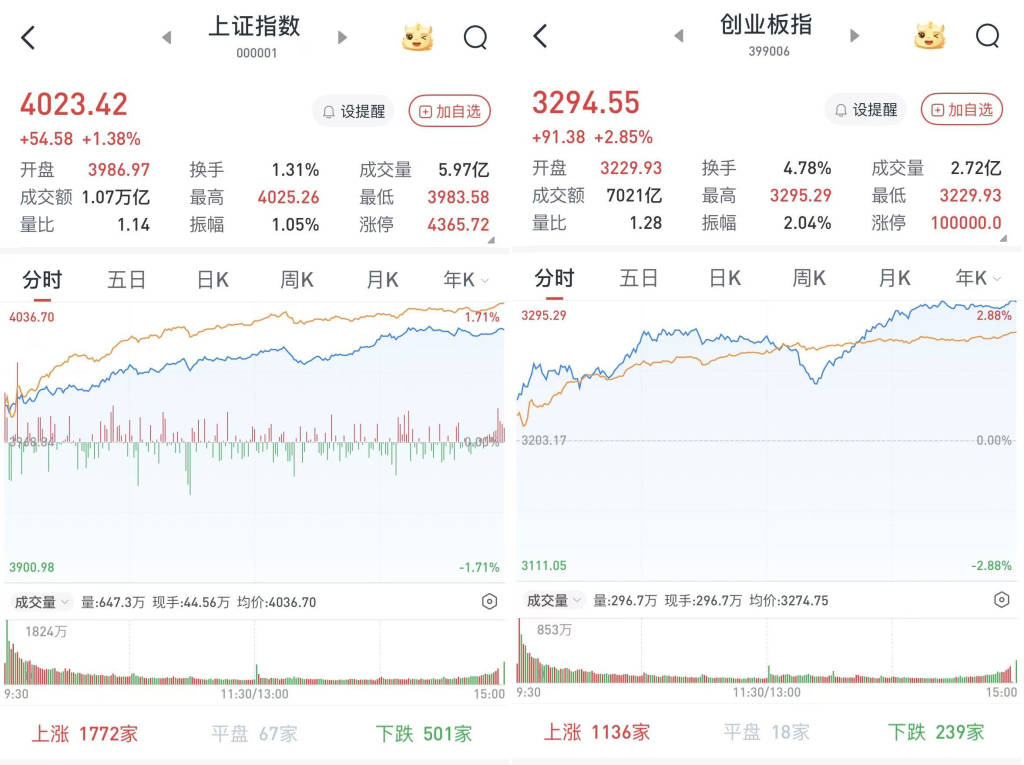
Market Performance - The A-share market opened strong in 2026, with the Shanghai Composite Index rising by 1.38% to return to the 4000-point level, while the ChiNext Index surged by 2.85% [1] - The total trading volume in the Shanghai, Shenzhen, and Beijing markets reached 25,672 billion yuan, an increase of 5,015 billion yuan compared to the previous day [1] - Nearly 4,200 stocks experienced gains in the market [1] Sector Highlights - Sectors such as brain-computer interfaces, AI applications, commercial aerospace, memory chips, and innovative pharmaceuticals saw a wave of stocks hitting the daily limit up [1] - Insurance stocks performed notably well [1] - The semiconductor industry chain saw a significant surge, with the Huatai-PB Fund's China-Korea Semiconductor ETF soaring by 8.46% [1] - The Hong Kong stock market's innovative pharmaceutical sector rebounded strongly, with ETFs like the Fortune and Huatai-PB's Hong Kong Stock Connect Innovative Pharmaceutical ETF and the Huaxia Fund's Medical Device ETF rising by 7.13%, 6.97%, and 6.95% respectively [1] Underperforming Sectors - The tourism sector declined, with two tourism ETFs dropping by 1% [1] - The oil and gas sector also faced a downturn, with the Energy Chemical ETF and the Oil and Gas ETF falling by 1% and 0.63% respectively [1]
A股2026年开门红:沪指站上4000点,两市成交超2.5万亿元,4180股上涨
Sou Hu Cai Jing· 2026-01-05 07:33
Market Overview - The A-share market opened higher on January 5, with the Shanghai Composite Index surpassing 4000 points, closing at 4023.42 points, up 1.38% [2] - The total trading volume in the Shanghai and Shenzhen markets reached 25,462 billion yuan, an increase of 5,011 billion yuan from the previous trading day [2] Sector Performance - The pharmaceutical and biotechnology sectors saw significant gains, with nearly 40 stocks hitting the daily limit or rising over 10%, driven by industry demand recovery and exceeding performance expectations [4] - Non-bank financial stocks, particularly insurance companies, performed well, with several stocks rising over 5% to 7% due to stable growth in investment assets and high dividend strategies [5] - The semiconductor sector also showed strong performance, with multiple stocks rising over 10% [6] Market Sentiment and Predictions - Analysts from Huaxi Securities believe the bull market remains intact, with 2026 expected to be a year of positive factors, including supportive macro policies and improved corporate earnings [8] - Zhongyuan Securities anticipates that the market will stabilize around the 4000-point mark, with a focus on macroeconomic data and overseas liquidity changes [9] - Citic Securities suggests that the balance between external and internal demand will be a significant factor in 2026, with a higher probability of market fluctuations in the early year [10]

A股高开,军工股全线走强
第一财经· 2026-01-05 01:42
Market Overview - The A-share market opened with all four major indices rising, with the Shanghai Composite Index up by 0.46%, the Shenzhen Component Index up by 0.80%, the ChiNext Index up by 0.84%, and the Sci-Tech Innovation Index up by 0.93% [3][4] - The commercial aerospace concept stocks continued to gain traction, while military industry stocks showed strong performance. Brain-computer interface concept stocks were active, and oil and gas stocks led the gains. However, themes related to Hainan Free Trade Zone, Yush Robot, and stablecoins experienced pullbacks [4] Company News - Meike Home announced its resumption of trading with a limit-up increase, following the announcement of plans to acquire 100% equity of Wandeli Guangdian [5][6] - The stock price of Meike Home reached 3.21 CNY, reflecting a 9.93% increase, with a trading volume of 32,169 shares [6] Hong Kong Market - The Hong Kong stock market opened with the Hang Seng Index up by 0.09% and the Hang Seng Tech Index up by 0.33%. Notable gainers included Kuaishou, Alibaba, and SMIC, while Li Auto, Xpeng Motors, and Trip.com saw declines [7][8]

管涛:数字人民币2.0时代的“变”与“不变”
Di Yi Cai Jing· 2026-01-04 13:15
Core Viewpoint - The digital renminbi is transitioning from the 1.0 era of digital cash to the 2.0 era of digital deposit currency, with a new management and service framework set to be implemented by January 1, 2026 [1] Group 1: Digital Currency Development - China is a pioneer in digital currency exploration, having initiated theoretical research and closed testing of the digital renminbi in 2014, with pilot programs starting in 2019 [3] - The digital renminbi ecosystem has been preliminarily established, following a path that relies on central bank leadership and integration with commercial financial institutions [3] - The digital renminbi 2.0 will be a modern digital payment and circulation method, issued and circulated within the financial system, featuring functions such as value measurement, value storage, and cross-border payment [3][4] Group 2: Operational Framework - The transition to digital renminbi 2.0 retains the successful core elements of the previous phase, particularly the dual-layer operational structure that separates management and operation [4] - The People's Bank of China will establish a digital renminbi management committee to oversee relevant business lines and ensure comprehensive functional regulation [5] - The operational management centers for digital renminbi will be located in Beijing and Shanghai, focusing on system security and cross-border business operations [5] Group 3: Technological Integration - Digital renminbi 2.0 will combine account-based management with blockchain efficiency, utilizing a hybrid architecture that incorporates both account and blockchain characteristics [6] - The digital renminbi will leverage smart contracts and digital technologies to enhance payment services, moving from electronic to digital payment [8][10] - Blockchain technology will be applied not only in cross-border payments but also in the digitalization of real-world assets, with platforms established for various financial services [11] Group 4: Changes in Currency Structure - The digital renminbi will shift from being a central bank liability to a digital deposit currency, allowing banks to manage digital renminbi wallet balances as part of their asset-liability operations [8] - Digital renminbi wallet balances will earn interest and be included in the banks' balance sheets, enhancing the stability of commercial banks' liabilities [8][9] - The digital renminbi will maintain its equivalence to fiat currency, ensuring interoperability and convenience for users [9]
