半导体国产替代

Search documents
汇通能源“牵手”张汝京,拟获得兴华芯7.43%股权
Xin Lang Cai Jing· 2025-08-12 13:21
Core Viewpoint - Shanghai Huitong Energy Co., Ltd. plans to acquire a 7.43% stake in Xinghua Chip (Shaoxing) Semiconductor Technology Co., Ltd. through a combination of equity transfer and capital increase, with intentions to further increase its stake as the company's production capacity is released [1] Group 1: Company Overview - Xinghua Chip was established in November 2022 and focuses on semiconductor photomask production, which is crucial for chip precision and yield [1] - The company is backed by Dr. Zhang Rujing, known as the "Chip Father," and has been recognized as a major industrial project in Zhejiang Province for 2024 [1] - Huitong Energy's investment in Xinghua Chip marks its first direct investment in the semiconductor sector after entering the hard technology field [1] Group 2: Industry Context - The global photomask market is dominated by leading companies such as Japan's DNP and the U.S.'s Photronics, with domestic high-end photomask localization rate below 20%, hindering China's chip industry development [1] - The semiconductor industry is experiencing a shift towards domestic substitution, with increasing interest from listed companies in hard technology [3] - The global semiconductor manufacturing equipment sales are projected to grow by 7.4% to $125.5 billion in 2025, while the pure semiconductor wafer foundry industry revenue is expected to exceed $165 billion by 2025, with a compound annual growth rate of 12% from 2021 to 2025 [3] Group 3: Strategic Rationale - Huitong Energy aims to transition from traditional service industries to high-tech sectors due to limited growth potential in its current light asset business [4] - The investment in the semiconductor sector allows the company to share in industry growth and leverage Zhang Rujing's team's technical and industrial resources to reduce R&D cycles and risks [4] - Xinghua Chip's location in the Yangtze River Delta, which accounts for over 60% of China's integrated circuit industry, provides significant regional resource integration advantages for Huitong Energy [4]

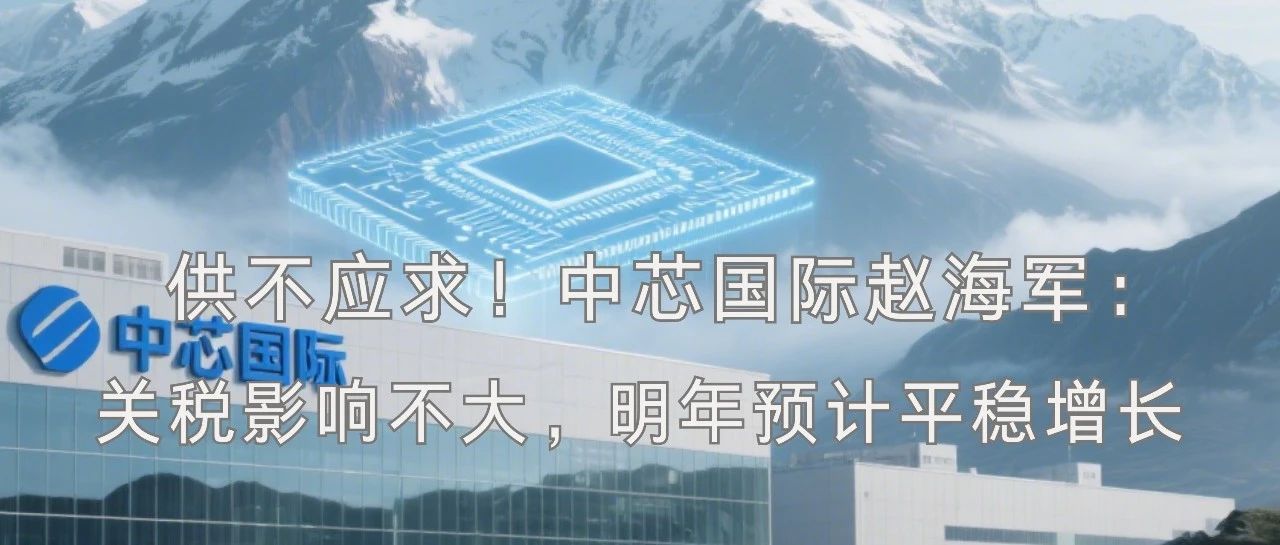
供不应求!中芯国际赵海军:关税影响不大,明年预计平稳增长
点拾投资· 2025-08-12 11:00
Core Viewpoint - SMIC's second-quarter financial results showed a revenue of $2.209 billion, a 1.7% decrease quarter-on-quarter but a 16.2% increase year-on-year. However, net profit fell to $133 million, down 19% year-on-year, missing market expectations of $167 million [2][3]. Group 1: Financial Performance - In Q2, SMIC's revenue was $2.209 billion, reflecting a 1.7% decrease from the previous quarter but a 16.2% increase year-on-year [2]. - The net profit for Q2 was $133 million, which is a 19% decline compared to the same period last year, falling short of market expectations [3]. - Following the earnings report, SMIC's AH shares experienced significant declines, with a 3.04% drop in Hong Kong and a 1.30% drop in A-shares [3]. Group 2: Market Outlook and Orders - SMIC's current order volume is in a state of supply-demand imbalance, with demand exceeding supply [7][11]. - CEO Zhao Haijun expressed optimism about the semiconductor industry's growth for this year and next, predicting stable growth unless extreme scenarios occur [5][36]. - Despite external pressures from tariffs, Zhao indicated that the impact on SMIC's revenue would be minimal, estimating it to be less than 10% of customer revenues [12][16]. Group 3: Investment Trends - Despite the challenges, some fund managers increased their positions in SMIC, citing opportunities in domestic semiconductor manufacturing and advanced process breakthroughs [4]. - SMIC remains a favorite among public funds, ranking among the top ten holdings with a market value exceeding 40 billion yuan, although the number of shares held decreased by 11.58% in Q2 [3][4]. Group 4: Strategic Developments - SMIC is focusing on meeting the demands of strategic customers by expanding its product offerings, particularly in power devices and analog chips [20][22]. - The company is also adapting to the growing demand for 8-inch wafers, primarily driven by domestic customers, while maintaining competitiveness in the international market [24][26]. Group 5: Pricing Strategy - SMIC has not actively raised or lowered prices, with ASP (average selling price) expected to rise due to a shift in product mix rather than direct price increases [28][30]. - The company maintains a cautious approach to pricing, ensuring that it does not compromise its market position while responding to competitive pressures [30]. Group 6: Industry Trends - The semiconductor industry is projected to grow steadily, with expectations of a 5%-6% increase in the coming year, driven by AI and other technological advancements [38]. - The demand for networking and storage-related products is expected to remain strong, with significant growth potential in domestic manufacturing of NAND Flash and DRAM [31][33].


中芯国际(00981):下游需求逐步复苏,驱动基本面稳步上升
First Shanghai Securities· 2025-08-12 07:11
Investment Rating - The report assigns a "Buy" rating to the company with a target price of HKD 60.00, representing a potential upside of 23.20% from the current price of HKD 48.70 [3][5]. Core Insights - The semiconductor industry is experiencing a gradual recovery in downstream demand, which is driving a steady improvement in the company's fundamentals [3]. - The company is expected to achieve a revenue CAGR of 25.0% and a net profit CAGR of 90.0% over the next three years, supported by increasing demand from downstream clients and the urgency for domestic semiconductor alternatives [5][7]. Financial Performance Summary - For the fiscal year ending December 31, 2023, the company reported total revenue of USD 6,321.56 million, a decrease of 13.09% from the previous year, but projected to grow to USD 8,029.92 million in 2024, reflecting a 27.02% increase [4][7]. - The net profit attributable to shareholders for 2023 was USD 902.53 million, down 50.35% from 2022, with forecasts indicating a recovery to USD 851.73 million in 2025 and USD 1,277.34 million in 2026 [4][5]. - The company's earnings per share (EPS) for 2023 was USD 0.11, with projections of USD 0.16 in 2025 and USD 0.22 in 2026, indicating a significant recovery trajectory [5][7]. Market Position and Outlook - The company ranks as the third-largest wafer foundry globally, with a market share of 6% as of Q1 2025, and is expected to benefit from advancements in process technology and increased production capacity [5][7]. - The company anticipates a 5%-7% revenue growth in Q3 2025, with a projected revenue range of USD 23.2 billion to USD 23.6 billion, aligning with market expectations [5][7]. - The demand for AI-related products is expected to grow by over 10% in 2025, contributing to an increase in wafer shipments despite a slight decline in prices [5][7].
00后试水A股,追热点、高活跃、爱炒科技股
2 1 Shi Ji Jing Ji Bao Dao· 2025-08-09 14:57
Core Viewpoint - The A-share market is experiencing a significant return of investor interest, with new account openings in July 2025 reaching 1.9636 million, marking a 19.27% month-on-month increase and a 70.5% year-on-year increase, primarily driven by individual investors [2][4]. Group 1: Market Dynamics - The surge in new accounts is attributed to a combination of market recovery and policy incentives, with the overall market showing a positive trend [4]. - In July, major A-share indices recorded increases, with the Shanghai Composite Index rising by 3.74%, the Shenzhen Component Index by 5.20%, and the ChiNext Index leading with an 8.14% increase [5]. - Trading activity also saw a significant uptick, with total A-share transactions reaching 29.4 trillion shares and a total transaction value of 37.58 trillion yuan, both setting new monthly records for the year [5]. Group 2: Investor Behavior - The new individual investors are showing a preference for sectors with clear policy support and strong industry trends, particularly in technology and high-end manufacturing [8][9]. - The average turnover rate in July reached 91.71%, a 15.13% increase from June, indicating high trading activity, especially in small-cap stocks [10]. - New investors are characterized by a tendency to chase market trends and engage in short-term trading, with many showing interest in high-growth sectors like the ChiNext and STAR Market [10][12]. Group 3: Brokerage Industry Impact - The increase in new accounts is expected to boost brokerage firms' trading volumes and revenues, with a notable rise in margin financing balances, which reached 1.9710 trillion yuan by the end of July [5][13]. - Despite the growth in trading activity, brokerage commission rates are declining, with the average commission rate in Shanghai dropping by 8.2% year-on-year to 0.201‰ [14][15]. - Brokerages are adapting by shifting focus from traditional transaction services to value-added services, such as personalized investment advice and wealth management, to meet the needs of new investors [15][16].

00后试水A股,追热点、高活跃、爱炒科技股
21世纪经济报道· 2025-08-09 14:47
Core Viewpoint - The A-share market is experiencing a significant return of investor enthusiasm, driven by a recovering market and the release of policy dividends, as evidenced by a substantial increase in new account openings in July 2025 [1][2]. Group 1: Market Dynamics - In July 2025, A-share new account openings reached 1.9636 million, a month-on-month increase of 19.27% and a year-on-year increase of 70.5%, with individual investors accounting for 99.5% of new accounts [1][2]. - The overall market performance in July saw major indices rise, with the Shanghai Composite Index up 3.74%, the Shenzhen Component up 5.20%, and the ChiNext Index leading with an 8.14% increase [2]. - Trading activity surged, with total A-share transactions reaching 29.4 trillion shares and total transaction value hitting 37.58 trillion yuan, both marking new highs for the year [2]. Group 2: Investor Behavior - The influx of nearly 200,000 new individual investors in July contributed to a total of over 14 million new accounts since the beginning of the year, indicating a rising participation rate among individual investors [7]. - Investors are gravitating towards sectors with clear policy support and strong industry trends, particularly in technology and high-end manufacturing, which accounted for over 30% of total trading volume [7][8]. - The average turnover rate in July reached 91.71%, a significant increase from 76.58% in June, with small-cap stocks being the primary focus for high-frequency trading [8]. Group 3: Brokerages and Industry Impact - The surge in new accounts is expected to drive growth in brokerage firms' trading volumes and revenues, with a notable increase in margin financing balances reaching 1.98 trillion yuan by the end of July [3][11]. - Despite the increase in trading activity, brokerage commission rates are declining, with the average commission rate in Shanghai dropping to 0.201‰, a decrease of 8.2% year-on-year [11][12]. - Brokerages are shifting their focus from traditional transaction services to value-added services, such as personalized asset management and wealth management, to meet the needs of new investors [12][13].

00后“互联网原住民”试水A股 追热点、高活跃、新趋势
2 1 Shi Ji Jing Ji Bao Dao· 2025-08-08 07:19
Core Insights - The A-share market is experiencing a significant return of investor enthusiasm, with new account openings in July reaching 1.9636 million, a month-on-month increase of 19.27% and a year-on-year increase of 70.5% [1] - The surge in new accounts is driven by a recovering market and the release of policy benefits, with major indices showing positive performance in July [2][3] Market Dynamics - The trading activity in July saw a total of 29.4 trillion shares traded, an increase of over 800 billion shares from June, with a total transaction value of 37.58 trillion yuan, marking a new monthly high for the year [2] - Over 3,600 A-shares rose in July, with more than 1,000 stocks gaining over 10% and nearly 200 stocks increasing by over 30%, indicating a broadening of structural opportunities [2] - Margin trading balances reached 1.98 trillion yuan by the end of July, reflecting a significant inflow of leveraged funds, which has become a crucial support for the market [2] Investor Behavior - New individual investors are showing a preference for sectors with clear policy support and strong industry trends, particularly in technology and high-end manufacturing [4] - The average turnover rate in July was 91.71%, a 15.13% increase from June, with small-cap stocks being the primary focus for high-frequency trading [6] - New investors are characterized by a tendency to chase trends and engage in short-term trading, with a notable inclination towards high-growth sectors [5][6] Brokerage Industry Impact - The increase in new accounts is expected to drive growth in brokerage firms' trading volumes and revenues, with a notable rise in brokerage income observed in the first quarter of the year [7] - Despite the growth in trading activity, brokerage commission rates are declining, with the average commission rate in Shanghai dropping by 8.2% year-on-year [8] - Brokerages are adapting to the influx of new investors by enhancing their service offerings, focusing on value-added services and personalized investment education [9]
00后“互联网原住民”试水A股,追热点、高活跃、新趋势
2 1 Shi Ji Jing Ji Bao Dao· 2025-08-08 07:09
Market Overview - The A-share market has seen a significant return of investor interest, with 1.9636 million new accounts opened in July 2025, a month-on-month increase of 19.27% and a year-on-year increase of 70.5% [1] - Individual investors accounted for 99.5% of new accounts, indicating strong participation from retail investors [1] Driving Factors for Investor Entry - The surge in new accounts is attributed to a recovering market and the release of policy benefits, with the overall market sentiment improving [2] - Major A-share indices recorded gains in July, with the Shanghai Composite Index up 3.74%, the Shenzhen Component up 5.20%, and the ChiNext Index leading with an 8.14% increase [2] Trading Activity and Market Dynamics - A total of 29.4 trillion shares were traded in July, an increase of over 8 trillion shares from June, with a trading volume of 37.58 trillion yuan, marking a monthly high for the year [2] - Over 3,600 A-shares rose in July, with more than 1,000 stocks gaining over 10% and nearly 200 stocks rising over 30%, indicating structural opportunities attracting outside capital [2] Investor Behavior and Preferences - New individual investors are showing a preference for sectors with clear policy support and strong industry trends, particularly in technology and high-end manufacturing [4] - The average turnover rate in July reached 91.71%, up from 76.58% in June, with small-cap stocks being the primary focus for high-frequency trading [6] Brokerages and Business Impact - The increase in new accounts is expected to drive growth in brokerage firms' trading volumes, with a notable rise in margin financing balances, reaching 1.98 trillion yuan by the end of July [2][7] - Despite the growth in trading activity, brokerage commission rates are declining, with the average commission rate in Shanghai at 0.201‰, down 8.2% year-on-year [8] Strategic Shifts in Brokerage Services - Brokerages are transitioning from a focus on transaction-based services to value-added services, aiming to meet the needs of new investors who are more sensitive to commission rates [9] - Many brokerages are leveraging AI tools to provide personalized investment advice and enhance customer engagement, reflecting a shift towards wealth management services [9]
【国信电子|半导体8月投资策略】看好本土制造产业链和周期性复苏的模拟芯片
剑道电子· 2025-08-08 00:54
Core Viewpoint - The report emphasizes optimism towards the domestic manufacturing supply chain and the cyclical recovery of analog chips in the semiconductor industry [3][5]. Group 1: Market Overview - In July 2025, the SW semiconductor index rose by 3.08%, underperforming the electronic industry by 3.51 percentage points and the CSI 300 index by 0.46 percentage points [3][10]. - The SW semiconductor index's PE (TTM) was 87.13x as of July 31, 2025, placing it at the 67.15 percentile since 2019 [3][14]. - The sub-sectors showing the highest growth included discrete devices (+8.21%), semiconductor equipment (+3.75%), and integrated circuit packaging and testing (+3.48%) [3][10]. Group 2: Industry Data Update - Global semiconductor sales in June 2025 reached $599.1 billion, marking a year-on-year increase of 19.6% and a quarter-on-quarter increase of 1.5% [7][24]. - China's semiconductor sales were $172.4 billion in June, reflecting a year-on-year growth of 13.1% [7][24]. - The prices of DRAM and NAND Flash continued to rise, with DRAM contract prices increasing from $2.10 to $2.60 and NAND Flash prices from $2.92 to $3.12 in June [26][29]. Group 3: Fund Holdings Analysis - In Q2 2025, the proportion of semiconductor holdings in active funds was 10.1%, a decrease of 0.5 percentage points from the previous quarter [6][23]. - The top five semiconductor heavyweights in active funds accounted for 37.1% of the total, slightly down from 37.9% in 2025 [19][21]. - Notable changes in the top twenty holdings included the addition of Naxin Micro and Si Rui Pu, replacing Feng Zha Technology and Ao Jie Technology [21][23].

美联储或有罕见举措,A股要成资产新贵!
Sou Hu Cai Jing· 2025-08-07 12:26
Group 1 - The unusual phenomenon in the U.S. Treasury market is highlighted, with the 5-year Treasury bond valuation at a historically high level, typically seen only during extreme periods when the Federal Reserve lowers rates to zero [3] - There is a significant divergence in the yield trends of different maturities of Treasury bonds, with the 5-year yield dropping by 60 basis points and the 2-year yield by 52 basis points, while the 30-year yield remains stable [3] - This divergence indicates a deep division in market expectations regarding future policy directions, suggesting a potential increase in the value of A-shares if such a scenario unfolds [3] Group 2 - The concept of "expectation difference" is emphasized as a key factor in financial markets, where institutional investors leverage information asymmetry to their advantage [4] - Historical examples illustrate that while retail investors may cling to surface-level phenomena, institutional investors often act based on underlying data trends, as seen during the 2015 stock market crash [4] Group 3 - Data analysis reveals that institutional investors often engage in active trading before a stock gains attention, showcasing their "first-mover" advantage [8] - Even in cases where stocks experience a downturn, institutional funds may remain active, indicating a strategy of "counter-trend positioning" [10] - Conversely, stocks that lack sustained institutional participation may underperform despite positive news, reinforcing the principle that "funding is more critical than favorable news" [12] Group 4 - The current anomalies in the U.S. Treasury market may reflect institutional investors' expectations regarding future policy changes, similar to observed patterns in the stock market [13] - Factors such as political pressure from the Trump administration, potential changes in Federal Reserve leadership, and implied rate cut expectations create a complex market landscape [13] Group 5 - Ordinary investors are advised to develop their own data analysis systems rather than blindly following market news, as this can help them navigate the complexities of the market [14] - The importance of recognizing and understanding the existence of expectation differences in the market is stressed, as it can lead to more informed investment decisions [14]

利和兴: 2025年度以简易程序向特定对象发行股票募集资金使用的可行性分析报告
Zheng Quan Zhi Xing· 2025-08-07 11:10
Fundraising Plan - The total amount of funds to be raised is not more than 167.5 million yuan, with the net amount after deducting issuance costs to be used entirely for the semiconductor equipment precision components R&D and industrialization project [1][2] - The project aims to enhance the production capacity of semiconductor equipment precision components, laying a solid foundation for future business development [1][2] Project Details - The project will be implemented by Lihexing Jiangmen, located in Jiangmen, Guangdong Province, with a total investment of up to 132.506 million yuan and a planned use of raised funds amounting to 117.5 million yuan, with a construction period of 24 months [2] - The semiconductor industry is crucial for China's technological independence, with a growing demand driven by advancements in AI, consumer electronics, and automotive electronics [2][3] Market Opportunity - The semiconductor equipment industry is experiencing significant growth, with global spending expected to reach 49.6 billion USD, a 35% year-on-year increase, and projected sales of semiconductor manufacturing equipment to hit 125.5 billion USD by 2025, growing over 7% [2][3] - The domestic market for semiconductor equipment components is expanding, supported by strong national policies and funding, creating a favorable environment for local suppliers [3][5] Competitive Advantage - The company focuses on smart equipment and specialized components, integrating various technologies to enhance its product offerings and core competitiveness [4][6] - The company has established long-term relationships with major clients such as Huawei and BYD, enhancing its brand recognition and market influence [5][6] Technical Capability - The company has a rich technical background in smart manufacturing, with 44 invention patents, 143 utility model patents, and 275 software copyrights, ensuring a competitive edge in the semiconductor sector [7] - The project has received necessary approvals, including the investment project filing certificate, and is expected to yield an internal rate of return of 15.08% with a payback period of 7.85 years [7][8] Financial Impact - The fundraising will enhance the company's asset scale and financial flexibility, supporting business growth and improving operational efficiency [8][9] - Although there may be a temporary decline in earnings per share during the construction phase, the project is expected to boost overall profitability and shareholder returns in the long run [9]