春季躁动

Search documents
【策略】关注春季行情——2026年1月A股及港股月度金股组合(张宇生/王国兴)
光大证券研究· 2025-12-30 23:05
以下文章来源于宇观策略 ,作者张宇生 宇观策略 . 光大策略张宇生团队感谢您的支持 点击注册小程序 查看完整报告 特别申明: 报告摘要 12月A股、港股出现分化 12月A股主要指数普遍上涨。受政策利好催化、市场风险偏好回暖等因素影响,12月(截至26日),A股 主要指数普遍上涨,其中创业板指涨幅最大,12月份累计上涨了6.3%,而科创50涨幅最小,累计上涨了 1.4%。行业端分化明显,国防军工、通信、有色金属涨幅居前。相对而言,金融地产及消费等板块表现则 较差,如传媒、房地产、食品饮料、银行等。 12月港股市场走势震荡。12月受美联储降息预期波动、美股波动等因素影响,港股市场整体走势较为震 荡。截至2025年12月26日,恒生香港35、恒生指数、恒生综合指数、恒生科技、恒生中国企业指数的涨幅 分别为2.4%、-0.2%、-0.4%、-1.8%、-2.4%。 A股观点:市场有望震荡上行 政策有望持续发力,叠加各类资金有望积极流入,市场有望震荡上行。一方面,历史来看,A股市场中几 乎每年都存在"春季躁动"行情;另一方面,政策有望持续发力,经济增长有望保持在合理区间,进一步夯 实资本市场繁荣发展的基础。此外,政策红 ...


【百亿基金内参】2026春季躁动:布局“打底+轮动”双主线,聚焦锂电反转、保险改善、商业航天扩散
Xin Lang Cai Jing· 2025-12-30 17:06
Group 1 - The spring market is showing signs of activity, with a focus on a "bottoming + rotation" strategy for investment [1] - The insurance sector is emerging as a clear mainline for the spring market due to improvements on both asset and liability sides [1] - A second wave of lithium battery market activity is starting, with copper foil and separators potentially leading the way despite the off-season [1] Group 2 - The commercial aerospace theme is expanding despite setbacks, with a focus on satellite and military applications [1] - Operators in the commercial aerospace sector, often overlooked, are highlighted as undervalued assets [1] - The semiconductor equipment sector is experiencing a resonance of cycles and growth, with overseas markets reaching new highs and domestic markets expected to catch up [1] Group 3 - The Hong Kong stock market is expected to experience a "small spring" in liquidity in the first quarter of next year, despite overall pressure for the year [1] - The AH premium is returning to its average, indicating a weakening of valuation advantages in the Hong Kong market, prompting a search for unique opportunities in the Hang Seng Technology Index [1] - MACD golden cross signals are forming, indicating positive momentum for certain stocks [1]
博时宏观观点:风险偏好上行,成长有色有望占优
Xin Lang Cai Jing· 2025-12-30 10:53
Group 1: Global Economic Overview - The US Q3 2025 GDP growth rate is 4.3%, significantly above market expectations, with consumer resilience and AI investments contributing one-third of this year's growth [10] - Japan has passed a large-scale fiscal budget plan for 2026, leading to a rapid increase in Japanese bond yields to 2.11%, which has exerted some pressure on the US dollar index due to yen appreciation [10] - The domestic industrial profit decline has widened in November, with a slight month-on-month increase in profit margins after adjusting for high base effects, but still weaker than seasonal trends [10] Group 2: Market Strategy - The bond market experienced narrow fluctuations from December 22 to 26, with a steepening curve; liquidity easing has improved short-term performance, while long-term remains volatile due to concerns about the post-year-end market [11] - The A-share market has seen a continuous rebound due to the resolution of structural differentiation and positive signals from the Central Economic Work Conference, alongside a strengthening yuan [11] - The Hong Kong stock market is currently in a phase of benefiting from liquidity while facing weak fundamentals, with the improvement of the price level in 2026 being crucial [11] Group 3: Sector-Specific Insights - The alcohol beverage and black metallurgy industries are dragging down overall profit growth, while the recovery in export growth is benefiting sectors like computer communications, automotive, electrical machinery, and specialized equipment [10] - The technology growth sector is expected to outperform as the crowding effect eases, although further recovery in PPI and profits is still awaited [11] - The oil market is under pressure due to weak demand, continuous supply release, and inventory accumulation [12]
130亿,跑了
Zhong Guo Ji Jin Bao· 2025-12-30 06:55
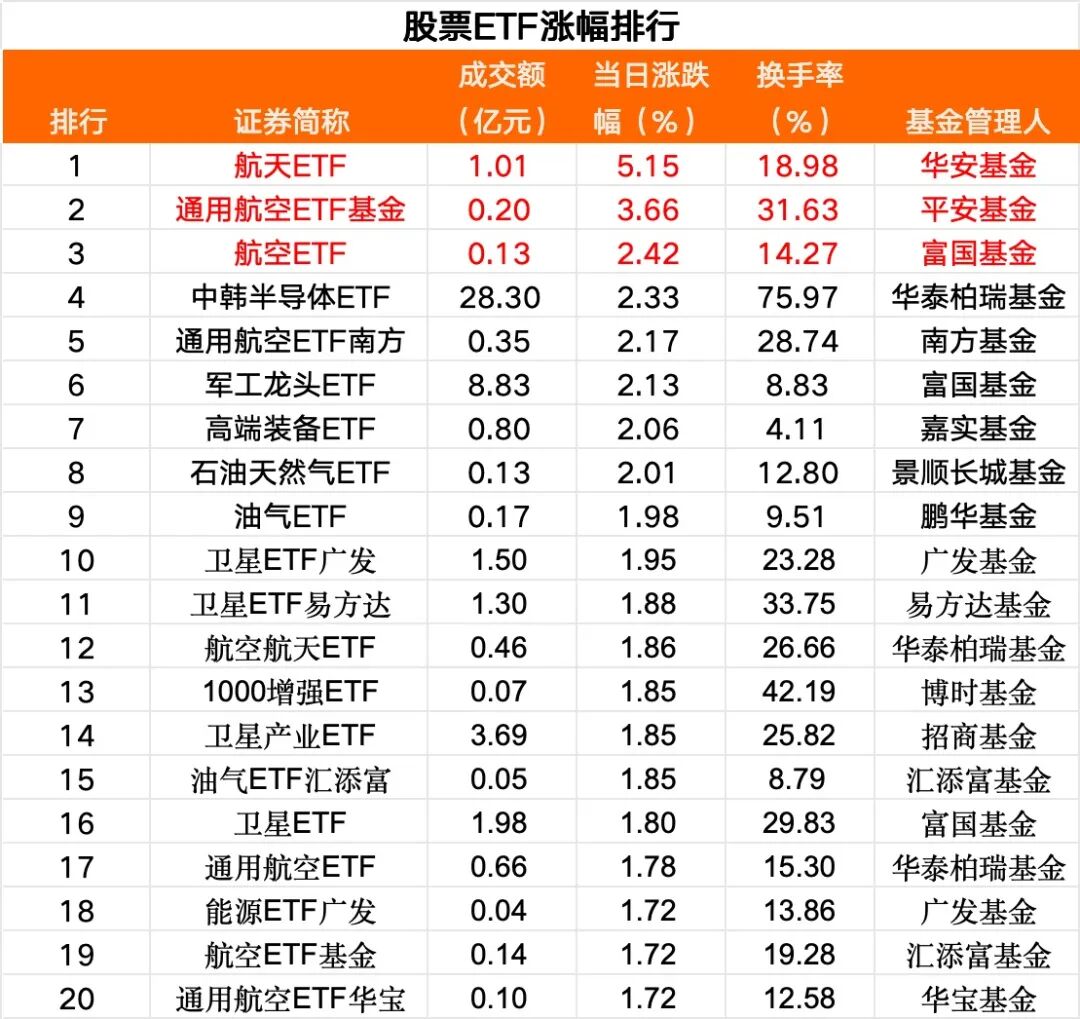
Group 1 - On December 29, the A-share market experienced a slight adjustment with a total trading volume exceeding 2 trillion yuan, while the Shanghai Composite Index rose by 0.04%, marking its ninth consecutive day of gains [1] - The overall stock ETF market saw a net outflow of over 13 billion yuan, with significant inflows into sectors such as non-ferrous metals, satellite industry, and steel [1][4] - The A500 ETF from Huatai-PineBridge had the highest trading volume on that day, reaching 13.798 billion yuan, followed by other A500 ETFs [2][4] Group 2 - The aerospace sector led the stock ETF performance, with the top three ETFs in terms of daily gains being from this sector, showing increases of over 5% [2][3] - The total scale of all stock ETFs reached 4.76 trillion yuan, with a trading volume of 218.68 billion yuan on December 29, an increase of 28 billion yuan from the previous trading day [2][4] - Notably, 27 stock ETFs saw net inflows exceeding 1 billion yuan, with the non-ferrous metals ETF, Hong Kong Stock Connect non-bank ETF, and A500 ETF leading the inflows [4][6] Group 3 - The net outflow from the broad-based ETFs was significant, with a total of 104.79 billion yuan, while bond ETFs and Hong Kong market ETFs saw net inflows of 94.41 billion yuan and 8.5 billion yuan, respectively [4][5] - The A500 index experienced a net outflow of 29.05 billion yuan, while the net inflow for the A500 index over the past five days exceeded 32 billion yuan [5][7] - The top three ETFs with the highest net inflows included the non-ferrous metals ETF, Hong Kong Stock Connect non-bank ETF, and A500 ETF, with respective inflows of 12.65 billion yuan, 7.78 billion yuan, and 5.61 billion yuan [6][8]
公募基金总规模首次突破37万亿元 震荡市中权益基金仍获申购
Sou Hu Cai Jing· 2025-12-30 05:30
Group 1 - The core viewpoint of the articles highlights the significant growth in China's public fund management industry, with total net asset value reaching a historical high of 37.02 trillion yuan by the end of November, marking eight consecutive months of growth [1] - As of the end of November, there are 165 public fund management institutions in China, including 150 fund management companies and 15 asset management institutions with public qualifications [1] - The growth in public fund size in November was primarily driven by money market funds, which increased by nearly 130 billion yuan, and bond funds, which grew by over 30 billion yuan compared to the end of October [1] Group 2 - Despite a nearly 2% decline in the A-share market in November, the net value of equity funds saw a decrease, with the total size of equity funds reaching 5.8 trillion yuan, down 2.2% from the previous month [2] - The latest data shows that the total share of equity funds at the end of November reached 3.82 trillion shares, reflecting a month-on-month growth of 2.09% [2] - Investor interest in equity and mixed funds remains strong, with both categories seeing significant share increases of 783.11 billion shares and 108.46 billion shares, respectively, compared to the end of October [2]
“春季躁动”积极条件正在积累,费率低的A500ETF易方达(159361)红盘震荡,聚焦优质核心资产投资机遇
Sou Hu Cai Jing· 2025-12-30 04:03
来源:智通财经 截至2025年12月30日午间收盘,中证A500指数(000510)上涨0.13%,A500ETF易方达(159361)上涨 0.16%,换手14.36%,成交48.62亿元,市场交投活跃。 拉长时间看,截至12月29日,A500ETF易方达(159361)近5个交易日内有4日资金净流入,合计"吸 金"48.41亿元。 A500ETF易方达(159361)紧密跟踪中证A500指数,中证A500指数从各行业选取市值较大、流动性较好 的500只证券作为指数样本,以反映各行业最具代表性上市公司证券的整体表现。 A500ETF易方达:159361 联接A:022459 联接C:022460 联接Y:022930 A500ETF易方达(159361)的管理费率为0.15%,托管费率为0.05%,均为行业最低水平,能为投资者节省 投资成本。 A500ETF易方达(159361)具备跟踪优质指数、费用低、交易优势大、方便场外参与以及投资分散化、跟 踪市场表现、透明度高和适合长期定投等特点和优势,备受市场关注。 华西证券认为,"春季躁动"的积极条件正在积累。当前来看,海外美联储降息和日本央行加息均已落 地,市 ...
【机构策略】A股大盘仍以结构性行情为主
Zheng Quan Shi Bao Wang· 2025-12-30 01:33
Group 1 - The A-share market experienced fluctuations and adjustments, with the Shanghai Composite Index achieving a nine-day winning streak, indicating strong market enthusiasm for buying [1] - Institutional reallocation demand and capital inflow are expected to improve market liquidity and boost trading activity as the year-end approaches [1] - The focus in the short term is on the selection of the new Federal Reserve chair and the implementation of domestic monetary and fiscal policies [1] Group 2 - The A-share market faced resistance after a rise, with sectors such as banking, petrochemicals, wind power equipment, and software development performing well, while energy metals, pharmaceutical commerce, batteries, and electricity lagged [2] - The domestic monetary policy is expected to maintain a stance of "moderate easing," and there is a general expectation that the Federal Reserve will continue its rate-cutting cycle into 2026, leading to a more accommodative global liquidity environment [2] - The recent strengthening of the RMB has enhanced the attractiveness of RMB assets, which is beneficial for attracting capital inflow [2]
盘前必读丨美股收跌贵金属大幅下挫;赣锋锂业涉嫌内幕交易罪被移送起诉
Di Yi Cai Jing· 2025-12-29 23:16
Group 1 - The overall market trend before the Spring Festival is expected to have upward potential, with short-term opportunities for low-position layouts identified by Zhongtai Securities [9] - Daitong Securities indicates that the post-holiday market will be crucial, with a clear upward trend supported by loose monetary policy and strong performance in key sectors [9] - China Aviation Securities notes that the current domestic economic growth stabilization effects need further confirmation, suggesting a cautious approach in the current slow bull market, with potential for new highs in A-shares after new catalysts emerge [9] Group 2 - The U.S. stock market saw all three major indices decline, with the Dow Jones down 0.51%, Nasdaq down 0.50%, and S&P 500 down 0.35% [3] - Tesla shares fell by 3.2% as ARK Invest continued to reduce its holdings, selling $30 million worth of Tesla stock [3] - Major tech stocks showed mixed results, with Apple up 0.1% and Nvidia down 1.2%, while the Nasdaq China Golden Dragon Index fell by 0.67% [4] Group 3 - International oil prices increased, with WTI crude oil rising by 2.36% to $58.08 per barrel, and Brent crude oil up by 2.14% to $61.94 per barrel [5] - The precious metals market experienced significant declines, with COMEX gold futures dropping by 4.50% to $4325.10 per ounce, marking the largest drop in two months, and silver futures down 8.67% to $69.856 per ounce, the worst performance since February 2021 [5] Group 4 - The Ministry of Finance and the State Administration of Taxation announced that tobacco advertising expenses are not deductible for tax purposes, while advertising expenses for cosmetics, pharmaceuticals, and beverages can be deducted up to 30% of annual sales revenue [6] - From January to November, state-owned enterprises in China reported total operating revenue of 75,625.76 billion yuan, a year-on-year increase of 1.0%, while total profits decreased by 3.1% to 371.945 billion yuan [6]




A500ETF基金(512050)盘中成交额超百亿元可比排名第一,多路资金抢跑“春季躁动”行情
Mei Ri Jing Ji Xin Wen· 2025-12-29 17:55
Group 1 - The A-share market experienced a slight decline in the afternoon, with the commercial aerospace sector continuing to show strength, and humanoid robots and energy metals stocks leading in gains [1] - The A500 ETF fund (512050) saw a decrease of 0.34%, with holdings such as Maiwei Co. and Guangwei Composite rising over 10%, and several stocks including Haige Communication and Goldwind Technology hitting the daily limit [1] - Huaxi Securities indicated that multiple funds are preemptively positioning for the "spring market," with a focus on buying on dips, supported by improving overseas monetary policy uncertainty and upcoming domestic events like the Spring Festival and Two Sessions [1] Group 2 - According to Zhongtai Securities, the main risk factors constraining the market have significantly weakened, leading to a maintained high risk appetite [2] - The market's optimistic expectations for consumer policies ahead of the Two Sessions are in a "non-falsifiable" period, which is beneficial for sustaining a high overall risk appetite [2] - The A500 ETF fund (512050) is designed to help investors capture core A-share assets and market growth, utilizing a dual strategy of "industry balanced allocation + leading selection" [2] Group 3 - Investors are encouraged to pay attention to related products such as the A500 ETF fund (512050) and the A500 Enhanced ETF fund (512370) [3]
国泰海通|固收:2026一季度,债市行情可能有什么不一样
国泰海通证券研究· 2025-12-29 14:58
Core Viewpoint - The article discusses the expected trends and characteristics of the bond market in the first quarter of 2026, highlighting the influence of policy expectations, government bond issuance, and market dynamics on interest rates and investment strategies [1][2][3]. Summary by Sections Historical Context - The bond market in recent years has experienced varying trends driven by different factors: - 2020 saw rapid interest rate declines due to the pandemic and aggressive central bank easing - 2021 experienced a rise in rates due to a pre-Spring Festival liquidity crunch, followed by a decline as monetary policy remained stable - 2022 had initial rate cuts and a surge in credit, leading to fluctuating rates - 2023's strong recovery expectations were temporarily undermined, resulting in a similar pattern of rising and then falling rates - 2024 is expected to see a significant decline in rates due to an asset shortage, while 2025 may witness rising rates as the central bank tightens funding [1]. Expectations for Q1 2026 - The bond market in Q1 2026 is anticipated to share several characteristics with previous years: - There is unlikely to be a "black swan" event affecting the fundamentals, with a focus on policy expectations and bond issuance rhythm - Government bond issuance may slow compared to the accelerated pace of 2025, with net financing expected to account for about 25% of the annual total - The net financing scale for government bonds is projected to slightly increase from 14.4 trillion to 14.8 trillion, a 2% rise - The stock market may continue to exhibit a "spring rally," putting pressure on the bond market - The probability of a reserve requirement ratio cut is higher than that of an interest rate cut, with historical trends indicating that cuts in reserve requirements typically precede interest rate reductions [2][3]. New Features for 2026 - The bond market is expected to exhibit new features in 2026: - Monetary policy iterations may provide timely support through MLF, buyout methods, and government bond transactions, with low funding volatility anticipated - The demand for long-term bonds may weaken towards the end of 2025, but could rebound around the Spring Festival as new capital enters the market - There will be a continued divergence in growth efficiency between emerging and traditional economies, with new productivity sectors outpacing traditional sectors, potentially leading to a "dual bull" market in stocks and bonds in the short term - Overall, the bond market pressure is expected to be limited, with a "weak first, strong later" rhythm anticipated, and the 10-year government bond yield may face pressure before the Spring Festival, with an upper limit of 1.90-1.95% [3].