
金融监管

Search documents
AI将如何影响金融系统 周小川、肖远企这样分析
Xin Hua Cai Jing· 2025-10-23 15:32
"AI可以在物价和微观行为的数据收集、处理、模式识别和推理方面影响货币政策决定,是否可以从历 史上金融稳定数据、金融机构健康性变化中,通过机器学习和深度学习,推理预知金融不稳定的出现, 我觉得这是一个很重要的方向。"周小川说。 新华财经上海10月23日电(陈冉)10月23日,在2025外滩年会的"外滩圆桌:金融领域的AI治理与国际 合作"上,国家金融监督管理总局副局长肖远企表示,当前尽管AI发展迅猛,应用广泛,但必须明确一 点,目前AI在金融领域的应用仍处于早期阶段,其作用仍是辅助性的,无法取代人的决策。 中国人民银行原行长周小川则表示,银行较少使用多模态或生成式技术,主要依赖大数据分析和推理模 型,基于这一特点,未来的从业人员规模会显著受到影响和减少。"人工智能在银行业的支付、定价、 风险管理和市场推广方面发挥着重要作用,这是一个很大的边际变化。" 对于AI效率提升是否会带来金融机构内部员工安置的压力,肖远企认为,到目前为止,还没有听到金 融机构单纯因AI应用而出现员工安置压力的案例。以柜员服务为例,AI是辅助工具,无法替代柜员与 客户之间个性化的互动。在信贷、保险定价、定损、精算等关键领域,仍然离不开人的 ...
周小川:AI是金融业“又一次边际变化”,国际合作仍需夯实基础设施
Di Yi Cai Jing· 2025-10-23 10:10
Core Viewpoint - AI represents a significant "marginal change" for the financial system, with the potential to reshape the operations of the banking industry and financial markets [1]. Group 1: AI's Impact on Banking - AI is seen as a new transformation based on information processing, IT, and automation, marking a shift from traditional banking operations to data-driven practices [4]. - The evolution of the relationship between humans and machines in banking has transitioned from "human-led, machine-assisted" to "machine-led, human as client interface" [4]. - AI facilitates the transition from traditional models to intelligent reasoning models, significantly impacting areas such as big data analysis, payment, pricing, risk management, and marketing [4]. Group 2: Changes in Workforce and Customer Behavior - The integration of AI in banking may lead to significant changes in the workforce size as operations increasingly rely on artificial intelligence [4]. - Customer behavior is shifting towards more interactions with machines, resulting in reduced human involvement in banking services [4]. Group 3: AI's Role in Financial Regulation - AI has profound implications for financial regulation, particularly in anti-money laundering and counter-terrorism financing, enhancing the ability to identify potential risks through pattern recognition and deep learning [5]. - Traditional methods of reporting large transactions are becoming less effective due to the volume of data, making AI a crucial tool for regulatory bodies [5]. Group 4: International Cooperation and Infrastructure - Current international cooperation on various issues is not directly related to AI, but there remains potential for collaboration at the infrastructure level [5]. - Strengthening AI infrastructure and cross-border connectivity in the financial sector is essential for laying the groundwork for future international cooperation [5].


尚福林:金融大规模技术应用需要预先设计好容错试错机制
Bei Ke Cai Jing· 2025-10-22 12:22
Core Insights - The application of technology in the financial sector has significantly improved efficiency and quality, while also expanding coverage and depth of financial services for the real economy, but it has introduced new challenges [1] - A new wave of technological revolution is reshaping the financial landscape and service models, leading to increased digitization, intelligence, and scenario-based trends in finance [1] - The boundaries of financial activities, institutions, products, and services are evolving from clear and simple to complex and ambiguous, which may become the norm in the future [1] Regulatory Framework - The Central Financial Work Conference emphasized the need to "legally include all financial activities under regulation," and the 20th National Congress proposed the formulation of a "Financial Law" [2] - The establishment of the Financial Law will help delineate financial boundaries through top-level legal design, enabling early detection and regulation of financial activities based on essential characteristics like funding pools and leverage [2] Risk Management - The application of technology in financial activities should be viewed dialectically, as technology is a "double-edged sword" that can both foster innovation and increase the concealment and rapid spread of financial risks [2] - A pre-designed error tolerance mechanism is necessary to match the extensive application of technology with the risk management and risk tolerance capabilities of financial institutions [2] Customer-Centric Approach - Financial services should prioritize customer needs, providing warm and responsible services that meet the growing demands of society and the economy [2] - The financial sector is described as the lifeblood of the national economy, with a mission to serve society and benefit people's livelihoods, emphasizing the importance of understanding customer needs and enhancing service precision, professionalism, and inclusivity [2]
中国人民银行:做到金融监管“无事不扰”而又“无处不在”
Bei Jing Shang Bao· 2025-10-21 12:36
Core Viewpoint - The People's Bank of China emphasizes the need for strict, standardized, fair, and civilized law enforcement to enhance regulatory effectiveness [1] Regulatory Approach - The regulatory approach will focus on a "risk-based" directive, strengthening enforcement checks and promoting corporate supervision, comprehensive law enforcement, and precise inspections [1] - There will be an increased enforcement effort in key areas that directly affect the public's interests, ensuring that financial regulation is both pervasive and non-intrusive [1] Administrative Penalties - The establishment of administrative penalty guidelines will adhere to the principle of "proportionality," with a zero-tolerance policy for illegal activities [1] - The management of administrative law enforcement personnel will be strengthened to improve the professionalism of enforcement [1] Legal Education and Outreach - The implementation of the "Eighth Five-Year Plan" for popularizing laws will be prioritized, alongside extensive financial legal education initiatives [1] - Regular activities such as "Financial Law for the People" outreach programs will be conducted to promote legal awareness in rural areas [1]
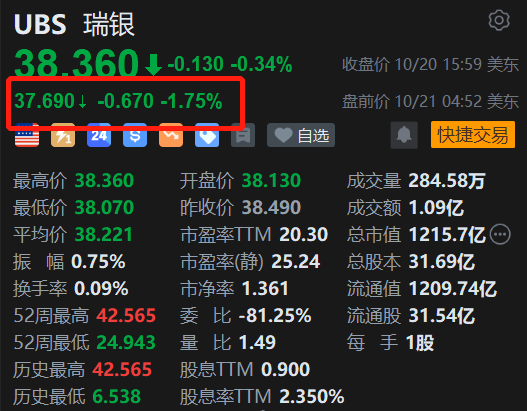
美股异动|瑞银盘前跌近2% 遭香港证监会谴责 并处以罚款800万港元
Ge Long Hui· 2025-10-21 09:08
瑞银(UBS.US)美股盘前跌1.75%。消息上,香港证监会对瑞银作出谴责,并处以罚款800万港元,原因 是UBS的内部系统及监控措施存在缺失,导致其在逾十二年间未能确保对客户的专业投资者身分作出准 确分类。 | UBS 瑞银 | | | | --- | --- | --- | | 38.360 4 -0.130 -0.34% | | 收盘价 10/20 15:59 美东 | | 37.690 ↓ -0.670 -1.75% | | 盘前价 10/21 04:52 美东 | | = 7 24 15 m + 日 = = 日 = | | ● 快捷交易 | | 最高价 38.360 | 开盘价 38.130 | 成交量 284.58万 | | 最低价 38.070 | 昨收价 38.490 | 成交额 1.09亿 | | 平均价 38.221 | 市盈率TM 20.30 | 总市值 1215.7亿 (m) | | 振 幅 0.75% | 市盈率(静) 25.24 | 总股本 31.69亿 | | 换手率 0.09% | 市净率 1.361 | 流通值 1209.74亿 | | 52周最高 42.565 | 委 比 ...

特朗普干预下美联储政策将出现哪些变化?
Qi Huo Ri Bao Wang· 2025-10-21 01:15
Core Viewpoint - The article discusses the increasing pressure from the Trump administration on the Federal Reserve, particularly regarding interest rate cuts, and the implications for the Fed's independence and future monetary policy direction [1][2][3]. Group A: Pressure on the Federal Reserve - The Trump administration has intensified its pressure on Federal Reserve Chairman Jerome Powell, demanding immediate interest rate cuts and criticizing Powell's cautious approach [3][4]. - Following unsuccessful verbal attacks on Powell, Trump shifted focus to personnel changes within the Fed, aiming to reshape its leadership by targeting other board members [3][4][5]. Group B: Changes in Federal Reserve Leadership - Trump's intervention began with the unexpected resignation of Fed Governor Kugar, which opened the door for Trump to nominate his ally, Milan, to fill the vacancy [4]. - The subsequent targeting of Fed Governor Cook, including criminal allegations against him, illustrates Trump's strategy to exert control over the Fed's board [4][5]. - Trump's public categorization of Fed board members into "Trump" and "Biden" camps indicates a clear intent to influence the Fed's decision-making structure [5]. Group C: Federal Reserve's Power Structure - The Federal Reserve's decision-making is primarily conducted by the Board of Governors and the Federal Open Market Committee (FOMC), with the Board being the key decision-making body [7][9]. - The Board consists of seven governors, and its decisions significantly influence monetary policy, banking regulation, and financial stability [9][10]. - The FOMC, which includes both Board members and regional Fed presidents, has the authority to set interest rates and conduct open market operations [8][9]. Group D: Potential Policy Changes - If Trump successfully controls the Fed's board, significant policy shifts could occur, including rapid interest rate cuts and expansion of the Fed's balance sheet to purchase U.S. Treasury bonds [15][16]. - Trump's desire for a 3% interest rate cut reflects a broader strategy to stimulate the economy, with expectations of at least 150 basis points of cuts in the near term [16][17]. - The potential for a more accommodative monetary policy could lead to increased financial market activity but may also raise systemic risks in the long term [18][19].
FDR’s Wall Street watchdog: Why the SEC’s role remains vital nearly 90 years on
The Economic Times· 2025-10-20 17:24
Core Insights - The Great Depression revealed the flaws in the economic model of the Roaring 20s, emphasizing the need for regulation to ensure fair opportunities for all [1] - FDR established the SEC in 1934 as a regulatory body to reform Wall Street, allowing average Americans to benefit from capitalism [2] - Historical challenges to the SEC's authority and effectiveness have persisted, including periods of deregulation that led to significant financial crises [3][4][5] Regulatory Evolution - The SEC was temporarily relocated to Philadelphia in 1942, which hindered its effectiveness until it returned to Washington in 1948 [3] - The 1960s saw a surge in Wall Street activity and fraud, overwhelming the SEC's resources and leading to major market manipulation issues [4] - Deregulatory policies in the 1980s, including the decision to let the CFTC regulate derivatives, contributed to significant market failures and investor losses [4] Recent Developments - The Commodities Futures Modernization Act of 2000 prohibited regulation of 'swaps', which contributed to the Global Financial Crisis in 2008 [5] - By late 2022, the lack of regulatory oversight on cryptocurrencies resulted in widespread bankruptcies and fraud [5] - The SEC is currently moving towards a more laissez-faire approach under recent proposals, which raises concerns about the potential for unchecked speculation [6][8] Historical Context - FDR's vision of a regulated financial environment remains relevant, as the SEC has been a work in progress for nearly 90 years, facing numerous challenges [7] - The importance of maintaining regulatory oversight is underscored by historical lessons, emphasizing the risks of forgetting past mistakes [7]

1.4万亿元河南最大城商行换帅!中原银行打法瞄准何方
Sou Hu Cai Jing· 2025-10-20 13:41
Core Viewpoint - Zhongyuan Bank has entered a "new headquarters era" and appointed Zhou Feng as the new president, facing multiple challenges including declining revenue and rising non-performing loans [1][3][4]. Group 1: Leadership Changes - Zhou Feng, with extensive regulatory and government experience, has been appointed as the new president of Zhongyuan Bank, pending regulatory approval [1][3][4]. - The previous president, Liu Kai, has resigned and will no longer hold any position within the bank [3]. Group 2: Financial Performance - For the first half of 2025, Zhongyuan Bank reported a revenue of 13.563 billion yuan, a decrease of 3.1% year-on-year, and a net profit of 2.034 billion yuan, down 0.8% [6]. - Non-interest income has significantly declined, with net commission income down 3.2%, trading net income down 30.5%, and investment securities income down 37% [6]. Group 3: Asset Quality and Risks - The non-performing loan (NPL) ratio stood at 2.01% as of June 2025, slightly down from the beginning of the year but still above the average of 1.76% for city commercial banks [6]. - The real estate sector's NPL ratio increased from 4.42% at the end of 2024 to 5.03% due to declining market demand and debt pressures [6]. Group 4: Strategic Focus and Challenges - Zhongyuan Bank aims to enhance its financial services to the real economy and improve its digital capabilities amid increasing competition from national banks and fintech companies [8][9]. - The bank is focusing on regional market development, technology finance, green finance, and digital finance to achieve differentiated growth [8][9]. Group 5: Organizational and Capital Strategies - The bank has established a diversified capital replenishment mechanism, issuing 8 billion yuan in subordinated debt and 10 billion yuan in perpetual bonds to enhance its capital adequacy [9]. - Zhongyuan Bank is actively involved in local government financial collaboration, providing services such as project financing and special bond issuance across various regions [9].

全球财富管理论坛·2025上海苏河湾大会举行 专家建言“世界变革下的未来之路”
Jing Ji Guan Cha Wang· 2025-10-19 02:59
Group 1: Monetary Policy and Financial Regulation - The People's Bank of China emphasizes the dual function of monetary policy, focusing on both total and structural adjustments to address the structural challenges in the economy [1] - The design of structural monetary policy tools aims to create an incentive-compatible mechanism, linking the central bank's base currency issuance to commercial banks' lending to specific sectors [1] - The application of artificial intelligence in finance is expected to have significant and fundamental impacts, enhancing financial services and operational efficiency while ensuring risk management [2] Group 2: Financial Supply and Demand - AI technology is projected to drastically reduce the costs of financial product development and production, making it economically feasible to cater to previously neglected niche demands, thus generating a "long tail effect" [2] - Financial regulation encourages institutions to leverage the latest technologies to optimize services, reduce operational costs, and improve management efficiency while maintaining a balance between safety and efficiency [2] Group 3: Macro Policy and Economic Challenges - The rising global public debt and increasing leverage levels pose challenges, necessitating the use of macro policy space to enhance effective borrowing and investment in data-driven infrastructure [2][3] - China is advised to optimize its debt structure and implement comprehensive debt solutions while maintaining a sustainable government debt ratio aligned with economic resilience [3] - In the face of global protectionism and fragmented supply chains, China is adopting a more open approach to globalization and is actively constructing a new development pattern that balances safety and efficiency [3]
金融监管总局副局长肖远企:AI对金融五大领域产生重要变革
Guo Ji Jin Rong Bao· 2025-10-19 01:09
对于金融机构核心竞争力的变化,肖远企认为,资本实力、客户基础、风控能力、人才队伍、公司治 理、企业文化等传统要素仍然重要,但人工智能时代催生了新的核心诉求。例如,数据与算法重要性上 升,如何将"可用数据"转化为"可信数据"、识别整合有价值信息变得非常关键。数据与模型选择的差异 会导致结果天差地别,坚持"选择中性"原则就显得很有必要,是金融机构竞争力的具体体现。在保险领 域,应用人工智能科技提升精算假设的合理性与可实现性,降低假设与结果的偏离度就构成了保险机构 的核心竞争力要素。 针对金融生产最大可能性边界,肖远企表示,金融的一个重要功能就是配置资源。人工智能的发展无疑 有助于更好更有效率地配置资源,潜力可以充分挖掘,更多的资源很有可能"恰到好处"地分布在生产可 能性曲线之上,完成现有资源的最优配置。同时,人工智能作为重大科技进步,推动金融最大生产可能 性边界向外移动也是完全可以期待的。 10月18日,金融监管总局副局长肖远企在全球财富管理论坛·2025上海苏河湾大会上谈到了人工智能科 技在金融领域的应用实践与趋势性变化情况,涉及金融供给、金融集中、金融机构核心竞争力、金融生 产最大可能性边界、金融监管五个方面 ...