长钱长投

Search documents
新京报贝壳财经资本市场研究院联合机构发布《长钱长投十条共识》
Bei Ke Cai Jing· 2025-09-12 10:17
Core Viewpoint - The recent salon hosted by the Beijing News Beike Finance Capital Market Research Institute focused on how patient capital can stabilize the market, aiming to build a robust ecosystem through consensus and collaboration among various financial institutions [1][4]. Group 1: Key Insights from the Salon - Long-term capital entering the market is a result of a positive capital market environment rather than the primary cause [5]. - To promote long-term capital inflow, it is crucial to optimize assessment cycles, maintain a long-term upward trend in the capital market, enforce anti-fraud measures, and reduce market volatility [6]. - A "slow bull" market is essential to attract more long-term "patient" funds into the capital market [7]. Group 2: Market Trends and Strategies - The stock market has transitioned from a "stagnation" phase to a long-term upward trend [8]. - The market needs to shift from a "liquidity-driven bull" to a "fundamentals-driven bull" for the major indices to continue breaking upward [8]. - Under a "slow bull" market, the stock market is expected to become a new reservoir for residents' assets, replacing real estate [9]. Group 3: Financial Institutions' Role - Banks are actively positioning themselves in the equity market, with the scale of "fixed income +" products expected to continue increasing [10]. - Fund companies should incentivize certain fund managers to pursue long-term stable returns to better meet the demand for long-term capital inflow [11]. - Enhancing investor education will contribute to the high-quality development of the asset management industry [12]. Group 4: Future Aspirations - The Beijing News Beike Finance Capital Market Research Institute aims to become a discoverer and shaper of capital market value, as well as a service provider and connector within the capital market ecosystem, supporting high-quality development of the Chinese economy [14].


引长钱促长投 中长期资金入市提速
Zheng Quan Shi Bao· 2025-09-11 17:53
Group 1 - The core viewpoint of the articles highlights the increasing participation of long-term funds, such as insurance funds and public funds, in the capital market, which is expected to stabilize market volatility and enhance resource allocation efficiency [1][2][3][4] - As of mid-2025, the total investment amount in stocks by five major listed insurance companies reached 1.846429 trillion yuan, reflecting a year-to-date increase of 411.858 billion yuan, or 28.71% [2] - By the end of Q2 2025, the balance of stock investments by life and property insurance companies reached 3.07 trillion yuan, with a net increase of 640.6 billion yuan in the first half of the year, representing a year-on-year growth of 47.57% [3] Group 2 - The total scale of public funds in China reached 35.08 trillion yuan by the end of July 2025, marking a significant increase and reflecting a shift towards long-term and value-based investment strategies [4] - The domestic ETF market has surpassed 5 trillion yuan, with an increase of 1.29 trillion yuan, or over 34%, since the end of 2024, indicating a growing preference for index-based investments among various investors [4][5] - The proportion of institutional investors holding stock-type funds increased from 34.44% in the previous year to 40.49% in mid-2025, demonstrating a shift towards more stable investment strategies [6] Group 3 - As of mid-2025, the net asset value of corporate annuities reached approximately 3.8 trillion yuan, with a significant portion allocated to equity investments, indicating potential for further growth in long-term capital supply [7] - The current equity investment ratio of corporate annuities is about 14%, suggesting substantial room for growth towards the 40% upper limit, which could enhance long-term returns and support the capital market [7]
发挥长钱长投优势险资系私募偏好大蓝筹
Zhong Guo Zheng Quan Bao· 2025-09-03 22:42
Group 1 - A new insurance-funded private equity firm, Hengyi Chiying (Shenzhen) Private Fund Management Co., Ltd., has completed registration with an initial fund size of 30 billion yuan [1] - The total number of insurance-funded private equity firms has reached seven, with a combined trial amount of 222 billion yuan [1][2] - The investment strategy of these firms is focused on long-term and value investments, favoring leading companies in energy and infrastructure sectors such as China Petroleum, China Shenhua, and Daqin Railway [1][4] Group 2 - The first batch of insurance capital long-term investment reforms was approved in October 2023, with China Life and Xinhua Insurance each contributing 25 billion yuan to establish a 50 billion yuan company fund [2] - As of now, six insurance-funded private equity securities investment funds are operational, with significant holdings in major companies [2][3] - The Honghu Zhiyuan Fund has become a major shareholder in China Petroleum and China Shenhua, with holdings valued at approximately 1.857 billion yuan and 2.116 billion yuan respectively [2][3] Group 3 - The Honghu Zhiyuan series of funds emphasizes a long-term investment approach, focusing on stable dividend yields through low-frequency trading and long-term holding [4] - The total assets of the Honghu Zhiyuan Fund I reached 57.112 billion yuan, with a net profit of 9.68 billion yuan in the first half of the year [3][4] - Insurance companies are establishing private equity funds to leverage their long-term investment advantages, supporting the capital market and promoting stable, sustainable investment returns [4]






四大证券报精华摘要:9月1日
Xin Hua Cai Jing· 2025-09-01 00:01
Group 1: Technology Sector Performance - The technology sector in the A-share market has shown significant performance, with Industrial Fulian's market value surpassing 1 trillion yuan and the communication and electronics industries experiencing a monthly increase of over 20% [1] - Many technology companies reported impressive earnings in their semi-annual reports, reflecting the effectiveness of increased R&D investments [1][5] - The overall trend indicates that Chinese technology enterprises are solidifying their technological foundations, contributing to the economic transformation [1] Group 2: Overall Market Recovery - As of August 31, 5424 A-share companies disclosed their semi-annual reports, achieving a total revenue of approximately 34.9 trillion yuan, a year-on-year increase of 0.03% [2] - The net profit attributable to shareholders reached about 2.99 trillion yuan, marking a year-on-year growth of 2.45% [2] - A significant portion of companies, 2908, reported a year-on-year increase in net profit, indicating a recovery across various industries, including agriculture, steel, and electronics [2][3] Group 3: Mid-Year Dividend Trends - A record high of 810 companies announced mid-year cash dividend plans, with a total proposed payout of 6428.08 billion yuan, reflecting a year-on-year increase of 9.56% in dividend amounts [6] - Among companies with dividends exceeding 1 billion yuan, state-owned enterprises account for about 30% [6] - The banking sector has also seen a notable increase in mid-year dividends, with 17 banks disclosing dividend plans, including seven banks that are implementing dividends for the first time since their listings [7] Group 4: R&D Investment - A-share companies reported over 810 billion yuan in R&D investments in the first half of 2025, with several industries, including software development and biopharmaceuticals, showing high R&D intensity [12] - Six companies, including BYD and China Mobile, each invested over 10 billion yuan in R&D [12] Group 5: Mergers and Acquisitions Trends - The A-share market is witnessing a shift in mergers and acquisitions from "buying scale" to "acquiring technology," with a notable increase in transactions involving core technologies [11] - In 2025, there have been 21 merger and acquisition projects focused on core technologies, totaling 2.569 billion yuan [11]
险资股票仓位激增,重仓368股,偏爱银行、运营商
21世纪经济报道· 2025-08-28 12:33
Core Viewpoint - Insurance capital is increasingly focusing on high-dividend stocks to secure stable returns and mitigate the impact of declining bond yields, with significant room for future investment growth in the equity market [1][6][10]. Group 1: Insurance Capital Holdings - As of August 27, 368 stocks are heavily held by insurance capital, primarily in sectors such as non-bank financials, banking, telecommunications, electric equipment, non-ferrous metals, and public utilities [1][3]. - In Q2 2025, insurance funds entered 79 new stocks, increased holdings in 124 stocks, and reduced holdings in 95 stocks, with total holdings amounting to 554.1 billion shares valued at 1.18 trillion yuan [1][5]. - China Life Insurance Group has the largest holding in China Life, valued at 795.93 billion yuan, while Ping An holds 135.73 billion yuan in Ping An Bank [3][4]. Group 2: Focus on Telecommunications - Telecommunications operators, including China Unicom, China Telecom, and China Mobile, became key targets for insurance capital in Q2, with significant increases in holdings by major insurers [3][5]. - China Life increased its stake in China Telecom by 205 million shares, bringing its total to 1.1 billion shares valued at 8.5 billion yuan [3][5]. Group 3: Investment Strategy and Market Conditions - The increase in insurance capital holdings is driven by policy guidance, the need for asset-liability matching, and the growing attractiveness of the capital market [6][8]. - Insurance companies are expected to maintain or slightly increase their stock and bond investments in the second half of 2025, with stocks being the preferred asset class [8][9]. - The total balance of insurance funds exceeded 36.23 trillion yuan by the end of Q2 2025, with a year-on-year growth of 17.39%, and stock investments reached 3.07 trillion yuan, marking a significant increase [8][9]. Group 4: Long-term Investment Outlook - Insurance capital is likely to continue focusing on stable, high-dividend value stocks, particularly in financial and public utility sectors, while also exploring opportunities in green energy and high-end manufacturing [9][10]. - The potential for significant and sustained inflows of insurance capital into the equity market is expected, driven by ongoing premium income growth and increased demand for equity market allocation [10].



华安证券上半年营收净利双增破同期纪录,四大业务协同发力,回购分红双线并行
Xin Lang Cai Jing· 2025-08-28 07:29
Core Viewpoint - Huaan Securities reported its best performance for the first half of the year since its listing, with significant growth in both operating performance and capital strength, showcasing a robust multi-business collaboration and strong investor return initiatives [1][2]. Financial Performance - The company achieved an operating income of 2.808 billion yuan, a year-on-year increase of 43.09%, and a net profit attributable to shareholders of 1.035 billion yuan, up 44.94%, marking the best performance for the same period since its listing [1]. - As of the end of June, total assets exceeded 100 billion yuan, reaching 102.118 billion yuan, with net assets of 23.106 billion yuan and net capital of 18.469 billion yuan, providing solid capital support for business expansion and innovation [1]. Business Segments - The growth was driven by the collaboration of four major segments: retail, industry, institutional, and proprietary trading, rather than relying on a single business [2]. - Retail business saw significant success in wealth management transformation, with agency buying income increasing by 66% and advisory business income surging by 129% [3]. - Proprietary trading revenue grew by 77.02%, becoming a core driver of net profit growth [5][6]. - Investment banking revenue skyrocketed by 229.70%, contributing significantly to overall revenue growth [6]. Shareholder Returns - The company completed a share buyback of 119 million yuan and plans to distribute a mid-term cash dividend of 187 million yuan, transitioning from annual dividends to a combination of annual and mid-term dividends [2][8]. - The company emphasizes a shareholder-centric approach, as reflected in its "Quality Improvement and Efficiency Return Assessment Report," which outlines specific measures and plans for enhancing investor returns [8].

多只芯片ETF上涨;ETF规模飙升至4.8万亿丨ETF晚报
2 1 Shi Ji Jing Ji Bao Dao· 2025-08-20 14:20
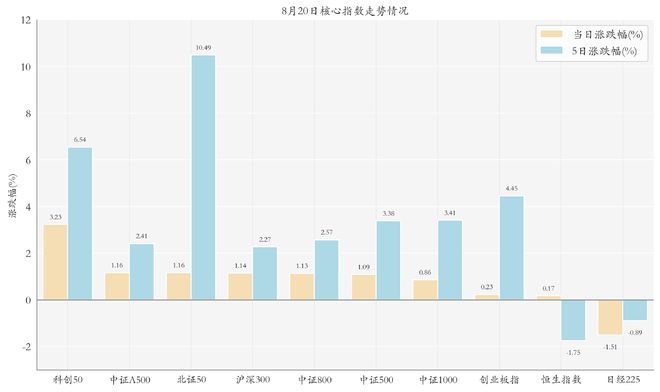
Market Overview - The three major indices in the A-share market rose collectively, with the Shanghai Composite Index increasing by 1.04%, the Shenzhen Component Index by 0.89%, and the ChiNext Index by 0.23 [1][4] - The performance of various ETFs was notable, particularly in the semiconductor sector, where several ETFs saw significant gains, such as the Kexin Chip Design ETF (588780.SH) rising by 5.57% [1][11] ETF Market Dynamics - Over 70% of stock ETFs experienced an increase in scale on August 18, with more than 800 ETFs collectively gaining just over 40 billion yuan, reflecting a 1.26% rise [2] - The total scale of the ETF market reached 4.8 trillion yuan as of August 18, with significant growth across various categories, indicating a shift towards ETFs as a key asset management tool [3] Sector Performance - In terms of sector performance, the beauty care, oil and petrochemical, and electronics sectors led the gains, while the pharmaceutical and real estate sectors lagged behind [6] - The semiconductor ETFs dominated the top performers, with the Kexin Chip Design ETF achieving a 5.57% increase and a 11.06% rise over the past five days [12] Trading Activity - The top three stock ETFs by trading volume were the Kexin 50 ETF (588000.SH) with 6.228 billion yuan, the CSI 300 ETF (510300.SH) with 5.938 billion yuan, and the A500 ETF (512050.SH) with 5.423 billion yuan [14]
基金早班车丨ETF规模首破四点八万亿元,长钱长投成主流
Sou Hu Cai Jing· 2025-08-20 00:47
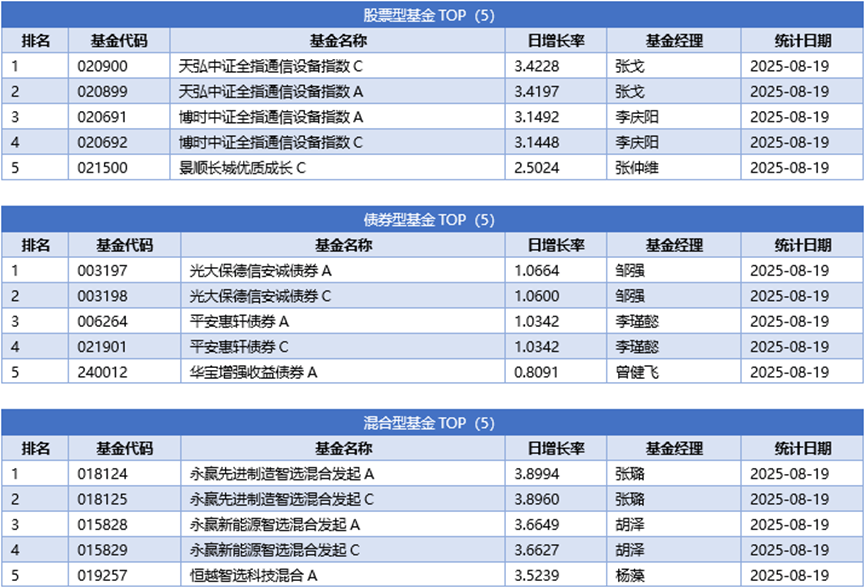
Trading Insights - The ETF market has been thriving this year, with a total market size reaching 4.8 trillion yuan as of August 18, showing significant growth in stock ETFs, cross-border ETFs, commodity ETFs, and bond ETFs compared to the end of last year [1] - ETFs are evolving from mere trading tools to essential wealth management infrastructure, becoming important vehicles for long-term investments amid steady economic recovery and policy support [1] Fund News - On August 19, three new funds were launched, primarily ETF-linked funds and equity funds, with the Huatai-PineBridge SSE Sci-Tech Innovation Board Artificial Intelligence ETF having an undisclosed fundraising target [2] - Public funds are actively entering the market, with the stock positions of active equity funds reaching a year-to-date high; newly established funds have quickly built positions, with several achieving over 10% returns within a month [2] - The A-share market has seen a simultaneous increase in volume and price, with public fund issuance remaining robust; 45 new funds are planned for issuance in the week of August 18 to August 24, marking a 36.36% increase from the previous week and continuing a trend of over 30 new funds issued weekly for four consecutive weeks [2] Fund Performance - The best-performing fund on August 19 was the Yongying SSE Sci-Tech Innovation Board Artificial Intelligence Index A, with a daily growth rate of 4.4065% [3] - In the stock fund category, the top performer was also the Yongying SSE Sci-Tech Innovation Board Artificial Intelligence Index A, while the bond fund champion was the Everbright Prudential Ancheng Bond A, with a daily growth rate of 1.0664% [3][4] - The top-performing mixed fund was Yongying Advanced Manufacturing Select Mixed Initiation A, with a daily growth rate of 3.8994% [3][4] - The leading ETF-linked fund was the Guotai CSI All-Share Communication Equipment ETF, achieving a daily growth rate of 3.8776% [3][4] - The top QDII fund was the Invesco Great Wall Hang Seng Consumer ETF, with a daily growth rate of 1.1153% [3][4]
专访瑞士百达谭思德:全球经济结构性剧震,四大因素塑造未来十年格局
Sou Hu Cai Jing· 2025-08-19 16:14
Group 1 - The concept of "long-term investment" has gained significant attention in recent years, with policies being developed to support it from top-level design to operational details [1] - Swiss private partnership firm, Pictet, has a long-standing commitment to long-term investment, tracing its history back to 1805, and has evolved into Switzerland's second-largest international financial institution [1] - Alexandre Tavazzi, Chief Investment Officer at Pictet, defines long-term investment as a 10-year horizon, with his team analyzing economic conditions and asset class returns over this period [1] Group 2 - The global economic landscape is undergoing "tectonic shifts," with structural impacts being more critical than cyclical ones in the next decade [4][5] - Negative impacts from U.S. policies include tariffs that effectively tax consumers and a government efficiency initiative that has not yielded expected savings [3] - Positive aspects include regulatory relaxations in the financial sector, allowing banks to operate with lower capital ratios, potentially increasing lending [3] Group 3 - The U.S. economy's stability, security guarantees, and high-return assets are being questioned, with increasing policy uncertainty since the Trump administration [6] - The attractiveness of U.S. assets is declining, particularly as competition from emerging sectors in China grows [7] - The long-term U.S. Treasury yield is viewed negatively due to insufficient compensation for risks, leading to a strategy of shortening duration in bond investments [8] Group 4 - Europe is experiencing significant changes, with Germany planning to abolish its debt brake and invest heavily in military and infrastructure, potentially leading to faster growth in the next decade [9] - The forecast for economic growth over the next decade predicts a U.S. growth rate of 1.8% and a Eurozone growth rate of 1.5%, narrowing the gap between the two regions [10] - Key factors shaping the future include deglobalization, decarbonization, demographic changes, and dominance of fiscal policy, with inflation expected to remain elevated [10]

历史新高!突破4.8万亿
中国基金报· 2025-08-19 06:37
Core Viewpoint - The article highlights the significant growth of the ETF market in China, with total ETF assets surpassing 4.8 trillion yuan, reflecting increased confidence and willingness of institutional and individual investors to enter the market [2] Group 1: Long-term Investment Strategy - The "long money, long investment" strategy aligns with the "three investment" philosophy, emphasizing the need for stability in the market and promoting a virtuous cycle between the capital market and the real economy [4] - Regulatory support through policies like the "National Nine Articles" and the "High-Quality Development Action Plan for Index Investment" aims to guide long-term capital into the market [4][5] - Investor education initiatives have been crucial in promoting long-term investment concepts, with significant outreach efforts reaching millions of clients [4] Group 2: ETF Market Dynamics - Broad-based ETFs tracking major indices like the CSI 300 and the STAR Market have become primary tools for long-term capital allocation, showing resilience during market adjustments [6] - The share of institutional investment in broad-based ETFs has increased significantly, indicating a shift towards long-term strategies [6] - The rise of thematic and sector-specific ETFs is driving capital towards strategic emerging industries, aligning with national priorities [7] Group 3: Bond ETFs and Market Stability - Bond ETFs have seen explosive growth, exceeding 500 billion yuan, serving as a stabilizing force in investor portfolios amid declining interest rates [8] - The demand for bond ETFs reflects strong long-term capital allocation needs among investors [8] Group 4: Institutional Investor Influence - Institutional investors have become a cornerstone of the ETF ecosystem, with their holdings in equity ETFs exceeding 40% by the end of 2024 [10] - The penetration rates of institutional investors in stock and bond ETFs have reached 62.14% and 84.9%, respectively, indicating a robust shift towards long-term investment [10] Group 5: Future Outlook - The deepening of personal pension systems and expansion of the third pillar of pensions will continue to broaden the supply of long-term capital [13] - ETFs are expected to play a crucial role in aligning capital with national innovation strategies, particularly in hard technology sectors [13] - The article envisions a resilient and vibrant capital market driven by patient capital flowing into strategic areas like hard technology and green initiatives [13]