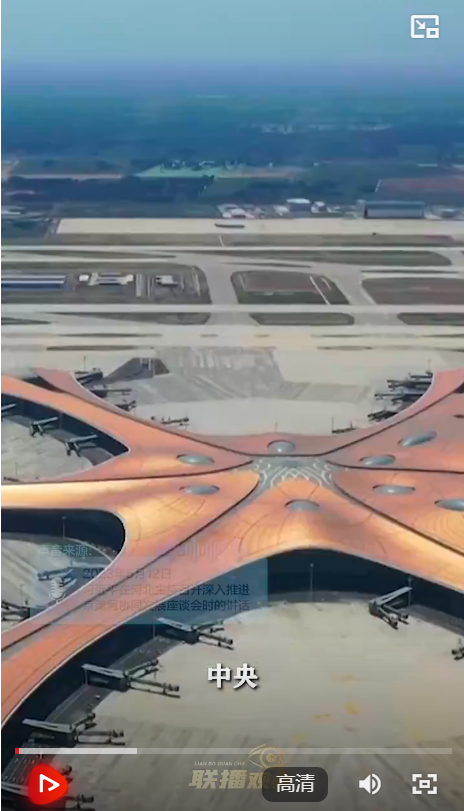
区域协调发展

Search documents
国家发展改革委:雄安常住人口已达到140万左右
Xin Lang Cai Jing· 2025-12-13 04:54
今天(13日),在中国国际经济交流中心举办的2025-2026中国经济年会上,国家发展改革委副秘书长 肖渭明表示,明年要推动区域协调发展,巩固提升京津冀等区域高质量发展动力源作用。积极稳妥推进 在京高校、医院、央企、金融机构、科研院所、事业单位疏解项目在雄安新区落地建设。目前,雄安常 住人口已达140万左右,较此前实现显著增长,新型城市化雏形已初步显现。(央视新闻) ...
支持高标准建设海南自由贸易港 拓展多领域合作共赢新空间
Zheng Quan Ri Bao· 2025-12-13 01:28
Core Viewpoint - The General Administration of Customs emphasizes the importance of implementing the spirit of the Central Economic Work Conference and aligning actions with the decisions made by the Central Committee, aiming to contribute to the economic and social development goals for the upcoming year [1][2]. Group 1 - The Customs will focus on strengthening the domestic market, enhancing policy supply, promoting trade innovation, optimizing import and export structures, and facilitating domestic and international dual circulation [2]. - The Customs aims to expand high-level opening-up by innovating customs supervision systems, supporting the construction of the Hainan Free Trade Port, and signing more regional and bilateral trade agreements [2]. - The Customs will work on promoting regional coordinated development by optimizing port opening layouts and improving regional opening support policies [2]. Group 2 - The Customs is tasked with ensuring safety and risk management as the year-end approaches, emphasizing the importance of safety production responsibilities and maintaining smooth operations [2]. - The Customs will promote the normalization and long-term effectiveness of work style construction, aiming to establish a clean political environment and achieve practical results [2].
站在更高起点挺起中部脊梁
Jing Ji Ri Bao· 2025-12-12 22:59
Group 1 - The central region's rise is crucial for national stability and development, showcasing significant progress in various industries such as optoelectronics, engineering machinery, and agriculture [1][2] - The central region is positioned as a strategic support point, linking eastern and western regions, and enhancing the efficiency of the national unified market [2] - The region faces challenges including insufficient innovation capabilities, a lack of integration within the industrial system, and the need for improved regional collaboration [2] Group 2 - The focus is on establishing a nationally influential technology innovation hub, enhancing regional innovation centers, and promoting high-quality industrial clusters in sectors like optoelectronics and new energy vehicles [3] - Key reforms are needed to optimize the business environment and promote rural revitalization, particularly in food security and agricultural technology [3] - Enhancing the hub function and openness of the central region is essential for it to become a vital node in the national unified market, with plans for comprehensive transportation networks and international logistics [4]
海关总署:支持高标准建设海南自由贸易港
Zheng Quan Shi Bao Wang· 2025-12-12 13:04
Core Viewpoint - The General Administration of Customs emphasizes the implementation of the Central Economic Work Conference's directives to enhance trade and economic development in China [1] Group 1: Economic Strategy - The customs authority is tasked with fully implementing the Central Committee's economic strategies for the upcoming year, ensuring effective execution of policies [1] - Focus will be on strengthening the domestic market and optimizing import-export structures to facilitate trade innovation [1] Group 2: International Cooperation - The customs will support high-level opening-up by innovating regulatory systems, particularly in the Hainan Free Trade Port, and expanding regional and bilateral trade agreements [1] - The initiative aims to enhance cooperation in multiple fields and contribute to the high-quality development of the Belt and Road Initiative [1] Group 3: Regional Development - The customs authority will optimize port opening layouts and develop a comprehensive customs development plan to support regional coordinated development [1] - Policies will be improved to enhance regional openness and support economic growth across different areas [1] Group 4: Security Measures - A focus on balancing development and security will lead to the enhancement of a full-chain regulatory system to ensure national security at borders [1]
多省会年底经济冲刺,协同发展涌现新趋势
2 1 Shi Ji Jing Ji Bao Dao· 2025-12-12 12:16
Group 1 - Major cities are accelerating economic growth as the year-end approaches, implementing policies such as issuing consumption vouchers and promoting tourism [1][3] - In the first three quarters of this year, Guangzhou, Chengdu, and Hangzhou lead the GDP rankings among provincial capitals, with GDPs of 23,265.65 billion, 18,226.9 billion, and 16,900 billion respectively [4][5] - The competition among provincial capitals is tight, with GDP differences within the range of 100 billion between cities like Changsha, Zhengzhou, Jinan, Hefei, and Fuzhou [1][4] Group 2 - Experts emphasize that provincial capitals should focus not only on GDP but also on leveraging resources in talent, research institutions, and finance to drive innovation [3][10] - The "14th Five-Year Plan" outlines the role of provincial capitals in enhancing regional coordination and innovation, with cities like Chengdu aiming to become significant economic and technological centers [6][8] - Provincial capitals are increasingly seen as innovation hubs, with cities like Guangzhou rising in global rankings for research cities, indicating a shift towards high-quality development driven by innovation [5][6] Group 3 - The "14th Five-Year Plan" suggests enhancing regional development coordination and promoting inter-city collaboration, with a focus on building innovation and industrial clusters [8][9] - Cities like Chengdu and Wuhan are positioning themselves as leaders in artificial intelligence and other high-tech industries, aiming to attract talent and capital [9][10] - The long-term vision for provincial capitals includes not just economic expansion but also the ability to radiate innovation and resources to surrounding areas, fostering a collaborative growth environment [8][10]

【招银研究|政策】开局之年,提质增效——2025年中央经济工作会议学习体会
招商银行研究· 2025-12-12 11:17
Core Viewpoint - The Central Economic Work Conference held on December 10-11, 2025, outlines the economic work for 2026, emphasizing a balanced approach to domestic economic work and international trade, with a focus on expanding domestic demand and optimizing supply to achieve effective qualitative improvement and reasonable quantitative growth [1] Group 1: Work Tone - The conference adopts a pragmatic and positive tone, affirming that the main economic goals for 2025 will be met, with an expected GDP growth rate of 5% [2] - It acknowledges persistent challenges in economic development, including external environmental changes, domestic supply-demand imbalances, and risks in key areas [3] Group 2: Macroeconomic Policy - The macroeconomic policy will maintain strength and enhance effectiveness, with a focus on both existing and new policies [5] - Fiscal policy will be more proactive, with a projected fiscal deficit rate of 4% for 2026, corresponding to a deficit scale of 5.85 trillion, an increase of 190 billion from 2025 [7] - Monetary policy will remain moderately loose, prioritizing economic stability over inflation, with expectations for a 50 basis point reduction in reserve requirement ratios [9] Group 3: Key Work Areas - The conference identifies eight key work areas, with "expanding domestic demand" as the top priority, focusing on increasing residents' income and optimizing supply [10] - Innovation-driven policies will see significant changes, including the establishment of a comprehensive education and technology talent development plan [12] - Emphasis on green transformation and addressing risks in key areas, particularly in real estate and local government debt [14][15]
券商解读中央经济工作会议:八项经济工作任务各有亮点
Sou Hu Cai Jing· 2025-12-12 07:06
Core Viewpoint - The Central Economic Work Conference held on December 10-11 emphasizes five essential approaches for economic work under new circumstances, including fully tapping economic potential and combining policy support with reform innovation [2] Group 1: Domestic Market and Consumption - The conference highlights the need to build a strong domestic market, focusing on boosting consumer spending and income to enhance residents' consumption capacity [3] - Specific measures include implementing actions to stimulate consumption, improving supply quality, and stabilizing employment and income expectations [3] - The emphasis is on optimizing policies for service consumption and removing unreasonable restrictions in the consumption sector [3] Group 2: Innovation and New Momentum - The conference stresses the importance of innovation-driven development and aims to establish international technology innovation centers in key regions [4] - It calls for a new round of high-quality development actions for key industrial chains, particularly in electric vehicles, photovoltaics, and energy storage [4][5] - Policies will focus on enhancing the innovation ecosystem and protecting intellectual property rights in emerging fields [4] Group 3: Reform and Market Vitality - The conference outlines reforms to enhance market vitality, including the establishment of a unified national market and addressing "involution" in competition [6][7] - It emphasizes the need for tax system reforms to improve local financial capabilities and support consumer-driven competition [7] - Measures will also target the revitalization of state-owned and private enterprises, addressing issues like overdue payments to private firms [7] Group 4: External Cooperation and Trade - The conference reiterates the importance of steady external openness, particularly in the service sector, and encourages the development of digital and green trade [8] - It aims to accelerate the signing of regional and bilateral trade agreements to enhance international cooperation [8] Group 5: Regional Development and Urban-Rural Integration - The conference promotes urban-rural integration and regional collaboration, focusing on the development of county towns and revitalizing rural areas [9][10] - It emphasizes the need for coordinated development among major city clusters and enhancing cross-regional cooperation [9] Group 6: Green Transition and Carbon Neutrality - The conference prioritizes green transformation, emphasizing the development of a new energy system and the promotion of energy efficiency in key industries [11][12] - It aims to expand the application of green electricity and strengthen the national carbon trading market [12] Group 7: Social Welfare and Public Services - The conference addresses key social welfare issues, including employment, social security, education, and healthcare, with a focus on stabilizing the birth rate [13] - It proposes comprehensive solutions to reduce burdens on residents in these areas, aiming to enhance overall living standards [13] Group 8: Risk Management and Real Estate - The conference outlines strategies for risk management, particularly in the real estate sector, shifting focus from stabilizing prices to controlling supply and inventory [14][15] - It emphasizes the need for reforms in housing provident funds and improving the financial health of local governments [14]



从中央经济工作会议看“十五五”开局之年中国经济着力点
Xin Hua Wang· 2025-12-11 16:50
中央经济工作会议12月10日至11日在北京举行。习近平总书记出席会议并发表重要讲话,总结2025年经济工作,分析当前 经济形势,部署2026年经济工作,为实现"十五五"良好开局定向领航。 不断深化新形势下做好经济工作的规律性认识 2025年是"十四五"规划收官之年,在中国式现代化进程中具有重要意义。 会议总结今年经济运行情况,指出"经济社会发展主要目标将顺利完成""'十四五'即将圆满收官,第二个百年奋斗目标新征 程实现良好开局"。 会议认为,通过实践,我们对做好新形势下经济工作又有了新的认识和体会:必须充分挖掘经济潜能,必须坚持政策支持 和改革创新并举,必须做到既"放得活"又"管得好",必须坚持投资于物和投资于人紧密结合,必须以苦练内功来应对外部挑 战。 新时代以来的中央经济工作会议,一贯重视理论总结,用以指导经济发展实践。随着形势变化,中央经济工作会议持续深 化对经济工作的规律性认识,2021年提出"四个必须",2022年提出"六个坚持",2023年提出"五个必须",2024年提出"根本保 证""五个必须统筹"。 原标题:新华全媒头条·聚焦中央经济工作会议|推动经济实现质的有效提升和量的合理增长——从中央经 ...
官宣,又一个14万亿大省来了
Mei Ri Jing Ji Xin Wen· 2025-12-11 14:58
Group 1 - Jiangsu's GDP is expected to exceed 14 trillion yuan, marking a significant milestone in its economic development [1][2] - The province aims to enhance its contribution to national economic growth, improve its radiating and driving capabilities, and increase development coordination and international competitiveness [2] - Jiangsu's manufacturing industry remains robust, with a projected added value of 4.63 trillion yuan in 2024, maintaining its position as the top manufacturing province in China [2] Group 2 - Jiangsu has the highest number of "trillion-yuan cities" in China, with cities like Suzhou, Nanjing, and Wuxi leading the way, and Xuzhou expected to join this group [3] - The province emphasizes expanding domestic demand as a strategic initiative, enhancing its role in economic growth [3] - Jiangsu's innovative consumption initiatives have gained national attention, reflecting its commitment to driving economic activity [3]
解码“十五五”|下活区域协调“一盘棋”
Yang Shi Wang· 2025-12-11 07:41
《中共中央关于制定国民经济和社会发展第十五个五年规划的建议》明确提出,要"优化区域经济布 局,促进区域协调发展",强调要发挥区域协调发展战略叠加效应、增强区域发展协调性、推动区域联 动发展,最终构建优势互补、高质量发展的区域经济布局和国土空间体系。 新时代以来,我国推动区域协调发展"一盘棋",已超越传统的地理空间整合,正迈向科技、产业、规 则、治理的多维深层协同。在区域协调发展的宏大棋盘上,激活区域联动、培育高质量增长新优势,必 将为中国式现代化注入更加均衡、更可持续的发展动能。 总监制丨骆红秉 魏驱虎 监 制丨王敬东 主 编丨李璇 策 划丨李珊珊 编 辑丨刘禛 视 频丨李雪菲 视 觉丨郝凤林 校 对丨蔡纯琳 李丹 任佳 毛长志 李英卓 出 品丨中央广播电视总台央视网 编者按:党的二十届四中全会审议通过"十五五"规划建议,擘画了中国未来五年的发展战略与实施路 径。蓝图绘就新征程。央视网《联播观察》推出《解码"十五五"》系列微视频,与您一同聚焦宏伟新蓝 图,洞察时代新脉动,解码发展新机遇,见证中国全面建设社会主义现代化国家的坚定步伐。 联播+区域协调发展是中国式现代化的内在要求。习近平总书记指出:"我们必须适应 ...