
半导体

Search documents
隆华科技(300263) - 隆华科技投资者关系活动记录表
2026-02-01 09:56
Group 1: Business Strategy and Market Positioning - The company focuses on lightweight, high-strength materials for the commercial aerospace sector, particularly through its PMI foam, which has established a strong market presence due to its cost control benefits related to payload weight [4]. - The company has transitioned from being a pure supplier of structural materials to a comprehensive solution provider, leveraging its material technology to meet diverse customer needs [4]. - The EPMI stealth materials have been successfully applied in key equipment, with plans to expand into civilian markets at an appropriate time [4]. Group 2: Product Development and Innovation - The company is actively developing IZO (Indium Zinc Oxide) and AZO (Aluminum-doped Zinc Oxide) target materials, focusing on next-generation TCO (Transparent Conductive Oxide) materials for perovskite solar cells and enhancing product performance [5]. - The company has established a systematic product planning for TCO materials, covering first to third-generation products, and is continuously advancing technology iterations and market applications [5]. - In the semiconductor field, the company is refining its product lines for metal targets and ITO targets, addressing the specific needs of various display technologies, including Micro LED and Mini LED [8]. Group 3: Financial Performance and Management - The company anticipates a 40%-80% year-on-year growth in 2025, reflecting significant improvement in fourth-quarter performance due to financial structure optimization [6]. - The completion of the conversion of an 800 million RMB convertible bond has alleviated future financial pressure, leading to a healthier financial structure with a reduced debt ratio [6]. - The company aims to enhance financial management to minimize performance volatility, particularly by managing impairment provisions more effectively [6]. Group 4: Production Capacity and Expansion Plans - The second-phase expansion project for Zhaoheng Technology is nearing completion, with construction expected to start in 2026, focusing on carbon-based stealth materials and functional composite materials [7]. - The current production capacity for PMI foam is designed between 20,000 to 40,000 cubic meters, with ongoing efforts to address capacity bottlenecks to meet increasing market demand [7]. - The expansion is aligned with the company's "one body, two wings" development strategy, targeting future market needs for stealth materials and composite materials [8].

短期调整,2月仍积极
Xinda Securities· 2026-02-01 07:34
Group 1 - The core conclusion indicates that since the launch of the spring market in mid-December 2025, the market has experienced two phases: from December 17, 2025, to January 12, 2026, there was a rapid inflow of leveraged funds and ETF purchases, leading to a significant rise in the Shanghai Composite Index by 8.9% and a sharp increase in turnover rate. From January 13 to January 30, 2026, the market saw a correction due to policy guidance cooling down, with a large outflow from broad-based ETFs and a decline in the index by 1.14% [3][9][10] - The report identifies two internal reasons for the short-term adjustment: first, the market tends to experience fluctuations or corrections after rapid increases in turnover rates, as seen in previous bull markets. Second, the trading volume of certain sectors, particularly non-ferrous metals, reached a high level, increasing internal adjustment pressure [4][10][14] - February is expected to continue the second half of the spring market, as it typically has the highest win rate during this period. Potential positive factors for incremental funds include increased allocation of equity assets by insurance funds, the maturity of fixed deposits, a rebound in public fund issuance, private fund replenishment, and foreign capital inflow [4][16][21] Group 2 - The report suggests that in February, small-cap growth stocks usually outperform, with a focus on themes rather than industries. High-elasticity growth themes, such as military and AI applications, may still perform well after a phase of profit-taking [4][16][24] - The analysis emphasizes the importance of mid-term logical directions in the industrial sector, indicating that after short-term valuation adjustments, there may be strong mid-term sustainability [4][16][24] - The report highlights that the current bull market is supported by a favorable liquidity environment, with potential for continued strong performance in the market, despite some expected volatility [21][24][25]

【财闻联播】工行调整黄金积存业务!2025年证券交易印花税增长57.8%
Sou Hu Cai Jing· 2026-01-30 12:39
Macroeconomic Dynamics - The Ministry of Finance announced that the securities transaction stamp duty is expected to reach 203.5 billion yuan in 2025, representing a growth of 57.8% [1] Energy Sector - The National Development and Reform Commission and the National Energy Administration will increase the proportion of fixed costs recovered through capacity pricing for coal-fired power plants to no less than 50% [2] Telecommunications Industry - According to the China Academy of Information and Communications Technology, the domestic smartphone shipment in December 2025 is projected to be 24.473 million units, a year-on-year decline of 29.1%. For the entire year of 2025, the total smartphone shipment is expected to be 307 million units, down 2.4% year-on-year [3] Financial Institutions - China International Capital Corporation (CICC) expects its net profit attributable to shareholders to be between 8.542 billion yuan and 10.535 billion yuan in 2025, reflecting a year-on-year increase of 50% to 85% [9] Market Data - The A-share market showed mixed results on January 30, with the Shanghai Composite Index down 0.96% and the ChiNext Index up 1.27%. The total trading volume was approximately 283.55 billion yuan, a decrease of about 39.44 billion yuan from the previous trading day [10] Company Dynamics - Sino Medical announced an expected revenue of 519 million to 526 million yuan for 2025, with a year-on-year growth of 13% to 15%. The net profit attributable to shareholders is projected to be between 43 million and 50 million yuan, indicating a significant year-on-year increase of 2767% to 3233% [13]






新朋股份:截至目前公司主营业务没有涉及半导体业务
Zheng Quan Ri Bao Zhi Sheng· 2026-01-30 11:12
Group 1 - The company, Xinpeng Co., has stated that its main business does not currently involve the semiconductor sector [1] - The company is involved in setting up investment funds that include projects related to multiple semiconductor enterprises [1] - Investors are encouraged to refer to the company's annual reports for detailed information regarding these investments [1]

北交所1月份定期报告:北交所市场结构持续优化
Dongguan Securities· 2026-01-30 08:14
Core Insights - The report indicates that since the fourth quarter, the funding structure of the Beijing Stock Exchange (BSE) has shown a "dual expansion" characteristic, with both the number and attention towards index funds steadily increasing, forming a preliminary bottom position for index products. Concurrently, some active funds are beginning to identify individual stocks with growth potential and undervaluation advantages, transitioning from a concentrated to a structured optimization approach, maintaining overall market stability [7][16] - From the market ecology perspective, the concentration of index constituent stocks has increased, and the valuation anchoring effect is gradually becoming evident. Some newly listed stocks with solid fundamentals and low coverage have become focal points for new incremental funds. As the allocation logic evolves towards the medium to long term, the market style is gradually shifting to a "selected + low turnover" characteristic. Overall, the current valuation of the BSE market offers relative cost-effectiveness, with a resonance structure among index funds, active funds, and new stock supply, which is expected to provide medium-term support for the market [7][16] Market Review and Valuation - As of January 29, 2026, the BSE 50 Index rose by 6.64% in January, with a maximum increase of 3.96% during the period. Among BSE stocks, 222 stocks increased, 69 stocks decreased, and none remained flat [8][17] - The average PE (TTM) of the BSE 50 Index as of January 29, 2026, is 64.50 times, with a median of 64.74 times. In comparison, the average PE (TTM) of the ChiNext Index is 43.24 times, and the Sci-Tech Innovation Board is 175.49 times [22] New Stock Dynamics - In January, four new stocks were listed on the BSE, bringing the total number of listed companies to 291 as of January 29, 2026. From January 1 to January 30, 2026, five companies were subscribed and five were listed [32] Key Company Announcements - The report includes various company announcements, highlighting significant contracts and operational updates from companies such as Copper Crown Mining, Taihu Yuanda, and Dana Biotechnology, which indicate ongoing business activities and strategic developments [40]
2025招商证券“招财杯”ETF实盘大赛,圆满落幕!
券商中国· 2026-01-30 07:24
Core Viewpoint - The A-share market is experiencing a volatile upward trend, with the Shanghai Composite Index surpassing 4000 points in 2025. ETFs have become essential tools for investors to allocate assets and capture structural opportunities due to their high transparency, low fees, and strong liquidity [2]. Group 1: ETF Market Growth - By the end of 2025, the net inflow into China's ETF market reached approximately 1.18 trillion yuan, with the number of ETFs listed on domestic exchanges increasing to 1402, and the total market size rising from 3.7 trillion yuan to 6.0 trillion yuan, reflecting a growth of over 60% compared to the beginning of the year [2]. - The ETF product line has become increasingly diverse, offering investors a multi-layered toolbox to seize market opportunities, ranging from broad indices to niche sectors and from domestic investments to cross-border allocations [2]. Group 2: ETF Competition and Education - The "Zhaocai Cup" ETF live competition, held by China Merchants Securities since 2023, has attracted nearly 270,000 participants over three years, reaching over ten million investors through educational and event-related content, thereby fostering a positive ETF investment ecosystem [3]. - The 2025 competition saw over 880,000 views, with participant engagement increasing by over 60% compared to the previous year, indicating a growing interest in ETF investments [3]. Group 3: Performance and Market Trends - The A-share market showed strong performance in 2025, with major indices experiencing significant gains. The technology growth sector, particularly AI, semiconductors, robotics, aerospace, and innovative pharmaceuticals, emerged as the strongest market drivers [4]. - Participants in the "Zhaocai Cup" demonstrated impressive performance, focusing on broad-based ETFs and sector-specific themes such as biomedicine, communication equipment, and semiconductor chips, reflecting their attention to market hotspots and strategic adjustments [5]. Group 4: Comprehensive Support for Investors - The competition upgraded its offerings across four dimensions: education, investment, events, and services, providing comprehensive support to help investors progress steadily in their investment journeys [6]. - The "ETF Classroom" section was revamped to offer in-depth articles and interactive quizzes, reaching over 1.41 million participants, effectively enhancing investor education [7]. - The competition collaborated with ten major fund companies to launch "Hot Topics" and "Sector Topics," providing insights into market dynamics and investment opportunities, with nearly 460 million views across 45 live sessions [8]. Group 5: Tools and Professional Guidance - An "ETF Selection Tool" was introduced to enhance the investment experience, allowing participants to compare indices and ETFs using various quantitative metrics, aiding in understanding risk-return characteristics [9]. - Thousands of wealth advisors from China Merchants Securities participated in the competition, offering professional support and sharing diverse investment strategies, including stable allocation methods and industry rotation strategies [10].



科顺股份等成立半导体公司
Cai Jing Wang· 2026-01-30 06:51
Group 1 - Guangdong Keshun Semiconductor Co., Ltd. has been established with a registered capital of 53 million yuan [1] - The company's business scope includes sales of integrated circuit chips and products, sales of semiconductor device special equipment, development of artificial intelligence application software, development of artificial intelligence basic software, and research and development of Internet of Things technology [1] - The company is jointly held by Keshun Co., Ltd. and Ma'anshan Jiming Private Equity Fund Management Co., Ltd., with Keshun Co., Ltd. holding 98% and Ma'anshan Jiming holding 2% [1]
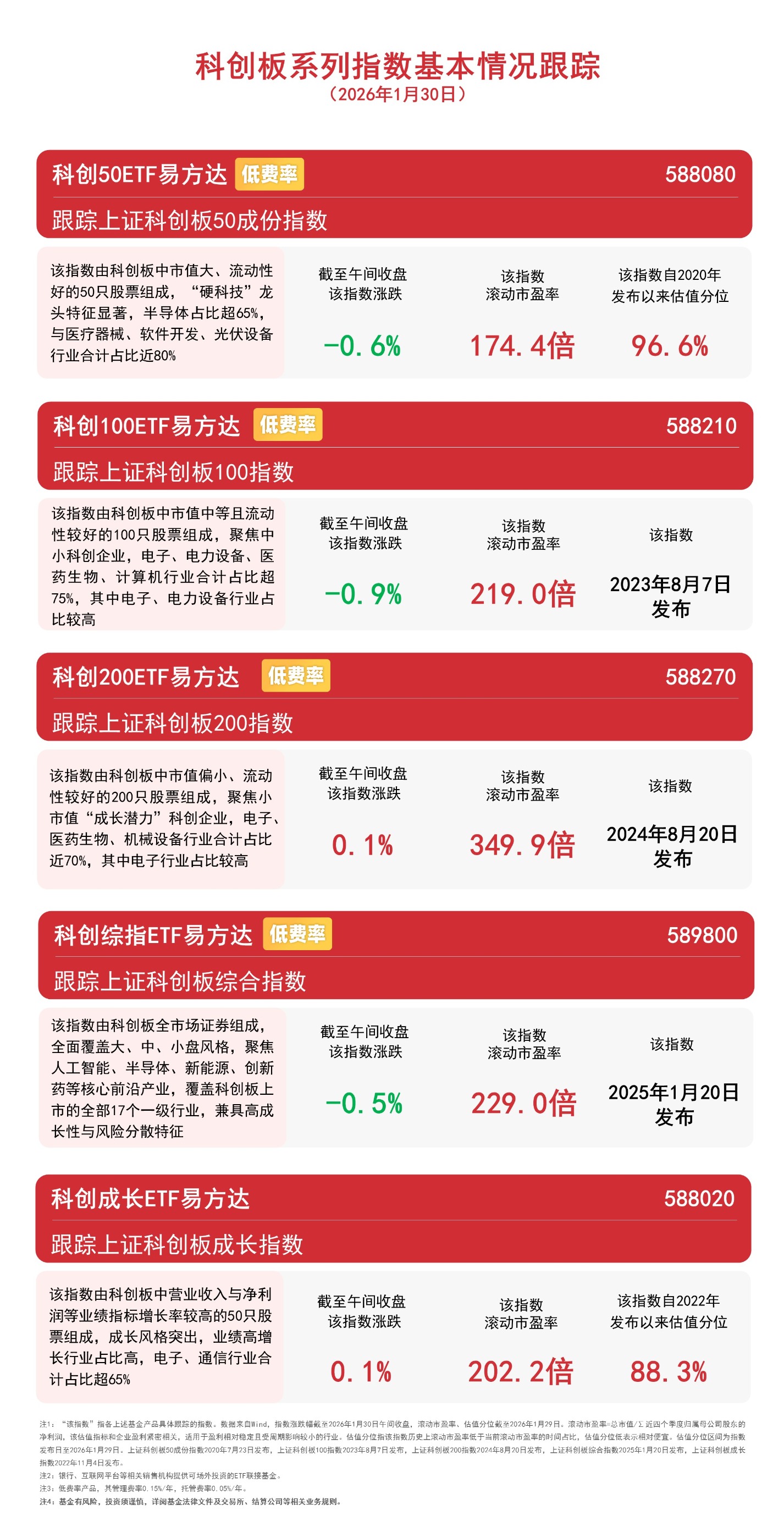
科创板系列指数率先反弹,关注科创200ETF易方达(588270)、科创50ETF易方达(588080)等布局机会
Mei Ri Jing Ji Xin Wen· 2026-01-30 06:38
Group 1 - The article discusses the performance and characteristics of various ETFs tracking the STAR Market indices, highlighting their focus on high-growth sectors such as technology and healthcare [2][3][4][5]. - The STAR 50 ETF tracks the top 50 stocks by market capitalization and liquidity on the STAR Market, with over 65% of its composition in the semiconductor sector, and nearly 80% in hard technology sectors including medical devices and software [2]. - The STAR 100 ETF focuses on 100 mid-cap stocks, with over 75% in electronics, power equipment, and pharmaceutical industries, reflecting a strong emphasis on small and medium-sized innovative enterprises [3]. - The STAR 200 ETF targets 200 smaller-cap stocks, concentrating on growth potential, with significant representation from electronics, pharmaceuticals, and machinery sectors [4]. - The STAR Composite ETF covers the entire STAR Market, including all 17 primary industries, with a focus on cutting-edge sectors like artificial intelligence, semiconductors, and renewable energy [4]. - The STAR Growth ETF consists of 50 stocks with high growth rates in revenue and net profit, predominantly in the electronics and communications sectors, showcasing a strong growth style [5]. Group 2 - As of the latest data, the STAR 50 index has a rolling P/E ratio of 174.4 times, while the STAR 100 index has a rolling P/E ratio of 219.0 times, indicating high valuations in these segments [2][3]. - The STAR Composite index has a rolling P/E ratio of 229.0 times, reflecting its broad coverage of various sectors and the associated growth expectations [4]. - The STAR Growth index has a rolling P/E ratio of 202.2 times, emphasizing the high growth potential of the companies included [5].
半导体产业链拉升,人工智能AIETF(515070)持仓股澜起科技大涨超11%
Mei Ri Jing Ji Xin Wen· 2026-01-30 05:59
Core Viewpoint - The semiconductor industry chain experienced a rapid increase due to positive news regarding domestic chips, with significant gains in stocks such as 澜起科技, which rose over 11% [1]. Group 1: Market Performance - The AI ETF (515070) saw a recovery in the afternoon after an early decline of over 2%, ultimately rising more than 1.2% with a trading volume exceeding 2 billion yuan [1]. - Stocks in the semiconductor sector, including 新易盛 and 北京君正, also experienced notable increases, reflecting a broader market rally [1]. Group 2: AI Developments - Baidu's Wenxin APP launched the industry's first "multi-agent" group chat beta, allowing multiple specialized agents to collaborate, enhancing AI's role as a "smart collaborator" in decision-making processes [1]. - This advancement signifies a shift in AI interaction from "human-machine dialogue" to "human-machine group chat," indicating a more integrated approach to AI in collaborative environments [1]. Group 3: Market Outlook - Dongwu Securities noted that favorable factors driving market strength remain unchanged, suggesting a stable transition into the second phase of the spring market rally [1]. - The China Securities Regulatory Commission emphasized maintaining stability and supporting a gradual market recovery, which is expected to provide a solid foundation for a sustained bull market [1]. - As the annual performance forecasts begin to be disclosed in late January, market focus is anticipated to shift towards earnings reports [1]. Group 4: AI ETF Composition - The AI ETF (515070) tracks the CS AI theme index (930713), selecting stocks that provide technology, foundational resources, and applications within the AI industry, often referred to as the "brain" creators of robotics and the "infrastructure" of the Internet of Things [2]. - The top ten weighted stocks in the ETF include leading domestic technology firms such as 中际旭创, 新易盛, and 科大讯飞, among others [2].

今日长江现货锡价重挫 科技金属估值遭多重利空碾压 短期反弹空间几何?
Xin Lang Cai Jing· 2026-01-30 05:09
Core Viewpoint - The significant drop in tin prices is attributed to a combination of macroeconomic pressures, geopolitical easing, weakening supply and demand, industry chain differentiation, and capital withdrawal, marking a critical adjustment in the industrial metal market [1] Macroeconomic Pressure - The primary driver for the decline in tin prices is the rapid deterioration of overseas macroeconomic sentiment, particularly following a nearly 10% drop in Microsoft shares due to weak earnings guidance, raising concerns about global tech capital expenditure and subsequently cooling tin demand expectations [1] - The rise in the US dollar index and sustained high US Treasury yields triggered a collective profit-taking by speculative funds in commodities, further suppressing tin's financial valuation [1] Geopolitical Easing - The geopolitical risks in the Democratic Republic of the Congo, which previously supported higher tin prices, have shown signs of localized easing, with no substantial impact on production and transportation from compliant mining companies despite ongoing armed conflicts [2] - The market's previous overestimation of "supply chain disruptions" has been corrected, leading to a rapid decline in the geopolitical risk premium embedded in tin prices [2] Supply Gap Narrowing - Global tin supply is entering a phase of incremental realization, with production resuming in Myanmar and Indonesia's export quotas being restored, contributing to an expected global tin production increase of approximately 8% by 2026 [2] - Domestic and international tin inventories have ended a continuous decline, showing slight accumulation, which has reversed the previous market consensus of "supply tightness" and intensified selling pressure in the spot market [2] Demand Weakness - The previous surge in tin prices has significantly detached from actual demand, coinciding with a traditional off-season before the Spring Festival, leading to weakened operations in key downstream sectors such as photovoltaics and home appliances [3] - Despite the long-term positive outlook for AI computing and semiconductors, their short-term tin consumption accounts for only 1%-2%, with actual procurement not yet reflecting demand growth [3] Industry Chain Differentiation - The high tin prices have resulted in an imbalance in profit distribution across the industry chain, with upstream mining companies enjoying substantial profits while midstream smelting and downstream processing sectors face high costs and weak demand [3] - The previously observed divergence between futures and spot markets has rapidly reversed following capital withdrawal, leading to a synchronized decline in both markets and a significant drop in trading activity [3] Market Outlook - In the short term, macroeconomic sentiment, seasonal demand weakness, and capital withdrawal are expected to continue dominating the market, with tin prices likely seeking support around 410,000 yuan/ton [3] - However, the long-term fundamentals remain unchanged, with a tight balance between global tin resources and emerging demand from AI, photovoltaics, and electric vehicles, suggesting a potential gradual recovery in tin prices post-holiday as demand resumes and market sentiment stabilizes [3] Conclusion - The recent sharp correction in tin prices reflects a revaluation of previously overstated benefits and the clearing of geopolitical premiums and speculative bubbles [4] - Despite short-term volatility, tin's strategic position as a key technology metal remains intact, with industry leaders enhancing risk resilience through overseas expansion, recycling, and industry chain extension, providing a more rational window for long-term investments [4]
